
Email Marketing Tools for Small Businesses: A UK & Ireland Buyer’s Guide
Table of Contents
Email marketing still delivers one of the strongest returns in digital marketing, but choosing the wrong platform can cost you more time and money than it saves. For small businesses in the UK and Ireland, the choice is complicated by a market flooded with US-centric reviews quoting dollar pricing, ignoring UK-GDPR obligations, and recommending tools that don’t integrate with the accounting software most local businesses actually use.
This guide covers the email marketing tools best suited to small businesses in the UK and Northern Ireland, with GBP pricing, a clear look at data residency and compliance requirements, and honest assessments of where each platform genuinely fits.
What to Look for in an Email Marketing Tool
Not every platform suits every business, and the wrong choice tends to reveal itself slowly: contacts you can’t segment properly, automations that don’t fire reliably, or a pricing jump that catches you off guard when your list grows past a threshold.
UK-GDPR and Data Residency
For UK businesses, data residency matters in a way that most American review sites don’t address. Under UK-GDPR, you need to understand where your subscribers’ data is stored and who can access it. Most mainstream platforms process data in the US under Standard Contractual Clauses (SCCs). That’s legally workable, but it does mean a more complex Data Processing Agreement (DPA) than if you were using a provider with EU or UK data centres.
Brevo (formerly Sendinblue) operates EU-based servers, which simplifies compliance for businesses handling sensitive subscriber data or operating in regulated sectors. If data residency is a priority for your business, check the provider’s DPA before committing, not after.
Automation and List Segmentation
The gap between a basic newsletter tool and a proper email marketing platform comes down to automation. A basic tool sends emails on a schedule. A proper platform sends the right email to the right contact based on what they’ve done — signed up, clicked a link, made a purchase, gone quiet for 60 days.
For most small businesses, the minimum you need is a welcome sequence, a re-engagement flow, and the ability to tag or segment contacts based on their behaviour. All of the platforms reviewed here offer this, but the ease of setup varies considerably.
Integration with UK Software
UK small businesses typically run on Xero, Sage, or QuickBooks, and many use Shopify or WooCommerce for e-commerce. Email tools that integrate seamlessly with these systems save hours of manual data management and let you trigger campaigns based on purchase behaviour or payment events.
Mailchimp and Constant Contact both integrate with Xero. ActiveCampaign integrates with most accounting and e-commerce platforms via Zapier or native integrations. If your tech stack includes Sage specifically, check integration availability before signing up, as Sage compatibility is patchier than Xero across most email platforms.
Email Marketing Tools Reviewed
Email marketing platforms vary more than their feature lists suggest. Price, automation depth, data residency, and integration compatibility all differ in ways that matter to UK and Irish small businesses. The seven tools below address the most common requirements across different budgets and growth stages.
Mailchimp: Best for All-Round Ease of Use
Mailchimp has been the default recommendation for small businesses for over a decade, and for good reason. The interface is genuinely intuitive, the template library is extensive, and the free plan includes basic automation for 500 contacts.
The platform has become more expensive since 2023. Pricing now starts at around £9.50/month for the Essentials plan (up to 500 contacts), with the Standard plan — where the more useful automation features live — starting at around £13/month. If your list is large or growing quickly, the cost compounds.
Key features: Drag-and-drop builder, audience segmentation, A/B testing, basic CRM, Xero integration, and native integration with Shopify and WooCommerce.
Honest assessment: Mailchimp is the sensible default for businesses starting out or running straightforward campaigns. If you need advanced automation or deep CRM functionality, you’ll hit its limits and likely move on. For a local service business with a list under 5,000 contacts and no complex journeys to build, it does the job well.
UK-GDPR: Data processed in the US under SCCs. DPA available on request.
Brevo (Sendinblue): Best for Volume Senders on a Budget
Brevo prices by email volume rather than contact count, which makes it considerably cheaper for businesses with large lists that don’t send frequently. The free plan allows 300 emails per day with unlimited contacts, which is genuinely useful for small businesses building a list before they’re ready to invest.
The platform added a transactional email layer and a basic CRM in recent years, making it a more complete marketing tool. Automation is available on paid plans from £19/month.
Key features: Unlimited contact pricing, EU server option, built-in SMS marketing, transactional email, basic CRM, and marketing automation on paid plans.
Honest assessment: For businesses with large or rapidly growing lists, Brevo’s pricing model is significantly more cost-effective than Mailchimp or MailerLite. The EU data residency option makes it a strong choice for businesses in regulated sectors or those that want to simplify their GDPR compliance documentation.
UK-GDPR: EU-based servers available. Strong compliance documentation.
MailerLite: Best for Simple, Reliable Automation
MailerLite sits in the middle ground between Mailchimp’s broad feature set and more specialist tools. It’s cleaner than Mailchimp, easier to navigate, and its automation builder is genuinely straightforward for someone setting up their first welcome sequence or abandoned cart flow.
The free plan covers 1,000 subscribers and 12,000 monthly emails, which is more generous than most competitors. Paid plans start at £9/month.
Key features: Clean automation builder, landing page creator, pop-up forms, newsletter templates, subscriber tagging.
Honest assessment: MailerLite is the tool we most often recommend to small businesses that want solid automation without complexity. It won’t replace a dedicated CRM, but for a business running content-led email campaigns to a list under 10,000, it rarely disappoints. The reporting is clear, and the support is responsive.
UK-GDPR: Data processed in the US. DPA available. EU server option available on higher plans.
ActiveCampaign: Best for CRM-Led Automation
ActiveCampaign is a step up in both power and price. It combines email marketing with a full CRM, deal pipeline management, and some of the most flexible automation logic available at this price point. The platform suits businesses where email is part of a longer sales process rather than a broadcast channel.
Entry pricing sits at around £39/month for the Starter plan (up to 1,000 contacts). For businesses with more complex sales journeys or multiple team members managing customer relationships, the cost is justified. For a sole trader sending a monthly newsletter, it’s overkill.
Key features: Full CRM integration, predictive sending, advanced segmentation, deal pipeline, site tracking, and deep Shopify and WooCommerce integration.
Honest assessment: If your email marketing needs to connect directly to a sales pipeline, ActiveCampaign is the strongest option at this price point. The learning curve is steeper than Mailchimp or MailerLite, but the payoff for businesses with complex follow-up sequences is significant. At ProfileTree, when we set up digital marketing systems for clients with longer sales cycles, we often recommend this platform.
UK-GDPR: US-based data processing under SCCs. Strong DPA documentation.
Constant Contact: Best for Event-Led Businesses
Constant Contact has long been known for ease of use and strong customer support, and both remain true. What distinguishes it from other tools on this list is its event management feature, which lets businesses manage registrations and send event-related emails from within the same platform.
Pricing starts at around £12/month for the Core plan, with no permanent free tier (a 60-day trial is available).
Key features: Event management, social media integration, e-commerce tools, extensive template library, excellent customer support, including phone support during UK hours.
Honest assessment: Constant Contact is a reliable choice for businesses that run regular events — training sessions, webinars, workshops, or in-person gatherings — and want to manage email and event communications in one place. For purely campaign-based email marketing, the pricing is competitive but the feature set doesn’t outperform MailerLite.
UK-GDPR: US-based data processing. DPA available.
HubSpot: Best for Growing Teams with CRM Needs
HubSpot offers a free CRM with built-in email marketing, making it attractive for small businesses that want to track contacts properly without paying for a standalone email tool and a separate CRM.
The free tier is genuinely functional, but HubSpot’s upgrade path is steep. The Marketing Hub Starter plan starts at around £15/month, but meaningful automation features are gated behind the Professional plan, which costs considerably more.
Key features: Full CRM, contact activity tracking, email sequences, landing pages, live chat, Xero integration (via third-party connector).
Honest assessment: HubSpot makes sense if you’re planning to grow into its broader feature set and want your email tool to eventually connect to your sales, service, and CMS infrastructure. For a small business that just wants to send campaigns to a list, it introduces more complexity than necessary, and the upgrade costs are high.
UK-GDPR: US-based data processing. Strong DPA and compliance documentation given the enterprise client base.
Campaigner: Best for Advanced Segmentation
Campaigner sits at the more sophisticated end of the tools covered here. Its strength is granular segmentation — the ability to split audiences based on detailed behavioural criteria and run highly personalised campaign sequences. Pricing starts at around £43/month for 5,000 contacts.
Key features: Advanced automation workflows, detailed segmentation, A/B testing, reputation defender (monitors sending reputation), and workflow branching logic.
Honest assessment: Campaigner earns its place for businesses that have outgrown MailerLite or Mailchimp and need more control over campaign logic without jumping to enterprise pricing. It’s less well-known than the other platforms here, which means less community support and fewer third-party integrations, but the core product is strong.
UK-GDPR: US-based data processing. DPA available.
The Cold Outreach Question
One distinction that most email marketing guides ignore: there is a difference between permission-based email marketing and cold B2B outreach, and most of the tools above are built for the former.
Mailchimp, MailerLite, and Brevo explicitly prohibit cold emailing in their terms of service. If you send to contacts who haven’t opted in, you risk account suspension regardless of whether your targeting is technically legal under UK “soft opt-in” rules for B2B.
For genuine cold outreach to business contacts — where UK PECR’s “legitimate interest” provisions may apply — platforms like Mailshake, Lemlist, or Apollo are built specifically for that use case and handle the compliance requirements differently. If you’re uncertain which approach applies to your business, the ICO’s guidance on direct marketing is the definitive reference.
How to Choose: A Framework for UK Small Businesses
The right platform depends on three things: where you are now, where you’re going, and what you need the tool to connect with.
If you’re starting out with a list under 1,000: MailerLite’s free plan or Brevo’s free plan. Both give you enough to run a proper welcome sequence and regular campaigns without paying anything.
If your list is growing and you want reliable automation: use the MailerLite paid plan or Mailchimp Standard. Both handle the most common automation requirements without overcomplicating the setup.
If email is part of a sales process, not just a broadcast channel: ActiveCampaign. The CRM integration and pipeline tracking justify the higher price for businesses where each lead has a meaningful value.
If data residency is a compliance priority: Brevo with EU servers selected.
If you run regular events: Constant Contact.
If you’re building a complete inbound marketing system: HubSpot, with a clear plan for how you’ll use the broader platform, not just the email tool.
Getting Emails Into the Inbox: Deliverability Basics
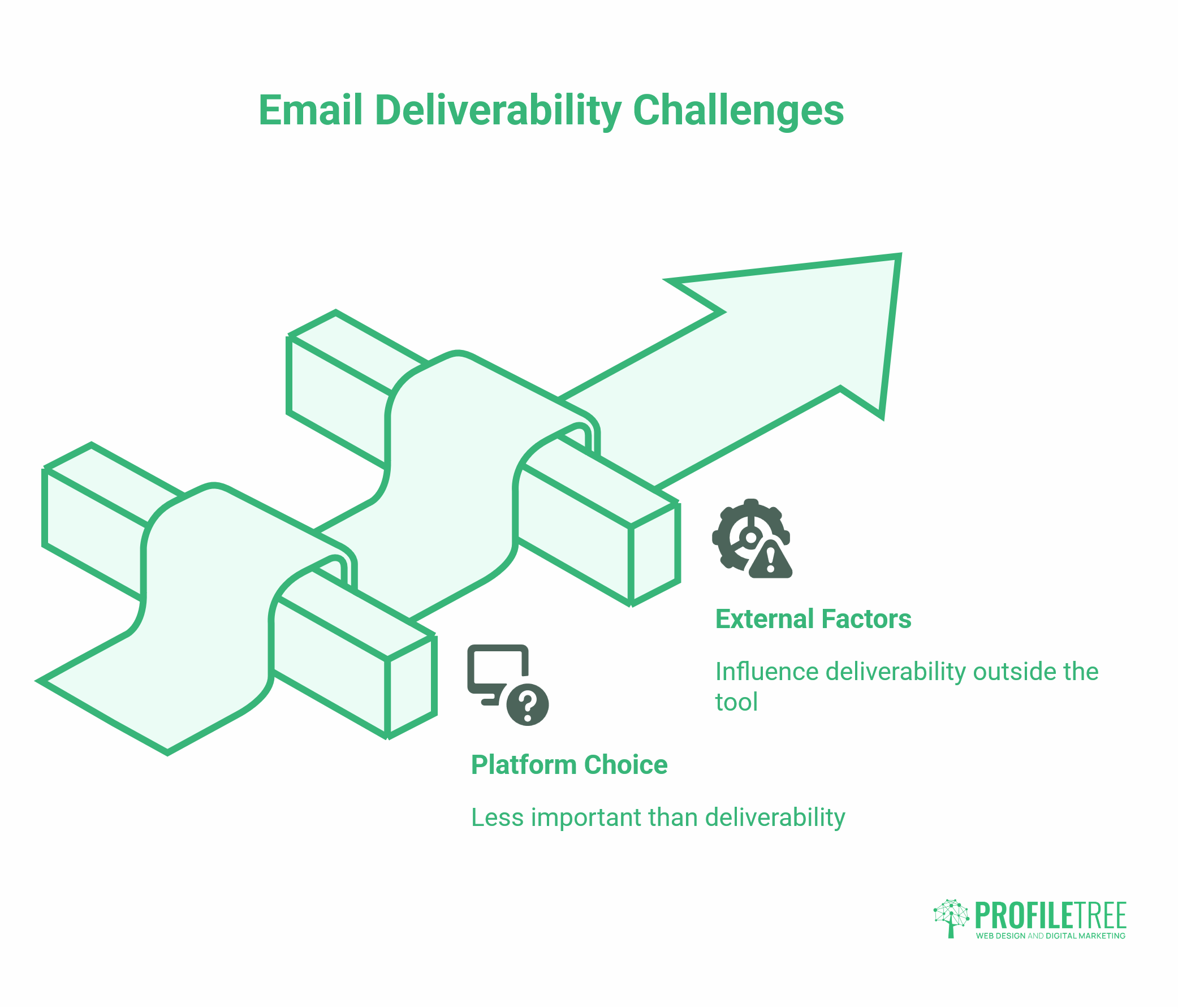
Choosing the right platform matters far less than you might think if your emails are landing in spam. Deliverability — whether your messages actually reach the inbox — depends on factors that sit outside the tool itself.
The first is domain authentication. SPF, DKIM, and DMARC are DNS records that tell receiving mail servers your emails are genuinely coming from you. Most platforms walk you through setting these up, but many small businesses skip the step. Without them, even well-written campaigns to opt-in subscribers will see higher spam placement rates.
The second is list hygiene. A list full of old, inactive, or invalid addresses damages your sender reputation over time. High bounce rates and low engagement signal to inbox providers that your emails aren’t wanted. Removing unengaged subscribers regularly — contacts who haven’t opened anything in six months or more — typically improves open rates and inbox placement across the board.
The third is send consistency. Suddenly emailing 10,000 contacts after six months of silence is a reliable way to trigger spam filters. If you’re starting from scratch or reactivating a dormant list, build volume gradually.
Most of the platforms reviewed here include deliverability monitoring tools. Mailchimp and ActiveCampaign both surface engagement data clearly enough to act on. MailerLite flags unconfirmed subscribers, making list cleaning straightforward. Use these features — they exist precisely because deliverability problems are common and largely preventable.
Email Marketing and Your Wider Digital Strategy
Email marketing works best when it’s connected to the rest of your digital activity. A well-structured website captures leads and adds them to your list. Your blog content feeds your campaigns. Your social media activity drives new subscribers. Without that broader system in place, even the best email tool will underperform.
At ProfileTree, we help businesses in Northern Ireland and across the UK build digital marketing strategies that properly connect these elements. That often includes setting up email marketing systems, integrating them with existing CRM tools, and making sure the content feeding those campaigns is doing its job. Understanding email statistics by industry can also help you set realistic benchmarks for open rates and conversions before you start.
If you’re working out how email fits into a broader strategy, our guide to using email marketing effectively covers the fundamentals in more depth. For businesses reviewing their marketing automation more broadly, our business automation statistics piece gives useful context on where automation typically has the most impact.
Ciaran Connolly, founder of ProfileTree, points out: “For most small businesses, the email marketing tool itself is rarely the problem. The real issue is having a clear enough strategy to know what you’re sending, to whom, and what you want them to do next. Get that right first, and almost any of the tools here will do the job.”
FAQs
What is the best free email marketing tool for UK small businesses?
MailerLite and Brevo are the strongest free options. MailerLite covers up to 1,000 subscribers and 12,000 monthly emails. Brevo is contact-unlimited, but caps daily sends at 300, which suits businesses with large lists that send infrequently. Both include basic automation on the free tier.
Do I need a UK-based email provider to comply with the UK GDPR?
No. You need a valid Data Processing Agreement in place and confirmation that data transfers to non-UK countries are covered by Standard Contractual Clauses. Most mainstream platforms have this documentation available. The critical step is actually signing the DPA, which many businesses overlook.
Is Mailchimp compliant with UK-GDPR?
Yes. Data is processed in the US under Standard Contractual Clauses, and a DPA is available through platform settings. Enable double opt-in for UK subscribers, maintain clear consent records, and use Mailchimp’s built-in tools to handle unsubscribes and data deletion requests.
Which email marketing tools integrate with Xero or Sage?
Mailchimp and Constant Contact both integrate with Xero. ActiveCampaign connects via Zapier. Sage compatibility is patchier across most platforms — verify directly with the provider before committing if Sage is essential to your workflow.