
AI Local SEO for Small Businesses: The UK and Ireland Playbook
Table of Contents
AI local SEO is changing how customers in Northern Ireland, Ireland, and the UK find nearby businesses. Search no longer matches keywords alone. It reads your Google Business Profile, your reviews, and your structured data, then decides whether to recommend you in a map pack or an AI answer. SEO services from a Belfast team can shorten that work, but the principles below are ones any owner can apply.
This guide covers the practical side: preparing your profile for AI, avoiding citation errors that quietly cost rankings, generating local schema, and adapting US-built AI tools for UK and Irish directories. No magic-bullet claims. AI is an efficiency tool, and it works when a person checks the output.
Three things that matter most:
- A complete, consistent Google Business Profile is still the single biggest local ranking factor, and AI tools now read it directly.
- Inconsistent name, address, and phone details across directories confuse both Google and AI search models, dragging your visibility down.
- AI can draft content, schema, and review replies, but unedited output on location pages is a real penalty risk.
How AI is reshaping local maps
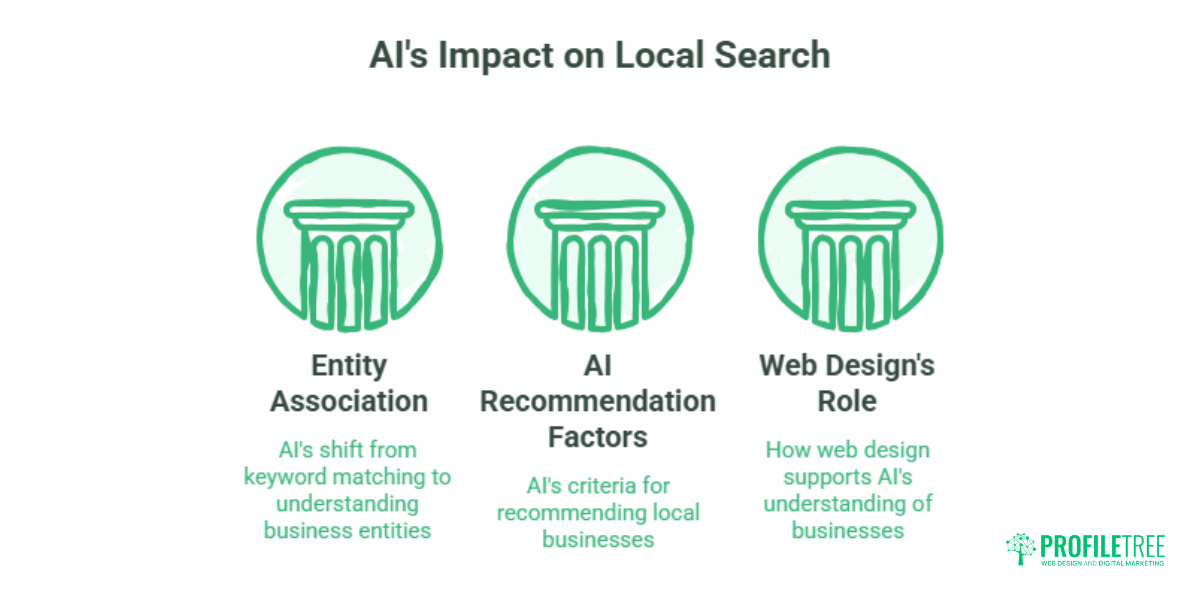
Local search has moved from keyword matching to entity association. Google and AI assistants now try to understand who your business is, where it operates, and whether other sources agree, before they recommend you. For a plumber in Derry or a cafe in Belfast, that means your reputation across the web matters as much as the words on your homepage.
From keyword matching to entity association
An entity is a thing search engines recognise as real: your business name tied to a location, a category, and a set of attributes. When those signals line up across your website, your profile, and trusted directories, Google trusts the picture and shows you more often. When they conflict, it hedges. Good web design helps here, because a clear, well-structured site gives both Google and AI models a reliable source to read from.
How AI selects which local businesses to recommend
AI Overviews and assistants weigh three things when suggesting a local business: proximity to the searcher, consistency of your details across the web, and the sentiment of your reviews. None of these is a keyword trick. They reward businesses that keep their information accurate and earn genuine customer feedback over time. If you want to understand the wider technical picture, our guide on AI Google My Business tools goes deeper.
The threat of AI citation drift
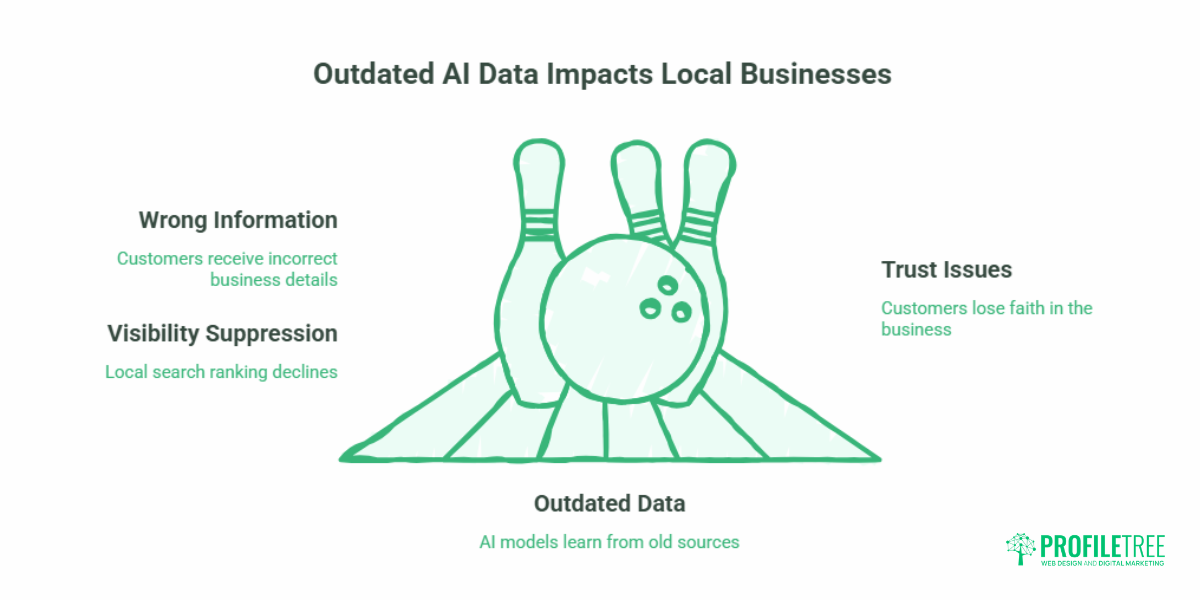
AI citation drift happens when AI search models learn your business details from outdated scraped data and then repeat them. If you moved premises, changed your number, or rebranded, an assistant may still hand customers the old information. This is a trust problem, and it can quietly suppress your local visibility.
Why AI models repeat outdated local details
Large language models build their picture of your business from many sources crawled at different times. An old directory listing, a cached page, or a stale aggregator entry can all feed in. Because the model blends sources, one wrong record can surface long after you fixed your own website. Our overview of free business listing sites shows where many of these records live.
Auditing your AI footprint: a simple diagnostic
Start by searching your own business name, address, and phone across Google, then ask ChatGPT, Claude, or Perplexity to recommend a business like yours in your town. Note any wrong details they return. Check your major directory entries against your live website. Where they differ, correct the source record, not just your own page. This is the same audit logic we apply in city-level local SEO work.
Why consistency beats volume
Blasting your listing across hundreds of low-quality directories used to be common advice. It now does more harm than good, because every extra record is another chance for a detail to drift. A smaller set of accurate, authoritative listings is worth far more. For SMEs weighing where to spend effort, our piece on SMEs implementing AI solutions covers how to prioritise.
“For local businesses, search algorithms now reward consistency and entity validation over sheer content volume. Get your name, address, and phone right everywhere first, then worry about everything else,” says Ciaran Connolly, founder of ProfileTree.
Preparing your Google Business Profile for AI
Your Google Business Profile is the source AI models trust most for local recommendations, so it deserves the most attention. A complete profile with accurate categories, real photos, and active posts gives AI a clean record to read. Profile management sits within our digital strategy work, but the steps below are straightforward to do yourself.
Writing a clear, NLP-friendly business description
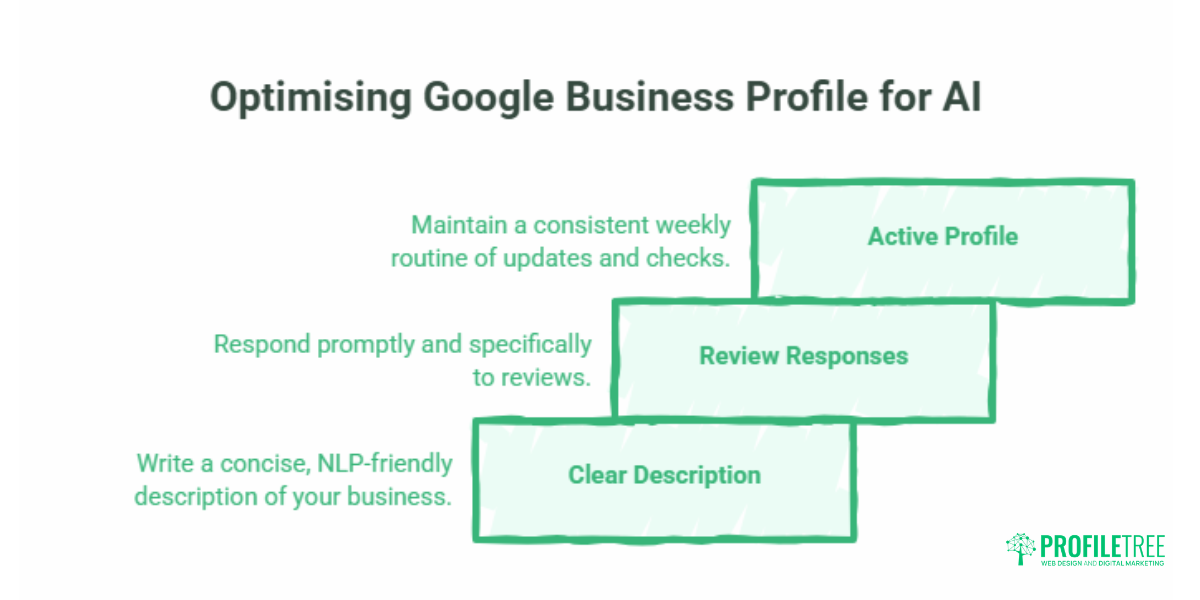
Write your description in plain language that states what you do, who you serve, and where. Avoid stuffing in keywords. AI systems parse natural sentences better than lists of phrases, and a clear description helps you appear for the conversational queries people now type and speak. If you want help getting the words right, our content marketing team works on exactly this kind of copy.
Structuring review responses for sentiment analysis
Reply to reviews promptly and specifically, naming the service or issue raised. AI models read this exchange as a signal of an active, responsive business. You can use AI to draft replies, but read every one before posting so it addresses the actual review and does not sound robotic. Review handling is one area where AI for marketing saves real time.
Keeping the profile active without a daily effort
A short weekly routine beats a burst of activity then silence. Respond to new reviews, post one update, check that hours and contact details are still correct, and add any new photos. For teams that want to do this confidently in-house, our digital training covers profile management end-to-end. The wider topic of voice search also feeds into how people phrase local queries.
Generating local schema markup with AI
Schema markup is structured data that tells search engines and AI models the facts about your business in a format they read first. It is the closest thing to a source of truth for local search. Adding it well is partly a development task, which is why it overlaps with our web development service.
Why is the schema the source of truth for search AI
When your LocalBusiness schema states your name, address, phone, opening hours, and price range, AI engines have a clean record to cite rather than guessing from page text. Attributes like sameAs links to your social profiles and accurate geo-coordinates strengthen that record further. The result is fewer chances for the citation drift described earlier.
Using AI to draft your JSON-LD, then checking it
You can ask an AI tool to generate a LocalBusiness JSON-LD block by giving it your exact business details. Treat the output as a first draft. Validate it with Google’s Rich Results Test, confirm every field matches your live site, and have a developer place it correctly. For sites we host, this sits alongside ongoing website hosting and management.
Where AI helps and where it does not
AI is good at handling repetitive schema structures and spotting missing fields. It is not good at knowing whether your details are actually current. That judgment stays with you. The same balance applies across AI training for any business process.
Localising for UK and Irish directories
Most AI SEO advice is written by US agencies and points to US directories. For businesses in Northern Ireland, Ireland, and the UK, that guidance misses the platforms that actually carry weight locally. Adapting AI tools for this market is where generic advice falls short and local knowledge pays off.
The directories that matter here
Alongside Google, UK and Irish trust signals come from platforms such as Yell, Thomson Local, Scoot, and Golden Pages in Ireland, plus regional and sector directories. When you use a US-built AI tool, instruct it explicitly to format UK postcodes and counties correctly and to clean citations on these regional aggregators, not only the American ones it defaults to.
Training AI on regional language
Local intent is captured through local language. A UK searcher looks for a solicitor, not an attorney, and a builder, not a contractor. AI tools default to American English and American terms, so set UK English spelling and vocabulary in your prompts. This affects how models parse and match your content to local queries. Our social media marketing team applies the same regional tone across channels.
Scaling location pages safely
A trade serving twenty towns across Greater Dublin or Yorkshire cannot publish twenty near-identical AI-written pages without risking a thin-content penalty. Use AI to build the structural outline and research, then add genuine local detail, photos, and unique service notes by hand. For the writing itself, our guide on honest content marketing sets out the standard.
Traditional local SEO versus AI-driven local SEO
The shift is less about new tasks and more about what search engines reward. The table below contrasts the old approach with the AI-driven one so you can see where to redirect effort.
| Area | Traditional local SEO | AI-driven local SEO |
|---|---|---|
| Keywords | Exact-match phrases in copy | Entity clarity and natural language |
| Directories | Volume of citations | Accuracy across a trusted few |
| Reviews | Star count | Sentiment and response quality |
| Data | On-page text | Structured schema as source of truth |
| Content | Manual page writing | AI draft plus human localisation |
For owners choosing tools, named platforms like BrightLocal, Localo, and Semrush Local handle tracking and listings, while a general assistant such as ChatGPT or Claude handles drafting and schema. The right mix depends on whether you run one location or several. Costs and trade-offs are covered in our piece on the cost and benefit of AI for SMEs.
Reviews, reputation, and AI in Belfast and beyond
Reviews now feed directly into how AI assistants describe and rank your business, so reputation management has become a search task, not just a customer-service one. Monitoring sentiment across platforms helps you fix operational issues before they spread. For Belfast and Northern Ireland businesses, this is where AI reputation management earns its place in a local strategy.
Turning feedback into visibility
AI tools can summarise the themes in your reviews so you see what customers praise and what frustrates them. Acting on those themes improves both the experience and the signals AI models read. Our AI chatbots can also handle first-line customer questions, freeing your team to respond to reviews properly.
Video on your profile and website is one more signal of an active business, and our video marketing team produces local content that supports exactly this. External guidance on how Google treats this sits in Google’s LocalBusiness structured data documentation.
Bringing it together
AI has not replaced local SEO fundamentals. It has raised the cost of getting them wrong. Keep your details consistent everywhere, give AI clean, structured data to read, earn and answer real reviews, and adapt US-built tools for the UK and Irish market. Use AI to move faster, and keep a person checking the output. Do that, and your business stays visible whether a customer searches Google directly or asks an AI assistant for a recommendation.
Frequently asked questions
Which AI local SEO tool is best for small businesses?
There is no single best tool. BrightLocal suits structured listings management and UK directory tracking, while a low-cost workflow pairs a general assistant for drafting and schema with a tool like Localo for localised tasks. Choose based on how many locations you run.
Can AI-generated content rank on Google for local pages?
Yes, Google does not penalise content for being AI-generated, but it does target unhelpful, generic pages. Town-by-town pages that are near-identical are a real risk. Use AI as an assistant and add genuine local detail yourself.
How does Google AI choose which local businesses to recommend?
It weighs three things: how close you are to the searcher, how consistent your details are across the web, and the sentiment of your reviews. Accuracy and reputation matter more than keywords.
Does Google penalise AI-drafted review responses?
No, as long as replies are accurate and personalised. Proofread every draft so it addresses the specific point raised and does not read as robotic.
What is AI citation drift?
It is when AI search models repeat outdated business details learned from old scraped data, such as a former phone number or address. The inconsistency confuses search algorithms and can lower your local visibility.
Are free AI tools enough for local SEO?
Free tools can draft a schema and post well. Tracking map-grid rankings or managing listings across UK directories usually needs a paid, specialised platform.