
Reputation Management Online for SMEs: A Strategic UK Guide
Table of Contents
Reputation management online is no longer the preserve of large corporations with dedicated PR departments. For SMEs across Northern Ireland, Ireland, and the UK, what appears on the first page of Google when someone searches your business name directly shapes whether they pick up the phone or click away to a competitor. A single unaddressed negative review, a poorly designed website, or a near-invisible Google Business Profile can cost you clients you never knew you were losing.
This guide explains how reputation management online works, what the four pillars of a strong digital presence look like in practice, and how SEO, web design, and content marketing combine to give your brand durable protection. It also covers the UK legal context, because knowing your rights under GDPR matters as much as knowing how to respond to a bad review.
Why Online Reputation is the Foundation of Digital Strategy
Most businesses think about reputation management after something goes wrong. A damaging review appears, a news story surfaces, or a competitor starts spreading misinformation. By that point, the response is always more expensive and more difficult than it needed to be.
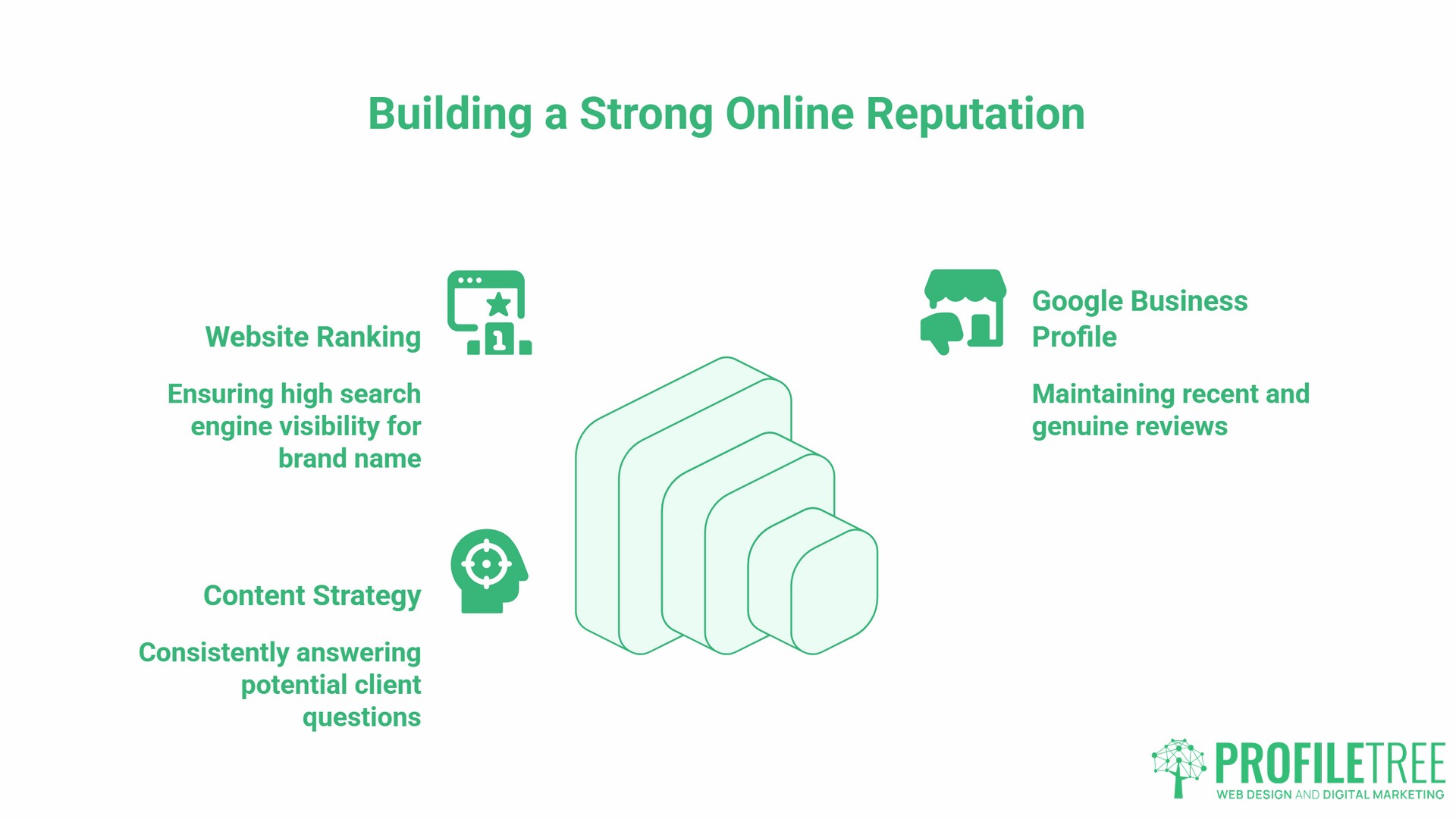
The businesses that handle this well are the ones that treat reputation management online as a continuous investment rather than a crisis response. When your website ranks strongly for your own brand name, when your Google Business Profile is populated with recent, genuine reviews, and when your content consistently answers the questions your potential clients are asking, negative material struggles to gain traction. You have already filled the search results with content you control.
For UK SMEs, the stakes are real. Consumers rely heavily on online searches before making purchasing decisions, and a business with no visible digital footprint often reads as less credible than a competitor with a well-maintained online presence. Reputation management online is therefore not a defensive tactic; it is a growth driver.
The Four Pillars of a Digital Reputation Fortress
Effective online reputation management is built on four categories of digital presence. Understanding each one helps you prioritise where to invest time and budget.
Owned Media: Your Website as the Source of Truth
Your website is the single most valuable asset in any reputation management online strategy. It is the only platform where you have complete control over the message, the design, and the technical performance. Everything else, from social media profiles to review sites, is rented territory where the rules can change overnight.
A professionally built website does several things for your reputation that no amount of social media activity can replicate. It signals legitimacy the moment a visitor lands. Fast load times, clear navigation, and well-structured content all reduce the friction that leads to frustration-based negative reviews. A website that is slow, difficult to use, or visually dated communicates something about the quality of your service before you have had the chance to speak to a potential customer.
ProfileTree’s web design work for SMEs is built around this connection between design quality and perceived trustworthiness. When a business invests in a professional website, it is not just buying a digital brochure; it is creating the strongest possible first impression at the moment potential clients are actively evaluating whether to make contact.
From a reputation management standpoint, your website should also host the content that defines your brand: detailed service descriptions, client testimonials, team profiles, and case studies that provide real evidence to back your claims. This is the material that search engines index and that appears when people search your name.
Earned Media: Third-Party Reviews and Press Coverage
Earned media is everything said about your business by external sources, including Google reviews, Trustpilot ratings, industry publications, local press, and directories. You cannot control what people write, but you can influence the volume and direction of earned media through how you deliver your service and how you ask for feedback.
For most SMEs, Google reviews are the single most visible form of earned media. They appear directly in search results, influence local SEO rankings, and are often the first thing a prospective customer reads. A business with a pattern of recent, positive reviews and professional responses to criticism presents a fundamentally different picture than a business with a handful of reviews from several years ago.
Responding to reviews matters. A measured, professional reply to a negative review often impresses potential customers more than the review itself damages you. It shows that the business takes feedback seriously and engages directly with clients rather than ignoring complaints.
Shared Media: Social Media Authority
Social media profiles rank in search results. For many businesses, their LinkedIn page, Facebook profile, or Instagram account appears within the first several results when someone searches their name. This gives you additional Google pages you control, which is strategically useful whether or not you actively use those platforms for marketing.
Beyond search visibility, consistent social media activity signals that a business is current and engaged. A profile last updated two years ago raises questions about whether the business is still trading. Regular posts, responses to comments, and participation in relevant conversations all contribute to a perception of a healthy, active organisation.
Social media also accelerates the spread of both positive and negative content. A well-handled public complaint on Facebook can build more trust than a glowing testimonial, because it is visible, verifiable, and demonstrates how the business behaves when things go wrong.
Paid Media: Protecting Your Brand Keywords
Paid search advertising plays a specific, often overlooked role in online reputation management. If a competitor or a disgruntled former employee is running paid ads against your brand name, or if negative content is ranking prominently, you can use paid ads to keep your own website at the very top of results for your brand name.
This is not about traditional advertising. It is about controlling what people see first when they are specifically looking for you. The cost of brand keyword campaigns is typically low because the competition for your own business name is minimal, making it a cost-effective protective measure.
How SEO and Content Marketing Protect Your Brand
Search engine optimisation is the most powerful long-term tool in any reputation management online strategy. It works because Google’s first page has a finite number of positions, and the more of those positions you occupy with content you control, the less space there is for content you do not want people to find.
Search Engine Suppression: Pushing Down Unwanted Results
When negative content appears in search results for your business name, the practical solution is not legal action in most cases. It is SEO. By publishing a steady volume of high-quality, optimised content across multiple channels, you give Google more material to index for searches related to your brand. Over time, this pushes lower-quality or older negative content further down the rankings.
The strategy involves creating and maintaining a range of owned and earned properties. Your website is the anchor. Your Google Business Profile is the most visible local search asset. LinkedIn company pages, industry directory listings, guest articles on relevant publications, and YouTube videos all create additional results that Google can index for your brand name.
ProfileTree’s SEO services help businesses build this kind of search presence systematically. The goal is not just to rank for commercial keywords but to occupy enough of the first page for branded searches that your business controls the narrative potential clients encounter.
Keyword research matters here in a specific way. Understanding what people actually search for when looking for your business, your industry, or your services tells you what content to create. If people frequently search “reviews of [your business name]” or “[your business name] complaints”, creating strong content that addresses quality, transparency, and client outcomes directly shapes what those searches return.
Content as a Shield: Authority Building Through Consistent Publishing
Content marketing is the mechanism by which SEO is built over time. Businesses that publish regular, genuinely useful content on topics relevant to their industry create two things simultaneously: search visibility and perceived authority.
A solicitor who publishes detailed guides on UK employment law, a building firm that documents projects with real before-and-after photography, or a software company that explains technical processes in plain English all build the same thing: a body of content that positions them as the credible expert in their field. When a potential client searches a relevant topic and consistently finds that business’s content, the reputation question is largely answered before the first conversation even takes place.
ProfileTree’s content marketing work for SMEs in Northern Ireland and Ireland is built on this principle. Content that ranks well and genuinely answers questions does more for a business’s reputation than any amount of advertising, because it is not perceived as promotional. It is useful, and that usefulness builds trust.
Content also provides a buffer against negative events. A business with a substantial content archive, several ranking videos, and an active social media presence has a fundamentally more stable digital reputation than one with a minimal website and no published content. A single bad review against that background has very little room to define the brand.
The UK Legal Context: GDPR and the Right to be Forgotten
One of the most underserved areas in reputation management guidance is the UK legal framework. Most of the content that ranks for this topic is produced in the United States, where privacy law and defamation law work very differently from the UK and Ireland.
UK businesses and individuals have specific rights that can be used as part of an active reputation management strategy. The key mechanisms are worth understanding even if you never need to use them, because knowing they exist changes how you approach the problem.
The Right to Erasure Under UK GDPR
Under Article 17 of the UK General Data Protection Regulation (UK GDPR), individuals have the right to request that organisations that hold their personal data erase it. The Information Commissioner’s Office (ICO) confirms that this right applies when the data is no longer necessary for the purpose it was collected, when consent has been withdrawn, and there is no other lawful basis for processing, or when the data has been unlawfully processed.
In the context of reputation management online, this becomes relevant when personal information is published without a legitimate reason to retain it. Google operates its own removal request process for content appearing in search results, and requests that involve inaccurate, outdated, or unlawfully published personal data may be considered for removal.
It is worth being clear about what these rights do and do not cover. The ICO is explicit that the right to erasure is not absolute. It does not generally apply to accurate, factual reviews of a business, or to public statements made about matters of genuine public interest. It applies most clearly to personal data published without consent, outdated information with no continuing legitimate purpose, or content processed in breach of a legal obligation. Any business considering a formal erasure request should check current ICO guidance at ico.org.uk, as this area is subject to ongoing development following the Data (Use and Access) Act 2025.
Defamation Law in the UK and Ireland
The Defamation Act 2013 in England and Wales introduced a requirement that a statement must have caused, or be likely to cause, serious harm to the claimant’s reputation before a defamation claim can proceed. For businesses trading for profit, the bar is set even higher: under Section 1(2) of the Act, harm to a company’s reputation only qualifies as serious harm if it has caused, or is likely to cause, serious financial loss. This is confirmed by the Act’s own explanatory notes and has been upheld in subsequent case law.
This matters because many businesses consider legal action a first response to negative online content. In practice, legal action against reviews or critical commentary is rarely the right starting point. It is slow, expensive, uncertain in its outcome, and can draw considerably more attention to the original content than leaving it uncontested would have. The preferred approach in most cases is the SEO and content strategy described in this guide.
The Republic of Ireland operates under different legislation, specifically the Defamation Act 2009. Irish businesses considering any legal response to online content should take specific legal advice on how that Act applies to their situation.
Reputation Management for SMEs: DIY Versus Specialist Support
Practical Steps for Small Businesses
Many aspects of reputation management online can be handled internally without agency support. The following steps are within reach for any business owner or marketing manager prepared to invest a few hours per month.
- Set up monitoring alerts. Google Alerts is free and delivers email notifications whenever your business name appears in new indexed content. Tools such as Brand24 offer more detailed social listening across platforms, including forums and review sites. Knowing what is being said is the first step to responding appropriately.
- Claim and complete your Google Business Profile. This is the most visible element of local reputation management and one of the most frequently neglected. A complete profile with current opening hours, accurate contact information, regular photo updates, and owner responses to reviews performs better in local search results than an incomplete one.
- Respond to every review. Positive reviews deserve a brief, genuine acknowledgement that references the specific feedback rather than a generic response. Negative reviews deserve a calm, professional reply that acknowledges the issue, avoids defensiveness, and, where appropriate, offers to take the conversation offline. The audience for your response is not just the person who left the review; it is every future customer who reads the exchange.
- Publish content regularly. Even a modest publishing cadence of two or three articles per month, maintained consistently over twelve months, creates meaningful search visibility. Focus on topics your target clients actually search for rather than announcements about your own business.
- Audit your digital footprint periodically. Search your business name, your own name, and your main services. Note what appears on the first two pages. This audit tells you where gaps exist and where negative content may be gaining ground.
When to Bring in a Specialist
The self-managed approach has real limits. When a business is facing a coordinated negative campaign, damaging content is appearing across multiple platforms, or it has no meaningful search presence at all, the time required to turn things around independently is substantial.
“Reputation management online is fundamentally an SEO problem,” says Ciaran Connolly, founder of ProfileTree, the Belfast-based digital agency. “The businesses that protect themselves most effectively are the ones that invest in building a strong search presence before they need it. A well-built website, consistent content, and active review management create a digital foundation that is very difficult for negative content to penetrate.”
ProfileTree works with SMEs across Northern Ireland, Ireland, and the UK to build this kind of presence through web design, SEO, and content marketing. The starting point is always the same: understand what currently exists, identify the gaps, and build systematically toward a first page that the business controls.
The ProfileTree digital marketing strategy for SMEs covers how these elements fit together as part of a broader business growth plan.
Building Long-Term Digital Resilience
Reputation management online is not a project with a defined end date. It is an ongoing commitment to maintaining the digital assets that shape how your business is perceived. The businesses that handle this well tend to share one characteristic: they started building before they had a problem.
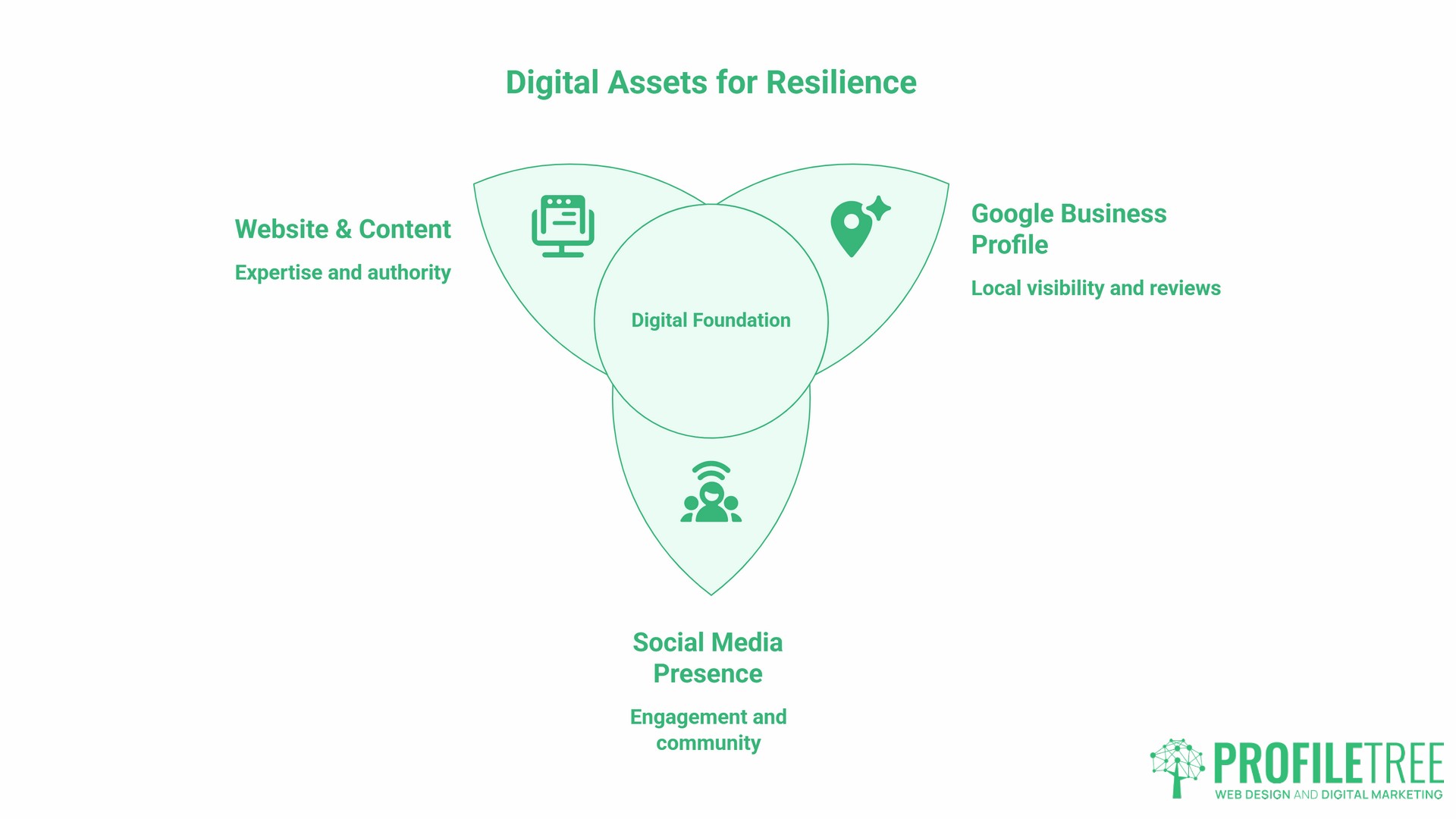
A website that ranks well for branded searches, a content archive that establishes genuine expertise, a Google Business Profile with a steady stream of recent reviews, and an active, professional social media presence all combine to create a digital foundation that is genuinely difficult to damage.
For SMEs in Northern Ireland, Ireland, and the UK, this investment is proportional to the size of the business. You do not need a substantial budget to build a credible online presence. You need consistency, quality, and a clear understanding of where your potential clients are looking when they consider whether to work with you.
Frequently Asked Questions
What is reputation management online?
Reputation management online is the process of monitoring, influencing, and maintaining how a business or individual appears in digital search results and across online platforms. It covers everything from responding to Google reviews and managing social media activity to building search visibility through SEO and content marketing. The goal is to ensure that when someone searches for your name or your business, they find accurate, positive, and credible information.
How long does it take to improve a damaged online reputation?
The realistic timeframe for meaningful improvement through SEO and content marketing is three to six months for initial results and twelve months or more for substantial, lasting change. This depends heavily on the severity of the existing problem, how much content has already been published, and how competitive your industry is in search results. Paid advertising can produce faster results for branded search terms while longer-term organic strategies take effect.
Can I remove negative reviews from Google?
Google will remove reviews that violate its content policies, including reviews that are fake, contain prohibited material, or are clearly irrelevant to the business. You can flag these through your Google Business Profile dashboard. However, Google does not remove negative reviews simply because they are unflattering or because you disagree with the assessment. For legitimate negative reviews, a professional public response is almost always the more effective approach.
What is the Right to be Forgotten in the UK?
Under Article 17 of UK GDPR, individuals can request that organisations erase personal data they hold, and in certain circumstances, this extends to requesting the removal of content from search engine results. The ICO provides guidance on when this right applies and how to exercise it. Successful requests typically involve data that is inaccurate, no longer necessary, or was collected without a lawful basis. The right does not generally cover accurate reviews of businesses or factual commentary on matters of public interest. Businesses and individuals should check the current ICO guidance at ico.org.uk before pursuing this route, as the framework is subject to ongoing regulatory development.
How much does reputation management online cost for an SME?
Costs vary depending on the scope of work and whether you manage it internally or through a specialist. Basic monitoring tools range from free (Google Alerts) to around £50 to £150 per month for more detailed social listening platforms. For agency-managed reputation work in the UK, SMEs typically pay between £500 and £3,000 per month for services combining SEO, content production, and review management, according to current UK market data. Below around £800 per month, you are more likely to be paying for automated monitoring tools than strategic agency support. One-off projects, such as a website rebuild or a content audit, carry separate costs depending on scope.
Is reputation management only for large businesses?
No. SMEs are often more exposed to reputational risk than large businesses, because a single negative event or a cluster of bad reviews has a proportionally larger impact against a smaller volume of existing positive content. Large organisations have the content volume and brand recognition to absorb individual setbacks. Smaller businesses do not, which makes proactive reputation management online more important, not less, for SMEs.
Does my website design affect my online reputation?
Yes, directly. A poorly designed website creates negative first impressions that translate into both lost business and, in some cases, frustrated reviews. Slow load times, confusing navigation, and a site that does not work properly on mobile all signal a lack of professionalism before a visitor has read a single word of your content. Professional web design for SMEs is one of the most direct investments a business can make in its online perception.