
Omnichannel Marketing Tools: A Guide for UK Businesses
Table of Contents
Omnichannel marketing tools connect the platforms a business already uses, its website, email, social accounts, in-store till, and customer database, so that a customer gets the same joined-up experience wherever they interact with the brand. The hard part for most UK SMEs is not choosing a single clever platform. It is getting the tools they own to talk to each other without an enterprise budget or an in-house IT team.
This guide explains what omnichannel marketing tools do, how they differ from a multichannel setup, and which categories matter for a small or growing business. It covers a realistic tech stack for businesses in Northern Ireland, Ireland, and the UK, the UK GDPR and PECR consent rules that catch people out, and the practical steps to connect everything without breaking the bank.
What Omnichannel Marketing Tools Actually Do
Omnichannel marketing tools are software platforms that unify customer data and messaging across every channel, so a person moving from your Instagram to your website to your shop sees one consistent, personalised brand experience rather than disconnected interactions. That single sentence is the whole point: connection, not just presence.
A useful way to picture it is a hub versus a loop. In a multichannel setup, the business sits in the middle and fires messages out along separate lines: an email here, a Facebook post there, a till receipt in the shop. None of those lines knows what the others are doing. In an omnichannel setup, the customer sits in the centre of a loop, and every touchpoint shares the same information about them. A purchase in the shop updates the email list. An abandoned online basket triggers a follow-up. The customer never has to repeat themselves.
For most SMEs in the UK and Ireland, the value shows up in three places: customers stay longer because the experience feels considered, average order values rise because offers are relevant, and the marketing team wastes less time copying data between disconnected systems. None of that requires the budgets that enterprise guides assume.
Omnichannel Versus Multichannel: The Core Difference
The terms get used interchangeably, but they describe different things. Multichannel means a brand is active on several platforms. Omnichannel means those platforms are integrated and share data, so the customer journey stays continuous across all of them.
| Factor | Single-channel | Multichannel | Omnichannel |
|---|---|---|---|
| Customer experience | One route only | Several routes, disconnected | Continuous across all routes |
| Data integration | None needed | Siloed per channel | Unified customer profile |
| Setup complexity | Low | Medium | Medium to high |
| Personalisation | Minimal | Per channel | Across every touchpoint |
The practical test is simple. If a customer who unsubscribed from your emails could still receive a marketing text because the two systems do not share that information, you are running multichannel, not omnichannel. Genuine integration is what closes that gap, and in the UK, it is also a legal requirement, which the compliance section below covers.
Why the Tools Matter More for Smaller Businesses
Large retailers can throw people at the problem of keeping channels aligned. A five-person business in Belfast or a regional service provider in the Republic cannot. For smaller teams, the tools are not a luxury layer on top of the marketing; they are what make a joined-up approach possible at all without hiring more staff.
This is where the strategy decision comes before the software decision. Choosing platforms before mapping how customers actually move between your channels tends to produce an expensive stack that nobody uses properly. A clear digital marketing strategy defines which channels matter and how they should connect, which then makes the tool choices obvious rather than overwhelming.
The Core Categories of Omnichannel Marketing Tools
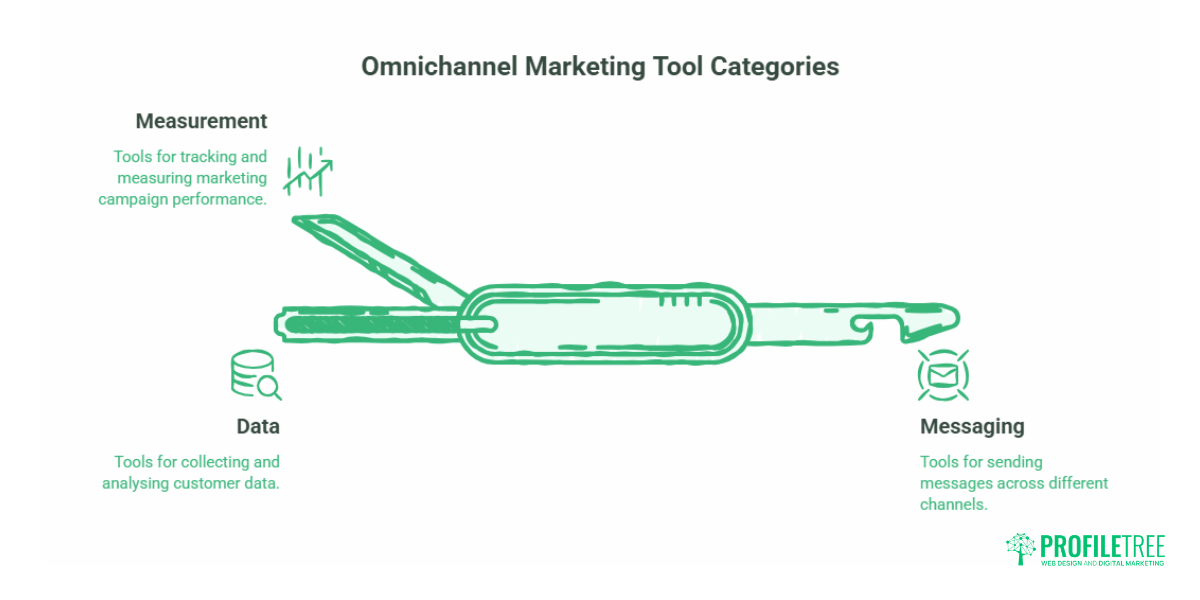
Most omnichannel marketing tools fall into a handful of categories. A business rarely needs one of everything. The aim is to pick the smallest combination that covers data, messaging, and measurement for the channels you actually use.
Customer Relationship Management Systems
A CRM sits at the centre of any omnichannel setup. It collects and stores customer data from different sources, email, phone, social, and in-store visits, into one profile, so the rest of your tools have a single version of the truth to work from.
For a micro-business, the CRM does not need to be elaborate. Free or low-cost tiers from accessible platforms can act as the central customer database for a small operation, tracking interactions and triggering follow-ups such as abandoned-basket reminders. The discipline that matters is more important than the brand: every channel should write back to the same record. Pairing a CRM with thoughtful customer segmentation is what turns a contact list into targeted, relevant messaging.
Marketing Automation Platforms
Automation platforms let a small team run consistent, targeted campaigns across email, SMS, and social without doing each one by hand. They trigger messages based on customer behaviour: a welcome flow after a first purchase, a reminder when someone leaves items in a basket, a check-in after a service appointment.
The strength for SMEs is scale without extra headcount. A solo retailer can run the same kind of behaviour-based email sequences that a much larger competitor uses, set them up once, and let them run. Tools in this category usually include A/B testing and reporting, so campaigns can be refined over time. Setting up automated post-purchase email flows is one of the highest-return first steps; the principles carry across from a guide on how to use email effectively.
Analytics and Data Management Platforms
Analytics tools track how customers behave across channels and show which touchpoints actually contribute to a sale. Without this layer, a business is guessing about what works.
For smaller setups, free analytics platforms cover most needs: acquisition sources, conversion rates, and engagement by channel. The value comes from connecting that data back to the CRM and automation tools, creating a feedback loop where each campaign informs the next. A customer data platform, which consolidates data from multiple sources, is usually overkill for a micro-business and a sensible upgrade only once data volumes justify it.
Social Media Management Tools
Given how much of the customer journey runs through social platforms, scheduling and monitoring tools keep posting consistently across Facebook, Instagram, LinkedIn, and the rest from one interface. They also handle social listening, flagging mentions and questions so the team can respond quickly.
The omnichannel benefit appears when these tools connect to the CRM, so a question asked on Instagram is logged against the same customer record as their email history. That continuity is what separates a genuinely integrated approach from simply being busy on several platforms at once.
E-commerce and Point of Sale Integration
For any business with both an online shop and a physical counter, linking the e-commerce platform to the till is the foundation of omnichannel retail. This is what makes click-and-collect work, keeps stock figures accurate across both, and applies the same offers and loyalty points whether a customer buys online or on the high street.
This category is where UK and Irish businesses gain a real edge by using local terms and local logistics: click-and-collect rather than American “BOPIS”, an EPOS system feeding the same database as the website, and tracked delivery through carriers customers recognise. Getting the technical side right depends on a properly built, integration-ready website, which is where solid web design and development earn their keep.
Building a Realistic Tech Stack on an SME Budget
The biggest gap in most omnichannel advice is cost. Enterprise guides talk about unifying databases with customer data platforms that run into tens of thousands of pounds a year. That figure frightens off the businesses that would benefit most, and it is unnecessary. A small business can achieve genuine omnichannel consistency for a modest monthly spend by using tools that integrate natively or through a simple connector.
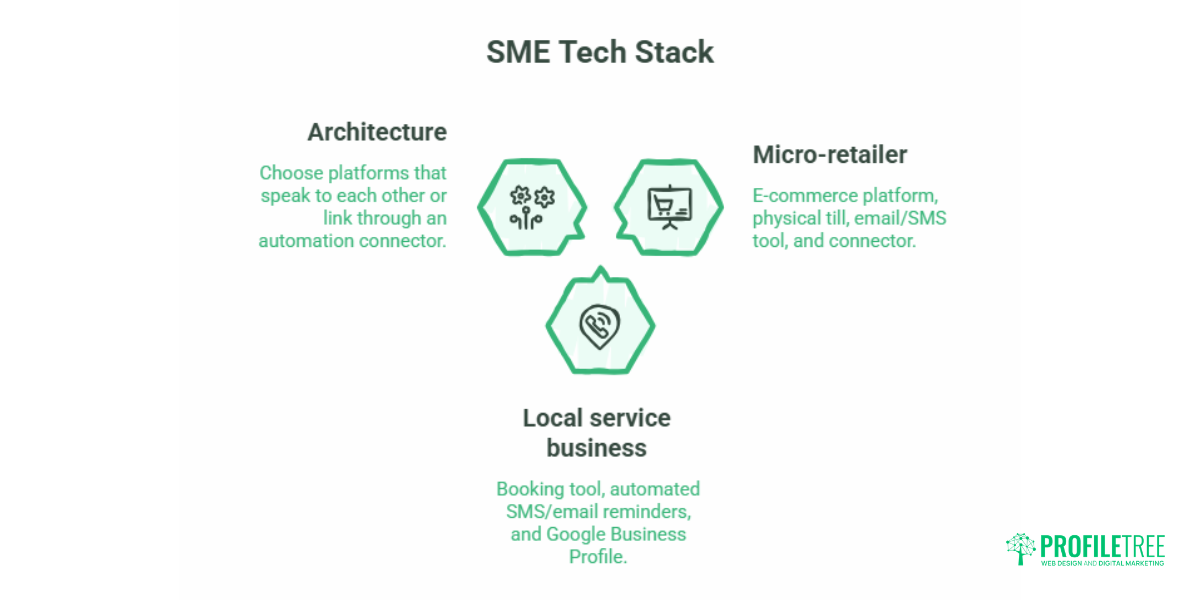
The principle is to choose platforms that already speak to each other, or that link through an automation connector, rather than buying one giant system. A micro-retailer might run an e-commerce platform, a physical till that syncs to the same inventory, a low-cost email and SMS tool, and a connector that ties them together. A local service business might pair a booking tool with automated SMS and email reminders and a Google Business Profile that drives local search. Both can sit comfortably under £100 a month.
UK indicative pricing in this guide is for guidance only and changes frequently; check current rates directly with each provider before committing. The point is the architecture, not the specific brands: small, connected tools beat one expensive platform that nobody fully adopts.
ProfileTree’s team covers the practical side of building a connected digital approach for smaller businesses in this walkthrough.
Where Most SME Stacks Go Wrong
The common failure is buying tools before mapping the customer journey, which produces a stack of half-used subscriptions. The second is treating integration as a one-off setup rather than something to test and maintain. Channels drift apart over time as platforms update, so a quarterly check that data is still flowing correctly between systems prevents the slow return to silos.
UK GDPR and PECR: The Compliance Layer SMEs Miss
This is the section nearly every US-centric guide skips, and it is the one most likely to cause a UK or Irish business real trouble. Running omnichannel email and SMS marketing means moving personal data between systems, and that triggers UK GDPR and the Privacy and Electronic Communications Regulations (PECR), enforced by the Information Commissioner’s Office (ICO).
The core risk is consent that does not travel with the customer. If someone opts out of marketing texts, but your SMS tool and your email tool do not share that status, you can keep contacting them lawfully on one channel while breaching the rules on another. PECR generally requires a clear, specific opt-in for electronic marketing, and consent for one channel does not automatically cover another. Syncing unsubscribe and opt-out status across every connected tool is, therefore, not just good practice; it is how you stay compliant.
The practical safeguard is a single source of truth for consent. Whichever system holds the master customer record should hold the definitive consent status, and every other tool should read from it. An in-store email sign-up at the till needs a clear, separate opt-in, and that choice must update the central database automatically rather than living on a paper sheet behind the counter. For the wider rules around handling customer information, ProfileTree’s guidance on customer data privacy and on UK digital compliance covers the details.
Ciaran Connolly, founder of ProfileTree, puts the integration challenge plainly: “The technology to connect channels is the easy part now. Where small businesses come unstuck is consent, keeping one honest record of who has agreed to what, across every tool they use. Get that wrong and the ICO does not care how clever your automation was.”
Real Omnichannel Scenarios for UK and Irish SMEs
Theory matters less than seeing how this works for a business the size of yours. The following scenarios are realistic illustrations, not client case studies, and they show the same logic applied at a manageable scale.
A High Street Boutique Running Click-and-Collect
A clothing shop in a Northern Irish town sells both in-store and online. Its e-commerce platform and EPOS share one inventory, so an item sold at the till disappears from the website immediately. A customer orders online, collects in store, and three days later receives an automated email asking how the purchase went. Their in-store loyalty points and online account are the same balance. The tools involved are modest; the experience feels considered, and the shop spends no extra staff time keeping it aligned.
A Regional B2B Service Provider
A consultancy serving clients across Ireland and the UK runs LinkedIn outreach alongside an email nurture sequence. When a prospect engages on LinkedIn, they enter the same automated email flow, and the team sees both interactions against one record. A booking tool sends SMS and email reminders before calls. The result is that no lead falls through the gap between social activity and follow-up, which is exactly where smaller B2B firms usually lose people.
Both examples lean on the same foundations: a connected website, a shared customer record, and automation doing the repetitive work. They are the practical face of a sound digital marketing strategy to attract and retain customers.
How to Choose Omnichannel Marketing Tools
Choosing well comes down to a short set of questions rather than a feature comparison. Start with the channels your customers genuinely use, ignore the ones they do not, and only then look at tools.
First, map how a customer currently moves between your channels and where the joins break. Second, identify the single system that will hold the master customer record. Third, choose tools that connect to that record natively or through one connector, and confirm they can sync consent status. Fourth, pick analytics you will actually read. Anything beyond that is usually premature for an SME. Many businesses find that a short piece of digital training for the team delivers more value than another subscription, because the tools only work when people use them properly.
The temptation to buy the most comprehensive platform on the market is worth resisting. For most SMEs in Northern Ireland, Ireland, and the UK, a small connected stack that staff understand will outperform an expensive system that sits half-configured.
Where Omnichannel Marketing Is Heading
The direction of travel is towards more automation of the connecting work itself. AI is increasingly used to predict what a customer wants next, to tailor messaging in real time, and to handle routine support across channels through chatbots and assistants. For SMEs, the useful version of this is not science fiction; it is practical tools that reduce manual effort and make personalisation possible at a small scale. ProfileTree’s work on AI implementation for SMEs focuses on exactly that kind of grounded adoption rather than hype.
Voice search, richer mobile experiences, and faster connectivity will keep adding touchpoints, but the underlying principle does not change. A business that has its data unified and its consent properly managed can add a new channel without starting over. One that has not will keep rebuilding the same silos in new places.
Conclusion
Omnichannel marketing tools reward businesses that connect what they already have rather than those that spend the most. For UK and Irish SMEs, the winning approach is a small, well-chosen stack built around a single customer record, automation that does the repetitive work, and consent management that satisfies UK GDPR and PECR. Get those three right and a five-person firm can deliver the kind of joined-up experience customers now expect, without an enterprise budget or a dedicated IT team.
Frequently Asked Questions
What is the difference between multichannel and omnichannel marketing?
Multichannel means a business is active on several platforms that operate separately. Omnichannel means those platforms share customer data, so the experience stays continuous and consistent as a person moves between them.
How much does it cost a small business to set up omnichannel marketing tools?
A capable SME stack can run for roughly £30 to £100 a month by using tools that integrate natively or through a low-cost connector. Free tiers and native integrations remove the need for expensive enterprise platforms. Pricing changes often, so confirm current rates with each provider.
Do I need a complex CRM to run an omnichannel campaign?
No. Accessible platforms, including free tiers, can act as the single customer database for a micro-business. The discipline of writing every interaction back to one record matters far more than the size of the system.
How do I sync in-store sales with my email list under UK GDPR?
Use a clear, separate opt-in at the point of sale, and make sure that choice updates your central customer database automatically. Keeping one master record of consent that every other tool reads from is how you avoid breaching UK GDPR and PECR.
Is Amazon or Nike an omnichannel brand?
Yes, both are well-known examples of the strategy in action. The same logic of connecting channels around one customer record applies just as well to a local high street shop or a regional service business.