
Video Production Online: A Growth Guide for UK Businesses
Table of Contents
Most businesses know they need video. Fewer understand what separates a video that generates enquiries from one that gets 40 views and disappears. Online video production is not complicated, but it needs a clear process, honest budgeting, and a firm view of what happens to the video after it is delivered.
This guide covers the production process, realistic UK costs, the legal points businesses often miss, and why online video production only pays off when it is treated as part of a wider marketing system rather than a one-off project.
Video as a Marketing System, Not a One-Off Project
A single video rarely delivers lasting commercial value on its own. Businesses that see consistent returns treat each piece of online video production as part of a connected system rather than an isolated project.
- Integrating video with SEO and web UX. Where a video lives matters as much as how it is made. A video embedded on a service page needs to load without slowing the page down, since page speed is a ranking factor and a drag on conversion. Businesses working with ProfileTree’s website development team typically host video through YouTube or a dedicated player rather than uploading raw files directly to WordPress, which keeps page weight down. Search engines also index video content differently from text, so a video sitting on a page that has been properly structured for search engine optimisation has a better chance of appearing in both standard search results and video-specific results.
- YouTube as a search engine in its own right. Businesses often plan online video production purely for social reach and forget that YouTube is itself a search engine, with its own ranking factors: titles, descriptions, watch time, and viewer retention all affect whether a video surfaces for a relevant search. A well-optimised YouTube channel, built around the searches an SME’s customers already make, can bring in enquiries long after a video’s initial publish date, in a way a one-off Instagram post cannot. This is where YouTube marketing and video production overlap, and treating the two separately usually means neither performs as well as it could.
- The content flywheel. A single day of filming can produce far more than one finished video. A 10-minute brand interview can become a full YouTube piece, three or four short social clips, an audio-only version for a podcast feed, and a transcript that feeds a blog post or email. This kind of repurposing is where a content marketing plan earns its keep. Filming with repurposing in mind from the outset, rather than as an afterthought, multiplies the return on a single production spend without requiring additional filming days.
The Three Stages of Professional Video Production
Every professional video production follows the same three-stage process, regardless of budget or format. Understanding each stage is the single biggest factor in avoiding wasted spend on online video production.
Stage 1: Pre-production.
This covers everything before a camera switches on: defining the video’s purpose and audience, writing or approving a script, building a shot list, confirming locations, and agreeing on a schedule. For corporate video, this stage also includes deciding who appears on camera, briefing them on key messages, and confirming any legal requirements around location filming or music licensing. Businesses often underinvest in pre-production because it feels like a delay. In practice, an hour spent on a clear brief saves three hours in editing. If you cannot answer what the single most important thing this video should communicate before filming starts, the finished product will show it.
Stage 2: Production.
For most business videos, this means one or two days on location with a camera operator, basic lighting equipment, and a directional microphone. Remote production replaces on-location filming with a managed recording session using tools such as Riverside.fm or SquadCast, which capture studio-quality audio and video locally on each participant’s device before syncing the files afterwards. This has made it entirely practical for a director based in Belfast to manage a contributor in Edinburgh while post-production happens in Dublin, removing a logistical barrier that once put professional video out of reach for smaller UK and Irish businesses.
The quality gap between professional and amateur footage is rarely the camera. It is almost always lighting and audio. A well-lit subject recorded with a decent directional microphone will outperform footage shot on a higher-spec camera with poor lighting and ambient noise every time. If your business is producing video in-house, invest in a ring light and a lapel microphone before upgrading any other equipment.
Stage 3: Post-production.
This covers editing, colour grading, sound mixing, graphics, subtitles, and final export. Key decisions include editing to the platform, since a LinkedIn video has different pacing expectations than a YouTube explainer, whether to include motion graphics or full animation instead of live footage, music licensing, and subtitle format. WCAG accessibility guidance recommends captions on all publicly distributed video content. This is not currently a legal requirement for every UK business, but it is best practice, and it improves watch time.
Hybrid Production: Agency Quality Without Agency Overheads
Not every video needs a full production crew, and not every video should be left to a smartphone. The right approach to online video production depends on purpose, audience, and how the finished piece will be used, not on budget alone.
| Approach | Typical Cost | Time Commitment | Best Use Case |
|---|---|---|---|
| DIY / in-house | £0–£1,500 | Low to medium (existing staff time) | Short social clips, quick testimonials, behind-the-scenes content |
| Freelancer | £500–£5,000 | Medium (briefing and one shoot day) | Explainers, single testimonials, product demos |
| Full-service agency | £1,500–£20,000+ | Higher upfront, lower ongoing effort | Corporate brand films, multi-format campaigns, ongoing content programmes |
The freelancer route works well when a business has a single clear deliverable and an internal team member who can brief it properly. The agency route earns back its higher cost over time through repeat work, since the process, style guides, and brand understanding only need to be built once. Treating a one-off freelance testimonial and an ongoing brand campaign as the same kind of purchase is one of the most common budgeting mistakes SMEs make with video production.
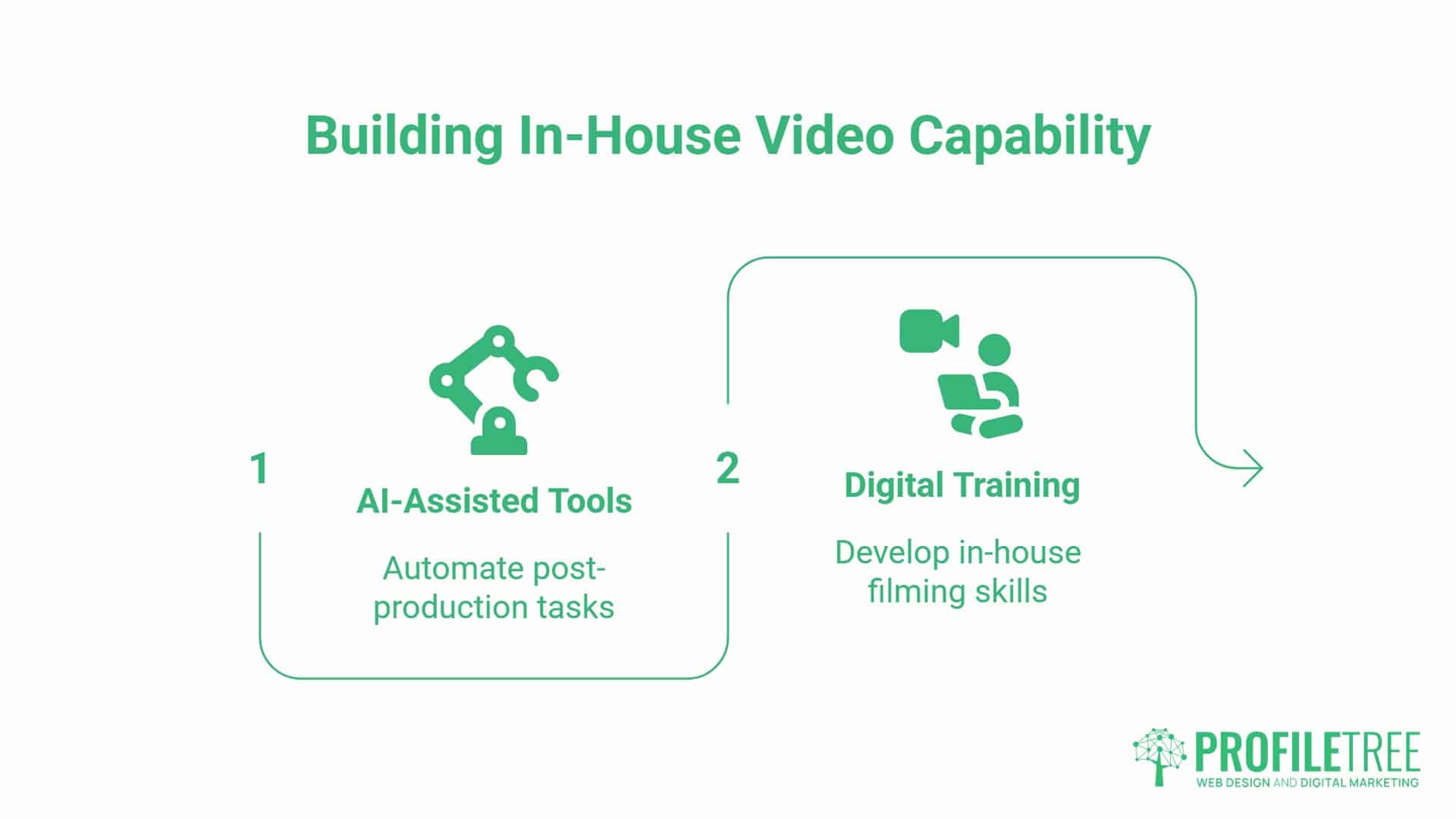
AI-assisted tools are further narrowing the gap between these tiers. Auto-captioning, rough-cut assembly, and translation for multilingual audiences can now be handled by tools such as Descript, cutting hours from post-production without a live editor present at every stage. This is a genuine efficiency gain, not a replacement for a director’s judgement on tone or message, and it is worth discussing with an AI implementation partner if a business wants to build these tools into a repeatable content workflow rather than using them ad hoc on a single project.
If your team wants to build in-house video capability rather than outsourcing every piece of online video production, a short block of digital training on filming basics, lighting, and editing software can be more cost-effective than commissioning every video externally, particularly for short-form social content that needs a fast turnaround.
Filming Across the UK and Ireland
Production costs and available talent vary more by region than many businesses expect. London day rates for crew and studio hire are well above the UK average, making regional production hubs an underused option for SMEs outside the capital. Belfast, Manchester, and Birmingham all have established crews and studio space capable of corporate-standard video production at a lower day rate than London equivalents, and a Belfast-based agency working across Northern Ireland and the Republic of Ireland brings practical familiarity with cross-border logistics, from currency handling on quotes to location permissions on both sides of the border, that a UK-only production team may not have.
UK Video Production Costs
The cost of online video production in the UK varies significantly depending on format, length, and production approach. The ranges below reflect current market rates for the Northern Ireland and wider UK market.
| Format | DIY / In-House | Freelancer | Production Agency |
|---|---|---|---|
| Short social clip (under 60 sec) | £0–£200 | £300–£800 | £800–£2,000 |
| Testimonial/talking head | £200–£500 | £500–£1,500 | £1,500–£3,500 |
| Explainer video (animated) | £500–£1,500 | £1,000–£4,000 | £3,000–£10,000+ |
| Corporate brand video | £1,000–£3,000 | £2,500–£7,000 | £5,000–£20,000+ |
| Full product demo with voiceover | £500–£1,500 | £1,500–£5,000 | £4,000–£12,000 |
These figures cover production only and exclude paid distribution, advertising spend, or ongoing channel management. Hidden costs that frequently catch businesses out include music licensing, subtitle creation, platform-specific re-editing for different aspect ratios, and storage for raw footage.
UK Legal and Compliance Considerations
- GDPR and employee consent. Anyone appearing on camera, whether an employee or a member of the public in a private setting, generally needs to give informed consent before filming, and should be told clearly how the footage will be used, where it will appear, and for how long it will be kept. A proper release form should cover the specific uses the footage is being filmed for, since consent given for an internal training video does not automatically extend to a public marketing campaign. Employees also retain a right to withdraw that consent later, which is worth building into any release process from the outset rather than treating consent as a single signature at the time of filming.
- Music licensing. Any video distributed publicly in the UK that includes commercially released music requires appropriate licensing. For online video, this typically involves a synchronisation licence for attaching a piece of music to visual content, and in some cases a public performance licence if the content is streamed. The simplest approach for most businesses is to use royalty-free music from licensed libraries such as Artlist, Epidemic Sound, or Musicbed, which offer annual subscriptions covering unlimited commercial use. Using unlicensed music on a YouTube channel or LinkedIn video is a common mistake that can result in the video being muted, removed, or monetised by the rights holder.
- AI-generated content disclosure. Where AI tools are used for voiceover, avatars, or other synthetic elements of a video, UK audiences increasingly expect this to be disclosed, particularly in a B2B context where the credibility of the message depends on the credibility of who appears to be delivering it. This is an evolving area without settled UK-wide rules covering every use case, so businesses using AI-generated elements in customer-facing video should treat clear disclosure as good practice now rather than wait for it to become a formal requirement.
Measuring the Return on Video Production
A piece of video content that costs several thousand pounds to produce needs a clear performance case, and the metrics worth tracking depend on where the video sits in the sales journey.
For awareness-stage content, track reach, watch time, and completion rate. A completion rate above 40 per cent on a video over two minutes is a strong signal that the content is resonating with its audience. For consideration-stage content, track click-through rate to service pages, time on site following video views, and assisted conversions in your analytics platform. For conversion-stage content such as testimonials or product demos, track direct conversions and compare conversion rates on pages with and without video present.
Mapping video output against these funnel stages before production begins gives every piece of online video production a clearer purpose and makes performance far easier to measure afterwards. Short-form awareness content belongs at the top of the funnel, where the goal is reach and recognition. Explainers and case studies sit in the middle, where the viewer is actively evaluating options. Testimonials and product demos close to the bottom, where the viewer needs confidence to act.
“The businesses that get the most value from video are the ones that treat it as part of a wider content strategy rather than a one-off project,” says Ciaran Connolly, founder of ProfileTree. “A single well-produced video placed strategically in the right part of the sales journey will outperform a dozen clips produced without a clear plan.”
Cost-per-view is often cited but rarely useful on its own. A video with a low cost per view that generates no commercial action is not performing well. Tie video spend to business outcomes, not vanity metrics, and where video sits on service pages, work with your SEO and analytics setup to track whether it is actually moving the pages it sits on, rather than assuming views alone justify the spend.
Online video production delivers a return when it is planned as part of a broader marketing system rather than treated as a standalone exercise. A clear brief, the right production approach for the goal, and a defined distribution plan are what separate a video that contributes to business growth from a video that simply exists. ProfileTree’s production team works with businesses across Northern Ireland, Ireland, and the wider UK, from single-day shoots to ongoing video content programmes.
FAQs
How much does online video production cost in the UK?
Costs range from a few hundred pounds for a basic in-house testimonial to over £20,000 for a full corporate brand film. Most SMEs commissioning a professional explainer from a specialist agency should budget between £3,000 and £10,000.
What are the three stages of video production?
Pre-production covers planning, scripting, and logistics. Production is the filming or remote recording stage. Post-production covers editing, grading, captioning, and export. Pre-production is the most underinvested stage and the one that most affects final quality.
Do I need consent to film employees for a business video?
Yes, employees and members of the public in private settings should give informed consent before being filmed and understand how the footage will be used. Consent can be withdrawn later, so this needs to be built into your release process, not treated as a single signature.
Do I need a music licence for my online video?
Yes, if you use commercially released music. A synchronisation licence is required for any copyrighted track used in a publicly distributed UK video, and a royalty-free subscription from a library such as Artlist or Epidemic Sound is the simplest solution for most businesses.
Should I hire a freelancer or an agency for video production?
It depends on scale and consistency. A freelancer suits a single testimonial or explainer with a defined brief. An agency suits ongoing content programmes, multi-format campaigns, or projects needing a full crew, since the higher upfront cost is offset by lower ongoing management effort.