
B2B Video Production: Smart Guide to ROI and Strategy
Table of Contents
Most B2B companies know they should invest in video. Fewer know how to make it pay. The gap between a corporate video that accelerates a sales cycle and one that’s gathering dust on a company website comes down to strategy, not production budget.
This guide covers what UK and Irish businesses need to get B2B video production working: the formats that convert, realistic GBP pricing, a clear ROI framework, and the questions your production brief should answer before filming begins.
What Is B2B Video Production?
B2B video production is the process of planning, filming, and editing video content designed to support business-to-business sales and marketing. Unlike consumer-facing video, B2B content must speak to multiple stakeholders: procurement teams evaluating risk, technical staff assessing capability, and senior executives weighing strategic fit.
Corporate buyers research extensively before making a purchasing decision, and video marketing content consistently receives more engagement than written proposals or static presentations at every stage of that process. Companies without professional video assets increasingly find themselves excluded from supplier shortlists, particularly for contracts where credibility signals matter as much as price. If you’re not visible before the shortlist is drawn up, you’re not on it.
ProfileTree, a Belfast-based digital marketing and video production agency, has seen this pattern across client work since 2011. Video has moved from a nice-to-have in B2B marketing to a core sales tool, and it’s now supporting prospecting, evaluation, and closing in organisations of all sizes. The businesses that grow their B2B pipeline fastest aren’t the ones with the largest production budgets; they’re the ones with video strategies mapped to specific buyer journey stages.
Types of B2B Video That Convert Corporate Clients
Not all B2B video production formats serve the same purpose. Choosing the right format for each stage of your buyer journey determines whether your production budget generates qualified leads or just views. The table in the ROI section maps these formats to funnel stages and measurable outcomes. If you’re working with a B2B video production company for the first time, starting with a clear format brief saves time and scope changes later.
Company Overview Films
A company overview film is one of the most common types of corporate video, typically running 2–4 minutes and serving as a digital handshake for prospects who haven’t yet engaged your sales team. It combines facility footage, brief employee interviews, and capability demonstrations into a single narrative. The goal is credibility, not promotion; buyers watch overview films to rule suppliers out, so professional quality and substantive content matter more than polished marketing language.
Product and Service Demonstration Videos
Complex B2B products and services require visual explanation to communicate value. Demonstration videos show how something works in practice rather than listing features in a brochure. Split-screen comparisons, motion graphics highlighting technical specifications, and real-world application footage help procurement teams understand what they are buying without requiring a site visit.
Client Testimonial Films
Third-party validation carries more weight with B2B buyers than any claim you make about your own business. Effective testimonial films don’t just use talking-head clips; they combine an interview with a real client contact, b-roll footage of the implementation in use, and a specific, quantifiable outcome. For companies operating in the UK and Ireland, testimonials from recognisable local businesses carry particular regional credibility.
Manufacturing and Process Videos
For businesses in manufacturing, engineering, or logistics, behind-the-scenes process footage builds confidence in delivery capability. Time-lapse sequences compress lengthy production processes into engaging short films, while facility tours allow procurement teams to evaluate scale and capacity before visiting in person. These videos address the due diligence questions buyers have but don’t always ask directly.
Executive Thought Leadership Films
Senior leadership videos are an underused asset in B2B marketing. They position a company as an authority while humanising its brand. Multi-camera interview setups, clean audio, and considered lighting transform an executive interview into credible thought leadership content. These work particularly well for professional services firms and technology companies where the expertise of the people matters as much as the product. If your buyers are evaluating you as a long-term partner, they’ll want to know who they’re dealing with.
Training and Onboarding Content
B2B sales often include post-purchase training components. Professional training videos demonstrate the depth of after-sales support while reducing demands on technical staff who’d otherwise repeat the same instruction. A well-structured video library can be a genuine differentiator in procurement evaluations, particularly when clients compare suppliers on long-term partnership potential.
What Does B2B Video Production Cost in the UK?
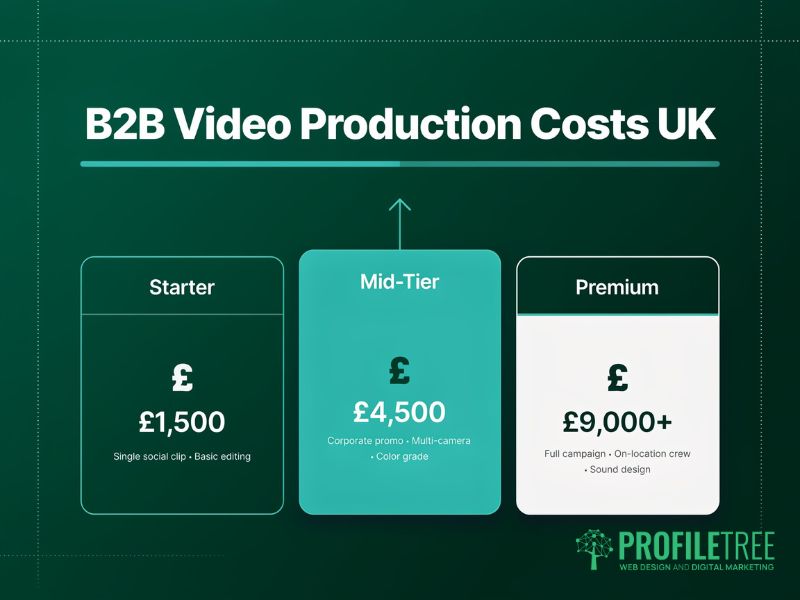
Pricing is the question most B2B buyers want answered before contacting a corporate video production company, and the question most UK agency websites avoid. The table below gives honest GBP ranges for each production tier. Actual costs vary based on shoot days, location logistics, post-production complexity, and whether you need motion graphics, drone footage, or multiple language versions.
| Production Tier | Typical Budget (GBP) | What You Get | Best Suited For |
|---|---|---|---|
| Starter | £2,000–£5,000 | Single-camera, basic grade, up to 3 min | SMEs, social clips, team introductions |
| Mid-Tier | £5,000–£15,000 | Multi-camera, motion graphics, branded edit | Product demos, testimonials, and overview films |
| Premium | £15,000–£50,000+ | Cinema-grade kit, drone, full post suite | Enterprise sales assets, campaign hero content |
Batch filming, where multiple videos are planned and captured in a single production day, cuts cost per asset considerably without compromising quality. It’s the most efficient way to build a video library on a fixed budget. Distribution costs, platform-specific editing, and paid social amplification typically add 15–25% to total investment for companies running structured video programmes.
How to Measure ROI from B2B Video Production
View counts aren’t a business metric. Professional B2B video programmes track outcomes that connect to revenue, and the measurement framework should be agreed with your production partner before filming begins.
Funnel Alignment: Video Types and Their Metrics
Mapping video formats to funnel stages and corresponding metrics prevents the common mistake of evaluating all video content on the same criteria.
| Funnel Stage | Video Type | Primary Goal | Key Metric |
|---|---|---|---|
| Awareness | Company overview, thought leadership | Build brand recognition | View duration, reach |
| Consideration | Product demos, process videos | Educate procurement teams | Completion rate, return visits |
| Decision | Client testimonials, case studies | Provide third-party validation | Conversion rate, sales cycle length |
| Retention | Training, onboarding, and update videos | Reduce churn, support upsell | Support ticket reduction, renewal rate |
Tracking Video-Influenced Pipeline
B2B deals involve multiple stakeholders and long decision cycles, which means video’s contribution to a closed deal isn’t captured accurately by last-touch attribution alone. The most practical approach is to track ‘video-influenced pipeline’: deals where at least one stakeholder engaged with video content before the deal closed. Ask your video production company to support this from the outset by delivering content with UTM-tagged links or platform embeds that connect views to your CRM.
Most CRM platforms, including HubSpot and Salesforce, can be configured to log video views against contact records. Comparing average deal value and sales cycle length between video-influenced and non-video-influenced opportunities gives a defensible ROI calculation that holds up in budget conversations.
Sales Cycle Reduction
The most consistent ROI signal from B2B video is sales cycle reduction. When product demonstrations answer technical questions that’d previously required a dedicated call, and when client testimonials replace reference check conversations, qualified leads move through evaluation stages faster. ProfileTree’s video production clients have reported measurable reductions in quote-to-contract timelines after integrating professionally produced video at key sales stages.
“The businesses that get the clearest returns from B2B video are the ones that treat it as a sales tool first and a marketing asset second. When you build a video specifically to answer the question a procurement team always asks in week three of an evaluation, you can see exactly where it’s working in your pipeline data.” Ciaran Connolly, Founder, ProfileTree
AI’s Role in B2B Video Production
Artificial intelligence is changing several parts of the video production workflow without replacing the strategic thinking or on-camera credibility that corporate buyers respond to. Understanding where AI adds genuine value (and where it introduces risk) helps B2B companies make better decisions about their production approach.
Localisation and Multi-Language Versions
For UK companies selling into European or global markets, AI-powered dubbing and subtitle generation has made multi-language video production far more accessible. A single English-language master can now be dubbed into multiple languages with voice synthesis that closely matches the original speaker’s tone. Quality still requires human review, particularly for technical terminology, but the cost per language version has dropped substantially.
Pre-Production and Rapid Prototyping
AI tools are genuinely useful for pre-production: generating first-draft scripts from a brief, creating storyboard concepts, and producing rough animatic sequences for client approval before committing to a full shoot. They shorten the strategy phase and reduce revision cycles. For ProfileTree’s production team, AI-assisted pre-production means clients can approve a creative direction earlier, with fewer surprises on shoot day.
Where Human Production Still Wins
Corporate buyers are perceptive about authenticity. Fully AI-generated video, particularly where synthetic voices or avatar presenters replace real people, tends to underperform with B2B audiences who are evaluating long-term supplier credibility. Real faces, genuine locations, and natural speech carry weight that the current AI generation can’t replicate for high-value sales contexts. AI is a production efficiency tool, not a replacement for the on-camera evidence that closes B2B deals. Your video marketing strategy should treat AI as a workflow accelerator, not a shortcut past the creative and strategic work that makes content perform.
Why Regional Context Matters: UK, Ireland, and Northern Ireland
B2B video production across the UK and Ireland involves considerations that purely national guides miss. Companies operating across Northern Ireland and the Republic of Ireland need content that works for both markets: different procurement processes, funding schemes, and regulatory contexts mean dual-market video content requires careful messaging that most generalist production companies won’t know how to address without a detailed briefing.
Location logistics vary widely outside Dublin and Belfast. Professional studio facilities with full equipment inventories exist in both cities, but regional locations may require portable studio setups in conference facilities. Drone permissions near airports in Belfast, Dublin, and Derry need advance planning. Weather is a consistent variable for outdoor content; professional productions build contingency days into schedules where exterior footage is essential.
UK parent companies evaluating Irish subsidiaries through video presentations represent a distinct use case. These productions must meet international corporate production standards, since they will be reviewed alongside content from larger operations in England and Scotland.
ProfileTree’s video marketing services cover the full production cycle from strategy through to post-production and distribution, with experience across Northern Ireland, the Republic of Ireland, and UK-wide client projects.
Common B2B Video Production Mistakes to Avoid
Most underperforming B2B video content fails for the same reasons, and most of them come down to treating video as a standalone project rather than part of a connected B2B marketing strategy. Spotting these patterns before production begins saves real budget.
Features Over Buyer Outcomes
A list of technical specifications without a business context doesn’t move procurement decisions forward. Effective B2B video translates capability into outcome: not ‘our system processes 10,000 transactions per hour’ but ‘out-of-hours transaction volumes no longer require manual oversight from your finance team.’ The second version answers the question a financial decision-maker actually has.
One Video for All Stakeholders
A single video that tries to address technical evaluators, financial decision-makers, and end users simultaneously doesn’t work well for any of them. B2B purchasing committees contain multiple personas with different priorities. A company overview film, a separate technical demonstration video, and a separate ROI-focused case study each serve specific stakeholders at specific stages. The production cost of a three-video series is manageable; the cost of a single video that no one finds relevant is higher.
No Distribution Plan
A video sitting on a page that no one visits doesn’t generate a pipeline. Distribution planning should be part of the production brief: which LinkedIn audiences will it reach, which sales team members will use it in outreach, which email sequences will it support, and which website pages will host it, where target buyers actually land. Production and distribution are one brief, not two separate conversations.
Working with a B2B Video Production Company
Selecting the right corporate video production company determines whether your investment delivers measurable results. Get this wrong, and you’ll spend money on content that looks fine but doesn’t move the needle. B2B video requires an understanding of corporate buying processes, experience with technical subjects and professional services, and the project management capability to coordinate across departments without disrupting operations. You’re looking for a genuine production partner, one who understands your sales process as well as your brief.
Evaluate potential partners on their corporate portfolio, not their creative showreel. Don’t be swayed by a visually impressive showreel if there aren’t examples from comparable industries or from companies selling to similar buyers. A good B2B video production company will push back on a weak brief rather than just film what you ask for. The production company should be able to articulate how a specific video contributed to a client’s pipeline. If they can’t connect it to a business outcome, that’s telling.
ProfileTree’s digital marketing services integrate video production with SEO, content marketing, and paid distribution so that video assets work as part of a broader growth strategy rather than in isolation. Founded in Belfast in 2011, we’ve delivered over 1,000 digital projects across Northern Ireland, Ireland, and the UK, with a 5-star rating from 450+ client reviews.
Production companies that also offer content marketing services can align your video programme with your wider B2B marketing activity, multiplying the return on each production through transcription, repurposing, and integrated amplification across search, social, and email.
Next Steps for UK and Irish Businesses Ready to Invest in Video
Professional B2B video production isn’t a marketing expense; it’s a sales infrastructure investment. The companies that treat it that way, building video assets mapped to specific buyer journey stages and tracking their impact on the pipeline, consistently report shorter sales cycles and higher conversion rates. That’s not an accident; it’s what happens when video is planned as part of a B2B marketing strategy rather than commissioned as a one-off.
Start with a brief audit of your buyer journey: where do qualified leads slow down or go quiet? You’ll usually find one or two stages where video would do the job that a long document currently isn’t doing. A technical demonstration that answers the question your sales team fields every week, a client testimonial from a comparable company, or an executive interview that establishes credibility before the first meeting are all more immediately valuable than a polished overview that no buyer ever sees.
To discuss a production brief or review your current video marketing strategy, visit our video marketing services page or explore our AI marketing services for campaigns that combine professional video with AI-powered distribution.
FAQs
1. How much does B2B video production typically cost in the UK?
Single corporate videos in the UK range from £2,000 to £5,000 at the starter tier and £5,000 to £15,000 for mid-tier productions with motion graphics and multi-camera setups. Full campaign packages with multiple formats can reach £15,000 to £50,000 or more. Batch filming across a single production day is the most cost-effective way for most B2B companies to generate multiple assets from one investment.
2. How long should a B2B video be for maximum engagement?
Company overview films perform best at 2–4 minutes. Product demonstrations can run to 4–6 minutes when the content is technical. Top-of-funnel awareness content for LinkedIn should be kept under 90 seconds. Corporate buyers will watch longer content than consumer audiences, but only when every minute provides specific, relevant evidence. They won’t tolerate padding. View duration analytics quickly reveal where content loses its audience.
3. How do I measure ROI from B2B video production?
Track video-influenced pipeline with support from your video production company: they should deliver content with UTM parameters or platform integrations that connect views to your CRM. Compare deal value and sales cycle length between video-influenced and non-video-influenced opportunities. Sales cycle reduction is typically the clearest early signal. Secondary metrics include qualified lead rates from pages with embedded video, view completion rates, and direct conversion rates where video sits adjacent to an enquiry form.
4. Should we film on location or in a studio?
On-location filming at your actual premises provides authenticity that corporate buyers value: they see real facilities, real people, and genuine working environments. Studio production is better for executive interviews, product demonstrations, and training content, where controlled conditions produce consistently higher technical quality. The strongest B2B productions often combine both: studio interview footage intercut with on-location b-roll.
5. Who owns the footage and rights after a B2B video production?
Ownership of raw footage, master files, and usage rights should be explicitly agreed upon in your production contract before work begins. Under UK copyright law, ownership defaults to the production company unless a written agreement transfers it to the client. Most professional B2B production companies grant full usage rights for agreed deliverables; they don’t automatically include raw footage in the standard package. Always clarify in writing before signing.