
How to Run a Successful Social Media Audit
Table of Contents
Most SMEs spend money on social media before they understand what’s working. A successful social media audit changes that. It gives you a clear picture of where your profiles stand, what your content is actually doing, and whether your activity is moving the business forward or just filling a content calendar.
This guide walks through every stage of the audit process, from inventorying your accounts to turning your findings into a strategy. Whether you manage your own channels or you’re preparing to brief an agency, the steps are the same.
What Is a Social Media Audit and Why Does It Matter?
A social media audit is a structured review of all the social channels your business uses. You assess whether each profile is complete and on-brand, whether the content you’re publishing is producing measurable results, and whether your activity aligns with your actual business goals.
For SMEs across Northern Ireland, Ireland, and the UK, the audit often surfaces a familiar problem: activity without strategy. Posts go out regularly, follower counts inch upward, but website traffic from social stays flat and enquiries rarely come through social channels. The audit is where you diagnose why.
It’s also the essential step before any new investment. Hiring a digital marketing agency, commissioning a content plan, or increasing ad spend without first auditing your baseline is the social media equivalent of renovating a house before checking the foundations.
Step 1: Profile Inventory and Account Security
Start by listing every social media account your business has ever created. This includes inactive accounts, platforms you no longer use, and any profiles set up by former team members or previous agencies.
For each account, record:
| Field | What to Check |
|---|---|
| Platform | Facebook, Instagram, LinkedIn, X, TikTok, YouTube, Pinterest |
| Username / handle | Consistent with brand name? |
| Profile status | Active, inactive, or abandoned |
| Admin access | Do you have full ownership and login credentials? |
| Two-factor authentication | Enabled? |
| Bio / About section | Complete, accurate, and up to date? |
Zombie accounts, profiles that were set up and then left untouched, are a real risk. They hold your brand name but may carry outdated information, old phone numbers, or links to a previous website. A competitor or bad actor finding an unmanned profile is an avoidable problem.
Many SMEs discover during this step that a former employee or agency retains admin access to their accounts. Audit access permissions across all platforms and revoke access for anyone who no longer works with the business.
Once you have a full list, decide which platforms are worth maintaining. Being present everywhere is not a strategy. For most Northern Ireland and UK SMEs, focusing on three to four platforms and managing them well will produce better results than spreading effort thinly across six or more.
Step 2: Brand Consistency and UK Compliance Check
Open each profile side by side and compare:
- Profile image and cover photo: same visual style across platforms?
- Bio copy: Does it describe the business accurately and consistently?
- Website URL: Does it link to the correct page, not a homepage that has since moved?
- Contact information: phone number, address, and email still accurate?
Visual inconsistency is more damaging than most business owners realise. When a potential customer checks your LinkedIn after seeing your Instagram, mismatched branding signals that the business is disorganised. For SMEs competing against larger brands, that first impression matters.
UK Compliance Points Are Often Missed in Standard Audit Guides
Under the CAP Code, any paid promotion, sponsored content, or brand partnership on social media must be clearly labelled with “#ad” or an equivalent disclosure. This applies to brands of all sizes, including SMEs working with local influencers or running ambassador programmes. Where products are gifted without any brand control over the resulting content, the obligation falls under CMA consumer protection rules rather than the CAP Code, but disclosure is still required either way.
During your audit, review any historical posts that involved a commercial relationship and check that they were correctly labelled. The ASA can publicly name non-compliant brands, and the CMA now has the power to fine up to 10% of a brand’s global annual turnover for serious breaches under the DMCC Act 2024.
GDPR also has implications for social media activity. If you run competitions that collect entrant data, or use social media contact forms to gather customer details, those data flows need to be covered in your privacy policy. The ICO’s guidance is clear that competition entries constitute personal data collection and that UK GDPR transparency requirements apply. This gap frequently appears in audits of businesses that have grown quickly without updating their privacy documentation.
Step 3: Content Performance Analysis
This is where the audit gets substantive. Pull data from the native analytics of each platform for the last three to six months and build a picture of what your content is actually doing.
The Metrics That Matter for SMEs:
| Metric | Why It Matters |
|---|---|
| Reach | How many unique accounts saw your content |
| Engagement rate | Interactions divided by reach, a more honest measure than raw likes |
| Link clicks | Direct indicator of traffic driven to your website |
| Saves and shares | Signals content people find genuinely useful |
| Follower growth rate | Net new followers over the period, not just total count |
Vanity Metrics vs. ROI Metrics
Follower count and total likes feel good, but tell you little about commercial value. A LinkedIn post with 400 impressions and 12 link clicks is performing better for business than one with 2,000 impressions and 4 likes. During your audit, look for content that generated actual off-platform behaviour: website visits, direct messages, profile link clicks.
Identifying Your Top-Performing Content Patterns
Sort posts by engagement rate. Look for patterns in the top 20%. Is it the format (video, carousel, single image)? The topic? The time of posting? The caption style? Most SMEs find two or three content types that consistently outperform everything else. The audit tells you what they are so you can create more of them deliberately.
A content marketing strategy built on audit data performs significantly better than one built on assumptions. If your audit reveals that video content generates far higher engagement than static images, that’s a brief to commission more video, not a coincidence to ignore.
Step 4: Audience Insights and Alignment
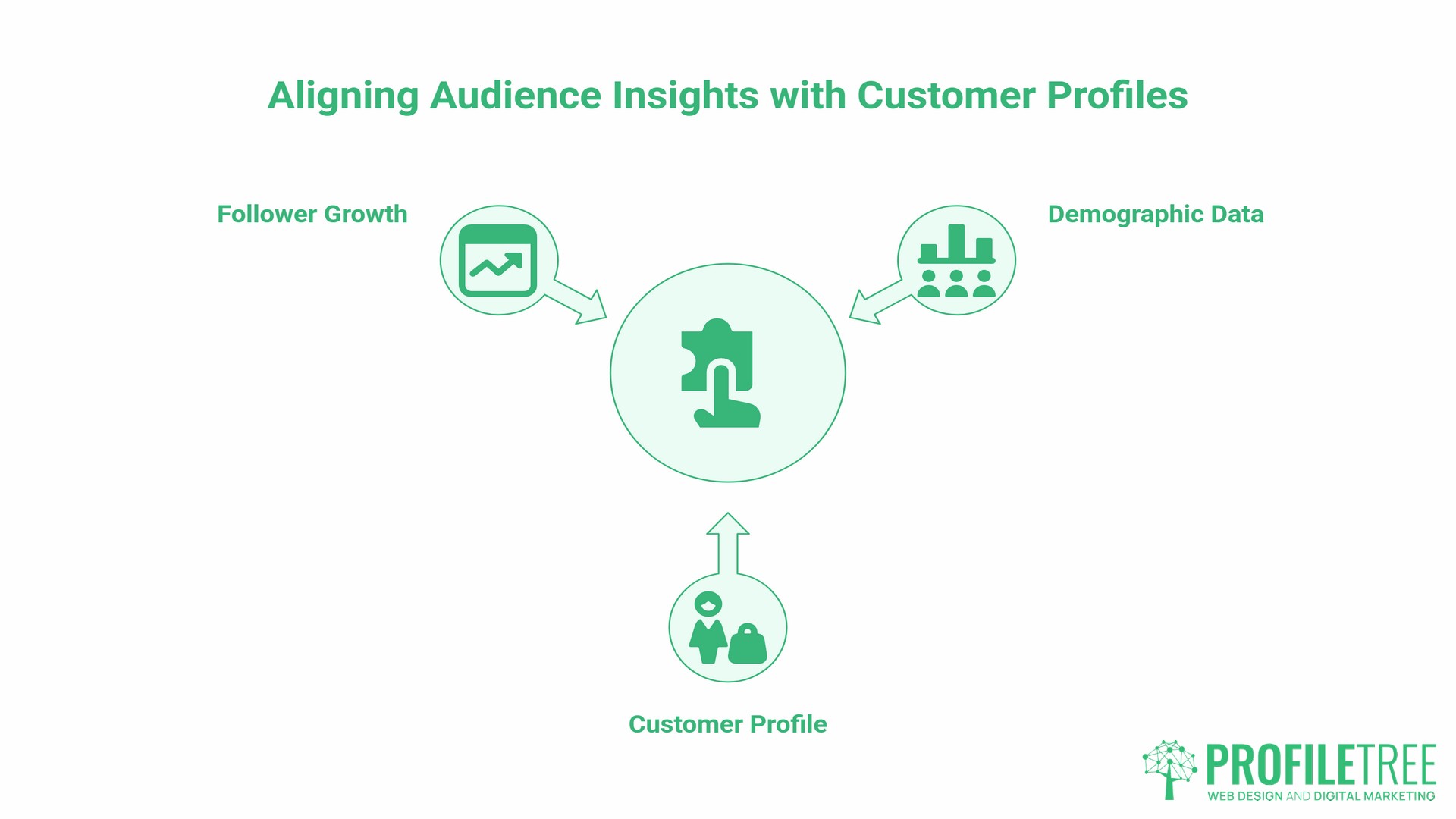
Every major platform provides demographic data about your followers: age ranges, locations, and in some cases industries and job titles (LinkedIn in particular). Pull this data for each platform and compare it against your actual customer profile.
The question is straightforward: are the people following you the ones who buy from you?
For a Belfast-based B2B services firm, a LinkedIn audience skewed toward decision-makers in Northern Ireland and Ireland is a healthy signal. An Instagram audience skewed toward 18 to 24-year-olds in the United States is not, unless that’s your market. Misalignment between follower demographics and customer profiles is one of the most common findings in SME audits, and it usually points to a platform choice issue rather than a content quality issue.
Also, review your follower growth pattern over the audit period. Steady organic growth is healthy. A large spike followed by a plateau often indicates a giveaway or viral moment that attracted followers with no commercial interest in your business.
Step 5: Competitor Benchmarking
Understanding how your social media performance compares with competitors provides context that internal data alone can’t. A 2% engagement rate might be strong in one industry and weak in another.
How to Benchmark Ethically and Practically
Identify three to five competitors or businesses operating at the level you’re targeting. These don’t need to be direct local competitors; they can be businesses in the same sector in other UK cities if direct regional competitors are hard to find.
For each, record publicly available data:
- Posting frequency
- Content formats used (video, carousels, static images, stories)
- Approximate engagement rate on recent posts: Divide total visible interactions by follower count to get a rough figure. This uses publicly visible data rather than reach, which is not available for accounts you don’t own, but it gives a consistent basis for comparison across competitors
- Types of content that appear to generate the most response
- Which platforms are they most active on
You’re not looking to copy competitors. You’re looking for gaps: topics they’re not covering, platforms they’re ignoring, or audience questions they’re not answering. Those gaps are where you can build authority.
Tools for Competitor Benchmarking
Meta’s Ads Library (facebook.com/ads/library) is free and publicly accessible without a login. It shows all ads currently running across Facebook and Instagram, letting you see what competitors are promoting in paid social at any given time. In the UK, ads are also archived for one year after their last impression, giving additional historical visibility. LinkedIn publicly displays follower counts and recent company posts at no cost. For more structured comparison data, paid tools such as Sprout Social, Hootsuite, and Socialinsider provide deeper benchmarking, though a manual review is perfectly adequate for most SME audits.
Step 6: The Audit-to-Action Bridge
Most audit guides stop at the data. This is the step they miss.
The purpose of a successful social media audit is not to produce a report. It’s to produce a plan. Once you have your findings across profiles, content, audience, and competitors, the next step is translating them into decisions.
Building a 90-Day Content Plan from Your Audit
Group your findings into three buckets:
- Fix immediately: Profile gaps, security issues, compliance problems, broken links. These take hours, not weeks.
- Adjust over 30 days: Content mix, posting frequency, platform prioritisation. These require small, consistent changes.
- Plan for 60 to 90 days: New content formats, platform launches, or campaigns that require production time and budget.
For the content plan itself, your top-performing content patterns (identified in Step 3) become your core formats. Your audience insights (Step 4) inform your topics and tone. Your competitor gaps (Step 5) tell you where there’s space to establish authority.
Using your audit to brief a digital agency
If you’re planning to bring in external support, your audit is the most useful document you can hand over. An agency that receives a well-structured audit brief can focus on strategy and execution from day one rather than spending the first month understanding where you are.
A good audit brief covers: current baseline metrics per platform, content that’s working and why, audience demographics, competitor observations, and the business goals social media needs to support. It’s the difference between briefing a digital marketing strategy that builds on what’s already working and paying for months of discovery work to reach the same point.
As Ciaran Connolly, founder of ProfileTree, puts it: “Most SMEs we speak to have been posting consistently for two or three years but have never stopped to measure whether any of it is working. The audit is the moment the conversation shifts from activity to results.”
Setting SMART Goals for the Next Quarter
Every action that results from the audit needs a specific, measurable target attached to it. “Post more video” is not a goal. “Increase video content from 20% to 50% of posts over 90 days and track engagement rate monthly” is a goal.
Set no more than three priority goals per platform. Trying to improve everything simultaneously rarely works for SMEs with limited time and resources.
Social Media Audit Best Practices
Treating the audit as a one-off event is the most common mistake. The findings from a single audit quickly become outdated, particularly as platforms adjust their algorithms, change their analytics interfaces, and shift the content they prioritise.
Recommended Audit Frequency for SMEs
A quarterly light-touch performance review, pulling key metrics, checking for significant changes, and updating your content plan, takes two to three hours once your tracking systems are in place. A full audit covering all six steps in this guide is worth running annually. This is when you reassess your platform choices, audience alignment, and whether your social media activity genuinely supports your broader business goals.
Audit Tools: Free vs. Paid
For most SMEs, native platform analytics combined with a well-structured spreadsheet is enough to conduct a thorough audit. You do not need an enterprise tool to get useful data.
| Approach | Best For | Cost |
|---|---|---|
| Native analytics (Meta, LinkedIn, TikTok) | Baseline data, audience demographics | Free |
| Google Analytics (social referral traffic) | Measuring off-platform impact | Free |
| Hootsuite / Buffer | Scheduling and cross-platform reporting | Paid (free tiers available) |
| Sprout Social | Deeper competitor benchmarking, client reporting | Paid |
| Manual spreadsheet | Flexible, customisable, no recurring cost | Free |
Integrating AI into Your Audit Process
AI tools can speed up the analysis stage of a successful social media audit, particularly for businesses with large volumes of content to review. Feeding post-performance data into tools like Claude or ChatGPT and asking them to identify patterns, group content by theme, or draft a performance summary can reduce hours of manual analysis to minutes. This doesn’t replace human judgment, but it makes the process faster for time-poor SME owners.
ProfileTree’s digital training programmes cover practical AI integration for marketing teams, including how to use AI tools within your audit and content planning workflow.
What to Do After Your Social Media Audit
A completed audit is only useful if it drives action. The six steps above will give you a clear picture of where your social media presence stands, but the real work starts when you close the spreadsheet and start making changes.
For many SMEs, the audit reveals that the real constraint isn’t content ideas or platform knowledge; it’s capacity. Creating consistent, well-produced content across multiple channels while running a business is a significant time commitment. That’s where professional support makes a practical difference, whether that’s a content marketing engagement to build out your editorial plan, video production to address the format gap most audits surface, or a broader digital marketing strategy to make sure social activity connects to your wider commercial goals.
The audit tells you what’s broken and what’s working. What you do next determines whether that knowledge translates into results.
Frequently Asked Questions
What is the goal of a social media audit?
A social media audit establishes your current baseline across all active platforms: what’s working, what isn’t, and where the gaps lie between your current activity and your business goals. The goal is not to produce a report but to produce a plan that makes future social media activity more deliberate and measurable.
How long does a social media audit take?
For an SME managing three to four platforms, a thorough audit covering all six steps in this guide takes between 4 and 8 hours spread over a week. A lighter quarterly check-in, focused on performance metrics only, can be completed in two to three hours. The time investment is front-loaded; once your tracking systems are in place, subsequent audits are faster.
What are the three pillars of a social media audit?
Profile health (completeness, brand consistency, security, and compliance), content performance (what content is working and for which audience), and competitive context (how your activity compares to others in your sector and where the gaps are).
Do I need a paid tool to conduct a social media audit?
No. Native platform analytics give you the core data you need: reach, engagement, follower demographics, and post-level performance. A structured spreadsheet for recording and comparing data across platforms is sufficient for most SMEs. Paid tools add value when you’re managing multiple client accounts or need deeper competitor benchmarking, but they’re not required to conduct a useful audit.
How much does a professional social media audit cost in the UK?
A professionally conducted social media audit from a UK digital agency typically starts at around £450 for a basic profile and content review, rising to £1,000–£2,500 or more for a thorough strategic audit covering multiple platforms, competitor benchmarking, and a written action plan. Pricing varies by agency size, depth of analysis, and whether the deliverable includes ongoing strategy support. For SMEs who want structured guidance without agency costs, a self-directed audit following the steps in this guide is a practical, equally thorough alternative.
How often should an SME run a social media audit?
A full audit once per year, with a lighter quarterly performance review in between. Businesses going through significant change, such as a rebrand, new service launch, or shift in target market, should run a full audit before and after the transition rather than waiting for the annual cycle.