
Headless Commerce Case Studies: SME Insights and Outcomes
Table of Contents
If you run an e-commerce business and your current platform is slowing you down, limiting your design options, or making it difficult to sell across multiple channels, you have probably started asking questions about headless commerce. The problem is that most case studies and guides you will find online are written for businesses with enterprise-level budgets and in-house teams of developers.
This guide takes a different approach. ProfileTree, a Belfast-based web design and development agency, has put together a practical look at headless commerce implementation that speaks to the reality of UK and Irish SMEs: tighter budgets, smaller teams, and a genuine need to weigh the investment carefully before committing.
We cover what headless commerce actually involves, three well-documented brand case studies that illustrate how the architecture performs in practice, the specific challenges SMEs face during implementation, and a clear framework for deciding whether this approach makes sense for your business right now.
What Is Headless Commerce and Why Does It Matter for SMEs?
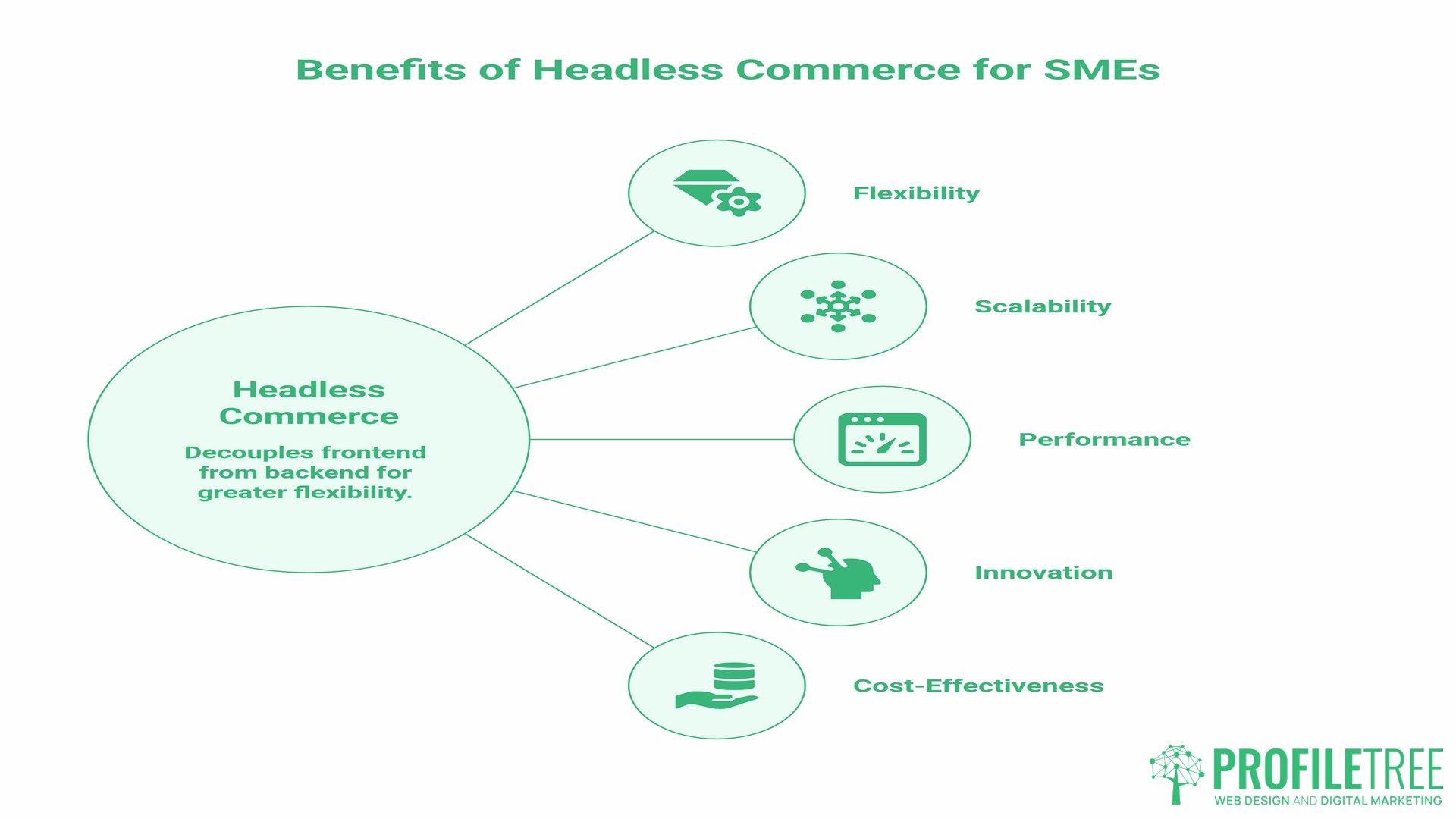
Traditional e-commerce platforms connect your storefront design directly to the backend system that manages products, orders, and payments. When you want to change how your site looks or add a new sales channel, you are often constrained by what the platform allows.
Headless commerce implementation separates these two layers. Your backend handles the commerce logic: product catalogues, checkout, inventory, and customer data. Your frontend, the part your customers see and interact with, is built independently and communicates with the backend through APIs (application programming interfaces). This separation means you can redesign your storefront, add new channels, or integrate new tools without touching the underlying commerce engine.
For SMEs, the question is not whether headless is technically superior. In most respects, it is. The question is whether the benefits are worth the additional complexity and cost at your current stage of growth.
Headless commerce implementation tends to deliver the most value when a business is selling across multiple channels (website, app, in-store, marketplaces) and needs consistent experiences across all of them, when page speed and mobile performance are directly affecting conversion rates, or when the marketing team needs to move faster than the platform allows.
If you are running a straightforward single-channel store with a manageable product range, your current platform may serve you well for several years yet.
The Technical Architecture Behind Headless Commerce Implementation
Understanding the basics of how a headless system is structured helps you have better conversations with developers and make more informed decisions about platforms and costs.
Separation of Frontend and Backend
In a traditional system, the frontend and backend are tightly coupled. A change to the product page template might require backend development work. In a headless setup, the frontend is an entirely separate application, often built with a modern JavaScript framework such as Next.js or Nuxt.js, that pulls data from the backend via API calls. Your designers and frontend developers can work on the customer experience without touching the commerce logic.
API-Driven Interactions
APIs are the communication layer between your frontend and backend. When a customer visits your product page, the frontend sends an API request to the backend, retrieves the product data, and renders it. This happens very quickly and allows different frontends (a website, a mobile app, a voice interface) to use the same backend data without duplication.
Microservices and Scalability
Many headless implementations use a microservices approach, where different functions (search, checkout, recommendations, payments) are handled by separate, specialised services rather than one monolithic system. This means you can scale individual components independently. During a product launch, for example, you could scale your checkout service to handle increased demand without scaling the entire platform, which is more cost-effective.
ProfileTree’s web development team works with clients to assess which architecture fits their current technical capability and growth trajectory before recommending a platform or approach. If you are considering how we approach these projects.
Three Headless Commerce Case Studies: What Happened When Brands Made the Switch
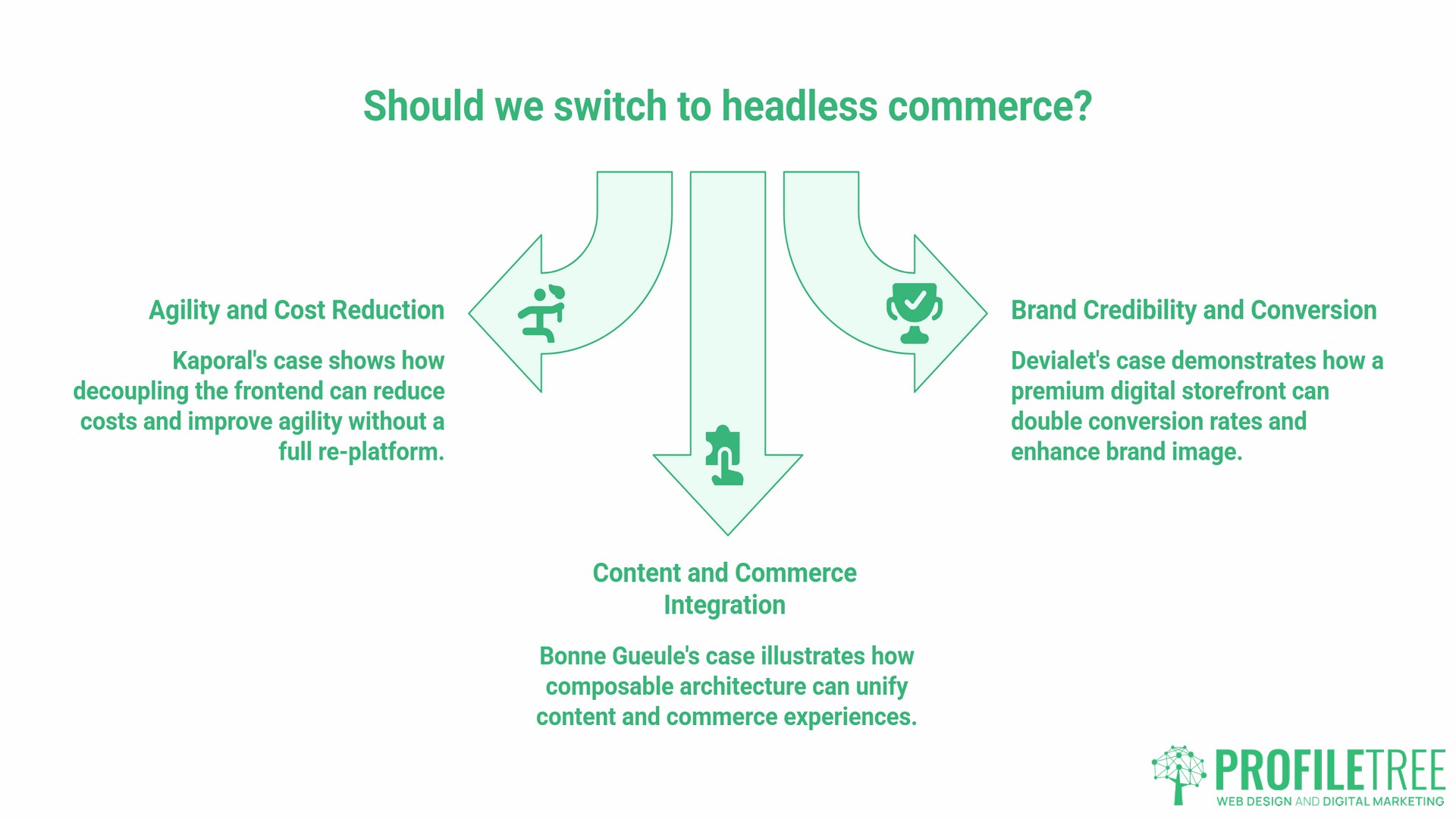
These three cases are among the most cited examples in discussions of headless commerce. All three brands worked with Front-Commerce, a headless frontend-as-a-service platform built for Magento. They illustrate different motivations for switching and outcomes, making them useful for SMEs trying to identify which scenario best matches their situation.
Kaporal: Agility and a 60% Drop in Bounce Rate
Kaporal is a French denim brand that has been running its e-commerce operation on Magento 1. As the platform aged, security vulnerabilities mounted, and the cost of frontend changes grew. A complete platform overhaul was the obvious answer, but also a long, expensive, and risky one.
Instead, Kaporal decoupled its frontend from its Magento backend using Front-Commerce, migrating to a Progressive Web App (PWA) standard frontend while keeping its backend operations stable. The approach reduced migration costs by a factor of five and cut time-to-market by a factor of four compared to a full platform rebuild, according to Front-Commerce’s published case study.
The results measured after nine months showed a 60% drop in bounce rate across all devices, a 15% increase in conversion rate on desktop, and an 8% increase on mobile. Page views per session rose 40% and session duration increased by 8%, indicating that faster load times led to more browsing rather than quicker exits.
What this means for SMEs: If your current platform makes frontend changes slow, expensive, or dependent on a full development cycle, Kaporal’s approach demonstrates how decoupling the frontend can restore operational agility without the risk of a full re-platform.
Devialet: Doubling Conversion Rate in 16 Weeks
Devialet is a French audio technology company that sells high-end speakers and amplifiers to consumers in 37 countries. By 2020, their website was technically functional but no longer reflected the brand’s premium nature. Mobile performance was particularly poor, and the existing architecture made it difficult to iterate on the frontend without affecting backend stability.
Working with development partner PH2M, Devialet migrated from Magento 1 to Magento 2 and implemented a headless frontend through Front-Commerce. The results were measurable within 16 weeks of launch: conversion rate doubled (a 100% increase), bounce rate fell by 25%, and their Google Lighthouse performance score rose from 70 to 95. The brand’s own head of e-commerce, Benjamin Braillon, noted that the results exceeded expectations and that further improvement was still possible, particularly on mobile.
What this means for SMEs: For businesses where the product itself is a premium purchase, a digital storefront that does not reflect that quality actively costs sales. Devialet’s headless commerce implementation addressed a brand credibility problem with measurable commercial outcomes. This is particularly relevant for Northern Irish and Irish craft, food, drink, and lifestyle brands competing for attention in UK and international markets.
Bonne Gueule: Merging a Media Site and an E-Commerce Store
Bonne Gueule is a French menswear brand that started as a fashion editorial website before adding e-commerce. Their brand proposition depends on content: detailed guides to fabric, fit, and style sit alongside the products they sell. The challenge was that their content platform and shop operated as separate systems, which created friction in the customer journey and limited what was technically feasible.
Working with digital agency Antadis, Bonne Gueule migrated from PrestaShop to Magento 2 and adopted a composable architecture that combines Front-Commerce as the headless frontend, Prismic as the headless CMS, and Algolia as the search layer connecting editorial content and the product catalogue. This allowed their editorial and commerce experiences to be unified in a single, fast, flexible frontend.
No specific post-launch conversion metrics have been publicly disclosed for Bonne Gueule. What the case documents is the architectural outcome: a platform where content and commerce can now be managed, updated, and iterated on independently without requiring a full system overhaul each time.
What this means for SMEs: If your business relies on content marketing to drive sales and you find that your content platform and shop are pulling in different directions, the Bonne Gueule approach shows how composable architecture can resolve that conflict. ProfileTree’s content marketing services are built on exactly this kind of integration between editorial strategy and commercial outcomes.
Headless Commerce Implementation in the UK and Ireland: The Context That Enterprise Case Studies Miss
The three cases above all involve European brands with dedicated development teams and substantial technology budgets. The headless commerce conversation for UK and Irish SMEs has some additional dimensions that rarely appear in enterprise guides.
Multi-Currency and Post-Brexit Complexity
UK businesses selling into EU markets, or Irish businesses selling across both jurisdictions, face multi-currency requirements, VAT complexities, and logistics considerations that US-centric case studies do not address. A headless implementation can make it considerably easier to deliver localised experiences (different pricing, different payment methods, different promotional content) from a single backend, which is a genuine operational advantage for businesses operating across the UK-Ireland border or into European markets.
Integration with UK and Irish Business Systems
Most UK and Irish SMEs already have accounting systems (Sage, Xero, FreeAgent), stock management tools, and logistics arrangements in place. A headless commerce implementation needs to integrate with these systems via APIs. This requires planning and development time. The key question to ask any developer or agency is not just “can you build the headless frontend?” but “how will this connect to our existing back-office systems?”
The Developer Dependency Question
One concern SME owners raise consistently is whether a headless system makes them more dependent on specialist developers for ongoing changes. The honest answer is: initially, yes. The frontend of a headless system typically requires expertise in React or Next.js, which is more specialised than WordPress or Shopify theme editing. Over time, as headless CMS platforms improve their editing interfaces, marketing teams can manage more content independently. The initial setup and ongoing development relationship needs to be factored into your cost calculations before committing.
Is Headless Commerce Implementation Right for Your Business? A Readiness Framework
Before committing to a headless commerce implementation, work through these five questions honestly.
1. Are you selling across more than one channel? If you sell through your website, a mobile app, a marketplace, and in-store, and each channel requires a different presentation of the same product data, headless is likely worth considering. If you sell through only one website, the added complexity may not be justified yet.
2. Is page speed directly affecting your conversion rate? Run your current site through Google’s PageSpeed Insights or Core Web Vitals reporting. If your mobile score is consistently below 50 and your mobile abandonment rate is high, performance improvements from a headless frontend could have a measurable commercial impact.
3. Does your marketing team need to move faster than your current platform allows? If every landing page, promotional banner, or product feature requires a development ticket and a waiting period, that operational constraint has a cost. Headless commerce implementation can shift content control back to the marketing team once the initial build is complete.
4. Do you have, or can you access, frontend development expertise? A headless build requires developers comfortable with modern JavaScript frameworks. If you do not have this in-house, you need a development agency with proven headless experience. ProfileTree’s web development team has worked with businesses across Northern Ireland, Ireland, and the UK on e-commerce builds and can advise on whether a headless approach fits your specific situation.
5. Can your budget absorb a three-to-six-month implementation project? A realistic headless commerce implementation for an SME typically takes three to six months from discovery to launch, depending on the complexity of your product catalogue, the number of integrations required, and whether you are migrating from an existing platform or building fresh.
Headless Commerce vs Traditional Commerce: What the Numbers Tell You
The decision between headless and traditional architecture involves trade-offs that look different at different stages of business growth.
| Factor | Traditional (Monolithic) | Headless Commerce |
|---|---|---|
| Initial build cost | Lower | Higher |
| Time to launch | Faster | Slower (3 to 6 months typical) |
| Design flexibility | Limited by platform | Near-unlimited |
| Page speed potential | Platform-dependent | High |
| Developer dependency | Lower ongoing | Higher initially |
| Multi-channel capability | Limited | Strong |
| Content and commerce integration | Restricted | Flexible |
| Long-term technical debt | Higher | Lower |
For most SMEs, a well-optimised Shopify or WooCommerce build will outperform a poorly executed headless implementation. The architecture is not the determining factor. The quality of implementation and the strategic clarity behind it drive results.
Common Pitfalls in Headless Commerce Implementation
Enterprise case studies focus on the wins. Understanding where headless implementations go wrong is more useful for a business making a significant investment decision.
Underestimating the Frontend Development Requirement
The most common error SMEs make is treating the headless frontend as a straightforward website build. It is not. A Next.js or Nuxt.js frontend requires developers who understand server-side rendering, API data fetching, caching strategies, and performance optimisation at a framework level. Hiring a generalist web developer and expecting them to build a production-quality headless frontend rarely ends well.
Neglecting the SEO Implications During the Build
Headless commerce implementation introduces SEO considerations that a traditional platform handles automatically. JavaScript rendering, canonical tag management, structured data implementation, and crawlability all require deliberate attention during the build. If your development team lacks specific experience with technical SEO in a headless context, you should involve an SEO specialist from the start of the project, not after launch. ProfileTree’s SEO services include technical SEO auditing and can be brought in at the architecture stage to prevent problems that are expensive to fix retrospectively.
Building a Headless CMS Without a Content Strategy
A headless CMS lets your team publish content across every channel from a single interface. That capability is only valuable if you have a content strategy that defines what to publish, where, and why. Several SMEs invested in headless infrastructure but found their marketing teams lacked the processes to use it effectively. The technology and the strategy need to develop together.
Skipping the Discovery and Planning Phase
A headless commerce implementation that starts with “let’s build it” rather than “let’s define the scope, the integrations, and the success criteria” consistently runs over time and budget. A proper discovery phase, typically four to six weeks, where you map your existing systems, define your API requirements, and agree on your tech stack, saves considerably more than it costs.
“Undertaking headless commerce is like navigating a ship through a storm. With precise planning and expert navigation, we can reach calmer waters and move ahead of the competition,” says Ciaran Connolly, ProfileTree Founder.
The Headless Commerce Tech Stack: What You Are Actually Choosing Between
Selecting the right components for a headless commerce implementation is not a single decision. You are choosing a backend commerce engine, a frontend framework, and a content management system, and all three need to work together.
Commerce Engines
Shopify Plus, with its Hydrogen framework, is the most accessible entry point for SMEs moving to headless. It gives you Shopify’s backend reliability (payments, inventory, shipping integrations) with full frontend freedom. Magento (now Adobe Commerce) is more powerful but considerably more complex and expensive to run. BigCommerce also offers strong headless support and is worth evaluating for mid-market businesses.
Frontend Frameworks
Next.js (built on React) is the most widely used framework for headless commerce frontends. It handles server-side rendering well, which is important for both performance and SEO. Nuxt.js is the equivalent for teams more comfortable with Vue.js. The choice here largely depends on your development team’s existing expertise.
Headless CMS Options
Contentful and Storyblok are the most commonly used headless CMS platforms in the UK and Irish SME contexts. Both offer strong API support and improved editorial interfaces that allow non-technical team members to manage content once the system is set up. Sanity.io is another strong option, particularly for teams that want more control over their content model.
The combination of Next.js, Shopify Plus, and either Contentful or Storyblok has become a common starting point for UK SME headless builds. It benefits from strong community support, good documentation, and a growing pool of developers with relevant experience.
Personalisation and AI in Headless Commerce Implementation
One of the clearest advantages of a headless commerce architecture is the ability to implement personalisation at a level that traditional platforms struggle to match.
Because the frontend is decoupled from the backend, you can integrate AI-powered recommendation engines, dynamic pricing tools, and behavioural targeting systems without waiting for your platform provider to build those features natively. The API-first architecture means that as personalisation tools improve, you can swap in better options without rebuilding your entire system.
For headless commerce personalisation implementation, the most practical starting points for SMEs are product recommendation engines based on browsing and purchase history, dynamic landing pages that adapt content based on traffic source or customer segment, and personalised email sequences triggered by on-site behaviour.
These capabilities are considerably easier to execute and iterate on within a headless architecture than within a traditional monolithic platform. ProfileTree’s AI implementation services cover the integration of AI tools into existing and new digital infrastructure, including e-commerce environments.
The Implementation Roadmap: Moving from Your Current Platform to Headless
If you have worked through the readiness questions above and decided to proceed, this overview provides a realistic look at what a headless commerce implementation project involves for an SME. ProfileTree’s web design team explains the key concepts and decisions behind modern web architecture in plain terms, offering a useful starting point before committing to platform discussions.
Phase 1: Discovery and Planning (Four to Six Weeks)
Map your current system: what platform are you on, what integrations do you have, what content exists, and what are your performance benchmarks? Define your tech stack. Agree on success criteria (target page speed scores, conversion rate baseline, and so on). This phase should result in a scoped technical specification.
Phase 2: Backend Configuration (Two to Four Weeks)
Set up and configure your chosen commerce engine. Migrate product data, configure payment gateways, set up inventory management, and test all API endpoints. This phase runs in parallel with the early stages of frontend development.
Phase 3: Frontend Build (Eight to Twelve Weeks)
Design and build the decoupled frontend. This is the longest phase and involves the most back-and-forth between designers, developers, and the client team. SEO configuration, performance testing, and content entry all happen during this phase.
Phase 4: Integration and Testing (Two to Three Weeks)
Connect all third-party systems (CRM, email platform, analytics, accounting software). Load test the platform. Run through checkout flows, edge cases, and mobile experiences systematically.
Phase 5: Launch and Optimisation (Ongoing)
Launch with a monitoring period. Track Core Web Vitals, conversion rates, and any API errors. Plan your first round of post-launch improvements based on real user behaviour data.
Total timeline for a typical SME headless commerce implementation: three to six months from project kick-off to launch.
Working with ProfileTree on Headless Commerce Implementation
ProfileTree is a web design and development agency based in Belfast, Northern Ireland. Since 2011, the team has delivered web projects for businesses across Northern Ireland, Ireland, and the UK, ranging from service business websites to e-commerce builds for product companies selling domestically and internationally.
Our web development services include technical consultation on platform selection and architecture, as well as full-build headless commerce implementation projects. If you are at the early stages of evaluating whether headless is right for your business, the most useful starting point is a conversation about where your current platform is limiting you and what your growth plans look like over the next two to three years.
For businesses not yet at the headless stage, our e-commerce web design work covers optimised Shopify and WooCommerce builds that deliver strong performance without the additional complexity. You can find out more about our approach to web design for growing businesses.
FAQs
Is headless commerce more expensive for SMEs?
The upfront cost of a headless commerce implementation is higher than a standard Shopify or WooCommerce build, typically by a factor of two to three times. However, the long-term technical debt on a traditional platform, the cost of workarounds, and the limitations on what you can build without further investment often make headless more cost-effective over a 3- to 5-year horizon. The right answer depends on your current platform’s limitations and your growth trajectory.
How long does a headless implementation take?
For an SME, a realistic timeline is three to six months from discovery to launch. Simpler implementations with limited integrations can be done in three months. Complex builds involving multiple third-party integrations, large product catalogues, or significant data migration will take longer. Front-Commerce, which powered the Kaporal and Devialet implementations above, notes that a progressive deployment approach can reduce initial time-to-value to as little as 16 weeks for well-scoped projects.
Do I need a separate developer for headless?
You need a developer with frontend framework experience (React or Next.js, primarily) that goes beyond standard WordPress or Shopify theme development. This is either a specialist hire or, more practically for most SMEs, an agency or freelancer with a proven headless commerce implementation track record.
Can I use Shopify for headless commerce?
Yes. Shopify Plus with Hydrogen (Shopify’s own React-based framework) is one of the most accessible headless commerce implementation options for growing e-commerce businesses. You retain Shopify’s backend infrastructure, which handles payments, inventory, and shipping reliably, while building a fully custom frontend.
What is the main benefit for UK retailers specifically?
Site speed and multi-channel flexibility are the two most commonly cited benefits. For UK retailers selling into Ireland and EU markets, the ability to deliver localised experiences (currency, language, VAT-inclusive pricing) from a single backend is a significant operational advantage that headless commerce implementation handles better than most traditional platforms.
What distinguishes a headless platform from a traditional e-commerce system?
In a traditional system, the frontend and backend are coupled, meaning changes to one often affect the other. In a headless setup, the two are completely separate and communicate only through APIs. This gives development teams the freedom to update, redesign, or replace the frontend without disrupting the commerce engine, and vice versa.
How does headless commerce differ from composable commerce?
Headless commerce refers specifically to the decoupling of frontend and backend. Composable commerce extends this further by treating every component of the e-commerce stack (search, checkout, recommendations, CMS, payments) as independently selectable and replaceable services. Composable commerce is a more advanced architectural approach that typically suits businesses with dedicated platform engineering teams, as Bonne Gueule’s implementation above illustrates.