
Tools in a Modern MarTech Stack: A Practical Guide for UK and Irish SMEs
Table of Contents
Tools in a Modern MarTech Stack: most marketing managers in Northern Ireland and across the UK arrive at one the same way, one tool at a time, under pressure. A CRM here, an email platform there, a social scheduling tool someone added two years ago that nobody quite remembers why. By the time they step back and look at the full picture, they are paying for seven or eight subscriptions that do not talk to each other, and a team using maybe half of what is available.
That is the real MarTech problem for SMEs in 2026. Not a shortage of tools. An excess of them, poorly integrated, with training gaps that mean the investment never delivers what it should.
This guide takes a different approach. Rather than listing every software category, it explains what a lean, well-integrated MarTech stack looks like for a small or mid-sized business: which pillars genuinely matter, how to audit what you already have, and where the biggest compliance risks sit for UK- and Irish-based businesses operating under GDPR.
What Is a MarTech Stack and Why Does It Matter?
A MarTech stack (short for marketing technology stack) is the collection of software tools a business uses to plan, execute, and measure its marketing activity. It typically covers everything from the CRM that stores customer data to the analytics platform that tells you whether your campaigns are working.
The term was popularised by Scott Brinker, who began cataloguing the marketing technology landscape in the early 2010s. At that point, there were a few hundred tools. Today, the number runs into the thousands, spanning categories that didn’t exist five years ago.
For SMEs, that growth creates a specific challenge: the tools designed for enterprise marketing teams (with dedicated data scientists, marketing operations staff, and integration budgets) are being sold to businesses with a single person managing the entire digital function. The result is either underuse, where expensive platforms sit largely untouched, or overcomplication, where too many disconnected tools create data silos rather than solve them.
The goal of a well-built MarTech stack is not sophistication for its own sake. It is the ability to understand your customers, reach them with the right message, and measure whether it worked, without needing a technical team to manage the infrastructure.
The 5 Core Pillars of a Modern MarTech Stack
The most useful way to think about a MarTech stack is in functional layers. Each pillar has a specific job. If you are missing one, the others become less effective. If you have duplicates across a single pillar, you are almost certainly wasting budget.
1. Data and Identity
Everything in a modern stack depends on clean, connected customer data. The data pillar includes your CRM, any customer data platform (CDP) you use, and the consent management tools that govern what you can do with the information you collect.
A CRM is the starting point for most SMEs. It stores contact records, tracks interactions, and gives your sales and marketing teams a shared view of the customer relationship. Common choices at the SME level include HubSpot, Zoho CRM, and Pipedrive. The right choice depends on your sales process, not on which platform has the longest feature list.
CDPs are a step up from CRMs. Where a CRM tracks individual contacts and deals, a CDP collects behavioural data from multiple sources (your website, email campaigns, paid advertising, and offline touchpoints) and creates a unified customer profile. For most SMEs, a CDP is only necessary once you are running meaningful activity across three or more channels and need a single source of truth to tie them together.
For UK and Irish businesses, this pillar also carries compliance requirements that go beyond tool selection. Any platform processing the personal data of UK or EU residents must meet GDPR requirements, regardless of where the platform vendor is based. Data residency (where your data is physically stored) matters, particularly for businesses in regulated sectors or those working with public-sector clients. This is discussed further in the compliance section below.
2. Content and Experience
Your content pillar handles how you create, manage, and publish the material your audience interacts with. This includes your content management system (CMS), any digital asset management tools, and the platforms you use for email, social, and other owned channels.
For most SMEs, WordPress remains the CMS of choice because it balances flexibility with manageability. A well-configured WordPress build with proper SEO foundations, clear site structure, and connected analytics gives a small marketing team everything they need to publish and measure content without developer support for routine tasks. ProfileTree, a Belfast-based web design and digital marketing agency, builds and maintains WordPress sites for SMEs across Northern Ireland, Ireland, and the UK, and the most common issue encountered during audits is a CMS that was set up without SEO or analytics integration from the start, meaning data is fragmented from day one.
Email platforms sit within this pillar rather than the automation pillar because the content itself (the copy, design, and messaging) is a content function. The automation rules that govern when emails are sent belong to the next layer.
3. Automation and Orchestration
This is where your stack starts doing things without human input for every step. Marketing automation platforms take the data from your CRM and content activity and use it to trigger communications, score leads, and move contacts through journeys based on their behaviour.
At the SME level, tools like ActiveCampaign, Mailchimp with automation features, or HubSpot’s marketing hub cover the basics: welcome sequences, re-engagement campaigns, lead nurture flows, and simple CRM updates triggered by website behaviour.
The AI layer that sits within modern automation tools deserves specific attention. Most mid-tier platforms now include AI features for subject line optimisation, send-time prediction, and content personalisation. These features are often already included in subscriptions that SMEs pay for but don’t use. Before purchasing additional AI tools, it is worth auditing what is already available within your current automation platform.
AI implementation for SMEs is one of the areas where ProfileTree delivers structured training and consultancy. The most common finding is not that businesses lack access to AI tools; rather, their teams have not been trained to configure or interpret them. A workflow that runs but produces irrelevant outputs is not an automation; it is noise.
4. Conversion
The conversion pillar covers the tools that turn interest into action. This includes landing page builders, A/B testing tools, heatmapping software, and live chat or chatbot platforms.
Conversion rate optimisation (CRO) is frequently treated as a specialist discipline separate from the main marketing function, but at the SME level, it is simply good web practice. Understanding where visitors drop off, which calls to action get clicked, and how different page layouts affect form completions requires tools, but not complicated ones. Microsoft Clarity is free. Hotjar has a functional free tier. Google Optimise has been discontinued and replaced with server-side testing options, but most WordPress-based sites can achieve meaningful CRO work with Clarity and Google Analytics 4 alone.
The connection between CRO tools and your wider stack matters. If your heatmapping and analytics data live on different platforms with no shared user identifier, the insights from each are limited. This is where the data pillar’s investment pays off.
5. Measurement and Attribution
The measurement pillar tells you what is working. Google Analytics 4 is the standard starting point for web analytics. Paired with Google Search Console, it gives you a clear picture of organic search performance, user behaviour on site, and conversion paths.
Attribution (understanding which touchpoints in the customer journey deserve credit for a conversion) becomes relevant once you are running activity across multiple channels simultaneously. For most SMEs running SEO, email, and perhaps paid social, a simple last-click or linear attribution model in GA4 is sufficient. Multi-touch attribution modelling requires more data volume and more sophisticated tooling than most SMEs need or can support.
The shift to first-party data measurement is worth understanding regardless of business size. Third-party cookies are effectively finished across most browsers. Building a measurement approach that relies on your own data (form submissions, logged-in user behaviour, email engagement) rather than third-party tracking is both a compliance position and a practical one.
| Pillar | Primary Function | Common SME Tools | Where SMEs Most Often Under-Invest |
|---|---|---|---|
| Data and Identity | Customer records, unified profiles, consent | HubSpot CRM, Zoho, Pipedrive | Consent management and data hygiene |
| Content and Experience | CMS, email, digital assets | WordPress, Mailchimp, Canva | SEO integration at the CMS level |
| Automation | Lead nurture, triggered comms, AI features | ActiveCampaign, HubSpot Marketing | Training on existing features |
| Conversion | Landing pages, CRO, live chat | Clarity, Hotjar, Intercom | Testing and iteration discipline |
| Measurement | Analytics, attribution, reporting | GA4, Google Search Console | Attribution modelling and data connection |
The UK and Ireland Compliance Layer
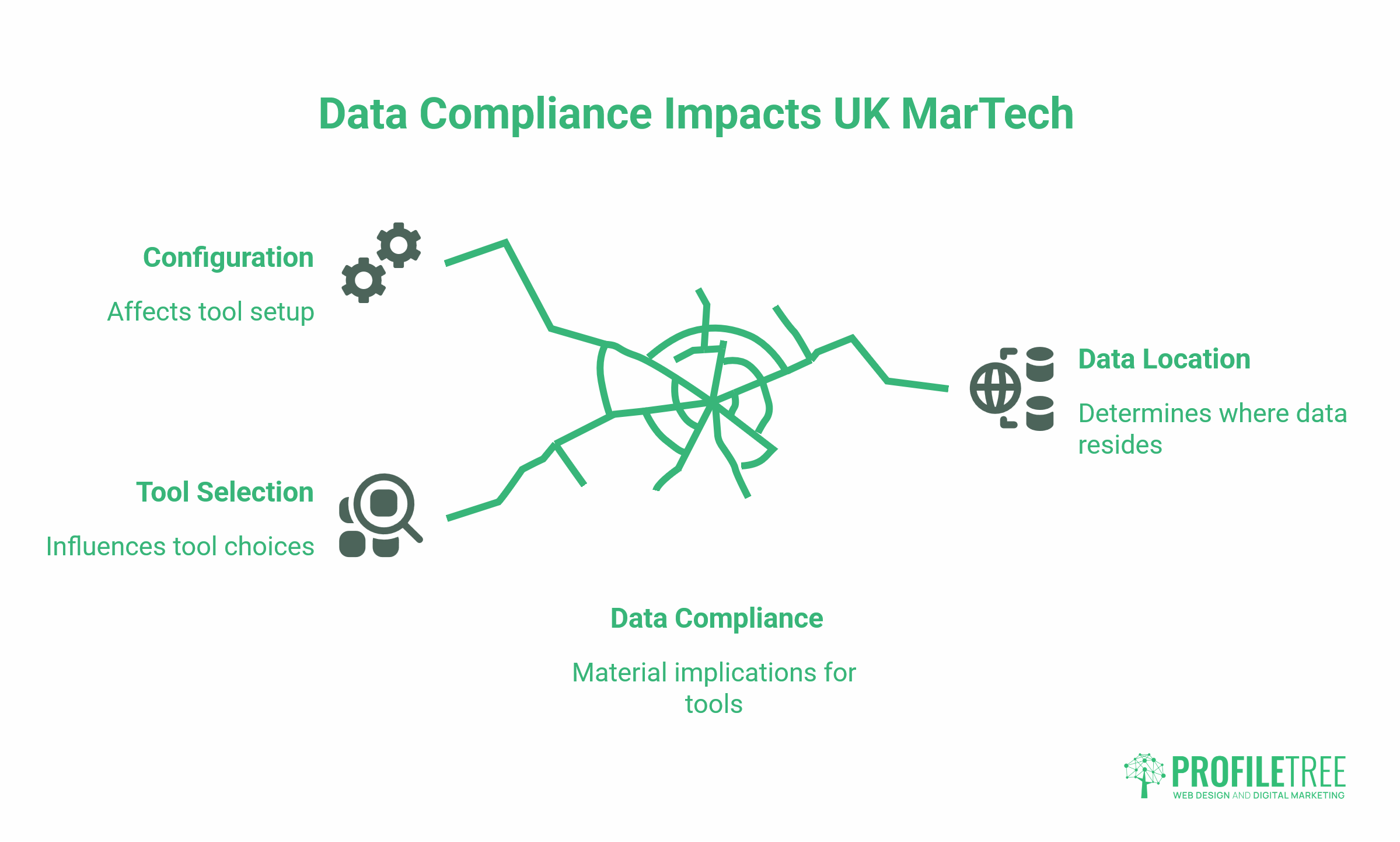
This is the section that US-centric MarTech guides consistently leave out. For businesses in the UK and Ireland, data compliance is not a box-ticking exercise; it has material implications for which tools you can use, how you configure them, and where your customer data lives.
GDPR for UK businesses: The UK operates under UK GDPR, which retained the substance of the EU regulation post-Brexit. Any tool that processes the personal data of UK residents must have a lawful basis for processing, a data processing agreement with the vendor, and clear data retention policies. This applies to your CRM, your email platform, your analytics tools, and any third-party integrations that receive customer data.
GDPR for Irish and EU businesses: Businesses operating in the Republic of Ireland remain subject to EU GDPR, enforced by the Data Protection Commission. The DPC has been notably active in enforcement, particularly against large platform providers. Irish businesses using US-based SaaS tools must have standard contractual clauses (SCCs) in place for any international data transfers.
Data residency: Some sectors (financial services, healthcare, public sector) face requirements or strong contractual expectations around where data is stored. The choice between a vendor with an EU data centre in Dublin or Frankfurt, versus a US-controlled cloud region with EU nodes, is not trivial for these clients. When evaluating MarTech tools, the data processing agreement and data residency options are not afterthoughts; they are part of the procurement decision.
Consent management: Any website collecting data through cookies, analytics, or tracking pixels needs a consent management platform (CMP) that meets the ICO’s requirements (UK) or the DPC’s guidance (Ireland). A cookie banner that does not offer genuine opt-out choices is non-compliant regardless of what the tool vendor claims.
For SMEs unsure whether their current stack is compliant, a digital strategy audit is the logical starting point. ProfileTree works with businesses across Northern Ireland and Ireland to review their existing tool configurations and identify where data-handling processes need updating.
How to Audit Your Existing Stack
Most SMEs do not need a new MarTech stack. They need a clearer picture of what they already have and a plan to use it better.
A stack audit is straightforward in principle: list every tool you pay for, map it to one of the five pillars, and ask three questions about each one.
Step 1: Inventory. List every tool, subscription, or platform your marketing function touches. Include tools that live in other departments but produce data that flows into marketing: your e-commerce platform, your booking system, your telephony provider if calls are tracked.
Step 2: Map to pillars. Assign each tool to one of the five functional layers above. Any pillar with no tools is a gap. Any pillar with three or more tools doing similar things is a consolidation opportunity.
Step 3: Assess utilisation. For each tool, estimate what percentage of available features your team actually uses. A platform used at 20% of its capability for three years is not a tool problem – it is a training problem.
Step 4: Check integrations. Where does data move automatically between tools, and where does someone have to export a CSV and re-upload it? Every manual data transfer is a source of errors, delays, and staff time costs.
Step 5: Review contracts and costs. Note renewal dates, contract lengths, and whether pricing has changed since the original purchase. Calculate the monthly stack cost and divide it by the number of active users.
Ciaran Connolly, founder of ProfileTree, sees this pattern regularly: “The businesses that get the most from their marketing technology are not the ones with the most tools; they are the ones where someone actually understands what each tool is supposed to do and has trained the team to use it. An underused CRM and a disconnected analytics setup will cost you more in missed opportunities than any subscription fee.”
The output of an audit is a prioritised list: tools to keep, tools to consolidate, integrations to build, and training gaps to address. That list is more valuable than any vendor comparison article.
ProfileTree’s digital training services cover MarTech platform training as part of broader digital marketing upskilling for SME teams in Northern Ireland and across the UK.
MarTech Stack Blueprints for UK and Irish SMEs
There is no universal stack. What works for a 200-person B2B software company will not be appropriate for a 12-person professional services firm or a family-run e-commerce business. The following are realistic starting points, not prescriptions.
Professional services (10 to 50 staff): CRM with pipeline tracking, a WordPress CMS with SEO integration, an email marketing platform with basic automation, Google Analytics 4 with Search Console, and a simple LinkedIn scheduling tool. Five tools, all with clear ownership, all integrated at the data level. Training for two or three staff on each platform.
E-commerce (product-based, UK/Ireland focused): WooCommerce or Shopify as the platform and CMS simultaneously, an email platform with abandoned cart and post-purchase automation, GA4 with e-commerce tracking properly configured, and a heatmapping tool for CRO work on product and checkout pages. GDPR-compliant cookie consent is non-negotiable for any UK or Irish e-commerce site collecting analytics data.
B2B with longer sales cycles: A more capable CRM with lead scoring, marketing automation for multi-touch nurture sequences, content analytics to track which assets influence deal progression, and a clear attribution model that accounts for the full length of the sales cycle. This is the profile where a CDP starts to justify its cost.
In each case, the most common advice ProfileTree gives to SMEs reviewing their stack is the same: invest in training and integration before investing in additional tools.
Where AI Fits Into Your Stack
AI features are now embedded across virtually every category of MarTech tool. The question for most SMEs is not whether to use AI in their marketing technology (they almost certainly already are) but whether they are using it intentionally.
The practical AI use cases that are genuinely accessible to SMEs without specialist technical resources include: predictive send-time optimisation in email platforms, AI-assisted subject line and copy suggestions, automated tagging and scoring of leads in CRM systems, and AI-generated content briefs or drafts within content management workflows.
The risk is tool proliferation. The 2024 to 2025 period saw an explosion in AI-specific MarTech tools, many of which replicate functionality that already exists in platforms SMEs are paying for. Before adding an AI writing tool, an AI ad copy generator, and an AI analytics layer as separate subscriptions, it is worth checking what the existing stack already offers.
A structured approach to AI implementation – understanding which tools offer what capabilities, how to configure them, and how to measure whether they are working – is more valuable than adding AI tools speculatively. ProfileTree’s AI training and implementation work for SMEs directly addresses this, helping businesses get usable results from the AI features already embedded in their existing platforms.
For a broader view of how real-time AI fits into marketing analytics decisions, see the ProfileTree guide to real-time analytics with AI.
Measuring the ROI of Your MarTech Stack
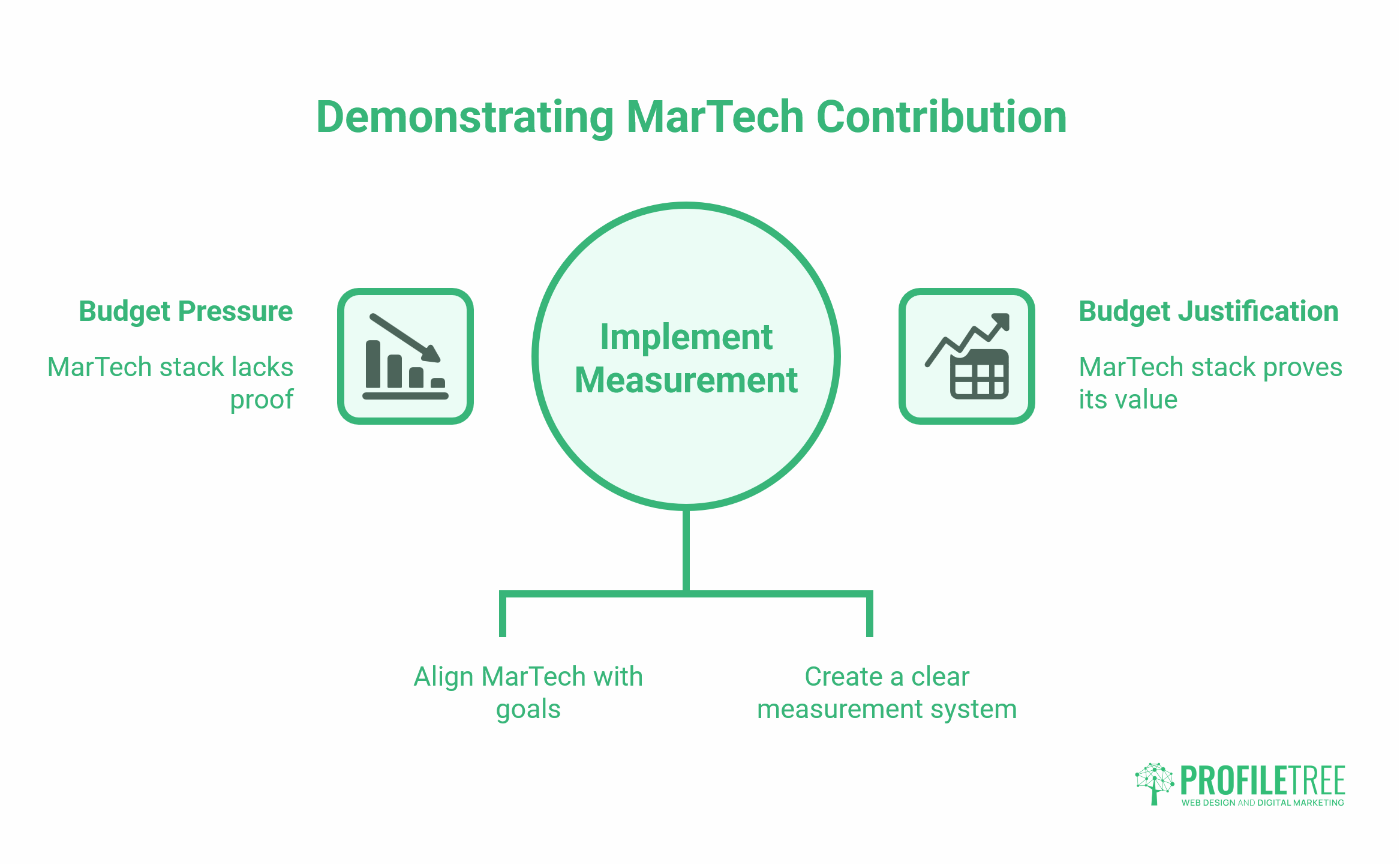
A MarTech stack that cannot demonstrate its contribution to business outcomes will always be under pressure at budget time. The measurement approach does not need to be complicated, but it does need to exist.
Start with the question: what is this tool supposed to make happen? For a CRM, it might mean fewer leads falling through the cracks or faster response times to enquiries. For an email automation platform, it might be revenue attributed to automated sequences, or the conversion rate of nurtured leads versus cold contacts. For analytics tools, it is the speed and quality of the decisions they enable.
Tracking these outcomes requires that the tools are properly configured from the start. A CRM with incomplete contact records cannot tell you your lead conversion rate. An email platform where automations have never been tested cannot tell you which sequences drive the most revenue.
The marketing analytics and ROI guide on the ProfileTree site covers the measurement frameworks that help SMEs turn platform data into commercial decisions.
Building a Stack That Actually Works: Tools in a Modern MarTech Stack
The MarTech industry has a vested interest in convincing businesses they need more tools. The reality for most SMEs in Northern Ireland, Ireland, and the UK is the opposite: fewer tools, better integrated, with a team trained to use them properly, will outperform a sprawling stack that nobody fully understands.
If every pillar is covered and data flows between tools without manual intervention, the stack is doing its job. If one pillar has three overlapping tools and another has none, that is where the audit starts.
ProfileTree works with SMEs across Northern Ireland, Ireland, and the UK on digital marketing strategy and training, including how to get measurable results from the marketing technology already in place.
FAQs
What are the main components of a MarTech stack?
The five layers are: data and identity; content and experience; automation; conversion; and measurement. A capable CRM and well-configured CMS often cover multiple functions adequately for SMEs.
How many tools should a UK SME have in its MarTech stack?
Five to eight well-integrated tools covering all five pillars will outperform fifteen loosely connected ones. The question is not how many tools you have, but how well data flows between them and how well the team is trained to use them.
How do I make my MarTech stack GDPR compliant?
Every tool processing personal data of UK or EU residents needs a data processing agreement with the vendor, a compliant consent management platform on your website, and clear data retention policies. For US-based platforms, confirm standard contractual clauses are in place for international data transfers.
Is a best-of-breed stack better than a single-vendor suite?
For most SMEs without a dedicated marketing operations resource, a capable single-vendor suite is more practical. Best-of-breed gives stronger individual tools but requires significantly more integration work to maintain.