
How To Use Psychology in Marketing: The Complete Expert Guide
Table of Contents
Every purchasing decision follows predictable patterns, even when customers believe they’re acting spontaneously. Psychology in marketing examines the cognitive processes, emotional drivers, and behavioural patterns that influence how people respond to brands, evaluate products, and make buying decisions. For business owners and marketing managers across the UK, Ireland, and Northern Ireland, these insights translate directly into commercial outcomes—higher conversion rates, stronger customer relationships, and more efficient marketing spend.
ProfileTree has spent over a decade applying psychology in marketing across web design, content marketing, SEO, and digital strategy for businesses throughout Belfast, Dublin, and the broader UK market. We’ve seen how psychology-informed approaches transform underperforming websites into conversion engines, converting sceptical prospects into loyal customers. This isn’t about manipulation—it’s about understanding why your ideal customer hesitates at checkout, what reassurance they need before booking a consultation, and which information they require to feel confident in their decision.
This guide walks you through the psychological triggers that drive marketing success, the ethical frameworks that ensure compliance with UK regulations, and the practical implementation strategies that turn theory into measurable business growth. The human brain has remained essentially unchanged for thousands of years, but the digital landscape has undergone a dramatic transformation. Successful psychology in marketing bridges this gap—using timeless psychological principles within modern digital contexts to create experiences that feel intuitive, trustworthy, and valuable.
What is Marketing Psychology?
Marketing psychology applies principles from behavioural science, cognitive psychology, and neuroscience to understand and influence how people interact with brands, products, and services. Rather than relying on guesswork or broad demographic data, this approach examines the underlying mechanisms that drive human behaviour—the emotional triggers, cognitive shortcuts, and subconscious patterns that shape purchasing decisions.
ProfileTree has worked with businesses across Northern Ireland, Ireland, and the UK to implement psychology-informed strategies in web design, content marketing, and digital campaigns. These principles apply whether you’re optimising a WordPress site for conversions, developing video content that resonates emotionally, or training your team to use AI tools more effectively.
The science reveals that humans rarely make purely rational decisions. Even in B2B contexts, emotion plays a significant role. People buy from brands they trust, choose products that make them feel confident, and avoid options that create confusion or anxiety. Marketing psychology helps you design experiences that align with these natural tendencies.
Why Psychology Matters in Marketing
Business owners often invest heavily in visibility—such as SEO rankings, paid advertising, and social media reach—only to watch potential customers arrive and leave without converting. The missing piece isn’t traffic; it’s understanding what happens between the first click and the final decision.
Beyond Surface-Level Engagement
Traditional marketing metrics tell you what happened. Psychology tells you why. When bounce rates are high, psychological principles help identify whether visitors face cognitive overload, unclear value propositions, or misaligned expectations. When conversion rates plateau, behavioural insights reveal friction points in your funnel.
ProfileTree’s approach to web design prioritises this psychological layer from the start. We don’t just build visually appealing sites; we craft experiences that naturally guide users toward desired actions. This means understanding how people scan pages, process information, and make decisions under different conditions.
The UK Market Context
British consumers exhibit distinct psychological profiles compared to those in other markets. Research consistently shows higher scepticism toward overt sales tactics and greater responsiveness to authority, expertise, and peer validation. This affects everything from the tone of your copy to the structure of your landing pages.
For businesses serving local markets in Belfast, Dublin, or Manchester, this cultural psychology becomes even more critical. Local trust signals, regional case studies, and community-focused messaging often outperform generic approaches. Understanding these nuanced preferences gives you an edge that generic marketing strategies miss entirely.
Risk Mitigation and ROI
From a business perspective, psychology-informed marketing reduces costly trial-and-error cycles. When you understand what drives decisions in your target market, you can predict which messages will resonate, which designs will convert, and which tactics will backfire. This directly translates to an improved return on marketing investment and a faster path to profitability.
“Psychology in marketing isn’t about tricking people into buying something they don’t need,” explains Ciaran Connolly, Director of ProfileTree. “It’s about understanding your customers so well that you can remove the obstacles between them and the solution they’re already looking for. That’s when marketing becomes genuinely helpful rather than intrusive.”
Key Psychological Triggers in Marketing
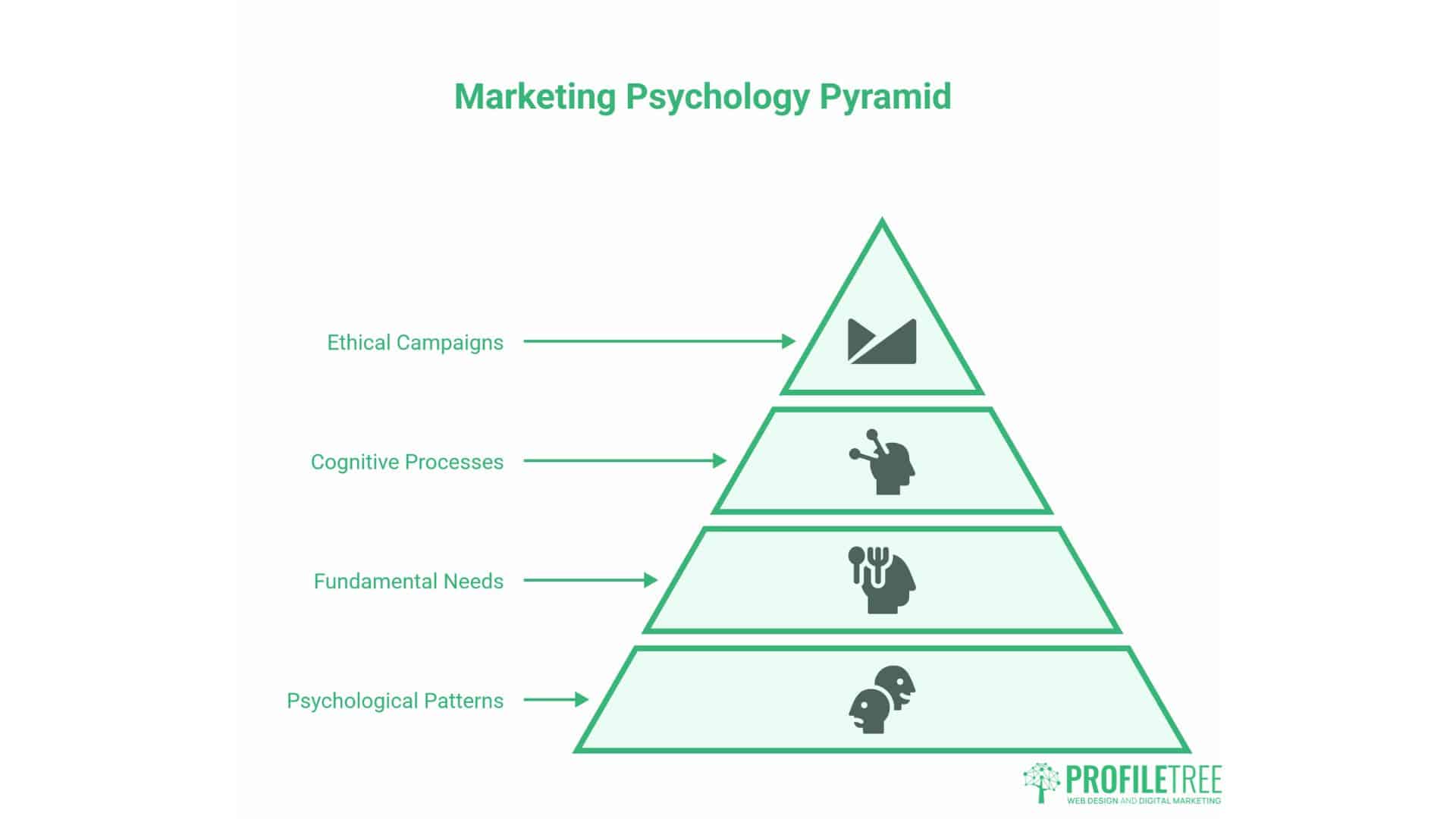
Effective marketing leverages specific psychological patterns that influence behaviour across contexts. These triggers are practical because they tap into fundamental human needs and cognitive processes that have evolved over thousands of years. Understanding them allows you to design campaigns that feel intuitive and persuasive without resorting to manipulation.
Desire for Acceptance and Validation
Humans are social creatures with deep-seated needs for belonging and acknowledgement. This drive shapes behaviour in subtle but powerful ways, from the brands we choose to the products we display publicly. Marketing that acknowledges this need creates stronger emotional connections and builds lasting loyalty.
Social proof represents the most direct application of this trigger. When potential customers see others like them using and endorsing your product, it validates their own consideration of the product. Testimonials, case studies, user reviews, and influencer partnerships all serve this function. For B2B companies, this might mean showcasing recognised corporate clients. For consumer brands, it could involve user-generated content campaigns.
ProfileTree’s video production services often incorporate customer testimonials precisely because they activate this trigger. Seeing a real business owner explain how web design improved their results carries more weight than any marketing claim. The key is authenticity—modern audiences quickly detect and reject fabricated endorsements.
Creating communities around your brand extends this principle further. Exclusive groups, loyalty programmes, and member forums give customers a sense of belonging that transcends individual transactions. When done well, these initiatives transform customers into advocates who validate your brand to their own networks.
Personalisation also serves this need by making individuals feel recognised and valued. When your email marketing references previous purchases, when your website remembers preferences, or when your content speaks directly to specific challenges, customers feel understood. This validation strengthens the relationship and increases lifetime value.
Fear of Missing Out (FOMO)
Loss aversion—the psychological principle that people feel losses more acutely than equivalent gains—underlies the effectiveness of FOMO. When potential customers believe they might miss an opportunity, urgency drives them to take action. However, this trigger requires careful handling to avoid damaging trust.
Genuine scarcity works powerfully. Limited-edition products, time-bound offers, and finite inventory all create genuine urgency. The crucial word is “genuine.” Fabricated scarcity breeds cynicism and can violate consumer protection regulations, particularly under UK trading standards.
Flash sales and countdown timers activate FOMO when they’re authentic. If you’re running a genuine 48-hour promotion, displaying a countdown adds pressure without deception. Businesses should avoid permanently displaying countdown timers that reset, as this tactic has been widely exposed and now signals a lack of trustworthiness.
Exclusive access functions similarly. Early-bird discounts, VIP previews, or member-only benefits create a sense of privileged access that drives sign-ups and purchases, for service-based businesses like digital agencies, limited consulting slots or seasonal capacity constraints represent genuine scarcity that can be communicated honestly.
Social FOMO works through showing others engaging with your offering. User counters (“47 people viewing this product”), recent purchase notifications, or trending indicators suggest demand without creating artificial pressure. This approach works particularly well for e-commerce and event-based businesses.
ProfileTree’s SEO services often help businesses rank for time-sensitive queries where FOMO naturally exists, such as “Black Friday deals,” “end of tax year planning,” and “summer course registrations.” Understanding when your audience experiences natural urgency allows you to align your marketing calendar accordingly.
Need for Ease and Convenience
Cognitive load refers to the mental effort required to process information and make decisions. Modern consumers face overwhelming choice and constant demands on their attention. Marketing that reduces this load wins customers by making their lives simpler.
Streamlined user experiences eliminate unnecessary steps between intention and action. For e-commerce, this means one-click purchasing, guest checkout options, and saved payment methods. For service businesses, it means clear pathways from the landing page to consultation booking. ProfileTree’s web development approach prioritises this simplicity, removing friction at every stage of the customer journey.
Decision fatigue occurs when individuals face an overwhelming number of choices. The paradox of choice suggests that beyond a certain point, more options decrease satisfaction and conversion rates. Innovative businesses curate their offerings, use recommendation engines, or create bundles that simplify decision-making.
Progressive disclosure presents information gradually, showing users only what they need at each stage rather than overwhelming them upfront. A complex B2B service might start with three simple packages before revealing customisation options. A SaaS product might introduce advanced features only after users master the basics.
Automation and time-saving tools add value beyond the core product. Subscription models eliminate repeat purchasing decisions. Intelligent recommendations reduce browsing time. Automated reminders prevent missed deadlines. These conveniences become differentiators in competitive markets.
Mobile optimisation matters increasingly as users expect seamless experiences across devices. When your website, booking system, or customer portal works flawlessly on smartphones, you remove a significant source of friction. ProfileTree’s WordPress development ensures responsive designs that maintain ease of use across all devices.
Dopamine-Driven Anticipation
The neurotransmitter dopamine doesn’t just reward us when we get something we want—it activates in anticipation of rewards. This creates marketing opportunities that generate excitement before the actual purchase or experience.
Product launches benefit enormously from building anticipation. Teaser campaigns, countdown announcements, and exclusive previews generate buzz that amplifies reach through organic sharing. Apple has mastered this approach, creating anticipation through carefully orchestrated reveal events.
Interactive experiences engage users actively rather than passively. Quizzes that lead to personalised recommendations, configurators that show customised products, or calculators that demonstrate potential savings all trigger dopamine through participation. These tools also gather valuable data about preferences and needs.
Gamification applies game design elements to non-game contexts. Points, badges, leaderboards, and progress bars tap into our intrinsic motivation for achievement. Loyalty programmes use this extensively, but it applies equally to onboarding processes, learning platforms, and community engagement.
Visual storytelling creates anticipation through narrative tension. Video content that poses questions, case studies that reveal results gradually, or before-and-after sequences all use this principle—ProfileTree’s video production and animation services often structure content to build anticipation and maintain engagement throughout.
Mystery and curiosity drive engagement when deployed strategically. Email subject lines that hint without revealing, social media teasers, or “coming soon” announcements all leverage the information gap theory—humans are compelled to close knowledge gaps once they’re aware of them.
Psychological Principles in Action
Understanding theory matters less than knowing how to apply it. The following principles translate psychological insights into practical marketing tactics that drive measurable results across digital channels.
Peer Influence and Social Proof
Social proof operates on the principle that people look to others for guidance when they are uncertain about decisions. This heuristic—or mental shortcut—helps us navigate complex choices by assuming that if others are doing something, it must be reasonable. Marketing that demonstrates widespread adoption reduces perceived risk and accelerates decision-making.
Customer testimonials are most effective when they’re specific and relatable. Generic praise (“Great service!”) carries little weight compared to detailed accounts that mention particular challenges and outcomes. Video testimonials prove particularly effective because they’re harder to fabricate and convey genuine emotion.
For businesses in Northern Ireland and the UK, featuring recognisable local companies or individuals adds credibility. A Belfast retailer benefits more from testimonials by other Belfast business owners than from generic international reviews. This specificity builds trust through familiarity and relevance.
Review aggregation and ratings provide quick decision-making shortcuts. Research indicates that products with higher star ratings and more reviews tend to convert better, even when price differences exist. Actively soliciting reviews and displaying them prominently should be standard practice.
Influencer partnerships extend social proof through the authority of these figures. However, authenticity matters—audiences quickly detect and reject incongruous partnerships. Micro-influencers with genuine connections to their audiences often outperform celebrity endorsements for this reason.
User-generated content campaigns turn customers into brand ambassadors. Encouraging customers to share photos, videos, or stories creates authentic social proof while generating content for your marketing channels. ProfileTree’s content marketing strategies often incorporate user-generated elements to build community and credibility.
Case studies function as extended social proof, particularly in B2B contexts. Detailed accounts of how your product or service solved specific problems demonstrate capability more convincingly than feature lists. ProfileTree regularly publishes case studies that demonstrate how our web design, SEO, and digital training services deliver measurable results for clients.
Urgency Through Scarcity
Scarcity taps into loss aversion by suggesting that delay might result in missing an opportunity. When implemented ethically, scarcity creates legitimate urgency that benefits both business and customer by accelerating decisions that might otherwise be postponed indefinitely.
Time-limited offers work when genuinely temporary. A two-week promotion with clear start and end dates creates real urgency. The offer should actually expire as stated—repeatedly extending “limited time” offers destroys credibility and trains customers to ignore your urgency claims.
Seasonal campaigns align with natural buying cycles. Back-to-school promotions, Christmas shopping periods, or tax year-end planning all carry inherent time constraints that feel authentic. ProfileTree’s digital marketing training often sees increased demand in January as businesses plan annual strategies.
Inventory-based scarcity applies to physical products or services with limited capacity. “Only 3 left in stock” or “5 consulting slots remaining this month” communicates real constraints. For service businesses, capacity limitations are genuine—you can only serve a certain number of clients well at any given time.
Event-based urgency works for webinars, workshops, or launches. Registration deadlines for live events create natural scarcity that feels legitimate. Recording availability doesn’t eliminate this urgency, because live participation offers distinct benefits, such as real-time interaction.
Early-bird pricing rewards prompt action without creating a false sense of urgency. Clearly stating that prices increase after a specific date gives customers control while incentivising earlier commitment. This approach feels fairer than artificial scarcity while achieving similar results.
Waitlists paradoxically create desire through scarcity. When a product or service is genuinely sold out or at capacity, offering a waitlist maintains interest while validating demand. This approach works particularly well for exclusive offerings or high-touch services.
Simplicity Bias in Design
Cognitive fluency—the ease with which our brains process information—directly impacts how we perceive and respond to marketing materials. Designs that reduce cognitive load feel more trustworthy, professional, and persuasive. This principle should guide every aspect of your digital presence.
Minimalist website design isn’t just an aesthetic preference; it’s a psychological strategy. Clear visual hierarchy, ample white space, and limited colour palettes reduce the mental effort required to navigate and understand your offering. ProfileTree’s approach to WordPress development prioritises clean, intuitive designs that guide users naturally toward conversion points.
Navigation simplicity matters more than completeness. Offering seven top-level menu items requires users to read and evaluate all options before taking action. Reducing to four or five primary paths, with secondary options nested strategically, accelerates decision-making. This aligns with both Hick’s Law and Miller’s Law, which describe how the quantity of choices impacts cognitive load.
Form optimisation removes friction from conversion points. Every field you request represents cognitive effort and potential abandonment. Request only essential information initially, with the option to provide additional details later. Progressive profiling—gradually collecting information across multiple interactions—reduces upfront burden.
Call-to-action clarity prevents decision paralysis. One prominent, clearly worded action button per page section guides users decisively. Competing CTAs create confusion about priority and intent. Your primary conversion goal should be visually dominant and unmistakable.
Scannable content structure acknowledges that web users rarely read in a linear manner. Short paragraphs, descriptive subheadings, bulleted lists, and clear topic sentences allow quick scanning. When users can grasp key information effortlessly, they’re more likely to engage deeply with content that interests them.
Loading speed represents invisible cognitive load. When pages load slowly, users experience frustration and doubt about your professionalism. ProfileTree’s website hosting and optimisation services prioritise performance because it directly impacts both user experience and search rankings.
Gamification for Engagement
Gamification applies game mechanics to non-game contexts, tapping into intrinsic human desires for achievement, recognition, and progression. When implemented thoughtfully, it enhances engagement, increases repeat visits, and fosters long-term loyalty.
Progress indicators show users how far they’ve come and what remains. Whether it’s a profile completion meter, a points balance approaching a reward threshold, or a learning progress tracker, visible advancement motivates continued engagement. This taps into the endowed progress effect—people are more motivated to complete tasks when they feel they’ve already made progress.
Reward systems are most effective when they’re attainable, meaningful, and varied. Points that never convert to tangible benefits feel empty. Rewards that require an unrealistic amount of effort often frustrate rather than motivate. Mixing predictable rewards with occasional surprises maintains interest through variable reinforcement schedules.
Achievements and badges satisfy our need for recognition and accomplishment. Digital badges, awarded for completing actions, reaching milestones, or demonstrating expertise, provide social proof within communities while acknowledging individual progress. LinkedIn’s profile completion approach exemplifies this effectively.
Leaderboards introduce healthy competition that drives engagement and motivation. They work best when multiple tiers exist—overall leaders, category winners, most improved—so more people can achieve recognition. Pure leaderboards dominated by unreachable top performers can demotivate average users.
Challenges and quests provide structure and purpose. Time-bound challenges (“Share 3 times this week”), themed quests (“Complete the beginner series”), or collaborative goals create frameworks that guide behaviour and sustain interest.
For service-based businesses, gamification may seem less applicable, but opportunities still exist. ProfileTree’s digital training programmes could implement completion tracking, skill badges, or community recognition for participants who apply what they learn and share results.
Ethical Marketing Practice
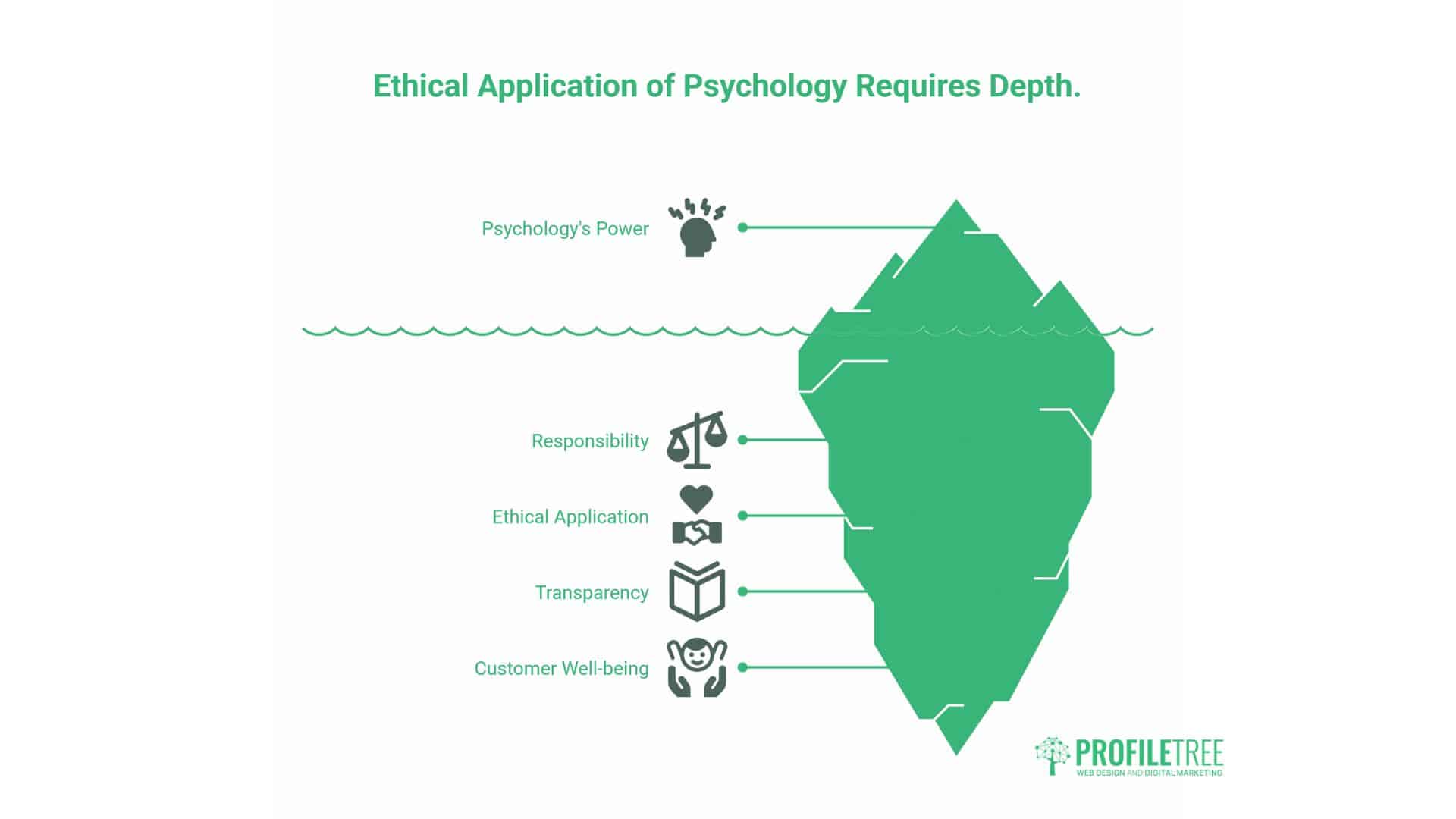
Psychology is powerful, which creates a sense of responsibility. The same principles that guide customers toward beneficial decisions can manipulate them into harmful ones. Ethical application requires intentionality, transparency, and genuine concern for customer well-being.
The UK Regulatory Context
The Competition and Markets Authority (CMA) has increased scrutiny of digital marketing practices, particularly those that pressure consumers into decisions they might regret. Recent guidance specifically addresses subscription traps, fake urgency, hidden costs, and manipulative design patterns.
Dark patterns—interface designs that trick users into actions they didn’t intend—face particular regulatory attention. Examples include making cancellation difficult, automatically enrolling users in paid services after free trials, or hiding key information in fine print. These tactics might generate short-term revenue but risk legal consequences and permanent reputation damage.
The Consumer Protection from Unfair Trading Regulations prohibit misleading actions and aggressive commercial practices. This includes false scarcity (“Only 2 left!” when inventory is unlimited), fake social proof (fabricated reviews or endorsements), and pressure tactics that impair consumer choice.
GDPR compliance intersects with marketing psychology in terms of data collection and personalisation. While personalised experiences improve relevance and reduce cognitive load, they require transparent data practices and genuine consent. Cookie consent patterns that make rejection difficult while accepting is easy represent precisely the kind of dark pattern regulators target.
For businesses across Northern Ireland, Ireland, and the UK, understanding these regulatory boundaries isn’t optional. ProfileTree’s approach to web design and digital marketing builds compliance into the foundation, creating experiences that are both persuasive and transparent.
Transparency as Strategy
Ethical marketing doesn’t mean abandoning persuasion—it means being honest about it. Transparency actually strengthens marketing effectiveness because modern consumers have sophisticated detection systems for manipulation. When they sense you’re trying to trick them, trust evaporates.
Transparent pricing builds confidence. Hidden fees, confusing tier structures, or charges revealed only at checkout create negative experiences that reduce lifetime value even if they generate individual sales. Transparent pricing signals confidence in your value proposition.
Honest timelines prevent disappointment. If delivery takes two weeks, saying it takes one might secure the order, but it guarantees an unhappy customer. Underpromising and overdelivering fosters trust, which in turn leads to referrals and repeat business.
Straightforward terms of service and cancellation policies demonstrate respect for customer autonomy. Making it easy to cancel subscriptions might seem counterintuitive, but it increases sign-up rates by reducing perceived risk. Services confident in their value retain customers through quality, not contractual obstacles.
Acknowledging limitations creates credibility. When you explain what your product doesn’t do or who it isn’t suitable for, you build trust with everyone else. This selective honesty—disqualifying poor fits while strongly serving good fits—improves both conversion quality and customer satisfaction.
ProfileTree’s consultative approach to AI implementation exemplifies this transparency. We assess whether AI solutions actually meet business needs before recommending them, sometimes advising that simpler alternatives would serve the needs better. This honesty fosters trust, which in turn leads to long-term relationships.
Avoiding Manipulation
The line between persuasion and manipulation lies in respect for autonomy. Persuasion provides information and motivation to help people make good decisions. Manipulation removes choice, exploits vulnerabilities, or prioritises seller benefit over customer wellbeing.
Vulnerability exploitation represents the most apparent violation. Marketing that targets financial desperation, emotional trauma, cognitive impairment, or other vulnerabilities crosses ethical boundaries. This includes payday loan advertising during economic crises, predatory gambling marketing, or wellness products that prey on health anxieties.
Information asymmetry—deliberately withholding relevant information—constitutes manipulation rather than persuasion. Customers should have access to information needed for informed decisions, even if complete disclosure doesn’t serve immediate sales goals.
Emotional manipulation through guilt, fear, or shame tactics damages both customer well-being and long-term brand relationships. While emotional appeals have their legitimate place in marketing, those emotions should connect to genuine value or an authentic brand purpose, not cynical exploitation.
Habit formation requires ethical consideration. Services designed to be addictive rather than useful prioritise company benefit over user wellbeing. Social media platforms face criticism precisely for engineering compulsive checking behaviour rather than serving user interests.
For businesses committed to ethical practice, the question becomes: “Would I feel comfortable explaining this tactic to customers?” If the answer is no, the tactic probably crosses moral boundaries.
Building Trust Through Psychology
Appropriately applied, marketing psychology builds rather than exploits trust. Understanding your customers deeply enables you to serve them better, communicate more effectively, and create experiences that genuinely enhance their lives.
Empathy-driven marketing starts with understanding customer challenges, fears, and aspirations. This emotional intelligence informs messaging that resonates because it addresses real concerns rather than manufacturing artificial needs. ProfileTree’s discovery process for web design and digital strategy projects prioritises understanding business goals and customer pain points before proposing solutions.
Value-first approaches prioritise customer benefit over immediate sales. Content marketing, educational resources, and free tools demonstrate expertise while serving audience needs. This generosity fosters reciprocity—people are more likely to support businesses that have helped them.
Long-term thinking aligns business success with customer success. When retention matters more than acquisition, ethical practice becomes good business. Companies focused on lifetime value naturally avoid manipulative tactics that might secure one sale while preventing many others.
Implementation and Testing
Theory means nothing without execution. Translating psychological principles into practical marketing improvements requires systematic processes for research, testing, and optimisation. ProfileTree’s approach to digital strategy combines these elements to produce measurable results.
Understanding Your Audience
Practical marketing psychology requires a deep understanding of the audience. Generic principles apply broadly, but specific applications depend on understanding who you’re actually serving—their motivations, obstacles, preferences, and decision-making patterns.
Customer interviews offer qualitative insights that quantitative data often overlooks. Conducting in-depth conversations with 10-15 customers reveals the language they use, the problems they prioritise, and the factors that influenced their decisions. These insights inform everything from value propositions to page copy.
Surveys gather structured data at scale. Questions about decision criteria, information sources, hesitations, and preferences help identify patterns across your audience. Keep surveys brief—long questionnaires face high abandonment rates and demonstrate poor understanding of cognitive load principles.
User testing observes how real people interact with your website, marketing materials, or products. Watching users navigate your site reveals friction points you’d never identify through analytics alone. Services like Hotjar provide heat maps and session recordings that show precisely where users struggle.
Social listening monitors online conversations about your industry, brand, and competitors. This unfiltered feedback reveals genuine perceptions, concerns, and desires that formal research might miss. Twitter, Reddit, industry forums, and review sites all offer valuable intelligence.
Analytics reveal behaviour patterns that inform psychological hypotheses. High bounce rates on specific pages suggest messaging misalignment or information gaps. Abandoned carts might indicate pricing concerns, trust issues, or checkout friction. Analytics identify where problems exist; psychology helps you understand why.
ProfileTree’s approach to SEO and content marketing begins with this research phase. Before recommending technical optimisations or content strategies, we analyse search behaviour, competitor positioning, and audience intent to build strategies grounded in genuine user needs.
A/B Testing Psychological Interventions
Conversion rate optimisation applies the scientific method to marketing. Rather than implementing changes based on assumptions, testing validates which psychological approaches actually work with your specific audience.
Hypothesis formation starts with a psychological principle. For example: “Social proof increases conversions, so adding customer testimonials near the pricing section will improve sign-up rates.” Clear hypotheses guide the focus and interpretation of testing.
Controlled experiments isolate variables. Testing multiple changes simultaneously makes it impossible to identify which intervention caused the results. Test one element at a time—headline variations, CTA wording, social proof placement—to understand individual impact.
Statistical significance matters. Running tests too briefly or with insufficient traffic produces unreliable results. Most A/B testing tools calculate confidence levels—wait until you reach 95% confidence before declaring a winner. This prevents premature conclusions based on random variance.
Multivariate testing examines how multiple elements interact with each other. While more complex, it reveals whether certain combinations perform better than others. Landing page builders often include multivariate capabilities for testing various heading, image, and CTA combinations.
Progressive testing builds on wins. Rather than running disconnected experiments, stack successful interventions to compound improvements. If adding testimonials increased conversions by 15%, test whether video testimonials perform even better.
ProfileTree’s approach to website optimisation follows this methodology. We don’t redesign sites based on aesthetic preferences; instead, we systematically test psychological interventions and measure their actual impact on business metrics.
Continuous Optimisation
Marketing psychology isn’t a one-time implementation. Consumer behaviour evolves, competitive dynamics shift, and new psychological insights emerge. Continuous improvement processes maintain effectiveness over time.
Regular audits assess whether existing marketing still aligns with psychological principles. As sites accumulate content and features, cognitive load often increases. Quarterly reviews identify bloat and opportunities for simplification.
Performance monitoring tracks key metrics consistently. Sudden changes in bounce rates, conversion rates, or engagement metrics might signal problems or opportunities. Setting up automated alerts prevents issues from persisting unnoticed.
Competitive analysis reveals how others apply psychology in your market. This isn’t about copying but understanding what standards exist and where differentiation opportunities lie. Competitor teardowns through a psychological lens often reveal overlooked tactics or saturated approaches to avoid.
Feedback loops incorporate customer input systematically. Post-purchase surveys, support ticket analysis, and sales call debriefs all provide insights about what’s working and what’s creating friction.
Technology updates require ongoing attention. Changes to analytics platforms, testing tools, or website infrastructure can affect psychological elements. Ensuring mobile experiences maintain psychological effectiveness requires regular testing across devices and browsers.
Future Trends in Marketing Psychology
The intersection of psychology and technology continues evolving rapidly. Understanding emerging trends enables businesses to prepare for shifts in consumer interactions with brands and informed decision-making.
AI-Powered Personalisation
Artificial intelligence enables personalisation at scales previously impossible. Machine learning algorithms analyse behaviour patterns to predict preferences, recommend products, and customise experiences for individual users. This technology amplifies the effectiveness of psychological principles by applying them precisely when and where they are most effective.
Dynamic content adaptation changes what users see based on their behaviour, demographics, or inferred interests. Email platforms already implement basic versions—showing different products based on browsing history. Advanced implementations adjust entire website experiences in real-time.
Predictive analytics anticipate customer needs before they are explicitly expressed. Netflix’s recommendation engine exemplifies this—suggesting content based on viewing patterns demonstrates understanding that builds loyalty. E-commerce platforms increasingly employ similar systems.
Conversational AI through chatbots and virtual assistants provides personalised guidance at scale. When implemented effectively, these tools reduce cognitive load by enabling users to find relevant information without the need for extensive searching. ProfileTree’s AI implementation services help businesses effectively deploy these technologies.
Privacy concerns balance against personalisation benefits. As regulations tighten and consumers become more protective of data, businesses must implement personalisation transparently and with genuine value exchange. Personalisation that serves users builds loyalty; personalisation that merely extracts value breeds resentment.
Immersive Technologies
Virtual reality (VR) and augmented reality (AR) create new opportunities for psychological engagement by offering experiences rather than just information. These technologies reduce psychological distance between customers and products, making abstract benefits tangible.
AR try-before-you-buy experiences remove purchase uncertainty. IKEA’s AR app, which shows furniture in your actual room, demonstrates the product-space fit better than any photo could. Cosmetics brands offering virtual makeup try-ons reduce the perceived risk of poor choices.
VR showrooms provide immersive experiences for high-consideration purchases. The real estate, automotive, and travel industries benefit particularly from allowing customers to experience their offerings virtually before making a commitment.
Gamified AR experiences blend entertainment with brand engagement. Pokémon GO demonstrated how AR could drive foot traffic and engagement through playful experiences. Brands increasingly explore similar approaches for product launches and events.
The psychology of presence—feeling physically situated in virtual environments—creates emotional connections impossible through traditional media. As these technologies become more accessible, businesses that adopt them early gain a competitive differentiation advantage.
Emotional Intelligence in Marketing
As AI handles more tactical execution, human creativity increasingly focuses on emotional intelligence—understanding and responding to the feelings that drive decisions. This shift prioritises authenticity, empathy, and genuine human connection over manipulation.
Purpose-driven marketing connects commercial activity to broader societal benefits. Younger consumers, in particular, expect brands to stand for something beyond profit. When authentic, this approach satisfies psychological needs for meaning and a sense of community.
Vulnerable storytelling builds connection through authenticity. Brands that share failures alongside successes, acknowledge limitations while highlighting strengths, and admit uncertainty when appropriate, create more genuine relationships than those carefully curated for perfection.
Community building prioritises relationships over transactions. Creating spaces where customers connect—not just with your brand—develops psychological ownership and a sense of belonging that transcends individual product benefits.
ProfileTree’s content marketing and video production often incorporate these emotional elements. Authentic business stories, genuine challenges and solutions, and community-focused initiatives resonate more deeply than polished but impersonal corporate messaging.
Conclusion
Marketing psychology represents the convergence of art and science—combining creative communication with systematic understanding of human behaviour. For businesses across Northern Ireland, Ireland, and the UK, these principles offer pathways to stand out in crowded markets, connect authentically with audiences, and achieve sustainable growth.
The key insights that should guide your implementation:
Start with empathy. Understanding your customers’ genuine needs, challenges, and decision-making processes forms the foundation for all effective psychological marketing. Research before you strategise.
Prioritise ethics. Short-term gains from manipulation inevitably damage long-term reputation and violate regulatory standards. Build trust through transparency and genuine value.
Test systematically. Psychology provides frameworks, but your specific audience may respond differently from the general patterns suggest. Validate assumptions through controlled testing.
Reduce friction relentlessly. The single most effective psychological intervention is often the simplest—removing unnecessary complexity and cognitive load from customer journeys.
Think long-term. Customer lifetime value matters more than individual transaction value. Psychological approaches that optimise for retention and referral ultimately outperform those focused solely on acquisition.
ProfileTree’s services—from web design and development to SEO, content marketing, and AI implementation—integrate these psychological principles from the foundation. We don’t treat psychology as an overlay on existing marketing but as fundamental to how effective digital presences function.
The businesses that thrive in competitive markets understand that people don’t buy features; they buy feelings, outcomes, and solutions to genuine problems. Marketing psychology helps you communicate those elements clearly, reduce barriers to action, and build relationships that extend far beyond individual transactions.
Whether you’re redesigning your website, developing a content strategy, training your team in digital marketing, or implementing AI solutions, psychological principles should inform every decision. The question isn’t whether to use psychology in marketing—you already are, whether consciously or not. The question is whether you’ll apply it skilfully, ethically, and strategically to serve both your business and your customers well.