
What Is SEMrush? Complete Guide for UK Digital Marketing Agencies
Table of Contents
SEMrush stands as one of the most recognised SEO and website management tools used by individual marketers and agencies across the UK to extract maximum value from their digital presence. But what is SEMrush, exactly?
At its foundation, SEMrush is a comprehensive digital marketing intelligence platform that consolidates keyword research, technical SEO auditing, backlink analysis, competitor tracking, content planning, and client reporting into one centralised dashboard. Unlike single-purpose tools that focus solely on keyword research or site audits, SEMrush offers an integrated ecosystem that enables agencies to manage multiple aspects of digital marketing campaigns without needing to switch between different platforms.
The system contains extensive UK search data, including local keyword volumes, region-specific competitor intelligence, and integration with British business directories—making it particularly relevant for agencies targeting markets across Northern Ireland, Ireland, and the broader UK. For agencies managing client SEO campaigns, website development projects, or digital training programmes, this consolidation reduces software stack complexity whilst providing professional-grade capabilities that support data-driven decision-making.
Understanding “what is SEMrush?” goes beyond listing features—it requires examining whether the platform justifies its investment through improved efficiency, client satisfaction, and competitive advantages for your specific agency needs. The platform serves several critical functions throughout the client lifecycle: during onboarding, agencies use SEMrush’s domain overview to audit existing SEO health and identify immediate opportunities; for ongoing retainers, position tracking and keyword research tools inform content strategies; web design projects benefit from site audit features that identify technical issues before launch; and content marketing teams leverage topic research to discover trending subjects within target markets.
For agencies like ProfileTree offering web design, SEO services, content marketing, AI training, and digital strategy, the question isn’t simply whether SEMrush offers robust features—it’s whether those features translate into tangible client results, operational time savings, and the ability to justify premium pricing in an increasingly competitive market.
This guide examines SEMrush from a practical agency perspective, analysing UK-specific pricing considerations, including currency conversion and VAT implications. It also explores the Agency Growth Kit that many agencies overlook and compares SEMrush against alternatives to help you determine whether this platform genuinely belongs in your agency’s toolkit.
What SEMrush Offers Digital Marketing Agencies
SEMrush functions as an all-in-one digital marketing intelligence platform. Unlike single-purpose tools, it consolidates keyword research, technical SEO auditing, backlink analysis, competitor tracking, and content planning into one dashboard. For agencies managing client SEO campaigns, website development projects, or digital training programmes, this consolidation reduces the need for multiple subscriptions.
The platform serves several core agency functions. During client onboarding, agencies use SEMrush’s domain overview to audit the client’s existing SEO health and identify immediate opportunities. For ongoing SEO retainers, the position tracking and keyword research tools inform content strategies. Web design projects benefit from the site audit feature, which identifies technical issues affecting search performance before launch.
“When we’re pitching digital marketing services to potential clients, SEMrush data provides the evidence base for our recommendations. Being able to show a business owner exactly where they’re losing traffic to competitors makes the conversation about SEO investment much more tangible,” notes Ciaran Connolly, Director of ProfileTree.
The platform’s database contains extensive UK search data, making it particularly relevant for agencies targeting British markets. This includes local keyword volumes, UK-specific competitor data, and integration with British business directories for local SEO campaigns.
SEMrush Core Features
SEMrush offers a comprehensive suite of tools designed to address every aspect of digital marketing—from initial client audits through ongoing campaign management and reporting. These features work together to provide agencies with the intelligence needed to make informed strategic decisions, identify opportunities competitors miss, and demonstrate measurable results to clients. For agencies managing multiple client accounts, understanding which features deliver the most value for your specific service offerings—whether that’s web design, SEO, content marketing, or digital strategy—determines how effectively you can justify the platform investment and extract maximum ROI from your subscription.
Site Audit for Technical SEO
The site audit function crawls your entire website to identify technical issues affecting search performance. This feature examines crawlability, HTTPS implementation, site speed, internal linking structure, and mobile responsiveness for agencies delivering web development services. Running a site audit before launch helps identify issues that could otherwise harm client rankings.
The audit generates a health score and prioritises issues by severity. Critical errors—such as broken links, duplicate content, or missing meta descriptions—appear at the top of the list, accompanied by specific recommendations for resolution. This structured approach enables agencies to effectively communicate technical issues to clients who may not be familiar with SEO terminology.
For WordPress websites, which ProfileTree primarily builds, the audit identifies plugin conflicts, slow-loading scripts, and accessibility issues. The tool integrates with Google Search Console, providing additional data on indexation problems and mobile usability warnings.
Keyword Research and Analysis
Keyword research forms the foundation of effective SEO and content marketing strategies. SEMrush’s keyword tools reveal search volumes, keyword difficulty scores, and related terms for any query. Agencies can identify high-value keywords with manageable competition, then build content strategies around these opportunities.
The keyword difficulty metric assesses competition by analysing the authority of sites currently ranking. For instance, a keyword difficulty score of 85 indicates highly competitive terms dominated by authoritative sites. This data helps agencies set realistic expectations with clients about ranking timelines.
Long-tail keyword suggestions provide opportunities for quicker wins. Rather than competing for “digital marketing agency,” an agency might target “AI training for SMEs Belfast” or “video production services Northern Ireland”—terms with lower competition but higher conversion intent.
The keyword gap analysis compares your site against competitors, revealing terms they rank for that you don’t. This competitive intelligence informs content planning and identifies potential opportunities that may be overlooked in your market segment.
On-Page SEO Checker
The on-page SEO checker evaluates individual pages and provides specific optimisation recommendations. After analysing a page, SEMrush suggests improvements across four categories: backlink opportunities, technical SEO fixes, semantic keywords to add, and content structure enhancements.
For content marketing teams, these recommendations guide article optimisation. The tool identifies related keywords to incorporate, enhancing topical relevance without resorting to keyword stuffing. Technical suggestions might include adding schema markup, improving header hierarchy, or optimising image alt text.
This feature proves particularly valuable for agencies managing content production at scale. Rather than manually auditing each article, the automated recommendations streamline the optimisation process across dozens of client pages.
Organic Traffic Insights
By connecting Google Analytics and Google Search Console to SEMrush, agencies access enhanced organic traffic data. This integration reveals which keywords drive actual visits, the average time users spend on the site, and bounce rates for organic traffic segments.
The session data helps agencies distinguish between new visitors and returning users, indicating whether SEO efforts successfully build an audience or simply generate one-time visits. For clients investing in content marketing, this metric demonstrates whether articles create lasting value.
Agencies can segment traffic by landing page, identifying which content formats and topics generate the most engagement. This informs future content planning and helps justify ongoing SEO investment to clients focused on ROI.
Brand Monitoring and Competitor Tracking
Brand monitoring tracks mentions of your agency or clients across the web, including social platforms and news sites. This feature provides early warning when brand reputation issues emerge, allowing agencies to respond before situations escalate.
For agencies managing multiple clients, setting up monitoring for each brand ensures no mention goes unnoticed. The tool tracks both direct mentions and variations of brand names, catching misspellings or informal references.
Competitor tracking reveals your rivals’ keyword rankings, content strategies, and backlink acquisition. Understanding where competitors gain traffic helps agencies identify gaps in their own strategy and opportunities to differentiate client offerings.
Social Media Tracking
SEMrush integrates with Facebook, Twitter, Instagram, LinkedIn, and YouTube to track social audience growth and engagement metrics. Agencies managing social media alongside SEO can monitor follower counts, activity levels, and engagement rates across all platforms from one dashboard.
The tool indicates whether metrics are trending upward or downward, making it easy to identify underperforming channels or successful campaigns. For agencies offering comprehensive digital marketing services, this consolidated view supports strategic decision-making about resource allocation.
While dedicated social media management platforms offer more sophisticated features, SEMrush’s social tracking provides sufficient oversight for agencies focused primarily on search marketing with supplementary social activity.
Additional Agency Tools
Position tracking delivers daily updates on keyword rankings within Google’s top 100 results. Agencies can track rankings at national, regional, or local levels—critical for businesses targeting specific UK cities or regions.
The social media poster allows scheduling posts across connected profiles. While not replacing dedicated tools like Hootsuite, it provides basic functionality for agencies managing client social presence alongside SEO.
PPC keyword tools support paid search campaigns by analysing competitor ad copy, identifying profitable keywords, and estimating cost-per-click. For agencies offering both SEO and PPC services, this integration streamlines campaign planning and management.
Backlink tools encompass comprehensive backlink audits and the identification of link-building opportunities. The audit flags toxic links that might trigger Google penalties, whilst the link-building tool suggests relevant sites for outreach based on competitor analysis.
Agency Growth Kit
The Agency Growth Kit represents SEMrush’s purpose-built solution for digital marketing agencies managing multiple clients. Unlike the standard plans designed for in-house marketers, the AGK addresses specific agency needs: client reporting, lead generation, and project management.
Many UK agencies initially subscribe to standard SEMrush plans before discovering the existence of the AGK. Understanding the value of this add-on determines whether the platform truly serves agency workflows or remains a personal SEO tool.
Three-Tier Structure
The Agency Growth Kit comes in three tiers: Start, Scale, and Advanced. Each level provides different capacities for client management and white-label reporting.
The Start tier supports up to three client projects with basic white-label PDF reports. This suits freelancers or small agencies beginning to scale beyond individual contractor work.
Scale expands capacity to 15 client projects and introduces the Client Portal—a branded dashboard that enables clients to access live data directly, eliminating the need for login to SEMrush. This tier targets established agencies managing ongoing retainers.
Advanced removes client limits entirely and provides API access for custom integrations. Larger agencies that build proprietary client dashboards or integrate SEMrush data into existing systems require this level.
White-Label Client Portal
The Client Portal transforms how agencies deliver reporting. Instead of exporting data to PDFs or manually creating presentations, agencies provide clients with a branded login to view real-time campaign performance.
Clients access their keyword rankings, site audit results, backlink growth, and traffic analytics through an interface carrying your agency’s branding. The portal URL can use your agency subdomain (reports.youragency.co.uk), reinforcing brand identity.
This transparency reduces “what are we paying for?” conversations everyday with retainer clients. When clients can independently verify that their rankings improved and technical issues decreased, trust in your services increases.
For UK agencies charging retainers between £1,500 and £5,000 monthly, the perceived value of providing a “proprietary dashboard” often justifies the entire SEMrush subscription cost in clients’ minds.
Agency Partner Directory
Purchasing the Agency Growth Kit qualifies your agency for listing in SEMrush’s Agency Partner Directory. This directory connects businesses seeking SEO expertise with certified SEMrush partners.
The partnership provides three agency benefits. First, high-intent leads actively searching for SEO professionals already understand the value of search marketing—these aren’t bargain hunters looking for £200 SEO packages.
Second, the “SEMrush Certified Agency Partner” badge offers third-party validation. Displaying this badge on your website and LinkedIn profile differentiates your agency in a crowded UK market.
Third, your agency profile on semrush.com provides a high-authority backlink to your website. For agencies investing in their own SEO, this domain authority boost carries significant value.
Client Management CRM
The AGK includes a lightweight CRM integrated directly into SEMrush. Agencies can organise projects by client, track campaign performance scores, and store client preferences for automated reporting.
This CRM won’t replace comprehensive systems like HubSpot or Salesforce for managing your sales pipeline. However, for delivery management—organising which keywords you’re tracking for which clients, storing login credentials, and setting report delivery schedules—the integrated CRM streamlines workflows.
Agencies juggling multiple clients appreciate having project organisation built into the same platform that holds their SEO data, eliminating the context switching between separate systems.
Investment Justification
For agencies with fewer than five clients, standard plans with manual PDF exports likely suffice. However, agencies managing 10 or more clients find that the labour savings from automated Client Portals and the inbound leads from a Partner Directory listing make the AGK financially sound.
The calculation becomes simple: if the AGK generates even one qualified lead annually, it pays for itself, for agencies charging £ 3,000 or more for SEO retainers, a single converted lead from the Partner Directory covers the annual AGK subscription cost.
UK Pricing Analysis
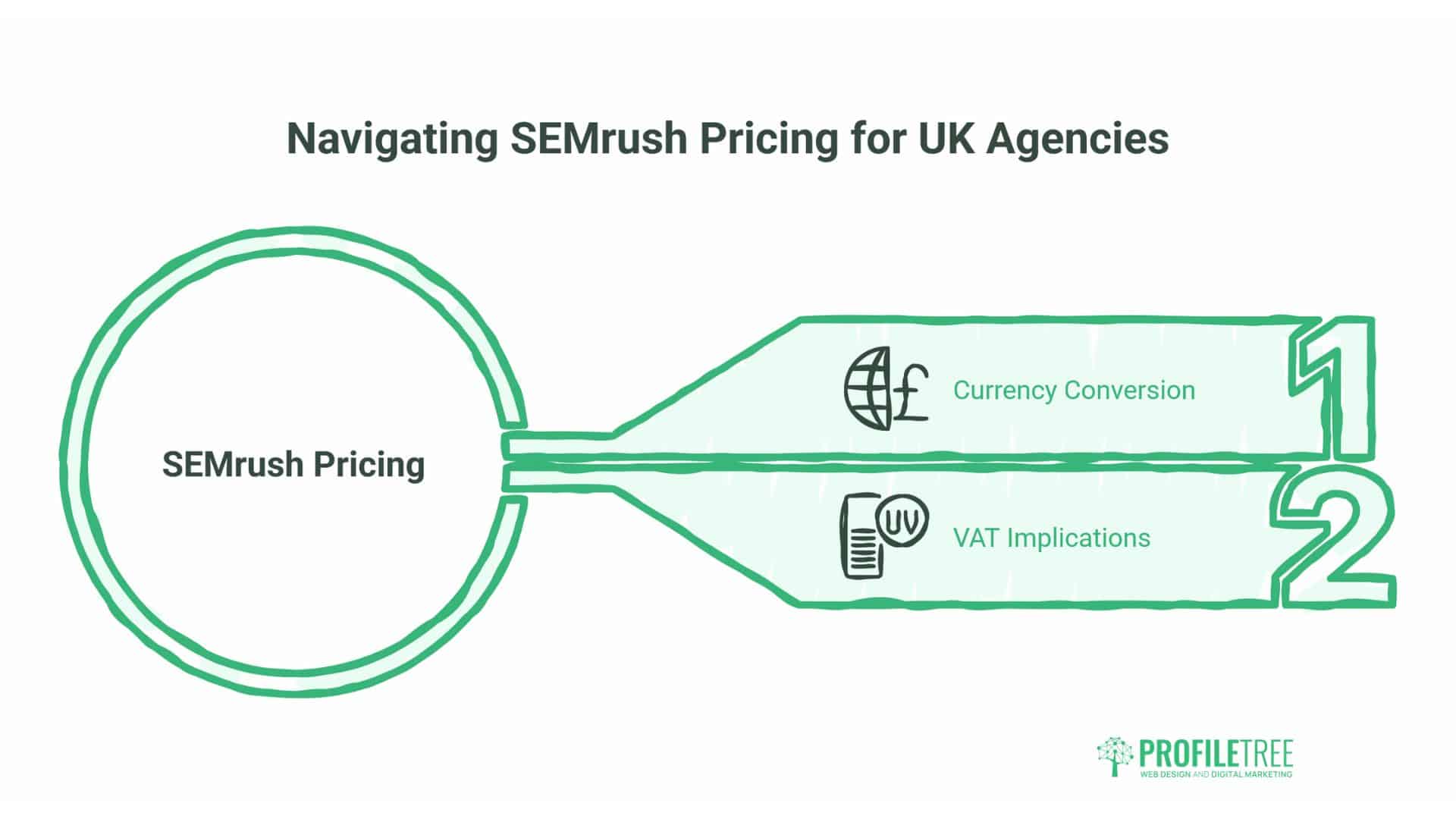
SEMrush pricing presents complications for UK agencies because subscriptions are billed in USD, creating exchange rate exposure. Understanding the actual cost of ownership requires converting base prices to GBP and accounting for VAT implications.
Base Plan Pricing
SEMrush offers three primary plans: Pro, Guru, and Business. Each tier provides different limits on projects, keywords tracked, and results per report.
The Pro plan costs approximately £100 monthly after currency conversion. This entry-level option is suitable for freelancers or agencies managing a single client. Limitations include tracking only 500 keywords and crawling 100,000 pages per site audit.
Guru, the most popular agency choice, costs approximately £200 per month. This plan increases limits to 1,500 tracked keywords, 300,000 pages per audit, and includes content marketing tools, as well as access to historical data. Most UK agencies with 5-10 clients find Guru sufficient.
Business costs approximately £380 monthly with substantially higher limits: 5,000 tracked keywords, 1,000,000 pages per audit, and API access. This tier targets larger agencies managing enterprise clients or numerous smaller accounts.
These conversions fluctuate with exchange rates. A 10% swing in USD/GBP rates materially affects your annual software spend, making cost predictability challenging for agency budgets.
Agency Growth Kit Additional Costs
The Agency Growth Kit costs are separate from base plans. The Start tier adds roughly £40 monthly, the Scale tier adds £120, and the Advanced tier adds £240 to your base subscription.
Most agencies pair Guru with Scale, creating a total monthly cost of around £320. This supports up to 15 clients with white-label reporting and Partner Directory listing—a reasonable cost per client when managing ongoing retainers.
For agencies charging £1,500 or more in monthly retainers, the per-client tool cost represents approximately 2% of their revenue. This positions SEMrush as an infrastructure investment rather than a prohibitive overhead.
VAT Considerations
UK businesses purchasing software from international suppliers must consider VAT treatment. Under the reverse charge mechanism, UK agencies account for VAT through their returns rather than paying it upfront to SEMrush.
This means the quoted price represents your actual cost, but you’ll need to account for the VAT amount in your accounting. For VAT-registered agencies, this is offset by the input VAT claim. Non-VAT registered agencies face the full inclusive cost.
Proper accounting treatment ensures compliance and avoids unexpected tax bills. Agencies should work with accountants to correctly handle reverse charge VAT on software subscriptions.
Hidden Costs and Add-Ons
Beyond base plans and AGK, several optional add-ons increase costs. Additional user seats cost approximately £35 monthly each. Agencies with multiple team members accessing SEMrush should budget for these extra seats.
Listing Management, which distributes business information to local directories, costs approximately £15 per month per location. For agencies managing local SEO campaigns across multiple client locations, these fees accumulate.
Historical data access (included in Guru and above) is crucial for agencies that need to demonstrate improvements in their rankings over time. Pro plan users wanting historical data face upgrade pressure.
Cost-Benefit Analysis
The critical question isn’t whether SEMrush costs £320 monthly, but whether it generates sufficient value to justify that investment. Agencies should assess three factors: labour savings, revenue generation, and client retention.
Labour savings come from automation. Manually researching keywords, auditing sites, and building competitor reports would consume dozens of hours monthly. SEMrush reduces these tasks to minutes, freeing staff to focus on higher-value strategy work.
Revenue generation occurs through the Partner Directory and the ability to offer sophisticated SEO services. Agencies lacking professional SEO tools struggle to compete against better-equipped rivals for valuable retainers.
Client retention improves when agencies provide transparent reporting through Client Portals. Clients understanding their campaign progress through data—not just agency assurances—maintain retainers longer.
SEMrush Tool Alternatives
SEMrush competes in a crowded market for SEO software. Understanding alternatives enables agencies to make informed decisions about tool selections, tailored to their specific needs and budgets.
Moz Pro
Moz Pro offers comprehensive SEO capabilities comparable to SEMrush. The platform combines site crawling, keyword research, rank tracking, and link analysis into a single subscription.
Moz’s Domain Authority metric has become a standard for assessing site strength in the industry. Many agencies prefer Moz’s link analysis, finding it more intuitive than SEMrush’s approach. The Keyword Explorer tool offers similar functionality to SEMrush’s keyword research, albeit with a different interface that some users find clearer.
Pricing aligns closely with SEMrush at similar tier levels. Moz offers a 30-day free trial, allowing agencies to test capabilities before committing. For agencies specifically focused on link-building campaigns, Moz’s link tools potentially justify choosing it over SEMrush.
However, Moz lacks some features SEMrush includes, such as social media tracking and PPC keyword tools. Agencies requiring all-in-one functionality may find Moz insufficient without supplementary tools.
Ahrefs
Ahrefs has built its reputation on backlink analysis and content research. Many SEO professionals consider Ahrefs the gold standard for understanding backlink profiles and identifying link-building opportunities.
The Content Explorer feature helps agencies discover trending topics and successful content formats within any niche. For agencies offering content marketing services, this competitive intelligence informs content strategies and identifies gaps in market coverage.
Site Explorer provides detailed competitor analysis, revealing which pages drive the most traffic and which keywords generate visits. This transparency helps agencies reverse-engineer successful competitor strategies.
Ahrefs pricing starts higher than SEMrush’s entry level but includes more generous usage limits. The platform updates its index more frequently than competitors, providing fresher backlink data. For agencies where link-building forms a core service, Ahrefs often justifies its premium.
The interface differs significantly from SEMrush, requiring a learning curve even for experienced SEO professionals. Some agencies run both platforms, using Ahrefs for link analysis whilst relying on SEMrush for broader digital marketing functions.
Serpstat
Serpstat positions itself as the budget alternative to SEMrush and Ahrefs. The platform offers keyword research, rank tracking, site auditing, and backlink analysis at a lower price point.
Free usage offers limited searches without requiring payment information—ideal for agencies looking to test capabilities before subscribing. This contrasts with SEMrush, which requires paid subscriptions for meaningful access.
However, Serpstat’s database contains less comprehensive data than premium competitors. UK-specific keyword volumes and competitor data appear less comprehensive, which may limit the effectiveness of agencies focused on the British market.
For smaller agencies with limited budgets, Serpstat offers adequate functionality at an affordable price. As agencies grow and require more sophisticated capabilities, many eventually migrate to SEMrush or Ahrefs.
SpyFu
SpyFu specialises in competitor analysis, particularly for PPC campaigns. The platform reveals competitors’ paid search keywords, ad copy, and estimated spend—valuable intelligence for agencies managing Google Ads alongside SEO.
Historical data shows how competitors’ strategies evolved over the years, helping agencies identify patterns and anticipate market shifts. This long-term perspective distinguishes SpyFu from platforms focused primarily on current data.
For agencies offering both SEO and PPC services, SpyFu’s competitor PPC intelligence provides unique value. However, the platform’s SEO features lag behind those of dedicated tools like SEMrush, requiring supplementary subscriptions to meet comprehensive agency needs.
Conductor and BrightEdge
Conductor and BrightEdge target enterprise clients with sophisticated content marketing and SEO platforms. Both offer advanced features like content performance analytics, audience insights, and integration with marketing automation platforms.
These enterprise tools integrate with other marketing technology (martech) systems, creating unified workflows for large marketing teams. However, pricing exceeds what most UK SME-focused agencies can justify, with annual costs reaching tens of thousands of pounds.
BrightEdge’s ContentIQ performs comprehensive site audits on large websites with thousands of pages. Conductor excels at developing content strategies, helping agencies plan editorial calendars based on search demand and content gaps.
Most ProfileTree clients—SMEs seeking web design, AI training, or digital marketing services—don’t require enterprise-scale platforms. However, agencies serving larger organisations should evaluate these options in conjunction with SEMrush.
Implementation for Agencies
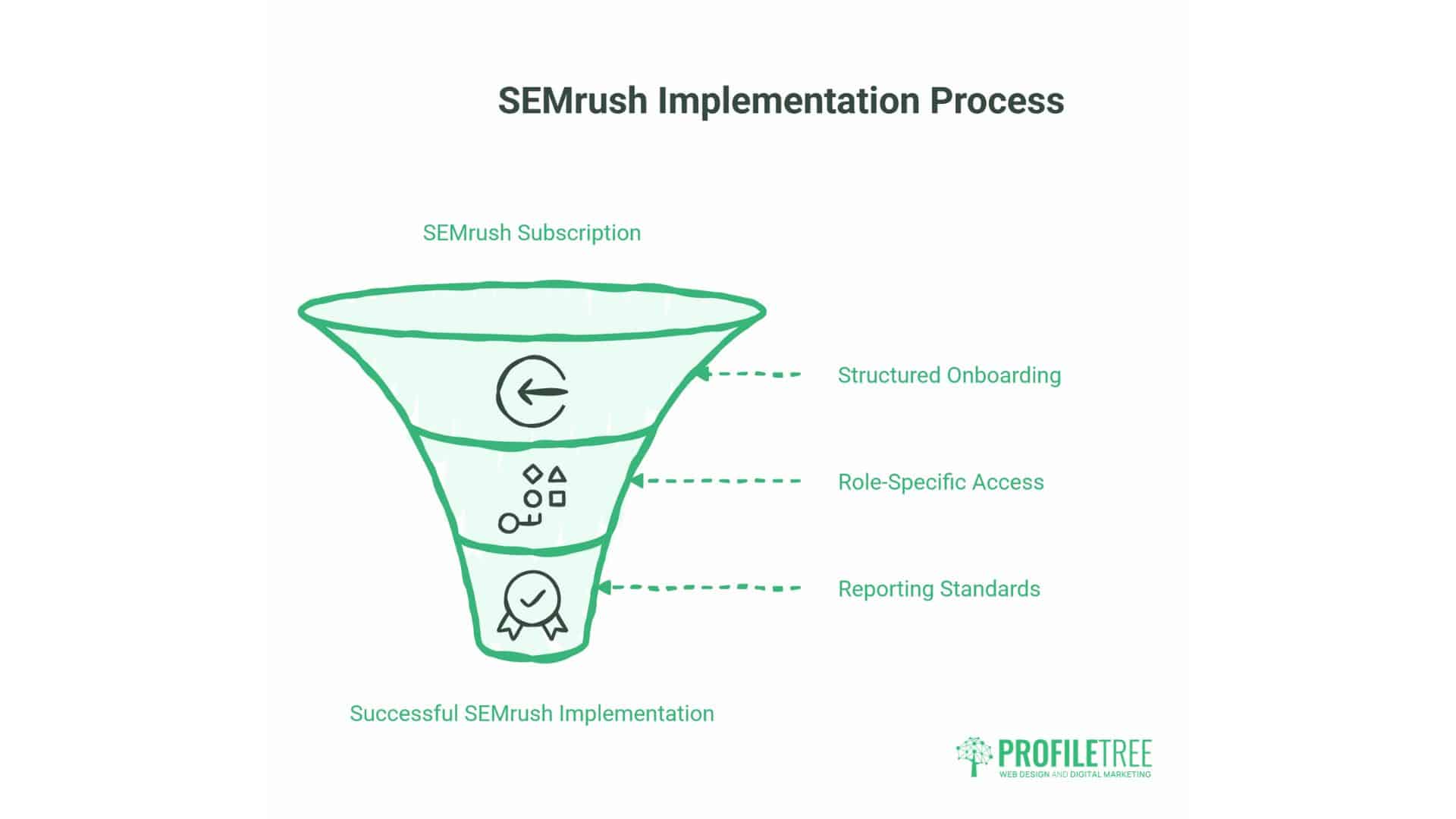
Successfully implementing SEMrush requires more than subscribing and hoping team members figure it out. Agencies should develop structured onboarding processes, define role-specific access, and establish reporting standards.
Initial Setup and Configuration
Begin by connecting Google Analytics and Google Search Console for all client accounts. This integration enriches SEMrush data with actual traffic information and indexation status. Without these connections, you’re working with incomplete information.
Configure position tracking for target keywords across all client campaigns. Set tracking frequency to daily for competitive industries where rankings fluctuate rapidly, or weekly for stable markets. Geographic tracking should match client target locations—national for UK-wide businesses, local for region-specific companies.
Set up branded report templates incorporating your agency’s visual identity. Configure automated report delivery schedules so clients receive updates without manual intervention. This automation frees team time whilst ensuring consistent client communication.
Organise projects logically within SEMrush, grouping related clients or campaign types. A clear project structure prevents confusion when team members work across multiple accounts simultaneously.
Training Team Members
Different team roles require different SEMrush capabilities. Web developers need site audit training to identify technical issues before launching their site. Content writers benefit from keyword research and on-page SEO checker training. Account managers require reporting and analytics skills for client communication.
Develop role-specific training programmes rather than attempting to teach everyone everything. This focused approach accelerates competency development and prevents overwhelming team members with irrelevant features.
SEMrush Academy offers free certification courses covering platform features. Encourage team members to pursue relevant certifications, both for skill development and to enhance your agency’s credibility.
Schedule regular training refreshers as SEMrush releases new features on a quarterly basis. Staying current with platform capabilities ensures your agency maximises its investment and maintains competitive advantages.
Client Onboarding Process
Standardise how you use SEMrush during client onboarding. Run comprehensive site audits before proposing SEO strategies, documenting existing technical issues and SEO health. This baseline data justifies your recommendations and provides comparison points for demonstrating progress.
Conduct a competitor analysis to identify which rivals dominate target keywords and understand their respective strategies. This intelligence informs realistic timeline expectations and helps identify quick-win opportunities, differentiating your client from competitors.
Conduct thorough keyword research to build initial target keyword lists. Balance high-volume competitive terms with achievable long-tail phrases, setting staged goals that demonstrate progress whilst pursuing longer-term ranking objectives.
Present findings in client-facing reports using SEMrush’s white-label capabilities. A professional presentation positions your agency as sophisticated and data-driven, justifying premium pricing compared to competitors relying on gut instinct.
Ongoing Campaign Management
Establish weekly or monthly routines for reviewing client campaigns. Check position tracking for ranking changes, review site audit reports for new technical issues, and monitor competitor activity for strategic shifts.
Utilise SEMrush’s task management features to assign follow-up actions to the relevant team members. When site audits identify broken links, create tasks for developers. When keyword research reveals content opportunities, assign topics to writers.
Integrate SEMrush data into your existing project management systems. Export keyword lists to content calendars, sync position tracking data with reporting dashboards, and share competitor insights during strategy sessions to inform your approach.
Regularly audit your own SEMrush usage patterns. Identify underutilised features that might deliver additional value, and discontinue paying for capabilities your agency never uses. Efficient tool usage maximises ROI on your subscription investment.
Reporting and Client Communication
Configure Client Portals for retainer clients, providing branded logins to allow them to review campaign progress independently. This transparency reduces reporting workload whilst building trust through data accessibility.
Supplement automated reports with strategic commentary explaining what the data means and what actions you’re taking. Raw data without context leaves clients uncertain about the value of their campaigns. Your analysis transforms numbers into actionable intelligence.
Schedule quarterly strategy reviews using SEMrush data to demonstrate progress and recommend new initiatives. Show year-over-year ranking improvements, organic traffic growth, and technical SEO health improvements—Utilise competitor analysis to support recommendations for staying ahead of market shifts.
Prepare for client questions by anticipating concerns. If rankings drop temporarily, proactively explain algorithm updates or seasonal factors. If competitor rankings improve, please explain the adjustments to your responsive strategy. This preparedness positions your agency as proactive rather than reactive.
SEMrush for Specific Agency Services
Different agency service lines extract different value from SEMrush. Understanding these service-specific applications helps agencies justify subscriptions across their entire business, not just SEO departments.
Web Design and Development
During website design projects, SEMrush’s site audit identifies technical requirements before development begins. Rather than discovering SEO issues post-launch, agencies can build solutions addressing crawlability, page speed, and mobile responsiveness from project inception.
Competitor analysis reveals design patterns and site structures working well in clients’ industries. This intelligence informs information architecture decisions and content hierarchy planning, creating sites optimised for both user experience and search visibility.
Keyword research during the planning phase ensures site navigation and page titles target valuable search terms. Building SEO considerations into wireframes and design mockups prevents costly redesigns after launch.
For WordPress websites—ProfileTree’s primary platform—SEMrush integrates with standard plugins, streamlining technical SEO implementation. The platform identifies plugin conflicts that affect site speed or create duplicate content issues.
Content Marketing and Strategy
Content teams utilise SEMrush’s Topic Research tool to identify trending topics and frequently asked questions within their target markets. This demand-driven approach ensures content addresses actual search intent rather than topics agencies find interesting.
The Content Analyser evaluates existing content performance, identifying top-performing articles and underperforming pages that need optimisation. This data-driven approach prioritises improvement efforts on content with the highest potential impact.
Competitive content gap analysis reveals topics competitors cover that your client’s site lacks. Creating content to fill these gaps captures traffic currently flowing to rivals whilst establishing topical authority in your market segment.
Keyword clustering groups related search terms into topic themes, helping agencies plan comprehensive content covering entire subject areas rather than creating scattered individual articles. This pillar-cluster approach builds topical authority and expertise in signalling to search algorithms.
SEO and Local SEO Services
Core SEO services rely heavily on SEMrush’s keyword tracking, technical auditing, and backlink analysis. Position tracking demonstrates campaign effectiveness to clients, justifying ongoing retainer investments through visible improvements in ranking.
For local SEO campaigns, listing management tools distribute client information to UK business directories, including Yell, Thomson Local, and other regional platforms. Consistent NAP (name, address, phone number) information across directories enhances local search visibility.
The platform’s local rank tracking shows performance in specific geographic areas—essential for businesses serving defined regions rather than national markets. Belfast-based businesses need Belfast-specific ranking data, not UK-wide averages.
Review monitoring alerts agencies when clients receive Google Business Profile reviews, enabling prompt responses that enhance local search signals and foster stronger customer relationships.
Digital Training and Workshops
Agencies offering digital marketing training—a core ProfileTree service—utilise SEMrush to illustrate SEO concepts with real-world data. Rather than engaging in theoretical discussions, trainers demonstrate live keyword research, competitor analysis, and technical audits using attendees’ own websites.
Training participants receive temporary access to SEMrush during workshops, allowing them to experience the platform’s capabilities firsthand. This hands-on approach accelerates learning compared to presentation-based training.
SEMrush certifications provide structured curricula for training programmes. Agencies can offer certification courses as productised training services, generating additional revenue beyond consulting work.
For AI training programmes—another ProfileTree speciality—SEMrush data supports discussions about AI-powered SEO tools and how automation transforms digital marketing workflows.
Video Production and YouTube Strategy
SEMrush includes YouTube analytics tracking, channel growth, video performance, and competitor comparison. Agencies offering video production services—such as ProfileTree—use this data to inform their content strategy and demonstrate campaign ROI.
Keyword research identifies popular search queries on YouTube, informing video topics and title optimisation. Understanding what people search for on video platforms ensures content addresses actual demand.
Competitor analysis reveals successful video formats and content approaches within clients’ industries. This intelligence enables agencies to recommend video styles and topics that are likely to perform well, based on proven market examples.
Integration between YouTube data and broader SEO metrics shows how video content supports overall digital marketing goals, justifying video production investment to clients focused on measurable business outcomes.
Conclusion: What Is SEMRush?
SEMrush has established itself as an essential tool for SEO professionals, digital marketers, and agencies seeking data-driven insights to optimise their sites and outperform competitors. With comprehensive features spanning keyword research, site audits, backlink analysis, rank tracking, and competitor intelligence, the platform provides a complete toolkit for developing effective marketing strategies.
For UK agencies managing multiple clients, SEMrush’s extensive capabilities justify the pricing through labour savings, improved client reporting, and competitive advantages. The depth of data, white-label reporting customisation, and integrations with analytics platforms enable agencies to take informed action efficiently. The Agency Growth Kit specifically addresses agency workflows through client portals, lead generation via the Partner Directory, and streamlined project management.
As search marketing continues to evolve rapidly, relying on intelligent tools for opportunity identification and performance measurement becomes increasingly imperative for staying competitive. Based on its vast database, continuous development, and widespread adoption among industry leaders, SEMrush remains a top contender in the digital marketing toolkit space.
For agencies like ProfileTree, which offer web design, SEO, content marketing, and digital strategy services across the UK, SEMrush provides the intelligence foundation supporting all digital marketing recommendations. Taking advantage of the trial period allows you to evaluate whether the platform delivers sufficient value—through time savings, improved client retention, and increased lead generation—to justify its monthly investment and support your agency’s growth trajectory.
FAQs
What is SEMrush and what does it do?
SEMrush is a comprehensive digital marketing platform providing tools for keyword research, competitive analysis, rank tracking, site auditing, and content optimisation. It helps businesses improve online visibility through data-driven SEO and marketing strategies.
Who can use SEMrush, and what are the benefits?
Businesses of all sizes use SEMrush, from startups to enterprises. Digital marketing agencies, in-house marketing teams, and individual consultants benefit from increased website traffic, improved keyword rankings, enhanced content performance, and stronger backlink profiles through data-informed decision-making.
How does SEMrush’s competitor analysis feature work?
SEMrush’s competitor analysis provides detailed insights into rivals’ website traffic, keyword rankings, backlink profiles, and top-performing pages. This intelligence enables agencies to benchmark client performance, identify areas for improvement, and adapt successful competitor strategies to their client campaigns.
What is backlink analysis, and how does SEMrush help with it?
Backlink analysis evaluates the quality and quantity of links pointing to a website. SEMrush’s backlink tools provide comprehensive insights into your site’s backlink profile and competitors’ link-building strategies, helping identify toxic links to remove and quality link-building opportunities to pursue.