
Product Development Process: A Go-to-Market Guide for SMEs
Table of Contents
Most small businesses do not fail because their idea was weak. They fail because the product reached the market without a plan for how it would be found, understood, and bought. A strong product development process closes that gap. It carries a concept from first sketch to a launch that customers actually notice, and it builds the digital foundations (a site that converts, search visibility, content that answers buyer questions) into the work from the start rather than bolting them on at the end.
This guide keeps the seven stages that experienced teams rely on, then reframes each one around what an SME in the UK and Ireland needs to launch and sell. You will get the full development sequence, the digital go-to-market steps that turn a finished product into revenue, the metrics worth tracking, and the mistakes that quietly drain budgets.
Why a Structured Product Development Process Matters for SMEs
A structured product development process gives a small team the discipline that larger firms get from headcount. It forces decisions in the right order, so you validate demand before you spend on engineering, and you plan distribution before you plan a launch date. For SMEs, where one wasted quarter can be the difference between growth and standstill, that order matters more than scale. The same structure that prevents costly build mistakes also sets up the digital channels you will rely on to sell, which is where early planning around website design services and search engine optimisation pays off.
Strategic Clarity and Resource Discipline
A clear process aligns everyone on the product vision, the target customer, and the commercial goal. That alignment prevents the slow drift that kills small projects, where each person quietly builds toward a slightly different version of the product. Time, budget, and attention are finite in any SME, and a defined sequence keeps all three pointed at the work that moves the product toward a sale.
Risk Reduction Through Early Validation
Testing demand and feasibility early surfaces problems while they are still cheap to fix. A concept that fails a customer interview costs you an afternoon. The same flaw discovered after production costs you stock, tooling, and reputation. This is the core argument for treating the product development process as a sequence of validation gates rather than a single sprint to launch.
Building the Commercial Foundation Early
The strongest reason to follow a deliberate process is commercial. Products developed with genuine customer insight solve real problems, and they arrive with the digital groundwork already in place: a defined audience, the search terms that audience uses, and a site ready to receive them. When marketing is an afterthought, the launch stalls. When it runs through the whole product development process, the launch has somewhere to land.
The Seven Stages of the Product Development Process
The product development process for most SMEs runs through seven connected stages, each building on the one before it. The sequence below keeps the established framework that teams trust, then adds the digital and go-to-market thinking that an agency-led launch depends on. Treat the stages as a loop rather than a straight line: what you learn at launch should feed the next round of ideas.
Stage 1: Idea Generation
Every product starts with ideas, and the goal here is volume, not judgement. Your own team is an underused source: salespeople and support staff hear the same customer complaints and requests every week. Ask them what features customers ask for most, which problems repeat, and where your current offer falls short.
External sources matter just as much. Customer surveys, reviews, and social listening reveal unmet needs, while a look at competitors shows gaps you could fill. A simple SWOT analysis helps you see where a new product fits your strengths. At this stage, generate widely and filter later.
Stage 2: Idea Screening
Screening filters a long list down to the concepts worth investing in. Set clear criteria first: strategic fit, market demand, technical feasibility, competitive advantage, development cost, and any regulatory requirements. Then bring in perspectives from across the business, so engineering judges feasibility, sales judges demand, and finance projects cost and return.
A weighted scoring model keeps screening honest. Rate each idea against your criteria, set a threshold for what progresses, and apply three final filters: return on investment, affordability against current budget, and realistic market potential. Ideas that clear these earn a deeper look.
Stage 3: Concept Development and Testing
This stage turns a screened idea into a concept you can put in front of customers. An idea is what you think you could build. A concept describes what the customer will actually experience and value, so specificity is everything. Define the problem, the person who has it, and why your solution beats the alternatives.
Build a detailed customer persona, outline the features and benefits that matter to that person, and write a short concept statement. Visualise it with sketches or mockups, because even rough visuals draw better feedback than abstract descriptions. Present the concept to potential customers, collect structured feedback, and refine over several rounds rather than chasing perfection in one.
Stage 4: Business Analysis
Before you commit real money, test whether the numbers work. Project fixed costs (development, setup, tooling), variable costs (materials, labour, packaging), and the extra costs of marketing, distribution, and compliance. A complete cost picture lets you set a break-even point and price with confidence.
Choose a pricing approach that suits your market, whether cost-plus, competitive, or value-based, then forecast sales using both expert judgement and any historical data you hold. Be conservative. Finish with a profitability check across gross margin, net margin, and ROI, and run a sensitivity analysis so you know which variables move the outcome most. This is also the point to factor in the cost of your launch channels, which a clear digital strategy plan will help you scope before you commit.
Stage 5: Product Development
With the business case validated, the concept becomes something real. Start with prototypes, which can be rough, since their job is to expose problems early. Move into design that balances user experience, ergonomics, visual appeal, and material choice, with designers and engineers working together rather than in sequence.
Engineering then translates the design into something you can actually make, covering specifications, manufacturing method, sourcing, and the cost work needed to scale without losing quality. Test throughout for function, quality, safety, durability, and usability, and document every result for compliance and future improvement.
Stage 6: Market Testing
Before a full launch, put the product in front of real customers in real conditions. Produce a small run, choose test markets that match your target audience, and track both hard numbers (sales, conversion, returns) and the softer signals in customer comments and support queries. A lukewarm response is useful, provided you find out why through interviews rather than guesswork.
Use this stage to test pricing, identify which features drive purchases, and review whether your marketing messages land. This is the last point where significant changes are cheap, so treat any weak signal as information rather than a setback.
Stage 7: Commercialisation and Launch
The final stage brings the product to full availability with marketing, distribution, and support aligned. Run last checks on manufacturing capacity, logistics, support systems, and legal compliance, then execute a coordinated launch. For most SMEs, the launch is where digital channels carry the weight: a site built to convert, content that answers buyer questions, and search visibility that puts the product in front of the right people. Reliable website development work matters here, because a launch that crashes under its first wave of traffic costs you the attention you spent months earning. The next section covers that go-to-market work in detail.
Building a Digital Go-to-Market Around the Product Development Process

A finished product is not a business until people can find it and buy it. The go-to-market layer is where the product development process meets commercial reality, and for SMEs it is overwhelmingly digital. The work below should begin during development, not after it, so that the day you launch, the channels are already warm. This is the stage where an agency partner earns its place, joining the product team to handle the parts of the launch that decide whether anyone notices.
A Website That Converts, Not Just Displays
Your site is the centre of any SME launch. It is where paid traffic, search visitors, and social referrals all land, so it has to do more than describe the product. It has to move a visitor toward a purchase or enquiry with clear value propositions, fast load times, and a path to action that does not make people think. Planning a conversion-focused website during development means it is ready on launch day rather than three weeks after, and dependable website hosting management keeps it fast and online when the launch traffic arrives. Treating the build as part of the product development process, rather than a separate project, keeps the message consistent from concept to checkout.
Search Visibility From the Start
Customers search before they buy, and if your product pages do not answer those searches, the launch leaks demand to competitors. Map the terms your target customer actually uses during development, build pages and content that answer them, and structure the site so search engines understand what you sell. Strong SEO support turns a launch spike into sustained traffic, because content that ranks keeps working long after the launch campaign ends. Pages that cover several related buyer questions tend to earn more visibility than thin product descriptions, which aligns with Google’s guidance on helpful content, so plan depth, not just presence.
Content and Video That Explain the Product
Buyers need to understand a product before they trust it, and that is what content and video do. Product demonstrations, explainer videos, and customer stories communicate value faster than text alone, while guides and articles answer the questions that come up before a purchase. A coordinated approach to digital marketing strategy ties these assets together so each one moves the buyer along, and professional video marketing content gives you the demonstration material that converts cautious visitors. Build this library during development so it is ready to publish at launch.
Reaching Buyers Through Social and Email
Owned channels carry the product to the audience you already have and the one you are still building. Social platforms put the product in front of new buyers and keep your existing followers engaged, while email brings back people who showed interest but did not buy on the first visit. Active social media marketing builds the awareness a launch needs, and a steady email marketing programme turns one-time interest into repeat purchases. Both work best when the audience and message are defined during the product development process rather than improvised at launch.
Aligning the Launch Campaign With Each Channel
A coordinated launch activates each channel for the job it does best. Search and content capture people already looking. Social and email build awareness and bring back people who showed interest. Paid advertising fills gaps while your organic visibility grows. Modern launches increasingly use AI-enhanced marketing, from audience targeting to message testing, and an AI chatbot support can answer buyer questions on your site around the clock during the launch window. The point is sequencing: the product development process should hand the marketing team a finished product and a defined audience, so the campaign targets real buyers rather than a vague market.
“The businesses we see succeed treat their website and marketing as part of building the product, not a job for after it ships. By the time their product is ready, the audience already knows it exists. The ones who struggle build something good, then start thinking about how to sell it, and lose months they did not need to lose.” Ciaran Connolly, Director of ProfileTree
Measuring Success After Launch
A launch is the start of measurement, not the end of the work. Define what success looks like before you ship, then track it across technical, commercial, and customer metrics so you can adjust quickly. The product development process should feed back on itself: what you learn from these numbers becomes the input for your next round of ideas, which is why the strongest teams treat the whole thing as a loop.
The KPIs Worth Tracking
Set your success criteria before launch so you can judge performance objectively. Useful indicators fall into three groups. Technical metrics cover reliability, performance, and defect rates. Commercial metrics cover revenue, margin, market share, customer acquisition cost, customer lifetime value, and break-even timeline. Customer metrics cover satisfaction, Net Promoter Score, engagement, retention, and feature adoption. Together they tell you not just whether the product sold, but whether it will keep selling.
Reading the Digital Signals
Your digital channels produce some of the clearest early signals. Search rankings, organic traffic, conversion rates, and the questions arriving through support all show how the market is responding. Watch which content draws buyers, which pages convert, and where visitors drop away, then adjust. These signals arrive faster than sales reports and let you fix problems while the launch is still young.
From Launch to Iteration
Successful products keep evolving. Plan for regular improvement, the capacity to scale operations as demand grows, and the ongoing support that builds loyalty and word of mouth. Markets shift and customer expectations move, so treat the product as something that adapts rather than something fixed. Building in-house capability through digital skills training helps your team run these channels without depending on outside help for every change. Each iteration is another turn through the product development process, informed by real data rather than assumptions.
Common Pitfalls That Derail SME Launches
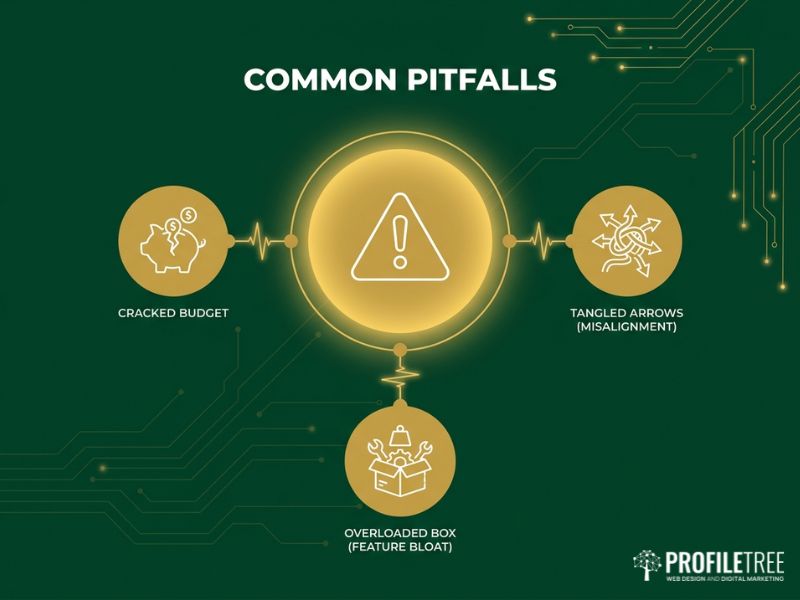
Most product launches that disappoint do so for predictable reasons. Knowing the common failure points helps you design the product development process to avoid them. The pitfalls below show up again and again in small business launches, and almost all of them trace back to skipping a validation step or treating marketing as separate from development.
Skipping Validation and Underplanning the Budget
Many businesses fall for their own idea without confirming customers share the enthusiasm, so always validate demand before heavy investment. Budgets are the second common trap, because development usually costs more and takes longer than first estimated. Build in contingency on both money and time so you are not forced to cut corners halfway through.
Treating Marketing as an Afterthought
The most expensive mistake for SMEs is leaving the launch plan until the product is finished. A good product with no audience and no search visibility sells slowly, if at all. When the product development process includes the website, content, and search work from the start, the launch has reach on day one. Folding a go-to-market plan into development from the outset avoids the scramble entirely. When it does not, you spend the first critical months building an audience you should already have had.
Feature Bloat and Neglecting Post-Launch
Adding too many features dilutes focus and inflates complexity, so prioritise the core value over a long feature list. Equally, the work does not end at launch. Plan for support, marketing, and product evolution from the start, because the products that last are the ones that keep improving after the first sale.
How ProfileTree Supports the Product Development Process
Bringing a product to market draws on skills that few small teams hold all at once, from market research and web design through to search, content, and video. ProfileTree, a Belfast-based digital agency, works alongside SMEs across Northern Ireland, Ireland, and the UK to handle the digital side of a launch. That includes web design and development that turns visitors into customers, SEO that helps the right buyers find the product, digital marketing strategy that coordinates the launch, and video production that explains the product clearly. The aim is simple: make the go-to-market work part of the product development process rather than a scramble after it.
Ciaran Connolly is the founder of ProfileTree, a Belfast-based web design and digital marketing agency. Since 2011, the team has completed over 1,000 web projects for businesses across Northern Ireland, Ireland, and the UK. Ciaran also delivers AI training for SMEs through Future Business Academy.
FAQs
What are the 7 stages in the new product development process?
The seven stages are idea generation, idea screening, concept development and testing, business analysis, product development, market testing, and commercialisation and launch.
What is the first step in the product development process?
Idea generation. You gather concepts widely from internal and external sources before screening them for viability.
How long does the product development process take?
It varies with complexity and resources. Simple products can take months, complex ones can take years. Clear planning keeps the timeline realistic.
What is the difference between a product idea and a product concept?
An idea is what you think you could build. A concept describes what the customer will experience and value, expressed in detail.
When should I start the marketing and website work?
During development, not after. Building the site, content, and search visibility early means the product launches to a ready audience.
Why is idea screening important?
It stops you wasting budget on weak concepts by filtering early on strategic fit, demand, feasibility, and financial return.
Amasing! very useful. The only problem we have as small businesses is Costs of becoming big!
Thank you. This summary list is very helpful guide.