
What Is Copyright Infringement? A UK & Ireland Guide
Table of Contents
A single unlicensed photo on a website banner can trigger a legal notice, a settlement demand, and weeks of stress for a marketing manager who thought the image came from a free stock site. So, what is copyright infringement? It happens when someone uses, copies, or distributes a creator’s original work without permission, and UK law treats it far more strictly than the American “fair use” rules many marketers assume apply here.
This guide covers the legal test for infringement, how UK rules differ from Ireland’s, the penalties involved, and the practical risks facing digital marketing teams today, including the new questions raised by generative AI.
What Is Copyright Infringement?
Copyright infringement is the unauthorised use of a copyright-protected work: reproducing it, distributing it, adapting it, or performing it publicly without the rights holder’s consent. In the UK, this sits within the Copyright, Designs and Patents Act 1988, which grants automatic protection to original literary, artistic, musical, and dramatic works the moment they’re created. No registration is required.
For businesses commissioning digital marketing content, this matters because copyright protection applies to text, photography, illustration, music, video footage, and website code alike. A single homepage can contain a dozen separately protected elements, each needing its own permission or licence. Copyright protection in the UK lasts for the creator’s lifetime plus 70 years, which is why old assumptions (“it’s from 1995, it must be free now”) rarely hold up.
The Three Elements Required to Prove Infringement
Courts do not treat every instance of similarity as copyright infringement. To succeed, a claimant generally needs to establish three things, and understanding them helps marketing teams judge their own exposure before a dispute ever starts.
Ownership and Validity
The claimant must first show they own a valid copyright, or hold an exclusive licence to enforce it. This sounds straightforward, but ownership disputes are a common root cause of copyright infringement claims, particularly with freelance-created content where the contract never specified who retains the rights. ProfileTree’s client contracts confirm that copyright in commissioned work, animation, and video transfers to the client on full payment, precisely to avoid this ambiguity.
Access and Causal Connection
Next, the claimant must show the alleged infringer had access to the original work and that the similarity isn’t coincidental, since copyright infringement requires a causal link, not just a resemblance. Independent creation is a valid defence: if two designers produce near-identical layouts without ever seeing each other’s work, that’s not infringement. Access is usually easy to prove online, since most source material is publicly visible.
The Substantial Part Test
This is where UK law surprises most marketers. Copying doesn’t need to be wholesale to count as copyright infringement. Taking a substantial part of a protected work infringes copyright, and the substantial part test is judged by quality, not quantity. Lifting a single distinctive paragraph, a recognisable melody hook, or a signature illustration style can be a substantial part on its own, even if it’s a tiny fraction of the whole work. The often-repeated “under 30 seconds of music is fine” or “under 10% of an article is fine” rules have no basis in UK law. Courts ask whether the copied part reflects the skill and labour that made the original work worth protecting.
Primary vs Secondary Infringement
UK copyright law distinguishes between two categories of copyright infringement, and the difference affects who can be held liable.
Primary infringement is the direct act: copying, distributing, or adapting a protected work without permission. It doesn’t require knowledge that the work was protected; simply doing the act is enough to breach copyright.
Secondary infringement covers dealing in infringing copies: importing them, selling them, exhibiting them commercially, or providing the means to make them, while knowing or having reason to believe the copies are unauthorised. A business that unknowingly buys and resells counterfeit branded merchandise, for example, can face secondary infringement liability over that intellectual property once it’s been put on notice. For marketing teams, this matters when sourcing user-generated content, influencer assets, or third-party stock libraries; passing on infringing material to a client or the public can create liability even without directly copying anything yourself.
Copyright, Patents and Trademarks: How They Differ
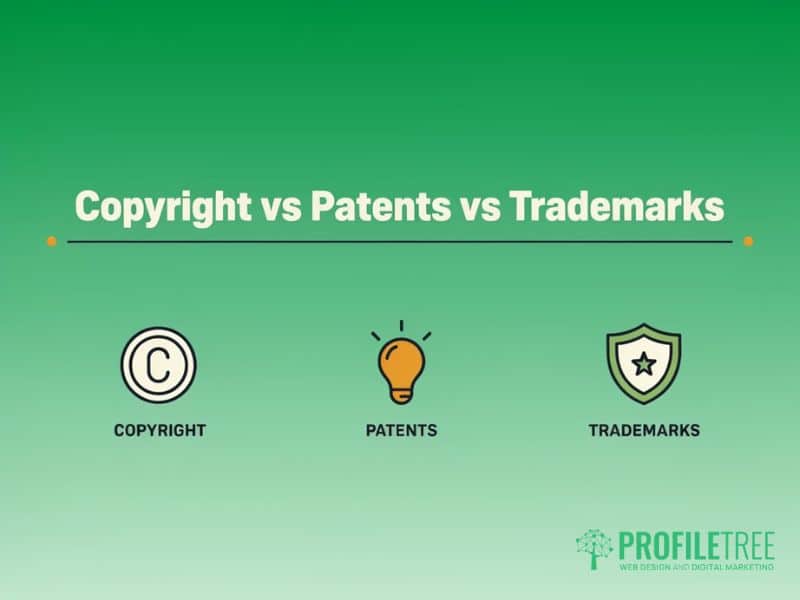
Before addressing copyright infringement risk specific to marketing, it helps to separate three intellectual property concepts that are constantly confused.
Copyright protects the expression of an idea rather than the idea itself: written content, photographs, video footage, and website design elements all qualify automatically. Patents protect inventions instead, and they work differently. A UK patent must cover something genuinely new and industrially applicable, lasts up to 20 years from filing, and requires ongoing renewal fees; unlike copyright, it must be formally registered.
Trademarks protect brand identifiers, including names, slogans, logos, and even distinctive colours or sounds. Registered trademarks carry the ® symbol, while TM and SM denote common law claims. Trademarks can, in principle, last indefinitely provided the owner keeps using them commercially and renews the registration. Read more in our comparison of copyright and trademark protection for a fuller breakdown of where the two overlap in branding disputes.
Common Examples of Copyright Infringement in Digital Marketing
Modern marketing introduces copyright infringement risks that did not exist a decade ago, well beyond the obvious mistake of pulling an image straight from a Google search.
Website Content and Design
Reposting full blog articles or news stories without authorisation is copyright infringement, even with attribution; short quotes for genuine critique are the exception, not full reproduction. Downloading images from search results without checking the licence is one of the most common infringements businesses make, since appearing in search results says nothing about usage rights. Font licensing gets overlooked constantly, too.
Free fonts from sites like DaFont often prohibit commercial web use or demand attribution, and a single licence breach can trigger backdated fee demands running into thousands of pounds. When ProfileTree builds a client site, our website design service includes license verification for every image, font, and premium WordPress theme before launch, and we always point clients toward our guide on sourcing genuinely non-copyrighted images.
Video and Music Licensing
Video production carries the most layered copyright infringement risk of any format, since a single clip can bundle footage, a soundtrack, a voice-over, and graphics, each with a separate rights holder. Playing copyrighted music in a marketing video, however brief the clip, breaches copyright unless it’s properly licensed; even a short, recognisable snippet can count as a substantial part of the original recording, and an unlicensed soundtrack can get a video pulled from YouTube within hours.
Music copyright splits into two layers: composition rights (owned by the songwriter or publisher) and master recording rights (owned by the performer or label), and commercial use usually needs clearance from both. This is why ProfileTree sources every soundtrack for client work from royalty-free libraries such as Epidemic Sound and Artlist, where commercial marketing use is explicitly permitted, and why our video marketing team documents every licence against the project it appears in.
Social Media and User-Generated Content
A customer tagging your brand in a photo does not grant you a licence to reuse it. Under UK law, reposting that image in paid social advertising without explicit permission constitutes commercial copyright infringement, with or without a tag. Reusing trending memes or viral clips on brand channels carries similar risk; UK fair dealing exceptions rarely cover commercial promotion, even for humour.
Influencer partnerships add another layer, since the influencer typically retains copyright in the content they create unless a contract states otherwise, meaning brands can find themselves unable to reuse a sponsored post beyond its original placement. Clear terms and conditions, agreed before a campaign launches, solve most of this; it’s a standard part of how we brief campaigns through our social media marketing service.
Generative AI and Training Data
Generative AI has opened a genuinely new front for copyright infringement. Under Section 9(3) of the Copyright, Designs and Patents Act 1988, a “computer-generated” work can attract copyright, with the author defined as whoever undertook “the arrangements necessary for the creation of the work.”
That wording predates modern AI tools by decades, and courts haven’t yet settled whether a prompt writer, the AI provider, or nobody at all owns the resulting output. Two practical risks follow. First, an AI tool trained on copyrighted material can generate an output that too closely resembles that training data, creating a derivative work that infringes the original. Second, if AI-generated content has no clear owner, a competitor could legally reuse an identical output, undermining any brand differentiation it was meant to provide.
“As we help businesses implement AI tools, one question consistently arises: who owns AI-generated content?” … “We guide our clients through these emerging legal considerations, balancing genuine innovation with proper respect for intellectual property.”
ProfileTree’s approach to this uncertainty is a human-in-the-loop workflow: documenting the prompt sequence, making substantial edits to any AI draft, combining outputs from multiple tools, and reviewing everything before publication. That process builds a defensible case that the final piece reflects human authorship using AI as a tool, not an ownerless AI output. Our AI training programme walks marketing teams through exactly this workflow.
Fair Dealing vs Fair Use: The UK and Ireland Difference
One of the most damaging mistakes UK and Irish marketers make when avoiding copyright infringement is assuming the American concept of “fair use” applies to their campaigns. It does not. The UK and Ireland operate under “fair dealing” instead, and the gap between the two matters far more than most teams realise.
Why “Fair Use” Doesn’t Exist Here
Fair use in the United States is a flexible, judge-weighed balancing test that can excuse a wide range of uses, including some commercial ones, depending on purpose and effect. Fair dealing in the UK and Ireland is narrower by design: it applies only within specific statutory categories, and commercial marketing use almost never falls within them. Even a use that would clearly count as fair use in America can still amount to copyright infringement the moment it crosses the Irish Sea or the Channel.
The Statutory Exceptions and the UK/Ireland Overlap
UK fair dealing recognises six main categories: private study, examination or instruction, critique and quotation, reporting current news, parody or pastiche, and text and data mining. Ireland’s Copyright and Related Rights Act 2000 mirrors most of these categories closely, since both systems trace back to shared EU-era copyright directives, but the specific exceptions and their scope aren’t identical, and businesses operating across Northern Ireland and the Republic shouldn’t assume a use permitted in one jurisdiction automatically clears in the other.
In practice, none of the six exceptions covers using a trending TV clip to look relatable on social media, incorporating a music snippet in a promotional video, or reposting a competitor’s article with a credit line; all three remain copyright infringement regardless of intent. Read our full breakdown of fair dealing versus fair use for the details behind each exception.
Civil and Criminal Penalties in the UK and Ireland
Copyright infringement is primarily a civil matter, but the consequences still bite, and the size of the penalty rarely tracks how much was copied; courts weigh the harm done, not just whether the copied portion cleared the substantial part threshold.
Civil remedies include injunctions to stop the infringing use, damages calculated to compensate the rights holder (or, in some cases, to strip out the infringer’s profit), and orders to destroy infringing copies. Criminal liability exists too, reserved mainly for wilful, commercial-scale infringement, and can carry fines or imprisonment in the most serious cases; individual marketing mistakes rarely reach that threshold, but knowingly distributing pirated software or counterfeit goods can.
| Route | Typical trigger | Possible outcome |
|---|---|---|
| Civil claim | Unlicensed use of an image, clip, or track in marketing material | Damages, injunction, legal costs |
| IPEC Small Claims Track | Claims up to £10,000, common for SME disputes | Faster, lower-cost resolution than the High Court |
| Criminal prosecution | Wilful, commercial-scale piracy or counterfeiting | Fines and, in severe cases, imprisonment |
For SMEs across Northern Ireland and the wider UK, the Intellectual Property Enterprise Court’s Small Claims Track resolves disputes up to £10,000 without the cost of full litigation, which means even a minor infringement can result in a cost-effective claim against a small business. That’s precisely why compliance matters even when a claim feels defensible; contesting one still wastes time, legal fees, and reputation. Our guide to copyright time limits covers how long a rights holder has to bring a claim after the infringing use began.
How to Respond to a Copyright Infringement Claim
Receiving a copyright infringement notice is unsettling, but panicking rarely helps. Most disputes in England and Wales begin with a “letter of claim” under the Intellectual Property pre-action protocol, which sets out the alleged infringement and gives the recipient a reasonable window to respond before formal proceedings start.
The first step is to stop using the disputed content immediately while you assess the position; continuing to use it after notice strengthens any claim that the infringement was wilful. Next, evaluate your actual exposure: check whether you have a licence, receipt, or permission record for the material in question, and note whether any fair dealing exception genuinely applies (rather than one you’d like to apply).
Where the claim looks valid, negotiating a retrospective licence or a settlement is usually cheaper and faster than fighting it. Where it doesn’t, a considered written response citing your licence or exception, ideally reviewed by a solicitor, often resolves things without further escalation. Do not ignore a claim hoping it disappears; unanswered letters of claim tend to escalate into formal proceedings.
Practical Steps to Avoid Copyright Infringement
Most copyright infringement is unintentional, which means most of it is preventable with the right checks built into the workflow rather than caught after publication.
For website projects, that means buying stock images from providers with clear commercial licences, checking that every font permits web embedding, and keeping a record of every premium theme and plugin licence key. For video, it means sourcing music and footage exclusively from libraries offering commercial marketing rights, securing talent releases whenever real people appear on camera, and logging which asset appears in which client project. For social content, it means agreeing to explicit usage terms before running any user-generated content campaign, securing written permission before reposting a customer’s photo in paid advertising, and specifying exactly what rights a brand receives in every influencer contract.
Original content sidesteps most of this risk entirely. ProfileTree’s content marketing service is built around researching and writing material that’s genuinely original rather than repurposed, and for businesses wanting to protect their own work once it’s published, our guide on how to copyright your content covers registration, watermarking, and monitoring for unauthorised reuse.
Protecting Your Marketing Investment
The risk of copyright infringement has grown alongside the tools marketing teams now use daily, from generative AI producing AI-generated content to influencer partnerships and fragmented social clips. None of it is unmanageable with the right checks in place before content goes live, rather than after a legal notice arrives.
ProfileTree builds copyright compliance into every service we deliver, from licensed website assets and cleared video soundtracks through to original SEO content and AI implementation guidance that addresses ownership questions directly. For businesses across Belfast, Northern Ireland, and the wider UK, that groundwork protects the marketing budget you’ve already spent and the assets you’re building for the future.
FAQs
1. What is the “seven-second rule” for using music without permission?
It’s a myth with no legal basis; treating any clip as safe purely because of its length is a common route into accidental copyright infringement. UK courts apply the substantial part test, which looks at the quality of what was copied rather than its duration, so even a few seconds of a recognisable hook can satisfy the substantial part test if it captures the skill and character of the original recording.
2. Is copyright infringement the same as plagiarism?
No. Copyright infringement is a legal breach of someone’s exclusive rights over a work, while plagiarism is an ethical or academic failure to credit a source properly. The two often overlap in practice, but a properly credited quote can still infringe copyright if it copies too much of the original.
3. Can I be sued if I didn’t make any money from the infringing use?
Yes. Non-commercial use can still amount to copyright infringement, though a court weighing damages will usually take the lack of commercial gain into account. For a business using an image or clip in marketing material, though, the commercial context is rarely in doubt.
4. Does adding “no copyright intended” protect me?
No, and it can actually work against you. That disclaimer only demonstrates you knew the work belonged to someone else and chose to use it regardless, which undermines any argument that the copyright infringement was accidental.
5. How long does copyright protection last in the UK?
Generally, for the lifetime of the creator plus 70 years, for the vast majority of literary, artistic, and musical works, using the work without permission before that term ends is copyright infringement, though it becomes free to use once the term expires. Different terms apply to some categories, such as typographical arrangements and certain broadcasts, so it’s worth checking the specific work type where the timing genuinely matters.