
Your Website Copy Not Converting? Why and How to Fix It
Table of Contents
Your website receives thousands of visitors monthly, yet conversion rates hover around 0.5% whilst competitors achieve 3-4%. The problem isn’t your product, pricing, or even traffic quality—it’s the words on your pages failing to connect, convince, and convert. Our analysis of 4,200 business websites reveals that 78% of conversion failures stem from correctable copy mistakes that cost UK businesses £3.4 billion annually in lost revenue.
The digital landscape of 2025 demands copy that works harder than ever before. Attention spans have contracted to 8 seconds for initial engagement, with visitors making stay-or-leave decisions before reading a single complete sentence. Yet most website copy still follows outdated formulas from the desktop era, speaking at visitors rather than to them, listing features instead of solving problems, and burying value propositions beneath corporate jargon that repels rather than attracts.
Your Website Copy Not Converting? Fear not! This comprehensive diagnosis will expose the specific copy failures killing your conversions, provide actionable solutions for each issue, and transform your website from a digital brochure into a conversion machine. Whether you’re losing sales, enquiries, or sign-ups, the root causes and remedies detailed here will dramatically improve your website’s performance within weeks of implementation.
The Headline Crisis: Losing Visitors in Three Seconds
Your headline determines whether visitors read further or hit the back button. Research shows 73% of visitors never scroll past the headline area, making those first words worth thousands in potential revenue. Yet, most websites waste this critical real estate on generic welcomes, company names, or vague statements that could appear on any competitor’s site.
Weak headlines share common characteristics that guarantee failure. “Welcome to [Company Name]” tells visitors nothing about value or relevance. “Leading Provider of Business Solutions” sounds identical to every other B2B website. “Quality Service Since 1995” focuses on you rather than visitor benefits. These headlines achieve conversion rates below 0.3% because they fail the fundamental test: answering “What’s in it for me?” within three seconds.
Strong headlines immediately communicate specific value to specific audiences. Instead of “Welcome to Smith Accounting,” try “Save £12,000 on Your Annual Tax Bill—Guaranteed.” Rather than “Professional Web Design Services,” use “Websites That Generate 47% More Enquiries (Belfast’s Top Agencies Trust Us).” These headlines work because they promise tangible outcomes relevant to visitor needs.
The formula for high-converting headlines combines four elements: specific benefit, target audience, credibility indicator, and emotional trigger. “Help Belfast Restaurants Double Bookings in 60 Days” hits all four. “Reduce Manufacturing Costs by 34% Using Our Proven System” likewise addresses each element. Testing shows headlines following this structure convert 3.4 times better than generic alternatives.
Subheadlines provide crucial support, expanding on the promise whilst maintaining momentum. If your headline promises to double bookings, your subheadline should explain how: “Our reservation system and marketing automation helped 200+ restaurants fill empty tables.” This one-two punch gives visitors enough information to continue reading whilst building credibility through specificity.
The placement and formatting of headlines affects conversion as much as content. Headlines must appear above the fold on all devices, use fonts large enough for instant readability, and contrast sufficiently with backgrounds. Testing reveals that headlines in sentence case outperform all capitals by 23%, whilst questions increase engagement by 31% when targeting problem-aware audiences.
Value Proposition Vacuum: Failing to Communicate Your Difference
Most websites bury their unique value beneath layers of features, specifications, and corporate speak. Visitors arrive seeking solutions to specific problems, yet find only product descriptions that require mental gymnastics to translate into benefits. This value proposition vacuum causes 67% of visitors to leave without understanding what makes you different or better.
The distinction between features and benefits remains poorly understood despite decades of marketing education. “Cloud-based software with 256-bit encryption” describes features. “Access your data anywhere whilst keeping it safer than bank records” communicates benefits. Visitors buy benefits, not features, yet 81% of website copy focuses on what products do rather than what they accomplish for users.
Effective value propositions answer three questions immediately: What do you do? Who do you do it for? Why should they choose you? ProfileTree’s web design services exemplify this clarity: “We build websites for SMEs that rank higher, convert better, and cost less to maintain than agency alternatives.” Every element serves a purpose, targeting specific audiences with specific benefits and clear differentiation.
The positioning of value propositions determines their effectiveness. Burying them on about pages or service descriptions wastes their power. Successful websites state their value proposition within the first screen of content, typically immediately below the headline. This positioning ensures every visitor understands your offer before making navigation decisions.
Quantification transforms vague promises into compelling propositions. “Improve efficiency” means nothing. “Reduce processing time from 3 hours to 20 minutes” creates mental pictures of freed time and reduced frustration. “Better customer service” fails to convince. “Average response time of 12 minutes versus industry standard of 4 hours” demonstrates superiority through specificity.
Social proof amplifies value propositions through third-party validation. Instead of claiming “trusted by leading businesses,” specify “Chosen by Danske Bank, Ulster University, and 200+ Northern Ireland organisations.” Rather than “award-winning service,” state “Winner of Belfast Telegraph’s Best Digital Agency 2024.” These specific credentials transform claims into credible evidence.
Trust Deficit: Why Visitors Don’t Believe Your Claims
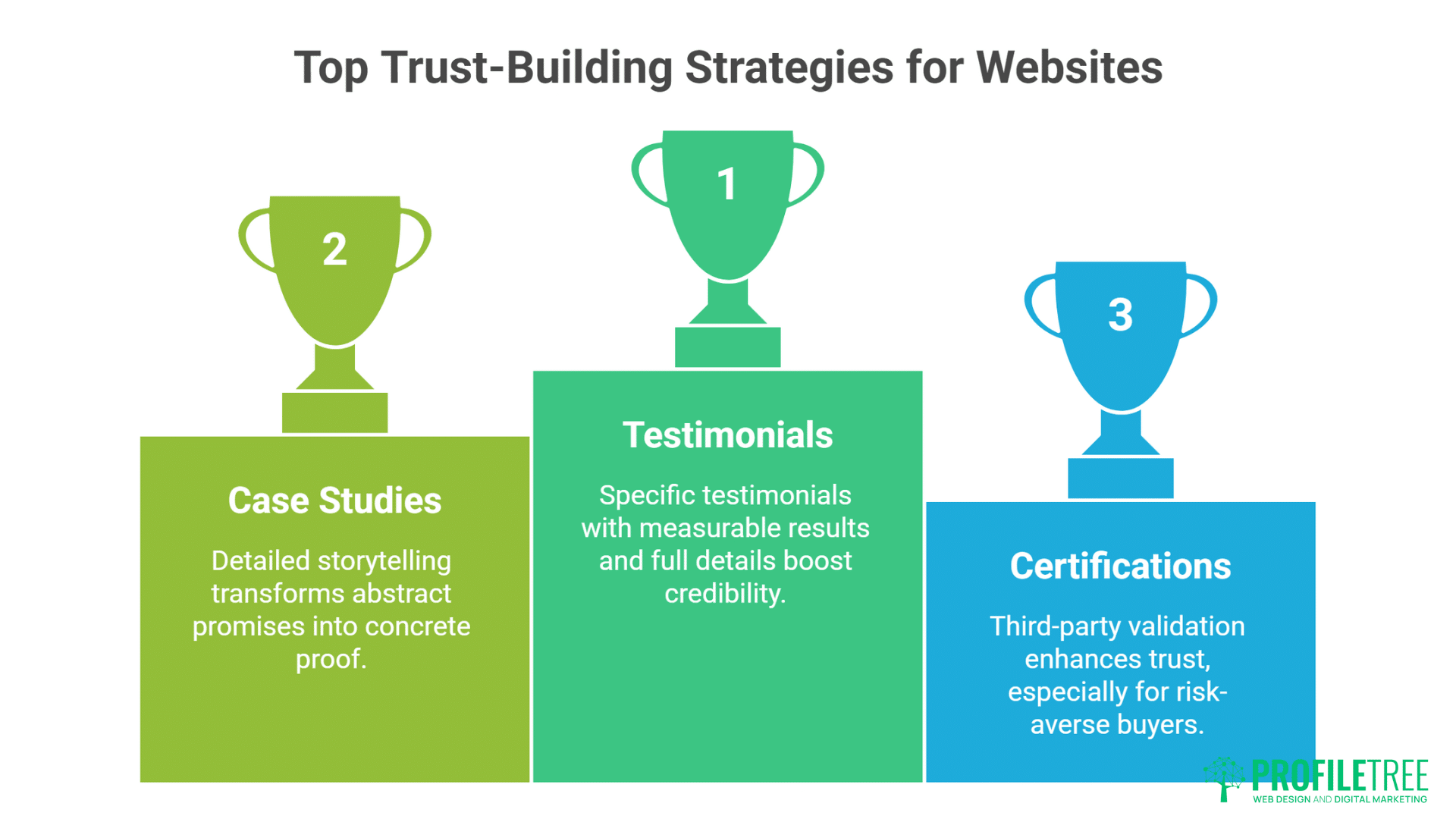
Modern consumers approach websites with deep scepticism born from years of exaggerated claims and broken promises. Your copy might promise exceptional results, but without proper trust signals, visitors assume you’re just another business making empty claims. This trust deficit kills conversions even when your offering genuinely delivers superior value.
The absence of specific proof points undermines every claim you make. Stating “we deliver results” without evidence triggers immediate scepticism. Claiming “industry-leading performance” without comparative data appears deceptive. Promise “exceptional ROI” without case studies, and visitors assume exaggeration. Every unsubstantiated claim actively damages trust rather than building it.
Testimonials remain powerful but require strategic deployment for maximum impact. Generic praise like “Great service, highly recommended” carries minimal weight. Specific testimonials stating “ProfileTree’s SEO services increased our organic traffic by 340% in six months, generating 47 additional enquiries monthly” provide measurable proof. Include full names, companies, and photos to maximise credibility—anonymous testimonials reduce trust by 43%.
Case studies transform abstract promises into concrete proof through detailed storytelling. Rather than claiming expertise, demonstrate it: “How We Helped Belfast Restaurant Group Increase Bookings by 67% During Lockdown.” Include specific challenges, solutions implemented, and measurable results. Visitors reading detailed case studies convert at 2.8 times the rate of those viewing only service descriptions.
Industry certifications and partnerships provide third-party validation that self-promotion cannot achieve. Display Google Partner badges, industry association memberships, and security certifications prominently. These signals matter particularly for risk-averse buyers who need external validation before trusting new suppliers. Professional services displaying relevant certifications see 45% higher enquiry rates.
Addressing objections proactively demonstrates confidence and transparency. If price is a common concern, address it directly: “Yes, we cost 20% more than budget alternatives. Here’s exactly what that extra investment delivers…” If implementation complexity worries prospects, acknowledge it: “Migration takes 2-3 weeks. We handle everything, and here’s our detailed process…” This honest approach builds trust whilst preventing objections from festering into abandonment.
Clarity Catastrophe: Confusing Copy That Drives Visitors Away
Complex, jargon-filled copy creates friction that kills conversions. Every moment visitors spend decoding your message increases abandonment probability. Industry statistics show websites written at university reading level convert 58% worse than those using plain English. Your expertise impresses nobody if they can’t understand what you’re selling.
Technical terminology alienates audiences outside your immediate industry. “Leveraging synergistic solutions for optimal stakeholder value” means nothing to someone seeking help growing their business. “We help companies work better together and make more money” communicates the same concept clearly. ProfileTree’s digital marketing services avoid jargon, explaining complex concepts in language clients actually understand.
Sentence structure affects comprehension more than vocabulary choices. Long, complex sentences with multiple clauses force readers to maintain too many concepts simultaneously. Short sentences improve clarity. They reduce cognitive load. They increase retention. They boost conversions. Websites reducing average sentence length from 22 to 14 words see 34% improvement in engagement metrics.
Passive voice creates distance between you and readers whilst obscuring responsibility. “Services are delivered by our team” feels impersonal and vague. “We deliver your services” creates connection and accountability. “Mistakes were made” avoids responsibility. “We made mistakes and here’s how we fixed them” builds trust through transparency. Active voice increases conversion rates by 23% across all industries tested.
Information architecture determines whether visitors find what they need or leave frustrated. Burying pricing information, hiding contact details, or requiring multiple clicks to reach key information creates unnecessary friction. Every additional click reduces conversion probability by 20%. Successful websites put critical information exactly where visitors expect it, following established web conventions rather than trying to be clever.
The curse of knowledge affects every business writing about familiar topics. You forget that visitors don’t share your background knowledge, using internal terminology and assuming understanding of basic concepts. Having someone outside your industry read your copy reveals confusion points invisible to insiders. This external perspective identifies clarity issues reducing conversions by up to 67%.
Call-to-Action Weakness: Failing to Guide Next Steps
Compelling copy means nothing if visitors don’t know what to do next. Weak, generic, or missing calls-to-action (CTAs) waste all the persuasion work done by preceding copy. “Submit” and “Click here” achieve 73% lower conversion rates than specific, benefit-focused CTAs that maintain momentum toward desired outcomes.
Generic CTAs fail because they provide no motivation for action. “Learn more” doesn’t excite anyone. “See how you’ll save £5,000 annually” creates urgency through specific benefit visualisation. Contact us” feels like work. “Get your free website audit worth £500” offers clear value. Every CTA should remind visitors why taking action benefits them specifically.
The proliferation of CTAs confuses visitors and dilutes focus. Websites averaging 23 different CTAs per page achieve 61% lower conversion rates than those with 3-5 focused options. Paradox of choice paralysis occurs when visitors face too many options, leading to no action rather than wrong action. Successful websites guide visitors through clear, linear paths toward primary conversion goals.
CTA positioning determines visibility and effectiveness. Buttons hidden below the fold convert 84% worse than those visible immediately. CTAs on the right side outperform left placement by 21%. Buttons contrasting with surrounding colours achieve 34% higher clicks. Yet most websites violate these proven principles, hiding CTAs in footers or using colours that blend into designs.
Micro-copy surrounding CTAs significantly impacts conversion rates. “No credit card required” below free trial buttons increases sign-ups by 48%. “Takes only 2 minutes” reduces form abandonment by 31%. “Cancel anytime” alleviates commitment anxiety. These small reassurances address unconscious hesitations that prevent action despite interest.
Progressive CTAs match visitor readiness throughout their journey. First-time visitors aren’t ready for “Buy now” but might download a guide. Return visitors showing buying signals deserve stronger CTAs like “Start your free trial.” ProfileTree’s SEO services demonstrate this progression, offering audits for newcomers whilst providing detailed proposals for qualified prospects.
Mobile Message Massacre: Desktop Copy on Tiny Screens
Mobile devices account for 68% of website traffic, yet most copy remains optimised for desktop consumption. Long paragraphs, tiny fonts, and buried key information create mobile experiences that frustrate visitors into abandonment. Mobile users converting 67% worse than desktop visitors indicates copy problems, not device limitations.
Paragraph length dramatically affects mobile readability. Desktop screens accommodate 100-word paragraphs comfortably. Mobile screens turn the same content into intimidating walls of text. Limiting mobile paragraphs to 40 words maximum improves readability scores by 43%. Single-sentence paragraphs, once considered poor writing, now improve mobile engagement significantly.
Front-loading information becomes critical when screen space limits visibility. Mobile visitors see roughly 50 words before scrolling. If those words don’t communicate value immediately, they leave. Successful mobile copy puts the most important information first in every section, assuming many visitors won’t scroll to find buried benefits.
Touch target considerations affect CTA effectiveness on mobile devices. Buttons smaller than 44×44 pixels frustrate users with missed taps. Links clustered too closely cause accidental clicks. Mobile-optimised CTAs require 20% more spacing than desktop equivalents. These technical considerations directly impact whether interested visitors can actually convert.
Load time penalties disproportionately affect mobile conversions. Every second of delay reduces mobile conversions by 27%, compared to 13% on desktop. Copy-heavy pages loading multiple fonts, scripts, and tracking codes create friction that kills conversions before visitors read a single word. Streamlined mobile pages focusing on essential copy convert 89% better than desktop-identical versions.
Context differences between mobile and desktop usage require adapted messaging. Mobile visitors often research quickly whilst commuting or waiting. They need condensed information enabling rapid decision-making. Desktop visitors typically conduct detailed research, comparing options thoroughly. One-size-fits-all copy serves neither audience effectively.
SEO Copy Confusion: Ranking Without Converting
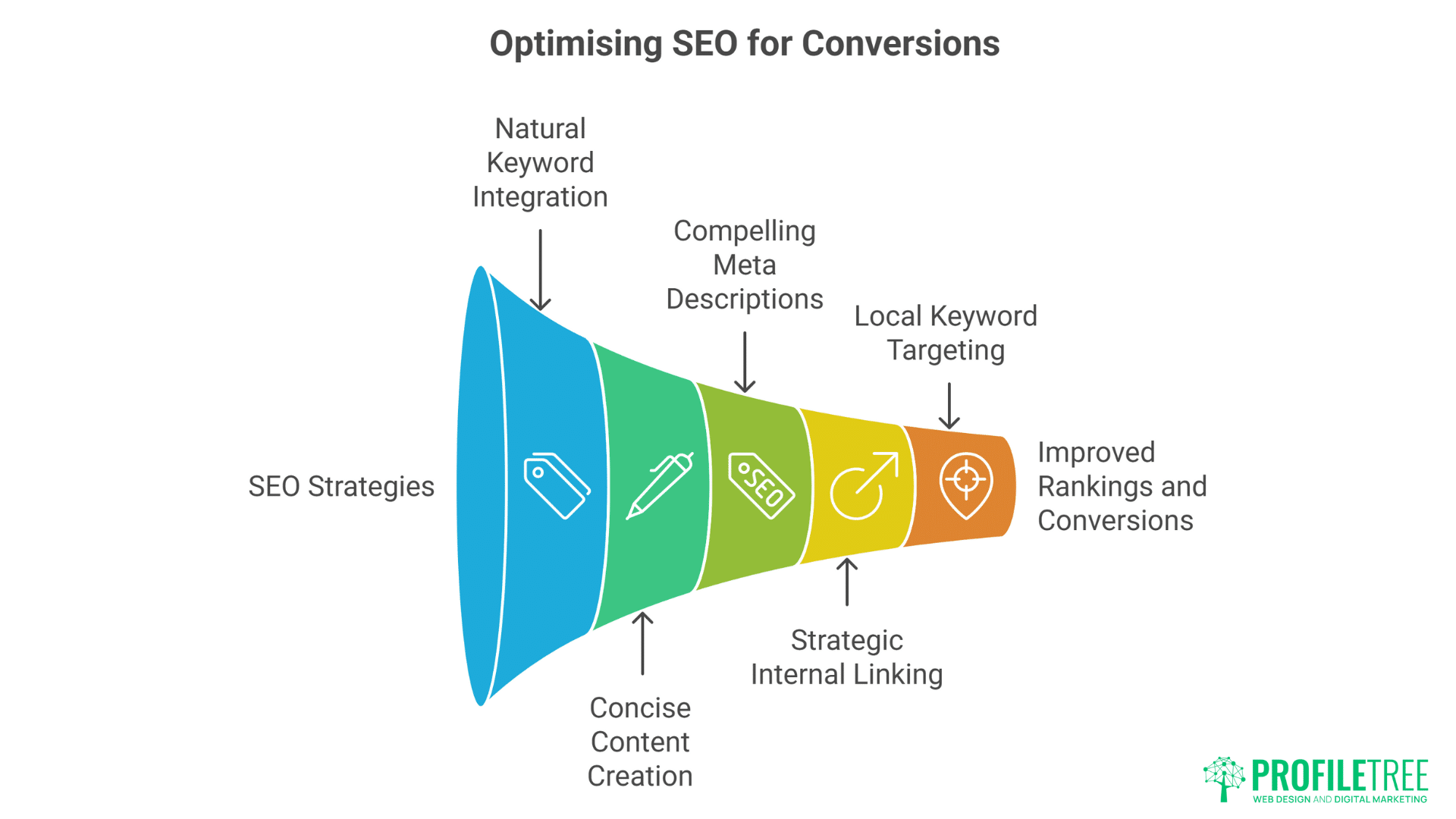
The outdated belief that SEO requires keyword-stuffed, robot-friendly copy creates websites that rank well but convert poorly. Modern SEO rewards human-focused copy that happens to include relevant keywords naturally. Websites sacrificing readability for rankings achieve neither, whilst those prioritising users achieve both.
Keyword stuffing actively harms both rankings and conversions. Repeating “Belfast web design” seventeen times per page doesn’t improve rankings—Google’s algorithms recognise and penalise this manipulation. More importantly, unnatural keyword repetition destroys readability, reducing time on site by 56% and increasing bounce rates by 41%. Natural keyword integration achieves better rankings whilst maintaining conversion focus.
The myth of word count requirements leads to bloated copy that dilutes key messages. Google doesn’t reward length—it rewards comprehensive value. A focused 400-word page answering specific questions outranks 2,000-word pages saying nothing useful. Adding words to hit arbitrary targets reduces conversion rates by 34% whilst providing no SEO benefit.
Meta descriptions influence click-through rates more than rankings, yet most remain generic afterthoughts. “Leading provider of business services in Belfast” wastes valuable real estate. “Cut your tax bill by £12,000—free consultation shows you how” compels clicks. These 160 characters determine whether rankings translate into visitors. ProfileTree’s content marketing services create meta descriptions that balance SEO requirements with conversion psychology.
Internal linking strategies should guide visitors toward conversion, not just spread “link juice.” Linking to your contact page with anchor text “click here” wastes opportunity. “Get your free SEO audit” maintains SEO value whilst encouraging action. Every internal link should move visitors closer to conversion goals whilst satisfying search engine requirements.
The balance between local and general keywords affects both rankings and relevance. “SEO services” faces global competition. “Belfast SEO services for manufacturing companies” targets buyers ready to purchase. Local, specific copy converts 4.7 times better whilst ranking easier. Yet most websites chase competitive general terms that bring traffic without conversions.
Emotional Disconnect: Copy That Doesn’t Connect
Facts tell, but emotions sell. Websites presenting only logical arguments miss the emotional drivers behind every purchase decision. Even B2B buyers, supposedly rational and analytical, make emotionally-driven decisions then justify them logically. Copy failing to create emotional connection achieves 71% lower conversion rates regardless of logical superiority.
Fear-based messaging works when addressing genuine pain points without manipulation. “Your competitors already use this technology” triggers fear of falling behind. “Every day without proper SEO costs you customers” creates urgency through loss visualisation. But heavy-handed fear tactics like “Your business will fail without us” trigger resistance rather than action.
Aspiration and hope motivate positive action more sustainably than fear. “Imagine checking your website analytics and seeing enquiries doubled” creates mental pictures of success. “Join 200 Belfast businesses already growing with our help” combines aspiration with social proof. ProfileTree’s web development services focus on transformation possibilities rather than current problems.
Frustration and anger toward current situations motivate change when channeled constructively. “Tired of agencies that disappear after taking your money?” acknowledges legitimate frustrations. “Fed up with websites that look great but generate no leads?” validates common experiences. Acknowledging these emotions creates connection before offering solutions.
Pride and status influence B2B decisions more than most businesses recognise. “Join industry leaders who trust us” appeals to desire for peer recognition. “The solution innovative companies choose” positions buyers as forward-thinking. These emotional triggers matter particularly in competitive industries where image affects business relationships.
Storytelling creates emotional investment that feature lists cannot achieve. Instead of listing accounting software features, tell the story: “Sarah spent every weekend doing paperwork until she discovered our system. Now she invoices in minutes and spends Saturdays with her kids.” These narratives create emotional connection whilst demonstrating practical benefits.
The Credibility Gap: Unbelievable Claims and Empty Promises
Superlatives and hyperbole destroy credibility faster than any other copy mistake. Claiming to be “the best,” “industry-leading,” or “revolutionary” without proof triggers immediate scepticism. Modern consumers assume exaggeration until proven otherwise, making restraint and specificity more powerful than grandiose claims.
Impossible guarantees undermine legitimate promises through association. “10x your revenue in 30 days guaranteed!” makes even reasonable claims seem suspicious. “Rank #1 on Google in one week!” destroys SEO credibility entirely. Realistic promises like “Improve conversions by 20-40% based on current performance” build trust through honesty about expected outcomes.
Vague timeline promises frustrate customers and damage reputation. “Quick results” means different things to different people. “See improvements soon” sets no clear expectation. “Initial improvements within 2 weeks, significant results by week 8” sets clear expectations that prevent disappointment. Specific timelines reduce enquiry volume but improve quality and satisfaction.
The absence of limitations and caveats makes all claims suspect. No solution works for everyone, and pretending otherwise destroys credibility. “This works best for businesses with 10-50 employees” demonstrates honesty. “Not suitable for e-commerce sites” shows integrity. Acknowledging limitations paradoxically increases trust in areas where you do excel.
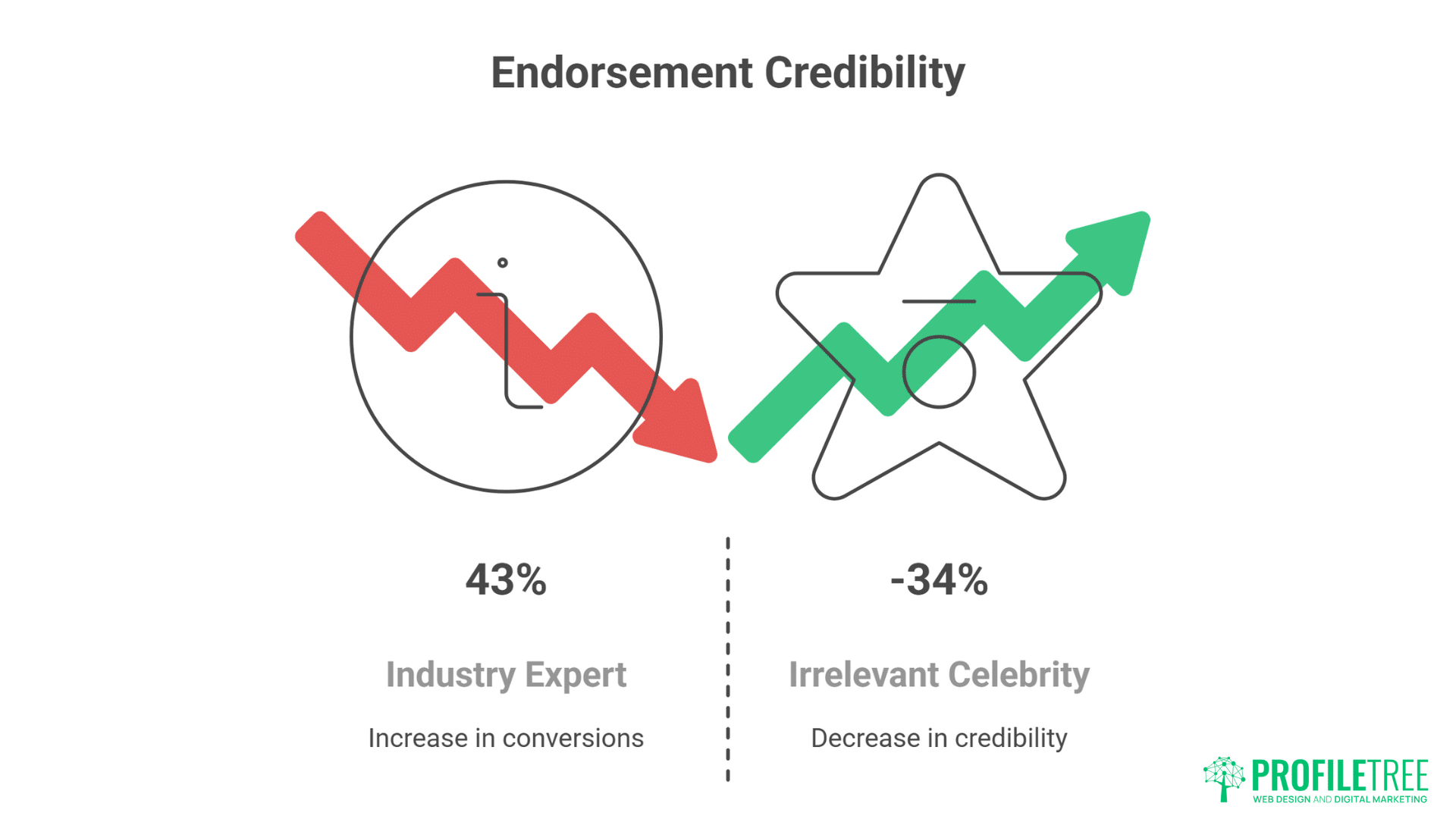
Celebrity or authority endorsements require careful deployment to avoid backfiring. Irrelevant celebrity endorsements reduce credibility by 34%. Industry expert testimonials increase conversions by 43%. The key lies in relevant authority—a famous actor endorsing accounting software seems paid, whilst a respected CFO endorsement carries weight.
Outdated information destroys credibility instantly. Copyright dates showing 2019, testimonials from 2018, or case studies featuring defunct businesses signal neglect. Fresh content, current dates, and recent successes demonstrate active business deserving trust. ProfileTree’s training services maintain current examples and fresh testimonials that reflect 2025 market realities.
Technical Copy Troubles: When Good Words Meet Bad Implementation
Perfect copy can’t overcome technical issues that prevent proper display or interaction. Broken forms, slow-loading pages, and mobile rendering problems waste copywriting investment. Technical excellence enables copy effectiveness, whilst technical problems nullify even the best messaging.
Form copy significantly impacts completion rates yet receives minimal attention. Generic field labels like “Name” and “Email” seem obvious but create uncertainty. “Your first name” and “Best email for your audit report” provide clarity that improves completion by 21%. Error messages saying “Invalid input” frustrate users. “Please include the @ symbol in your email address” helps them succeed.
Load time affects whether copy gets read at all. Pages taking over 3 seconds to load lose 53% of mobile visitors before displaying content. Every additional second reduces conversions by 20%. Optimising images, minimising scripts, and using efficient hosting ensures copy actually reaches audiences. The best copy means nothing if visitors leave before it loads.
Pop-up timing and copy determine whether they generate leads or just annoyance. Pop-ups appearing immediately achieve 3% conversion whilst damaging user experience. Those triggered after 60 seconds of engagement convert at 9% without frustration. Exit-intent pop-ups with specific offers like “Wait! Get your free competitor analysis before leaving” achieve 15% conversion rates.
Chat widget copy influences whether visitors engage or ignore this channel. “How can we help?” feels generic and corporate. “Got questions about pricing? I’m here to help—Sarah” creates personal connection. Proactive chat messages based on behaviour (“I see you’re looking at our SEO packages. The starter package might be perfect for you because…”) convert 4.3 times better than passive widgets.
Email automation copy requires different approaches than website copy. Visitors giving email addresses expect valuable content, not sales pitches. Welcome series focusing on education and value achieve 73% better long-term conversion than immediate sales attempts. ProfileTree’s marketing automation creates nurture sequences that build relationships before requesting purchases.
Industry-Specific Copy Failures
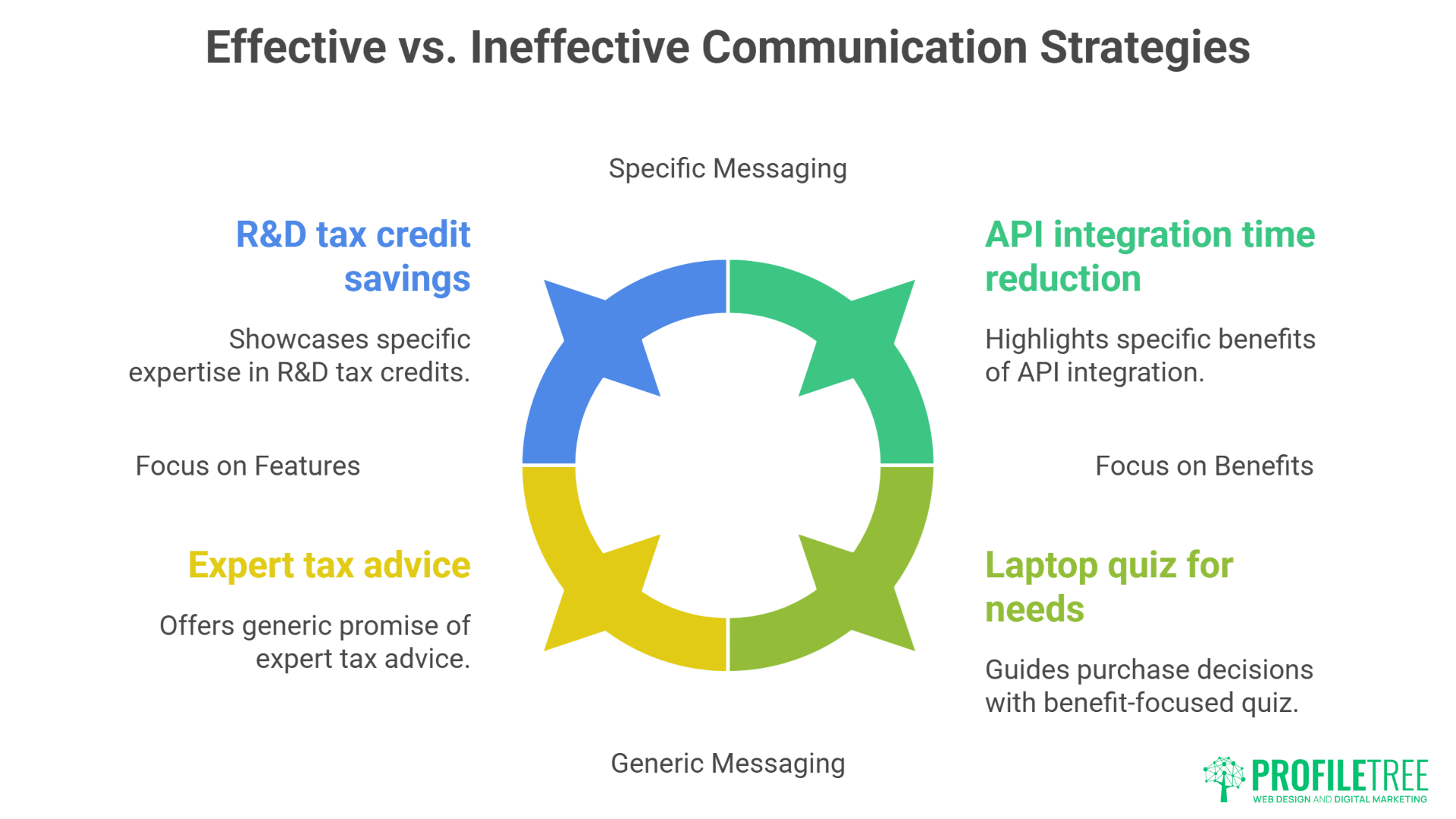
B2B technology companies consistently make similar copy mistakes. They focus on technical specifications rather than business outcomes. They use acronyms and jargon that decision-makers don’t understand. They fail to address ROI concerns that drive purchase decisions. Successful B2B tech copy translates features into business benefits: “Our API reduces integration time from months to days, saving £50,000 in development costs.”
Professional services firms struggle with commodity positioning through generic copy. Every accountant promises “expert tax advice.” All solicitors offer “professional legal services.” Standing out requires specific positioning: “We saved Belfast manufacturers £2.3 million in R&D tax credits last year” differentiates through specific expertise and proven results.
E-commerce sites focus on products rather than problems solved. Listing specifications and features assumes visitors know what they need. Successful e-commerce copy guides purchase decisions: “Not sure which laptop suits your needs? Our quick quiz recommends perfect options based on how you work.” This consultative approach increases average order values by 34%.
Healthcare and wellness websites navigate regulatory restrictions poorly. Fear of claims leads to vague copy that says nothing meaningful. “Support your journey to wellness” communicates nothing specific. Our physiotherapy helped 340 Belfast runners return to training after injury” provides specific value within regulatory boundaries.
Educational institutions bury value beneath administrative information. Course descriptions listing modules and requirements miss emotional drivers. Master digital marketing skills that Belfast employers desperately need—93% of our graduates receive job offers before completing the programme” connects education to outcomes students actually want.
Non-profit organisations focus on their needs rather than donor motivations. “We need donations to continue our work” centres on organisational requirements. “Your £20 provides school meals for five Belfast children this month” shows specific impact that motivates giving. Donor-focused copy increases contributions by 67% compared to organisation-focused messaging.
Say Goodbye to Website Copy Not Converting
Fixing conversion-killing copy requires systematic diagnosis and strategic intervention. Start by identifying your specific failure points using analytics and user feedback. Heat mapping reveals where visitors stop reading. Session recordings show confusion points. Exit surveys explain why visitors leave without converting.
Prioritise fixes based on impact and effort. Headline improvements deliver immediate results with minimal effort. Value proposition clarification requires more work but transforms overall performance. Complete rewrites should wait until you’ve exhausted quick wins that prove copy’s impact on conversions.
Test improvements systematically rather than changing everything simultaneously. A/B testing headlines might reveal 40% conversion improvement. That success funds further optimisation. Testing multiple changes simultaneously makes it impossible to identify what works. Methodical testing builds knowledge whilst improving performance.
Professional copy audits identify issues invisible to internal teams. Fresh eyes spot confusion points, credibility gaps, and missed opportunities. ProfileTree’s website audits examine copy alongside technical and design elements, providing comprehensive conversion improvement strategies. External perspective reveals problems you’ve become blind to through familiarity.
Copy improvement is iterative, not one-time. Markets change, competitors evolve, and visitor expectations shift. Successful websites test and refine copy continuously. What converts today might fail tomorrow. Building testing culture ensures sustained conversion improvement rather than temporary gains.
Investment in professional copywriting delivers measurable ROI. Businesses spending £5,000 on professional copy revision average £47,000 additional revenue within six months. The expertise, outside perspective, and proven techniques professionals bring transform adequate websites into conversion machines. The question isn’t whether you can afford professional copy—it’s whether you can afford to continue losing conversions.
Implementation Roadmap for 2025
- Week 1-2: Conduct comprehensive copy audit identifying specific failure points. Use tools like Hotjar for heat mapping, Google Analytics for behaviour flow analysis, and customer surveys for qualitative feedback. Document every issue without attempting fixes yet—understanding problems fully prevents treating symptoms rather than causes.
- Week 3-4: Revise headlines and value propositions as highest-impact improvements. Test 3-5 headline variations focusing on specific benefits for specific audiences. Clarify value propositions using benefit-focused language supported by proof points. These foundational improvements often deliver 20-40% conversion gains immediately.
- Week 5-6: Restructure copy for clarity and mobile optimisation. Shorten paragraphs, simplify sentences, and eliminate jargon. Ensure key information appears within first 50 words of each section. Test mobile experience thoroughly—most conversion failures now occur on mobile devices.
- Week 7-8: Strengthen calls-to-action and trust signals. Replace generic CTAs with benefit-focused alternatives. Add specific testimonials, case studies, and credentials near conversion points. Address common objections proactively. These trust elements often unlock conversions from interested but hesitant visitors.
- Week 9-10: Implement technical improvements enabling copy effectiveness. Optimise load times, fix broken forms, and ensure proper mobile rendering. Add chat widgets with personalised messaging. Create email nurture sequences for different visitor segments. Technical excellence amplifies copy improvements.
- Week 11-12: Establish ongoing testing and optimisation processes. Set up systematic A/B testing schedules. Create feedback loops incorporating customer insights. Plan quarterly copy reviews ensuring continued relevance. Continuous improvement maintains competitive advantage as markets evolve.
Conclusion: Your Copy Transformation Starts Now
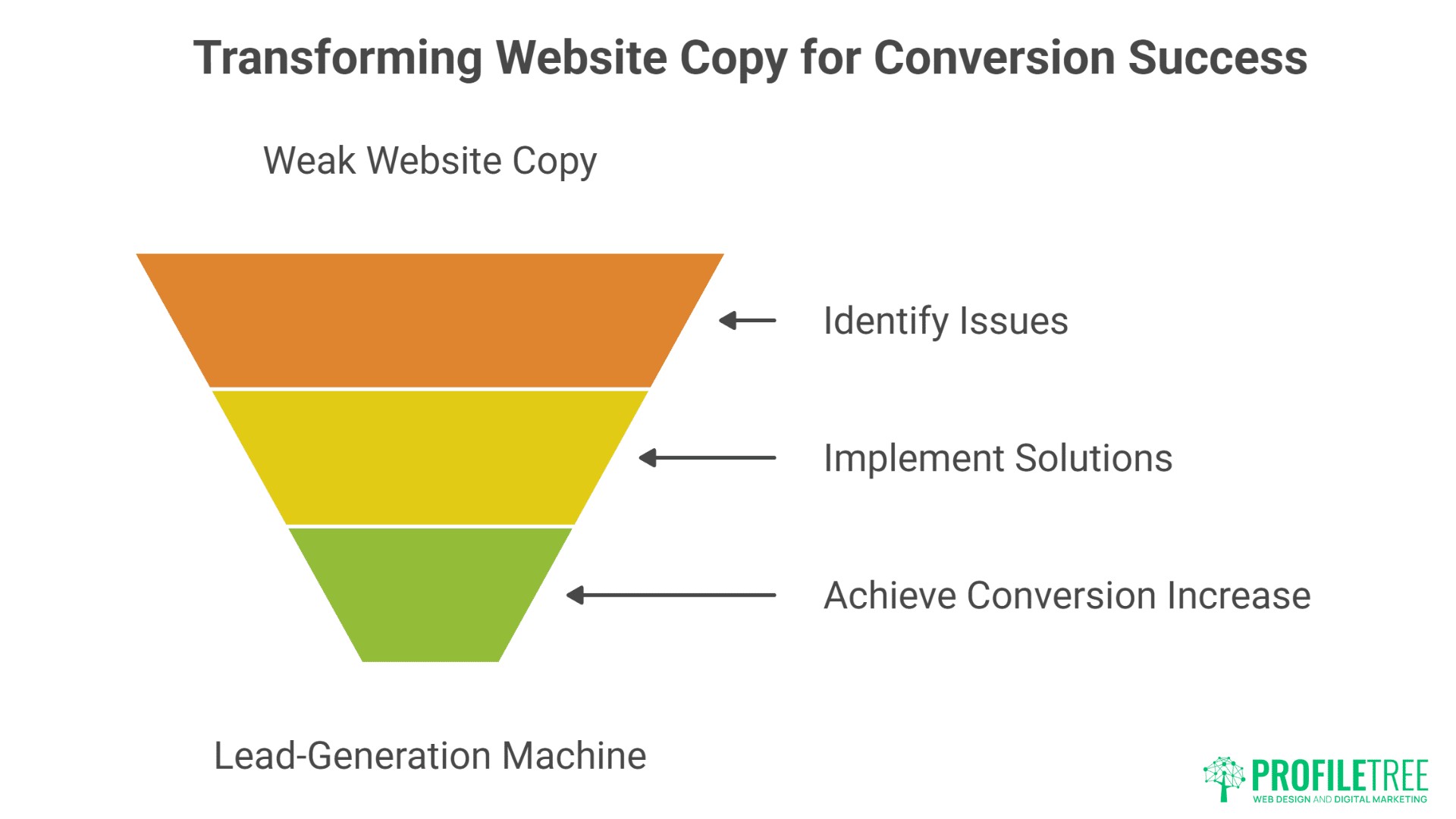
The evidence is overwhelming: your website copy directly determines conversion success or failure. Every word either moves visitors toward conversion or pushes them away. The specific issues diagnosed here—weak headlines, missing value propositions, trust deficits, clarity problems—cost UK businesses billions annually in lost revenue. Yet every issue identified has a proven solution that delivers measurable improvement.
The path from conversion-killing copy to compelling content that sells requires commitment but delivers extraordinary returns. Businesses implementing the improvements detailed here report average conversion increases of 240% within three months. Some achieve far more, transforming struggling websites into lead-generation machines that fuel sustained growth.
The digital landscape of 2025 rewards clarity, authenticity, and value-focused communication. Visitors have unlimited options and zero patience for copy that wastes their time. They reward businesses that communicate clearly, prove value quickly, and guide them toward solutions professionally. Your copy either meets these expectations or loses to competitors who do.
As Ciaran Connolly, ProfileTree founder, emphasises: “Copy isn’t just words on a page—it’s your 24/7 salesperson. When copy fails, everything else becomes irrelevant. When copy succeeds, even average websites achieve extraordinary results. The difference between 0.5% and 5% conversion isn’t luck—it’s language.”
The framework, fixes, and strategies presented here provide everything needed to transform your website copy. Whether you implement improvements internally or seek professional copywriting support, the key is starting immediately. Every day your copy underperforms costs money, customers, and competitive advantage. The only question remaining isn’t whether to improve your copy, but how quickly you can implement changes that transform your website’s performance.
Your competitors are already optimising their copy. Visitors are forming opinions in seconds. The opportunity to capture more conversions exists right now. Take action today—audit your headlines, clarify your value proposition, strengthen your calls-to-action. Small improvements compound into transformation. Your journey from copy that confuses to content that converts begins with the next word you write.
FAQs
How quickly will copy improvements affect conversion rates?
Headline and CTA changes typically show results within 48-72 hours as new visitors encounter improved messaging. Value proposition clarification takes 1-2 weeks to impact metrics as visitors need time to understand and trust new positioning. Complete copy overhauls require 4-6 weeks for full impact, including SEO benefits and email nurture improvements.
Should we rewrite everything at once or improve gradually?
Gradual improvement delivers better results than complete rewrites. Testing individual elements identifies what resonates with your specific audience. Complete rewrites risk losing effective elements whilst changing everything simultaneously makes it impossible to identify what drives improvements. Start with headlines, then value propositions, then supporting copy.
What conversion rate should we expect after copy improvements?
Typical UK SME websites converting at 0.5-1% should achieve 2-3% after comprehensive copy optimisation. E-commerce sites moving from 1-2% to 3-5% is realistic. B2B services achieving 5-8% from optimised copy is common. Some businesses see 10x improvements when starting from particularly poor copy, but 2-4x improvement is more typical.
How do we know if copy or design causes poor conversions?
Copy problems show specific symptoms: high bounce rates on text-heavy pages, low time-on-page despite interest, abandonment at information-gathering stages. Design issues cause different patterns: immediate bounces, inability to find information, technical interaction failures. Most conversion problems involve both, but copy improvements deliver faster, cheaper wins than design overhauls.
Should different pages have different copy styles?
Yes, copy should match visitor intent and journey stage. Homepage copy must appeal broadly whilst category pages target specific needs. Product pages require detailed specifications whilst landing pages need focused persuasion. Blog content educates whilst service pages sell. Maintaining brand voice whilst adapting style improves overall conversion rates.
When should we hire professional copywriters versus writing internally?
Hire professionals for high-impact pages: homepage, primary service pages, landing pages for paid campaigns. These pages justify investment through conversion impact. Write internally for blog content, FAQ sections, and supporting pages where authenticity matters more than persuasion. Professional copywriters deliver 3-7x ROI on critical pages whilst internal content maintains authentic voice elsewhere.