
Humanising AI Content: A Practical Guide for UK and NI SMEs
Table of Contents
AI output has a recognisable signature. Read enough of it and you will spot it within a sentence or two: the same overworked phrases, the symmetrical paragraph structure, the tone that sounds like nobody in particular. Marketing managers across the UK and Ireland are increasingly aware that publishing unedited AI output does not just fail to engage audiences. It actively signals to readers, and to Google, that no human expert stood behind the content.
Humanising AI content is not about avoiding AI tools. It is about treating AI output as a draft: raw material that requires skilled editing before it is ready to represent your brand. This guide covers what causes the robotic effect, how to correct it through smarter prompting and editing, and how to build a repeatable workflow that lets your team use AI tools without losing the brand voice your audience trusts.
Why Raw AI Content Is a Risk to Your Brand’s E-E-A-T
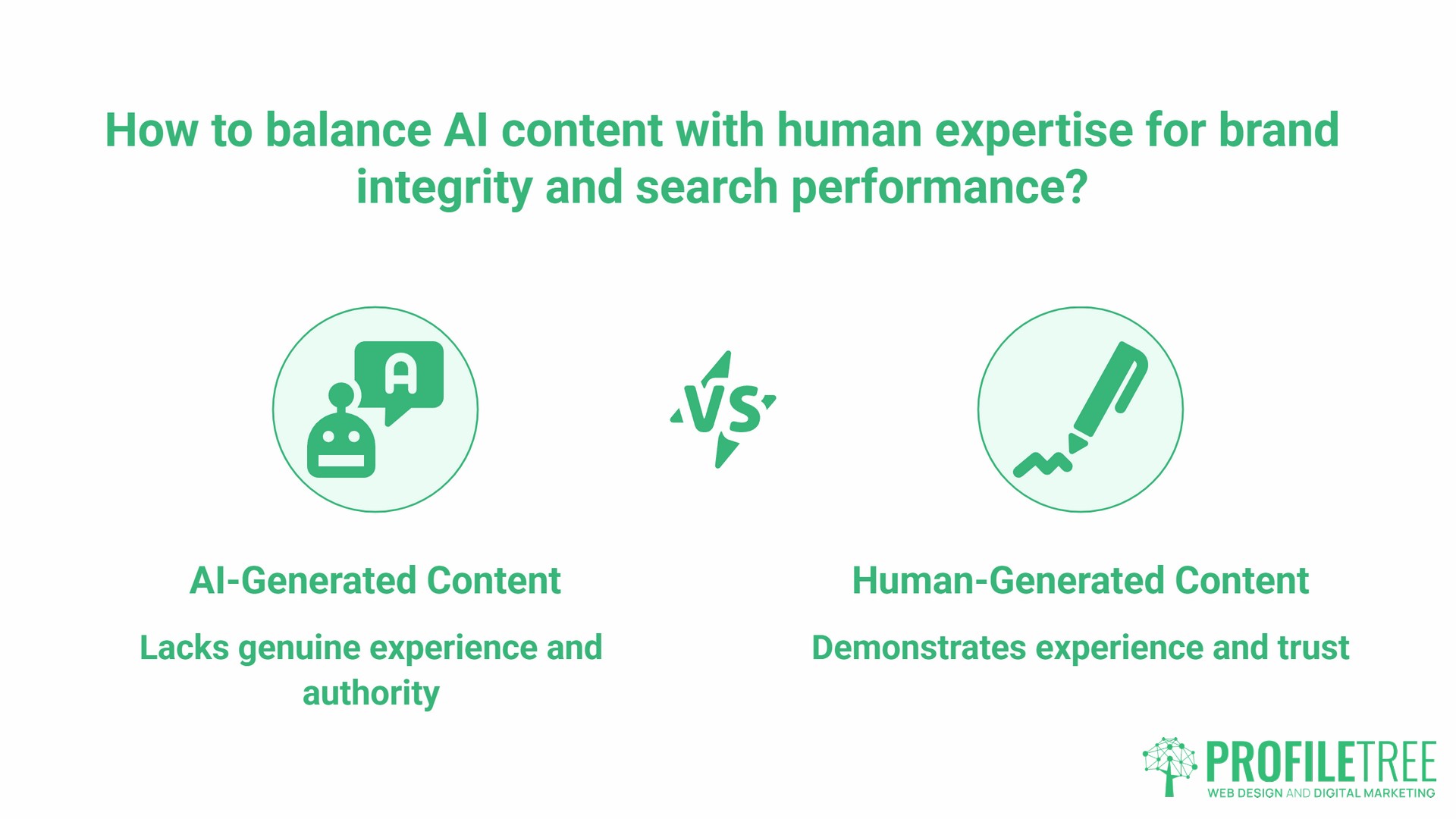
Google’s quality assessment framework, Experience, Expertise, Authoritativeness, and Trustworthiness (E-E-A-T), places particular weight on the Experience signal. According to Google’s Search Quality Rater Guidelines (last updated September 2025), this signal measures whether content reflects genuine first-hand knowledge. The guidelines were updated in December 2022 to add Experience to the existing framework, specifically to capture content that demonstrates “actual use of a product, having visited a place, or communicating personal experiences.”
AI models are trained on existing published content. They can synthesise patterns from that training data, but they cannot replicate the specific experiences, client conversations, or professional judgement that give content genuine authority.
This matters because Google’s quality raters are trained to look for this distinction. Content that covers a topic without demonstrating any experience of actually doing the thing tends to be at a disadvantage compared to content that includes specific processes, real outcomes, and the kind of nuanced caveats that only come from practice.
The risk is not just ranking performance. When a potential client in Belfast or Dublin reads your website copy, and it sounds like every other digital agency’s copy, your brand loses its distinctiveness at exactly the moment it needs to make an impression. Humanising AI content is, at its core, as much a brand integrity exercise as a search performance one.
The Five-Step Human-in-the-Loop Workflow
A structured review process prevents the most common problems with AI output and gives your team a repeatable approach that scales without sacrificing quality. This workflow is the foundation of humanising AI content at a professional level.
- Step 1: Strategic prompting. The quality of an AI output depends almost entirely on the specificity of the prompt. A vague brief produces generic copy. Before generating anything, define the audience (for example, “SME owners in Northern Ireland considering their first website redesign”), the purpose (inform, convert, build trust), the tone (direct, plain, no jargon), and any specific facts or angles the content must include. If you have a brand voice document, paste a relevant extract directly into the prompt.
- Step 2: Fact verification. AI models generate plausible-sounding text that sometimes includes statistics, claims, or attributions that are inaccurate. Every non-obvious factual claim in AI output must be verified against a named, verifiable source before publication. If a claim cannot be sourced, it should be removed rather than softened with vague hedging. ProfileTree’s approach to transparent content marketing treats this step as non-negotiable.
- Step 3: Narrative injection. This is where the human editor adds what AI cannot supply: a real example from client work, a specific observation about how a market is behaving, a professional opinion that takes a clear position. Even a single well-placed specific detail does more for E-E-A-T than three paragraphs of well-structured generic advice.
- Step 4: Tone alignment. Run the draft against your brand voice document and check it against your banned word list. AI output defaults to formal, promotional language patterns. Words like “seamless,” “robust,” and “game-changing” cluster together in AI output because they cluster together in the marketing content on which these models were trained. Replace them with plain, specific language. If the content is meant to sound like a Belfast digital agency talking to local business owners, it should read that way.
- Step 5: Compliance check. The UK’s Advertising Standards Authority (ASA) has confirmed that its Codes apply to all advertising content regardless of how it is created, including AI output published as marketing content. The Committee of Advertising Practice (CAP) advises marketers to ask whether the audience would be misled if AI involvement is not disclosed, and whether any claims made in the content can be substantiated. Content that includes unverifiable performance claims must either have those claims sourced or removed.
What Causes the Robotic Effect (and How to Fix It)
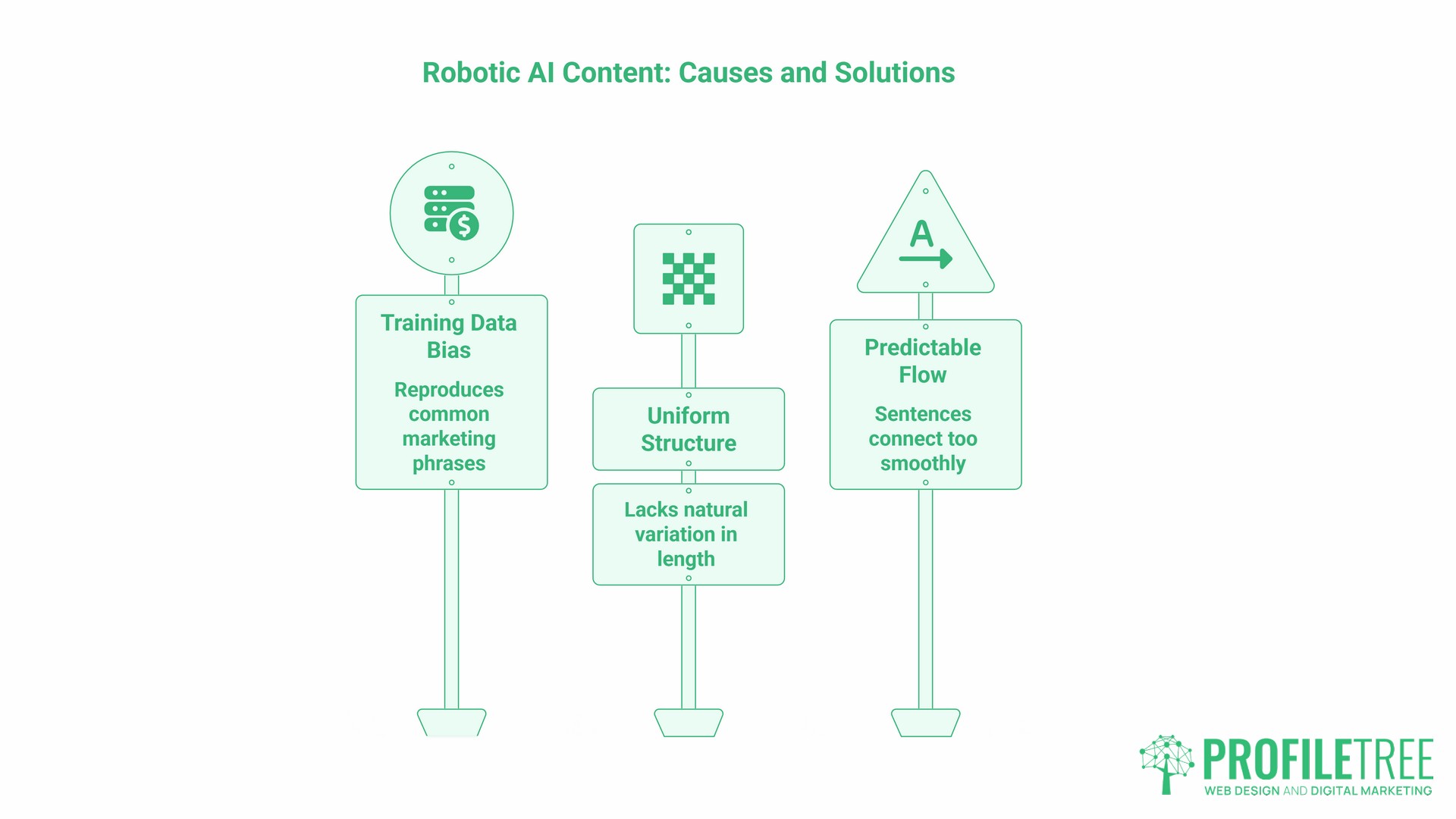
Understanding why AI content sounds the way it does is essential for humanising AI content effectively. AI language models are trained on vast corpora of existing text, including millions of marketing emails, blog posts, and corporate communications. The patterns most heavily represented in that training data are the patterns AI reproduces most reliably.
This is why phrases like “cutting-edge solutions,” “seamless integration,” and “unlock the potential” appear so often in unedited AI output. These phrases are statistically common in marketing content, so the model treats them as standard marketing language. Without explicit instruction to avoid them, AI defaults to these expressions.
The structural problem runs deeper than vocabulary. AI models tend to produce content with uniform paragraph lengths, symmetrical section structures, and an even distribution of information across headings. Human writing has natural variation: some sections are longer because the point is complex; some paragraphs are two sentences because the point is obvious; some ideas are left unresolved because that reflects honest uncertainty. This natural variation is one of the clearest markers that distinguish human from AI output.
When humanising AI content, the editing pass should deliberately introduce this variation. Break up symmetrical sections. Give more space to the points that matter more. Start some paragraphs with the conclusion rather than the setup. Use a short sentence where a long one would be expected.
A useful test: read the draft aloud. Robotic content has a detectable rhythm. It flows too smoothly, with every sentence connecting predictably to the next. Human writing occasionally catches, changes direction, and makes choices that a machine would not.
Training AI on Your Brand Voice
One of the most effective techniques for humanising AI content before editing begins is to give the model explicit guidance about your brand voice at the start of every prompt.
A brand voice document does not need to be lengthy. It needs to answer four questions: How does this brand speak? What does it never say? What examples exist of content that sounds right? Who is the audience and how does the brand relate to them?
For a Northern Ireland SME, that might look like this:
“Write in plain UK English. The audience is owners of small and medium-sized businesses in Northern Ireland, Ireland, and the wider UK. The tone is direct and practical: confident without being boastful, helpful without being patronising. Avoid words like ‘leverage,’ ‘optimise,’ ‘seamless,’ ‘robust,’ and any phrase that sounds like it came from a corporate press release. Use contractions naturally. Prefer specific examples and concrete outcomes over general claims. When discussing services, describe what actually happens, not how it feels.”
This kind of voice specification, pasted into the prompt before the content brief, produces noticeably better AI output than a bare topic instruction. It does not eliminate the editing pass, but it reduces the work required in steps four and five of the workflow above. ProfileTree’s guidance on brand voice consistency covers how to structure a voice document for ongoing use across a content team.
Writing Prompts That Produce Human-Sounding Output by Platform
Humanising AI content for social media requires additional specificity because each platform rewards different communication styles. A prompt that works for a LinkedIn post will not produce appropriate copy for Instagram. Approaching each platform with a tailored prompting strategy is one of the most practical ways to improve the quality of AI output for social media.
LinkedIn audiences expect content that demonstrates expertise without reading as a sales pitch. The prompt should clearly name the audience, specify a practical insight as the core of the post, and instruct the AI to write in first person, with a question at the end that invites genuine professional discussion rather than surface-level engagement.
Example prompt structure: “Write a LinkedIn post for a Belfast digital agency. The audience is SME owners who are sceptical about digital marketing claims. Share one practical insight about [topic] that a business owner could apply this week. Write in first person, avoid any promotional language, and end with a question that opens a real conversation.”
Instagram rewards visual storytelling and personality. The prompt needs to specify what the visual shows, what feeling the caption should create, and how the brand’s personality should come through. Hashtags should feel like part of the copy, not a list appended at the end.
Example prompt structure: “Write an Instagram caption for a photo of our team at a client planning session. The tone is warm and behind-the-scenes. Show personality without being unprofessional. Include one practical takeaway about [topic]. Place two or three relevant hashtags naturally within the text.”
X (formerly Twitter)
X rewards brevity and a clear point of view. The prompt should ask for a single observation or question, specify that the language should sound like a real person rather than a company account, and avoid any promotional framing.
For all three platforms, the principle of humanising AI content remains the same: specificity in the prompt reduces the gap between raw AI output and publishable copy.
For a full platform-by-platform prompting system, including the 4-P Framework and a batching workflow for repurposing one idea across five networks, see our guide to platform-specific AI prompts for social media.
Raw AI Output vs Human-Edited Content: A Comparison
The difference between unedited AI output and a human-reviewed version is visible at the sentence level. The table below illustrates what the process of humanising AI content actually changes.
| Element | Raw AI output | After human editing |
|---|---|---|
| Opening line | “In today’s digital landscape, businesses must leverage cutting-edge AI tools…” | “Most AI-generated copy has the same problem: it sounds like nobody wrote it.” |
| Statistics | Vague or unattributed (“studies show that…”) | Named and sourced, or removed entirely |
| Brand mention | Generic (“a leading digital agency”) | Specific (“ProfileTree, a Belfast-based web design and content agency”) |
| Sentence variation | Consistent 18-22 word sentences throughout | Mix of short and long; rhythm changes between sections |
| Tone | Formal and promotional | Conversational and direct |
| Specificity | General advice applicable to any business | Examples relevant to NI and UK SMEs |
The editing investment is real, but it is considerably smaller than writing from scratch. AI output is most useful as a first draft; the human editor’s job is to make it worth publishing.
Injecting Local Relevance for Northern Ireland and UK Audiences
AI models are primarily trained on US-produced content. Without explicit instruction, they default to American English spelling, US-centric cultural references, and market assumptions that do not apply to businesses in Belfast, Dublin, or Manchester.
For UK and Irish audiences, humanising AI content includes a localisation pass that covers spelling (colour not color, recognise not recognize, programme not program), currency (£ not $), cultural references (High Street not Main Street, VAT not sales tax), and regulatory context (UK GDPR and ASA guidelines rather than US equivalents).
Beyond spelling, localisation means grounding the content in the market your audience actually operates in. A Northern Ireland retailer thinking about a digital marketing strategy is not facing the same conditions as a retailer in California. Content that acknowledges the specific pressures of cross-border trade, the particular character of the Belfast business community, or the grant schemes available through Invest NI will resonate in a way that generic AI copy cannot.
This is a gap that most competing content on this topic fails to fill. The high-ranking guides from global SaaS providers cover the technical mechanics of humanising AI content but offer little insight into the UK or Irish market context. For a Belfast-based agency with direct experience of those markets, that local knowledge is a genuine competitive advantage in content.
Navigating UK Advertising Standards and AI Transparency
The ASA’s position on AI-generated content is clear. According to the Committee of Advertising Practice (CAP), existing advertising codes apply regardless of how content is created, edited, or targeted. Ads made using AI are subject to exactly the same standards as ads produced through any other process.
The specific guidance CAP has issued asks marketers to consider two questions before publishing AI-generated content. First, would the audience be misled if the use of AI is not disclosed? Second, if there is a risk of misleading, would disclosure clarify or contradict the overall message? CAP also states explicitly that disclosure alone cannot remedy fundamentally deceptive messaging. An inaccurate claim in AI output does not become acceptable simply because the copy carries a note indicating that AI was involved in its writing.
The practice of ethical digital marketing matters here beyond regulatory compliance. AI content that includes unsubstantiated claims damages the brand’s credibility with the audience that matters most: the potential clients evaluating whether to trust this company with their marketing budget.
On disclosure more broadly, current UK best practice is to be transparent when AI has played a significant role in content creation, particularly in contexts where the audience might reasonably expect human authorship. This does not mean labelling every AI-assisted blog post, but it does mean avoiding the impression that content reflects first-hand human experience when it does not.
How ProfileTree Approaches Human-Led AI Content Strategy
ProfileTree, a Belfast-based web design and digital marketing agency, works with SMEs across Northern Ireland, Ireland, and the UK to develop AI content strategies that keep the human editorial layer central to the process.
“The businesses getting the best results from AI content tools are not the ones using the most sophisticated models,” says Ciaran Connolly, founder of ProfileTree. “They’re the ones who have invested in understanding their brand voice clearly enough to brief an AI effectively, and who have an editing process that catches what the AI gets wrong before it goes anywhere near a customer.”
Humanising AI content is not a single task but an ongoing discipline. ProfileTree’s AI prompts for business resource cover practical prompt structures for common business content needs. For teams that want to understand how AI detection tools assess content quality, the AI content detection guide explains what these tools actually measure.
For SME marketing teams that want to build this capability internally, ProfileTree’s digital training programme covers AI content tools, prompt engineering, and brand voice development as part of a practical curriculum designed for non-technical marketing professionals. The training is available through ProfileTree Academy and through the Future Business Academy programme.
Measuring Whether Your Humanisation Process Is Working
Engagement quality is the most useful signal for whether humanising AI content is making a difference. The metrics to watch are not likes or shares in isolation, but comment quality, conversation depth, and whether new followers engage with more than one piece of content over time.
On organic search, E-E-A-T improvements tend to show up gradually. A page that demonstrates genuine experience and expertise does not jump to position one overnight. But pages that consistently fall short of the quality standard will plateau or decline, while pages that meet it tend to show slow, stable improvement over time.
The clearest short-term signal is direct audience feedback. If LinkedIn posts generate replies from people who genuinely find the insight useful, rather than polite acknowledgements, the tone is working. If a potential client mentions something they read on your blog during a first conversation, the content is doing what it should.
Frequently Asked Questions
How do I tell if my AI content sounds too robotic?
Read it aloud. Robotic content has a detectable rhythm: every sentence is roughly the same length, every paragraph follows the same structure, and transitions between ideas are too clean. If it flows without a single surprise or catch, it almost certainly reads as AI output rather than human writing. The more practical test is to ask whether any sentence in the piece could only have been written by someone with direct experience of this topic. If the answer is no throughout, the content lacks the experience signal that Google and human readers look for. Humanising AI content means addressing exactly this gap.
Will AI content hurt my Google ranking?
Not automatically. Google’s guidance makes it clear that the issue is whether the content is helpful to the reader, not whether AI was involved in producing it. AI output that has been properly reviewed, fact-checked, and edited to reflect genuine expertise can rank well. Unedited AI output that is thin, inaccurate, or generic will underperform regardless of how it was produced. The question is not “did AI write this?” but “is this actually useful?”
What are the most common AI words and phrases to remove?
The high-frequency offenders include: leverage, seamless, robust, cutting-edge, game-changing, innovative, transformative, unlock, harness, elevate, foster, and ecosystem. Beyond individual words, watch for trailing “-ing” phrases that puff up significance without adding information, such as “reflecting the continued importance of…” or “emphasising the need for…”. These should be cut entirely. If the point is worth making, make it directly. This is one of the core disciplines of humanising AI content.
Do I need to tell people if I used AI to write my content?
According to the UK’s ASA and the Committee of Advertising Practice (CAP), there is no blanket legal requirement to disclose AI involvement in standard marketing content. However, CAP advises that marketers should ask whether the audience would be misled if AI use is not disclosed. Where AI output is presented as original expert opinion, that question matters most. If a piece is presented as a first-person professional opinion or a case study based on direct experience, but was generated by AI without that grounding, it is misleading and damages trust.
How do I maintain brand consistency across AI output?
Build a brand voice document and include a relevant extract in every prompt. The document should cover your preferred register (formal or conversational), words and phrases you never use, a sentence or two describing your audience relationship, and two or three examples of existing content that sounds right. Update it when content performance data tells you something is not resonating. The goal is not a static rulebook but a living reference that reflects what actually works.
What is the best tool for humanising AI content?
Skilled human editing. Detection-bypass tools and “AI humaniser” services that algorithmically rephrase content address only the surface pattern rather than the underlying problem. Content that genuinely reflects expertise, specific experience, and a clear point of view does not need to be processed through a secondary tool. The investment in a proper editorial layer produces content that is better for readers and more durable for search performance than content paraphrased to avoid detection. Humanising AI content is ultimately an editorial process, not a technical one.