
Ubersuggest Hacks: A Practical SME Guide to Smarter SEO
Table of Contents
Ubersuggest is one of the few SEO tools that genuinely suits a small or medium business budget. Free-tier access, low-cost lifetime plans, and a straightforward dashboard make it a practical starting point for keyword research, site audits, and competitor analysis, without the hefty monthly outlay of enterprise platforms.
But most guides covering Ubersuggest hacks read like an uninspired software manual. This one is different. ProfileTree, a Belfast-based digital marketing agency, works with SMEs across Northern Ireland, Ireland, and the UK to stretch limited marketing budgets as far as possible. That hands-on experience with lean budgets is what shapes every recommendation in this guide.
Rather than listing features, the focus here is on the specific workflows that actually move the needle for SMEs operating in the UK and Irish markets, and on being transparent about where Ubersuggest’s data requires cross-referencing before you act on it.
What Ubersuggest Actually Is (And What It Isn’t)
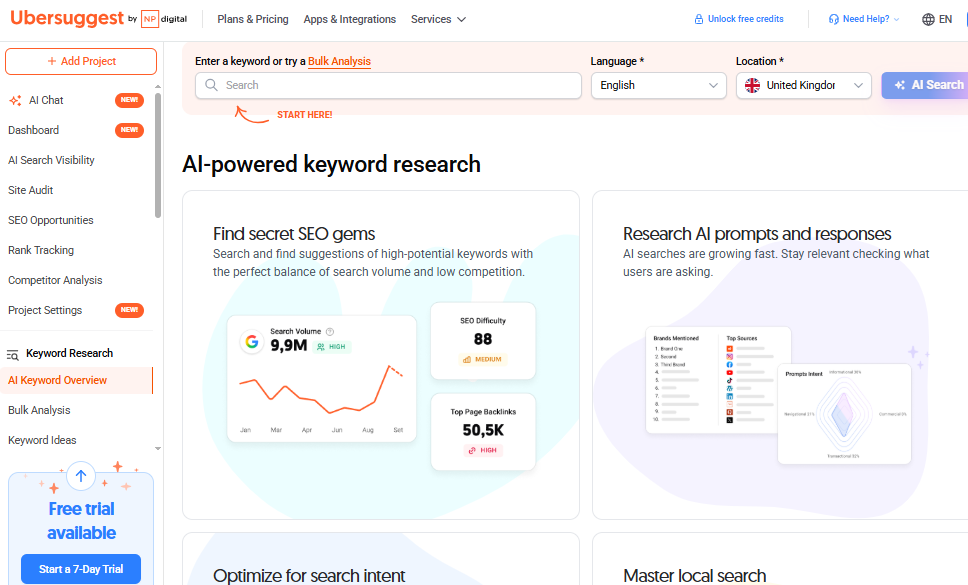
Ubersuggest started as a keyword suggestion tool and was later acquired and rebuilt by digital marketer Neil Patel into a broader SEO suite. The current platform includes keyword research, a site audit module, backlink tracking, competitor analysis, content ideas, and rank tracking.
What it isn’t: a replacement for Ahrefs or Semrush at the enterprise level. Ubersuggest’s backlink index is smaller, its keyword volume data lags slightly behind paid tools, and its AI features are still maturing. That said, for SMEs without five-figure SEO budgets, it covers enough ground to build a coherent strategy.
The Ubersuggest dashboard gives you five main areas to work with: Keyword Ideas, SEO Audit, Backlinks, Top Pages by Traffic, and your project’s rank tracking view. Most users only scratch the surface of two or three of these.
Chapter 1: Calibrating the Data Before You Rely on It
The most common mistake SME owners make with Ubersuggest is treating its numbers as definitive. Search volume figures in Ubersuggest are drawn from Google Keyword Planner data, which Google deliberately buckets into ranges rather than precise figures. This means a keyword showing “1,300 monthly searches” in Ubersuggest might actually be anywhere from 700 to 2,000.
How Ubersuggest Compares to Ahrefs and Semrush
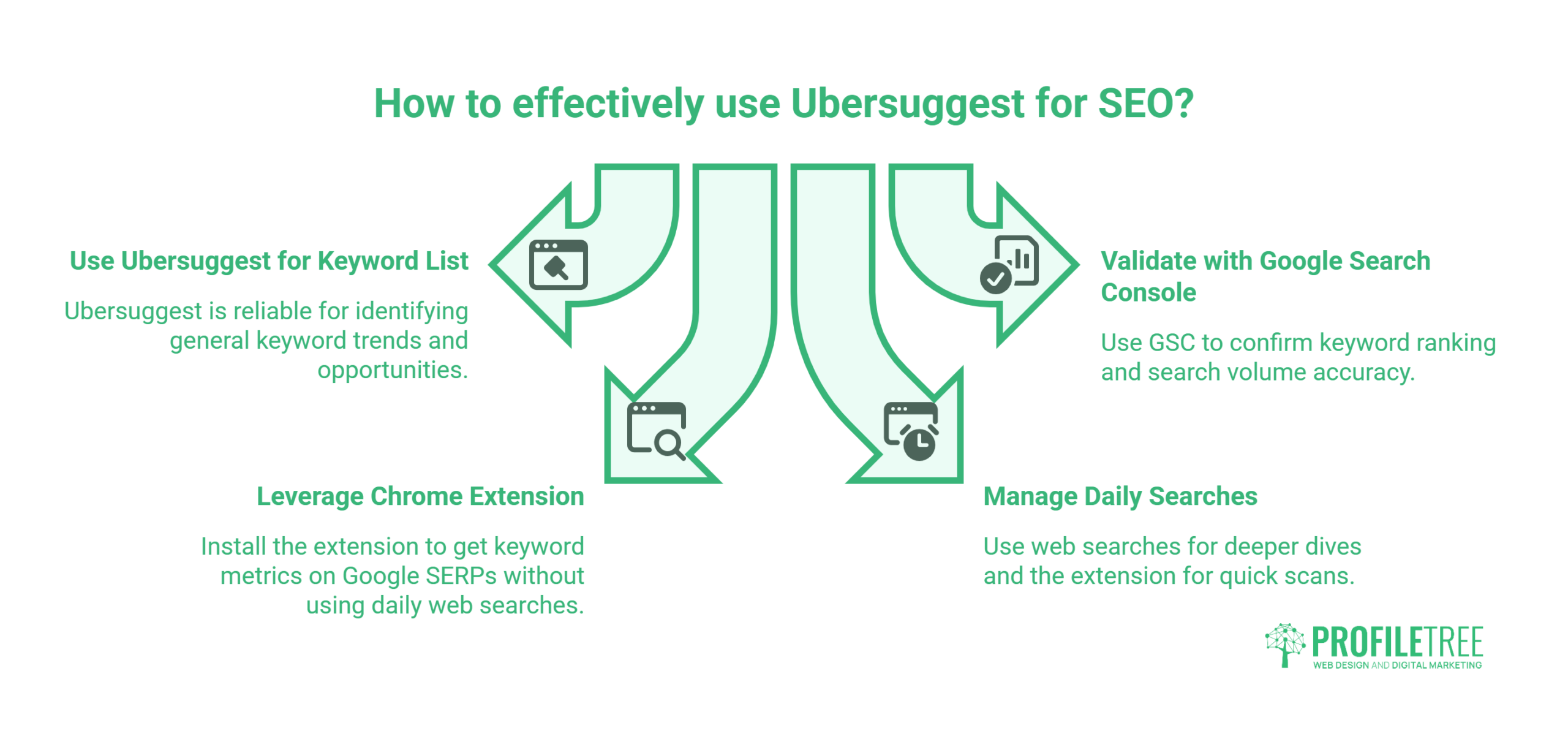
For direction, Ubersuggest is reliable. You’ll identify the same general winners and losers that premium tools surface. Where it diverges is in the finer-grained data:
| Metric | Ubersuggest | Ahrefs | Semrush |
| Search volume accuracy | Reliable for trends; bucket-based | More granular, updated more frequently | More granular, updated more frequently |
| Backlink index | Smaller than premium tools | Industry-leading index | Large, strong index |
| Domain authority metric | Uses its own DA scoring | Domain Rating (DR) | Authority Score |
| Local search filtering | Country-level; no sub-regional | Country and city-level | Country and city-level |
| Free tier | 3 searches/day (web); unlimited via Chrome extension | None | Limited trial |
The practical implication: use Ubersuggest to build your keyword list and identify opportunities, then validate your top 10 to 20 targets against Google Search Console data before committing to a content campaign. If GSC shows you already rank on page two for a term, that’s a stronger signal than Ubersuggest’s search volume estimate alone.
Navigating the Daily Limits Without Upgrading Immediately
The free web interface allows three searches per day. That sounds tight, but most people don’t realise the Chrome extension operates on a separate limit. Install the Ubersuggest Chrome extension, and you get basic keyword metrics (volume, CPC, competition) overlaid directly onto Google SERPs without consuming your daily web allowance.
A practical free-tier workflow:
- Use the Chrome extension to scan SERPs as you browse, noting volume and competition scores for terms relevant to your business
- Reserve your three daily web searches for deeper dives: one keyword research session, one competitor domain lookup, one site audit task
- Export results to a spreadsheet before the session ends; Ubersuggest doesn’t store unlimited history on free accounts
This approach stretches the free tier considerably further than most guides acknowledge.
Chapter 2: Advanced Keyword Research Workflows
The best Ubersuggest hacks for keyword research tend to start in the keyword research section, specifically in the tabs most users scroll past.
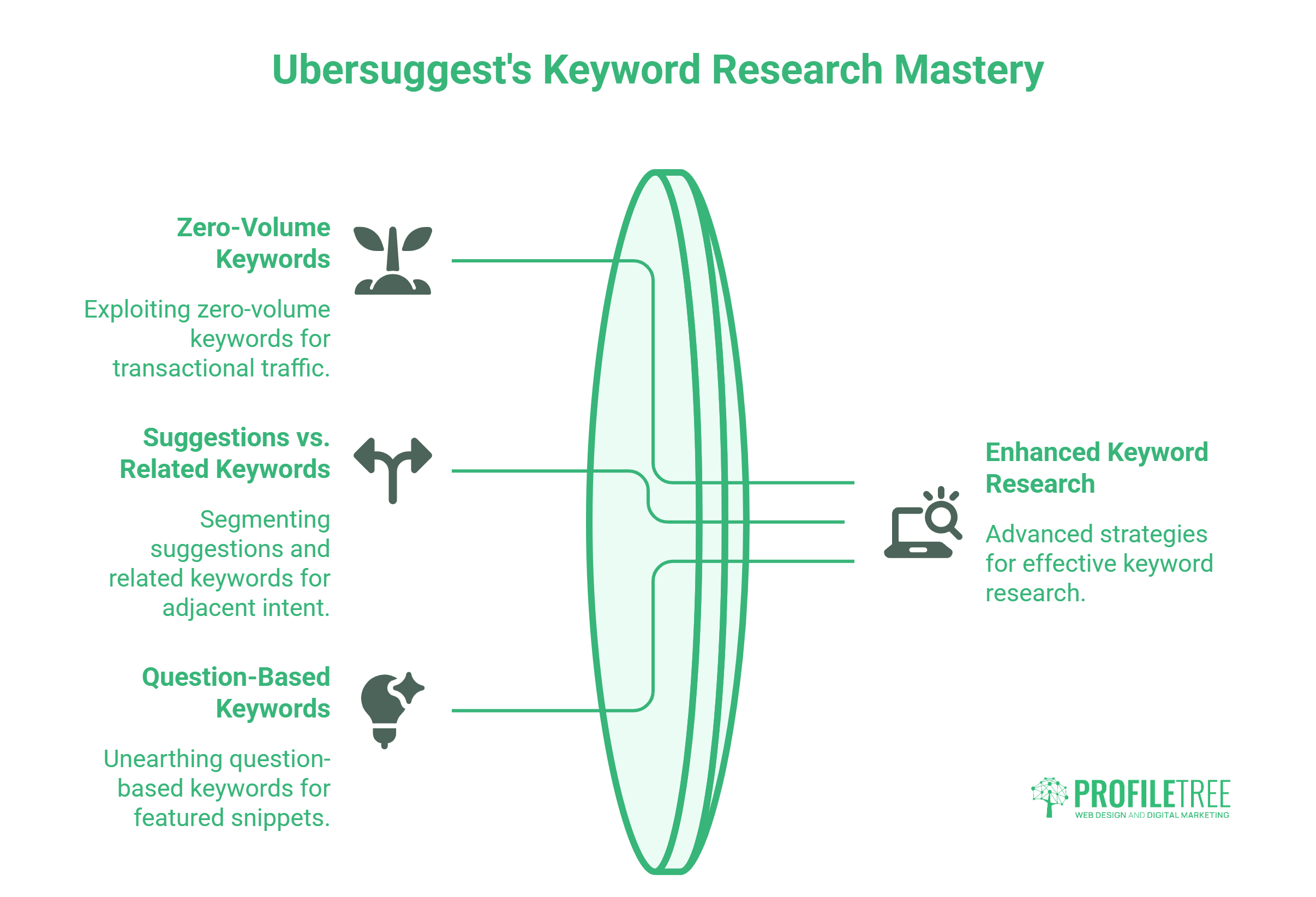
Exploiting Zero-Volume Keywords for Transactional Traffic
When you run a keyword search in Ubersuggest, the default view filters for terms with measurable volume. Most users leave that filter in place and miss a significant opportunity.
Zero-volume keywords (terms showing 0 to 10 searches per month in Ubersuggest) are frequently transactional. A term like “local SEO for plumbers Northern Ireland” might show no volume, but anyone searching it knows exactly what they want and is far more likely to convert than someone searching the broad term “SEO services.”
The method:
- Search your head term in Ubersuggest and switch to the “Questions” tab
- Remove any minimum volume filter
- Export the full list and sort by SEO difficulty (lowest first)
- Cross-reference the lowest-difficulty, zero-volume terms against Google Autocomplete to confirm real-world usage
You’ll find niche terms that no competitor has bothered to target. For a small business in a specific region or sector, these can be the fastest path to page one.
Segmenting Suggestions vs Related Keywords
The “Keyword Ideas” section in Ubersuggest has two tabs that most users treat as interchangeable: “Suggestions” and “Related.” They serve different purposes.
‘Suggestions’ surfaces terms that contain your seed keyword verbatim. ‘Related’ surfaces terms that are semantically connected but may not include your exact phrase. This is where you find the adjacent search intent that your competitors have mapped out, but you haven’t targeted yet.
For example, a Belfast accountancy firm searching “self-assessment tax return” in ‘Suggestions’ will find obvious variations. In ‘Related’, they might uncover “HMRC online account problems” or “UTR number explained”, informational queries with lower competition that can build topical authority and funnel readers toward a service page.
Unearthing Question-Based Keywords for Featured Snippet Positioning
The ‘Questions’ tab in Ubersuggest is one of its most underused features. It surfaces question-format queries related to your seed term, which map directly to the kind of structured FAQ content that earns featured snippets and AI Overview citations.
Ciaran Connolly, founder of ProfileTree, notes: “The SMEs we work with in Northern Ireland often underestimate how much their customers are searching in question form. Structuring your content around those exact questions is one of the most direct routes to appearing in AI-generated search answers, where a large share of commercial intent queries are now being resolved.”
For each question keyword you identify, write a direct 40 to 60-word answer at the start of the section it appears in, then expand with supporting detail. This format is what AI Overviews extract.
Chapter 3: Competitor Analysis and Content Blueprint Extraction
These Ubersuggest hacks for ‘Competitor Research’ are where the tool earns its keep for most SMEs.
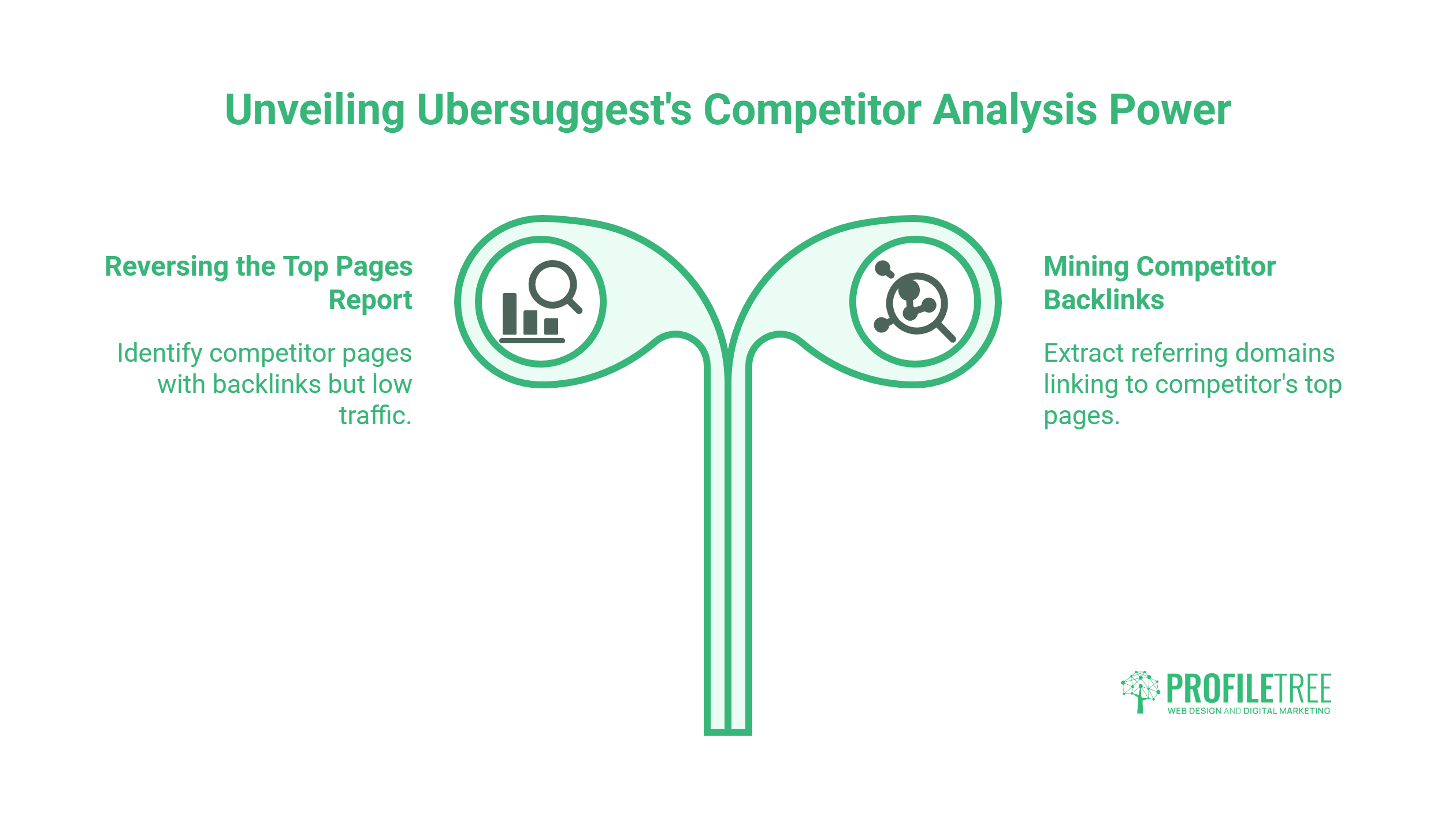
Reversing the Top Pages Report
Enter a competitor’s domain into the Ubersuggest search bar and select “Top Pages by Traffic.” This shows you the pages sending the most organic visitors to their site, along with the estimated traffic, the number of backlinks to that page, and the social shares.
What you’re looking for is not their strongest pages but their weakest ones in the traffic column that still have meaningful backlinks. These are pages where a competitor has earned link equity, but the content hasn’t held its rankings. Build a better resource on that topic, and you have a natural outreach target: the sites linking to the weak page are already interested in the subject.
Mining Competitor Backlinks for Outreach Targets
From the competitor domain view, open their backlink profile. Filter for referring domains linking to their top-performing pages. The sites in that list are already primed to link to strong content on the topic. Many will be directories, industry publications, or resource pages with recurring content requirements.
Export this list, remove direct competitors from the outreach pool, and you have a ready-made link-building prospect list built from verified relevance signals rather than cold guesswork.
Chapter 4: AI Overviews and LLM Visibility
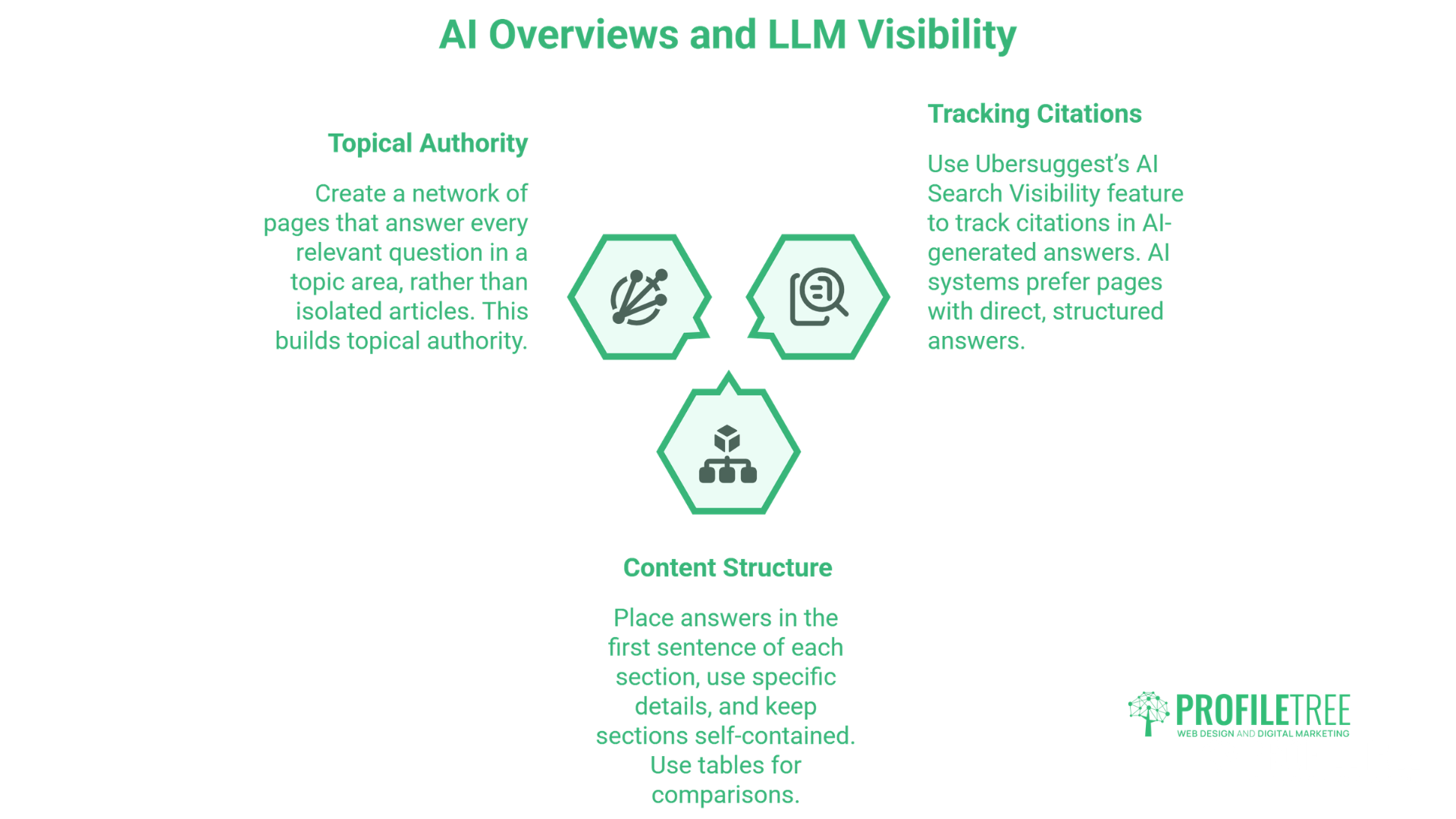
This is the area where most Ubersuggest guides written before 2025 are now outdated. AI-powered search (Google AI Overviews, ChatGPT, Perplexity) now influences a meaningful share of commercial search queries. Getting cited in these answers requires a different content structure from standard ranking optimisation.
How to Track and Win Citations in AI Overviews
Ubersuggest recently introduced an “AI Search Visibility” feature that tracks whether your domain is being cited in AI-generated answers. At the time of writing, this is in its early stages, but the underlying principle is straightforward: AI systems preferentially cite pages that provide direct, structured answers to specific questions.
The workflow:
- Use Ubersuggest’s Questions tab to pull question-format queries for your target topic
- Build individual FAQ sections in your content that answer each question in 40 to 60 words, directly and without preamble
- Mark up those FAQs with FAQPage schema (note for dev team)
- Make sure each answer includes the entity context an AI system needs: who, what, where, and for what audience
Pages that cover multiple sub-questions within a topic are significantly more likely to appear in AI Overviews than pages that cover one question in depth. Ubersuggest’s keyword clustering tools can help you map which sub-questions belong together on a single page.
Structuring Content for LLM Extraction
The structural principles that help AI systems extract and cite your content:
- Put the answer in the first sentence of every section, not the last
- Use specific numbers, named tools, and concrete steps rather than general advice
- Keep each section self-contained enough to be understood without the rest of the article
- Use tables where comparison is the point; AI systems extract table data well
For SMEs working with agencies such as ProfileTree on their wider digital strategy, this kind of structured content approach sits within the broader work of building topical authority: creating a network of pages that collectively answer every relevant question in a topic area rather than producing isolated articles.
Chapter 5: Localised Targeting for UK and Irish Markets
Ubersuggest’s geographic filtering works at the country level, which creates a practical problem for businesses operating across the UK, Northern Ireland, and the Republic of Ireland. These three markets have overlapping but distinct search behaviour, regulatory contexts, and keyword competition levels.
Bypassing Global Averages to Find Low-Difficulty Regional Keywords
When you set Ubersuggest to “United Kingdom,” you’re seeing aggregated data that includes London, Manchester, Birmingham, and every other high-competition market. For a Belfast or Derry-based business, this overstates the competition you’ll actually face.
The workaround is to search in Ubersuggest at the UK level, note the SEO difficulty scores, then cross-reference in Google Search Console against the actual queries and positions you’re seeing from Northern Irish visitors. Queries where your GSC data shows Northern Ireland impressions but Ubersuggest flags high UK-level competition are often far more winnable in practice than the tool suggests.
Calibrating for Multi-Region Dynamics
For businesses operating across both Northern Ireland and the Republic of Ireland, run separate Ubersuggest projects set to “United Kingdom” and “Ireland” respectively. Compare keyword volume and difficulty between the two. You’ll frequently find terms where competition in the Republic is lower for the same product or service category, or where Irish-market searchers use different terminology (e.g. “CV” vs “resume,” “solicitor” vs “lawyer”) that creates a separate content opportunity.
This multi-project approach also lets you track rankings separately for each market, which gives a much clearer picture of where you’re gaining traction than a single blended view.
Local SEO for service businesses involves more than just keyword targeting. If you want to understand how to build a broader local search presence across Northern Ireland and Ireland, ProfileTree’s guide to local SEO strategies for service businesses covers the connection between keyword data and Google Business Profile optimisation.
Chapter 6: Subscription Management and the Free Tier
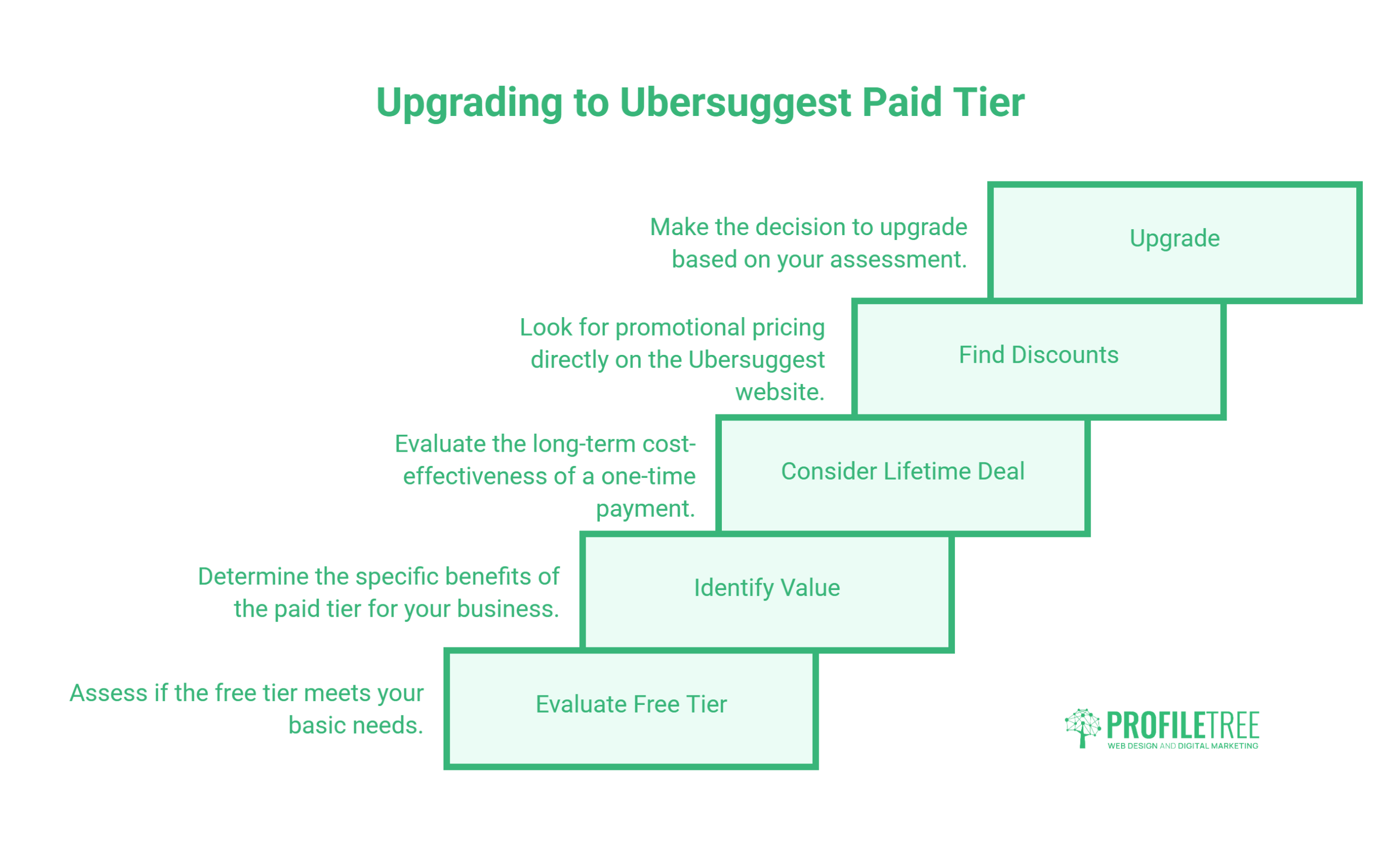
Most SMEs start on the free tier and stay there longer than they need to, or upgrade before they have a clear picture of what they actually need. Understanding where the paid plan adds genuine value, and where it doesn’t, makes the decision straightforward .
What the Paid Tier Actually Adds
The free tier covers three web searches per day with access to keyword ideas, site audit for up to 150 pages, and limited backlink data. The paid tier removes the daily limit, expands the site audit to 300+ pages, gives you deeper rank tracking, and increases the number of tracked keywords.
For most SMEs testing the tool, the free tier is enough to evaluate whether Ubersuggest suits their workflow before committing. The lifetime deal (priced as a one-off payment rather than a monthly subscription) represents good value if you’re going to use it consistently for 18 months or more.
Finding Legitimate Discounts
Ubersuggest runs promotional pricing at intervals throughout the year, including during seasonal sale periods. The tool has historically offered significant discounts on its checkout page when users initiate a subscription review during a trial period. There are no third-party coupon codes worth chasing; the best pricing is almost always available directly through the official pricing page.
Using Ubersuggest Alongside a Professional SEO Strategy
Once you’ve worked through the core Ubersuggest hacks above, the natural question is where the tool fits in a broader strategy. Ubersuggest works best as a research and discovery layer, not as a complete SEO management system. For SMEs at the stage where they’re identifying keywords and understanding competitors, it delivers strong value per pound spent. As your SEO strategy becomes more complex (multi-location targeting, technical audit depth, link acquisition at scale), the tool’s limitations become more relevant.
This is where working with an SEO specialist adds what the tool can’t: judgement about which opportunities to pursue, technical implementation, and the content production required to turn keyword data into rankings.
For businesses across Northern Ireland and Ireland who want to understand how professional SEO services work alongside tools like Ubersuggest, ProfileTree’s SEO services for Northern Ireland businesses outline the practical difference between DIY SEO tool use and a managed SEO strategy. The two approaches aren’t mutually exclusive; many clients use Ubersuggest internally for ongoing monitoring while the agency handles the heavier lifting on content and links.
The 15-Minute Daily Ubersuggest Hacks Routine

A repeatable daily workflow for SMEs on the free tier:
- Open the Chrome extension while browsing or reading industry content. Note any keyword metrics that surface relevant terms for your market.
- One keyword research search (web): Enter a term you’re considering writing about. Export the Questions tab results before closing.
- One competitor check (web, alternating days): Check a competitor’s top pages and note any new content they’ve published this week.
- Weekly site audit review: Run the audit on your own domain once a week. Address any new critical errors before moving to warnings.
That’s the full free-tier workflow. It takes under 15 minutes once you’ve built the habit and produces a consistent stream of keyword ideas, competitor intelligence, and site health data without cost.
For those building out keyword research skills more broadly, the 8 ways to carry out keyword research article covers the full range of research approaches, of which Ubersuggest is one.
FAQs About Ubersuggest Hacks
Is Ubersuggest accurate enough for professional SEO campaigns?
For identifying keyword opportunities and understanding broad competitive positioning, Ubersuggest is reliable. Its search volume data is bucket-based, so it’s best treated as directional rather than precise for high-stakes decisions. Professional campaigns with complex multi-location or multi-language requirements should cross-reference Ubersuggest data against Google Search Console and, where budget allows, a premium tool like Ahrefs or Semrush before committing to a content strategy.
What is the difference between Ubersuggest and AnswerThePublic?
Both tools are owned by Neil Patel. Ubersuggest is a full SEO suite covering keyword research, site audits, backlink tracking, and rank monitoring. AnswerThePublic is a dedicated semantic research tool that visualises the questions people ask around a topic. The two work well in combination: AnswerThePublic for mapping search intent, Ubersuggest for qualifying the volume and competition data.
How do I legally get the most out of the Ubersuggest free tier?
The most practical approach is pairing the web interface (three searches per day) with the Chrome extension, which displays keyword volume, CPC, and competition scores on Google SERPs without consuming your daily web allowance. This combination covers most keyword evaluation needs for SMEs who aren’t yet running active campaigns across dozens of target terms.
Does Ubersuggest offer a lifetime subscription deal?
Yes. Ubersuggest has offered lifetime pricing as an alternative to a monthly subscription since around 2020. This is available directly through the official pricing page and is generally the most cost-effective option for businesses that plan to use the tool for more than 18 months. Promotional pricing appears at intervals throughout the year; the checkout page is the most reliable place to find current offers.
Can I use Ubersuggest to target localised keyword volumes in Northern Ireland or the Republic of Ireland?
Ubersuggest filters by country (United Kingdom or Ireland) rather than sub-region, so there’s no dedicated Northern Ireland database. The practical workaround is to run separate projects for UK and Ireland settings, then cross-reference the results against your own Google Search Console data, which does show performance by region. This combination gives a more accurate picture of the search market for businesses operating across both markets.
How do I use the Ubersuggest dashboard to track my keyword rankings?
Set up a project with your domain URL in the dashboard. Add the keywords you’re targeting manually, then go to the “Rank Tracking” section. Ubersuggest checks your positions weekly on the free tier and daily on paid plans. For a more complete view of ranking performance, connect your Google Search Console account through the dashboard integration, which pulls in impression and click data alongside the position tracking.
Ready to Turn Keyword Data Into Rankings?
Ubersuggest tells you what to target. Turning those targets into content that ranks, earns backlinks, and converts visitors into customers is where the real work starts.
If you’re at the point where the tool is surfacing opportunities but the time or expertise to act on them isn’t there, that’s where a specialist makes the difference. ProfileTree works with SMEs across Northern Ireland, Ireland, and the UK on exactly that: taking keyword research from a spreadsheet to a strategy that produces measurable results.
Get a free SEO consultation today and find out what’s holding your site back!