
Digital Business Strategies for SMEs: From Theory to Investment
Table of Contents
Most Belfast and UK SMEs approach digital marketing backwards. They build websites because everyone has one, or try SEO because someone recommended it, without connecting these investments to how they actually compete.
The businesses that succeed digitally aren’t those spending the most — they’re those whose digital investments align with their business strategy. A cost leader investing £20,000 in flashy design has misaligned their spend. A professional services firm competing on expertise that settles for a £500 template site undermines their differentiation.
This guide starts with business strategy, then maps specific digital investments to support it. Whether you’re competing on price, quality, or niche focus, you’ll learn which digital services actually support your competitive position.
What is a Business Strategy?

Your business strategy is the framework for achieving your key aims, whether profitability or growth. At its core, business strategy answers one question: how will you compete to win customers and build a sustainable business?
Most business decisions ultimately serve one of two goals:
- Increasing revenue
- Reducing costs
The key levers available include finding new customers, increasing retention, improving process efficiency, boosting productivity, and strengthening market positioning. Different business strategies require specific frameworks for improving these areas — whether moving into new markets, optimising operations, or refining your brand.
For SMEs in Belfast and across the UK, your business strategy should directly inform your digital investments. A retailer competing on price needs different digital tools than a consultancy competing on expertise. Understanding your strategic position helps you avoid wasting budget on digital services that don’t support how you actually compete.
The Four Core Business Strategies
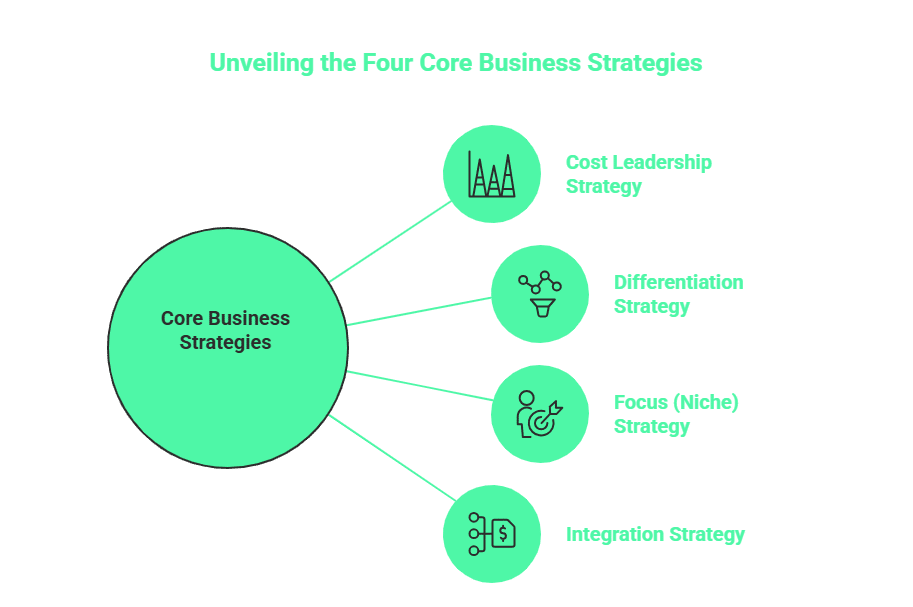
Business strategies can be categorised into four main approaches, each with a distinct competitive logic. Understanding these frameworks helps SMEs make smarter decisions about where to invest limited resources — including digital marketing budgets.
Cost Leadership Strategy
A cost leadership strategy focuses on achieving the lowest operational costs in your industry. This often comes through operational efficiency, economies of scale, and strategic supplier relationships. Companies pursuing cost leadership aim to undercut competitors on price, making their offerings more attractive to price-sensitive customers.
Real-World Example: Walmart
Walmart exemplifies a cost leadership strategy. The company’s relentless focus on minimising expenses — from optimising supply chains to negotiating supplier prices — allows consistently low customer pricing. This strategy has been central to Walmart’s position as one of the world’s largest retailers.
For UK SMEs, cost leadership doesn’t mean being the cheapest — it means operating efficiently enough to offer competitive pricing while maintaining acceptable margins. A Belfast retailer competing with national chains needs lean operations and smart cost control across every function, including digital marketing.
Differentiation Strategy
Differentiation strategy emphasises creating unique, distinctive products or services that stand out from competitors. This approach appeals to customers willing to pay premium prices for superior quality, innovation, or brand recognition.
Real-World Example: Apple
Apple demonstrates a differentiation strategy through product design, user experience, and brand positioning. iPhones, iPads, and Macs are recognised for sleek design, intuitive interfaces, and innovative technology. Apple’s consistent innovation creates products that command premium pricing and customer loyalty worldwide.
For professional services and B2B companies in Northern Ireland, differentiation often centres on demonstrable expertise, client service quality, and specialised knowledge. Your digital presence needs to communicate these differentiators clearly and credibly.
Focus (Niche) Strategy
A focus strategy involves targeting a specific market segment rather than serving everyone. By concentrating on a niche, companies tailor offerings to specific needs and preferences, becoming recognised experts in their chosen area and building strong customer loyalty.
Real-World Example: Warby Parker
Warby Parker revolutionised eyewear through a focus strategy, targeting young, fashion-conscious consumers with stylish, affordable glasses. Their online-first, direct-to-consumer model disrupted traditional eyewear retail, making quality glasses accessible to a specific demographic.
For Belfast and Derry businesses, focus strategies often combine geographic and industry targeting — such as accounting services for construction firms in Northern Ireland, or legal services for hospitality businesses across the UK.
Integration Strategy
Integration strategy involves controlling multiple stages of production or distribution. This can mean acquiring suppliers, distributors, or even competitors. The goal is increased efficiency, reduced costs, and greater supply chain control.
Real-World Example: Amazon
Amazon exemplifies an integration strategy by expanding beyond core e-commerce into logistics, cloud computing, and media streaming. This integrated approach allows Amazon to control its supply chain, optimise operations, and offer extensive products and services to customers.
While full vertical integration suits large corporations, SMEs can integrate their digital marketing activities for better results. Rather than buying web design from one agency, SEO from another, and content from a third, an integrated approach delivers better outcomes at lower total cost.
Translating Business Strategy Into Digital Investment
The same strategic frameworks that guide your business decisions should inform your digital marketing investments. Yet most SMEs approach digital services reactively — building websites because competitors have them, or trying SEO because someone recommended it — without connecting these investments to their competitive positioning.
Here’s the strategic logic: your digital presence either supports or undermines your business strategy. A company competing on price that invests £20,000 in a flashy, custom website has misaligned its digital investment with its business model. Conversely, a professional services firm competing on expertise that settles for a £500 template site undermines its differentiation strategy before prospects even make contact.
ProfileTree works with SMEs across Belfast, Northern Ireland, and the UK to align digital investments with business strategy. Based in Belfast with over 1,000 projects completed since 2011, we’ve seen which digital approaches work for different competitive positions — and which waste money.
The Strategy-to-Digital Mapping Framework
| Business Strategy | You Compete On | Digital Priority | Typical Investment Range | Key Outcome |
|---|---|---|---|---|
| Cost Leadership | Price/efficiency | Lean, functional platforms | £3k-8k website + £75-150/mo hosting | Professional presence without premium cost |
| Differentiation | Quality/expertise | Premium design + trust content | £8k-15k website + video production | Standout presence that justifies premium positioning |
| Focus (Niche) | Specific segment dominance | Targeted visibility | £2k-5k local SEO + niche content | Ranking for specific geographic/industry terms |
| Integration | Multi-channel control | Unified digital ecosystem | £5k-12k integrated setup | All services working together, not in silos |
This framework helps answer the question Belfast business owners ask most: “Should I spend £5,000 on a new website or £5,000 on SEO?” The answer depends entirely on your business strategy.
Cost Leadership Digital Strategy: Building Efficient Online Presence
For SMEs pursuing cost leadership, every operational expense matters — including digital marketing. Your digital presence needs to deliver professional results without enterprise costs.
WordPress vs Premium Platforms for Cost Leaders
Belfast retailers, trade businesses, and service companies competing on price typically benefit from WordPress development rather than proprietary systems. WordPress provides the core functionality most SMEs need — professional design, content management, basic e-commerce, contact forms — without ongoing platform fees or agency lock-in.
ProfileTree builds WordPress websites from £3,000-8,000 that deliver equivalent functionality to £15,000+ proprietary systems. Our hosting and maintenance packages run £75-150 per month versus £300-500 for agency-locked platforms. We work with Northern Ireland businesses where site costs need to match pricing strategy — delivering professional online presence without premium price tags.
Cost-Effective SEO Approaches
Cost leaders can’t ignore SEO, but should focus investment on high-return tactics rather than comprehensive strategies. Priority areas include:
- Technical foundations: Ensuring your site loads quickly, works on mobile, and follows basic SEO principles. This provides baseline visibility without ongoing costs.
- Targeted content: Creating focused content around specific product categories or service offerings rather than broad industry topics. A Belfast plumber ranks for “emergency plumber Belfast” more cost-effectively than “plumbing best practices UK.”
- Local listings: Claiming and optimising free business listings (Google Business Profile, Bing Places, industry directories) provides visibility without advertising spend.
- DIY capability: Building sites where you can add products, publish blog posts, and update service pages yourself reduces ongoing agency dependency.
For cost leaders, the digital strategy emphasises efficiency: get online professionally, get found for relevant searches, and keep ongoing costs manageable. You’re not trying to win design awards — you’re ensuring customers can find you, trust you, and transact with you without friction.
Differentiation Digital Strategy: Standing Out Through Design and Content
For professional services, B2B companies, and premium brands, a differentiation strategy requires a digital presence that immediately communicates quality, expertise, and distinctiveness. Generic templates and stock photography undermine differentiation before prospects even read your content.
Premium Web Design for Differentiated Brands
A Belfast solicitor’s practice competing against established firms needs more than a functional website — they need a standout design that builds trust instantly. Premium web design for differentiators includes custom layouts, professional photography, considered typography, and user experiences tailored to your specific audience.
ProfileTree’s premium web design service focuses on differentiated businesses where first impressions matter. We combine professional design with strategic user experience — guiding visitors toward conversion actions while communicating expertise and credibility throughout their journey.
Investment for differentiated web design typically ranges from £8,000 to £ 15,000, with complexity depending on required functionality, content volume, and custom features. For professional services in Northern Ireland, competing on expertise and reputation, this investment directly supports your competitive positioning.
Video Content for Trust and Differentiation
Differentiation in service industries means showing expertise, not just claiming it. Video content provides the strongest trust-building medium for demonstrating knowledge, showcasing client results, and humanising your brand.
ProfileTree’s video production service helps Northern Ireland businesses create professional conten,t including client testimonials, service explainers, case study videos, and thought leadership pieces. Video increases site engagement measurably — visitors viewing video content typically stay 3+ minutes versus under 60 seconds for text-only sites.
For professional services like legal, accountancy, consultancy, and financial advisory, video testimonials from satisfied clients provide social proof that written reviews can’t match. Seeing and hearing a real person discuss their positive experience carries more weight than any amount of persuasive copy.
Content Marketing for Expertise Demonstration
Differentiated businesses need content marketing that demonstrates genuine expertise. This means publishing in-depth guides, analysis, and commentary that prove your knowledge rather than generic blog posts about industry topics.
ProfileTree’s content marketing service works with Belfast and UK businesses to create authority-building content, including comprehensive guides to complex topics, case studies explaining client challenges and solutions, regular commentary on industry developments, and practical resources that prospects find genuinely useful.
For differentiation strategies, content marketing serves dual purposes: attracting organic search traffic through useful information, and demonstrating expertise that justifies premium positioning and pricing.
“The businesses that succeed digitally are those whose web design, SEO, and content investments align with how they actually compete. If you’re competing on price, investing £20,000 in a flashy website makes no sense. If you’re differentiated by expertise, a £3,000 template site undermines your positioning,” says Ciaran Connolly, founder of ProfileTree.
Focus Strategy: Local SEO for Belfast and Northern Ireland Businesses
Focus strategies targeting specific geographic or industry segments translate naturally into local SEO tactics. A Derry-based accountancy firm specialising in construction businesses doesn’t need to rank nationally for “accountant” — they need to dominate “construction accountant Derry” and “trade business accounting Northern Ireland.”
Google Business Profile Optimisation
Your Google Business Profile represents the most important local SEO asset for service-area businesses. Proper optimisation includes accurate business information (name, address, phone, hours), service area definition, category selection, and regular posts about projects, services, and business updates.
ProfileTree’s local SEO service begins with a comprehensive Google Business Profile setup and optimisation. We work with Belfast businesses targeting tight geographic niches — typically 10-20 mile service areas — to ensure they appear in Google’s local pack (the map results showing above organic listings).
Location-Specific Content Strategy
Ranking for local search terms requires location-specific content on your website. This means service pages that explicitly mention your service areas, blog content addressing local business challenges, and case studies or testimonials from customers in your target region.
For a Belfast-based business targeting customers across Northern Ireland, this might include separate service pages for Belfast, Derry, Newry, Lisburn, and other key areas. Each page addresses the same core service but includes genuinely useful local information — not just repeating the same content with different city names inserted.
Local Link Building and Citations
Local SEO performance improves through citations (mentions of your business name, address, and phone number) across relevant directories and local websites. Priority citations include local business directories, industry-specific directories, chamber of commerce listings, and local news or community sites.
ProfileTree manages local citation building for Northern Ireland businesses, ensuring consistent NAP (name, address, phone) information across all platforms and securing mentions on relevant local and industry sites.
Realistic Local SEO Timelines
Most small businesses see measurable local SEO improvements within 3-6 months, though competitive industries may take longer. Initial gains often appear in long-tail local keywords before broader service terms improve. Factors affecting the timeline include your starting point, local competition levels, and consistency of optimisation efforts.
For focus strategies, local SEO delivers exactly what the business model requires: dominance of specific geographic and industry search terms that bring highly qualified prospects. You’re not trying to rank nationally — you’re ensuring everyone in your target area finds you first.
Digital Strategy Roadmap for UK SMEs: From Foundation to AI Adoption
Most Belfast and UK SMEs approach digital marketing reactively, adding services piecemeal without a strategic sequence. A proper digital strategy follows a logical progression, building each capability on solid foundations before advancing to more sophisticated approaches.
Phase 1: Digital Foundation (Months 1-3)
Core objective: Professional online presence with basic visibility
Essential elements:
- Professional website on a reliable platform (typically WordPress)
- Basic SEO setup (technical foundations, site structure, meta information)
- Google Business Profile claimed and optimised
- Essential business listings and citations completed
- Basic analytics implementation (Google Analytics 4)
Typical investment: £3,000-8,000 setup + £75-150 monthly hosting/maintenance
This phase establishes your digital presence. You exist online professionally, can be found through basic searches, and have infrastructure to support future activity.
Phase 2: Targeted Visibility (Months 4-9)
Core objective: Ranking for priority keywords and appearing in local search
Essential elements:
- Content marketing focused on target keywords
- Local SEO optimisation for service areas
- Review generation and reputation management
- Internal linking structure optimisation
- Monthly performance monitoring and refinement
Typical investment: £500-1,500 per month for ongoing SEO and content
Phase 2 builds search visibility. You’re creating content that ranks, appearing in local pack results, and generating organic traffic from prospects actively searching for your services.
Phase 3: Conversion Optimisation (Months 10-15)
Core objective: Converting traffic into enquiries and sales
Essential elements:
- User experience analysis and improvements
- Conversion rate optimisation testing
- Lead nurturing systems (email marketing)
- Client testimonial and case study development
- Call tracking and enquiry source analysis
Typical investment: £1,000-2,500 depending on complexity
Phase 3 focuses on results. You’re getting traffic; now you ensure that traffic converts. This phase often delivers the highest ROI as relatively small improvements in conversion rate multiply the value of all your previous visibility work.
Phase 4: Authority Building (Months 16-24)
Core objective: Industry recognition and brand building
Essential elements:
- Video content production (testimonials, explainers, thought leadership)
- Guest posting and digital PR
- Speaking opportunities and webinars
- Comprehensive guides and pillar content
- Social media thought leadership
Typical investment: £2,000-5,000, depending on content volume
Phase 4 elevates your market position. You’re no longer just visible — you’re recognised as an authority. This phase particularly benefits professional services and B2B companies where expertise and reputation drive premium pricing.
Phase 5: AI-Enabled Efficiency (Ongoing)
Core objective: Operational efficiency and enhanced customer experience
Essential elements:
- AI chatbots for common enquiries and qualifications
- AI-assisted content creation (with human oversight)
- Marketing automation using AI personalisation
- AI-enhanced customer service and support
- Predictive analytics for customer behaviour
Typical investment: £500-2,000 a month, depending on implementation scope
Phase 5 represents the 2026 reality: AI tools that genuinely save time and improve customer experience. ProfileTree’s AI training helps Northern Ireland businesses implement practical automation — from chatbots handling routine queries to AI-assisted content maintaining brand voice while reducing production time.
Budgeting Your Digital Investment: What Should UK SMEs Spend?

The question Belfast business owners ask most frequently: “How much should I spend on digital marketing?” The answer depends entirely on your business size, industry, competitive position, and growth ambitions.
Investment by Business Size
Micro businesses (1-9 employees):
- Initial website investment: £3,000-6,000
- Monthly ongoing (hosting, maintenance, basic SEO): £200-500
- Annual digital marketing budget: £5,000-10,000
Micro businesses typically handle some digital activities internally (social media, basic content) while outsourcing technical work and strategic guidance. Focus on establishing professional presence and basic local visibility.
Small businesses (10-49 employees):
- Initial website investment: £6,000-15,000
- Monthly ongoing (hosting, maintenance, SEO, content): £750-2,000
- Annual digital marketing budget: £15,000-35,000
Small businesses generally benefit from consistent monthly SEO and content marketing alongside their initial website investment. At this scale, you’re building sustainable organic visibility rather than just maintaining basic presence.
Medium businesses (50-249 employees):
- Initial website investment: £10,000-25,000+
- Monthly ongoing (integrated digital marketing): £2,000-5,000
- Annual digital marketing budget: £35,000-80,000
Medium businesses typically pursue integrated digital strategies combining web design, SEO, content marketing, video production, and often paid advertising. At this scale, digital marketing becomes a core business function rather than an occasional project.
Investment by Business Strategy
Your competitive strategy should influence digital budget allocation:
- Cost leaders: Higher proportion toward efficient platforms and basic SEO; minimal spending on premium design or extensive content. Typical split: 60% website and hosting, 30% SEO, 10% content.
- Differentiators: Higher proportion toward premium design, video production, and authority content; less toward basic SEO. Typical split: 40% website and design, 20% video, 30% content marketing, 10% SEO foundations.
- Focus players: Higher proportion toward local SEO and targeted content; moderate website investment. Typical split: 30% website, 50% local SEO and citations, 20% location-specific content.
ROI Expectations and Timelines
Digital marketing ROI varies by channel and timeline:
- Website redesign: Expect measurable improvements in conversion rate within 1-3 months if the user experience is significantly improved.
- SEO: Most businesses see traffic improvements within 4-6 months, with continued growth over 12-18 months as authority builds.
- Local SEO: Local pack visibility often improves within 3-6 months, particularly for lower-competition service areas.
- Content marketing: Long-term play with compounding returns. Individual pieces may rank within months, but portfolio authority develops over 12+ months.
- Video content: Immediate impact on site engagement and conversion for visitors who watch; SEO benefits develop over 6-12 months as YouTube authority grows.
The critical insight: digital marketing compounds. Early months establish foundations; later months build on those foundations for accelerating returns. Businesses that invest consistently for 18-24 months almost always outperform those that invest heavily for 6 months then pause.
Regional Support: Digital Grants and Funding in Northern Ireland and the UK
Several government and business support programmes help offset digital investment costs for qualifying SMEs across the UK and Ireland.
Northern Ireland: Invest NI Support
- Digital Transformation Fund: Invest Northern Ireland offers grants supporting digital technology adoption, including website development, e-commerce systems, and digital marketing capabilities. Eligible businesses can receive up to 50% grant support for qualifying projects.
- Innovation Vouchers: Smaller businesses can access innovation vouchers worth up to £5,000 to work with knowledge providers on digital innovation projects.
England: Help to Grow Programmes
- Help to Grow: Digital: UK government scheme providing discounted access to approved digital software and platforms. Qualifying businesses receive a 50% discount (up to £5,000) on software for accounting, customer relationship management, and e-commerce.
- Help to Grow: Management: Leadership and management programme, including digital transformation modules. Not direct funding for digital projects, but supporting strategic capability development.
Wales and Scotland: Regional Business Support
- Business Wales: Digital Advisory Service providing free diagnostic support and signposting to appropriate digital tools and training.
- Scottish Enterprise: Digital Growth Programme supporting Scottish SMEs with digital strategy development and implementation.
Republic of Ireland: Local Enterprise Office Support
Trading Online Vouchers: Irish SMEs can access vouchers worth up to €2,500 to develop online trading capabilities, covering website development, online marketing, and e-commerce platforms.
Eligibility and funding availability change regularly. ProfileTree helps Belfast and Northern Ireland clients identify relevant support programmes and ensure applications align with genuine business needs rather than accessing funding for the sake of it.
Common Digital Strategy Mistakes SMEs Make
Working with over 1,000 businesses since 2011, ProfileTree has identified recurring digital strategy mistakes that limit results and waste budget.
Mistake 1: No Strategic Foundation
The most common error: buying digital services without connecting them to a business strategy. Building a website because everyone has one, or trying SEO because someone recommended it, without clear logic linking these investments to how you compete and win customers.
Solution: Start with a business strategy. Clarify whether you compete on price, quality, or niche focus. Then map digital investments to support that strategic position.
Mistake 2: Platform Over Strategy
Businesses often obsess over platform choice (WordPress vs Wix vs Shopify) while ignoring strategic questions. The platform matters far less than having clear answers about the target audience, key messages, conversion goals, and how the site supports your competitive positioning.
Solution: Choose platforms based on strategic requirements, not trends. Most SMEs succeed perfectly well with WordPress. Premium brands may justify custom development. The platform decision should follow strategic decisions, not drive them.
Mistake 3: Vanity Metrics Focus
Tracking website visitors, social media followers, or engagement rates without connecting these to business outcomes wastes attention on metrics that don’t matter. A website getting 10,000 monthly visitors generating zero enquiries performs worse than one getting 500 visitors generating 20 enquiries.
Solution:Define success metrics aligned with business goals. For most SMEs, this means enquiries, quote requests, phone calls, or actual sales — not traffic volume or time on site.
Mistake 4: Inconsistent Investment
Many businesses invest heavily in digital for 3-6 months, see initial results, then pause investment — losing momentum and often losing previous gains. Digital marketing compounds with consistent effort; stopping and starting repeatedly resets the compounding effect.
Solution: Budget for sustained investment over 18-24 months minimum. Better to invest £500 monthly for two years than £5,000 for two months, then nothing. Consistency beats intensity in digital marketing.
Mistake 5: DIY Everything or Outsource Everything
Two extremes both cause problems: businesses trying to handle all digital marketing internally despite lacking expertise, or outsourcing everything without maintaining any internal capability or strategic oversight.
Solution: Hybrid approach. Outsource technical specialisms (web development, technical SEO) while building internal capability for ongoing activities (content creation, social media, customer engagement). Maintain strategic oversight even when outsourcing execution.
Mistake 6: Ignoring Mobile Experience
Despite mobile traffic exceeding desktop traffic years ago, many businesses still design primarily for desktop users and then treat mobile as an afterthought. Mobile users abandon sites that don’t work properly on their devices, regardless of how good the desktop experience is.
Solution: Design mobile-first. Ensure every page, form, and conversion path works smoothly on mobile devices. Test your site regularly on actual phones, not just in browser simulation mode.
Mistake 7: No Measurement or Analysis
Businesses launch websites or start SEO campaigns without implementing proper analytics, or implement analytics but never actually review the data to understand what’s working and what isn’t.
Solution: Implement Google Analytics 4 properly from day one. Schedule monthly performance reviews examining key metrics. Use data to identify what’s working (do more of it) and what isn’t (fix or stop it).
Conclusion
Most Belfast and Northern Ireland SMEs know they need better digital presence but struggle to determine which services to prioritise and how much to invest. Your business strategy provides the answer.
ProfileTree offers digital strategy consultations for SMEs across Belfast, Northern Ireland, and the UK. Based in Belfast with over 1,000 projects completed since 2011 and a 5-star Google rating from 450+ reviews, we help businesses connect competitive positioning to digital investment decisions.
Ready to align your digital investment with your business strategy? Contact ProfileTree to discuss how web design, SEO, content marketing, and AI implementation can support your competitive position.
FAQs
What’s the difference between a digital strategy and digital marketing?
Digital strategy is the overarching framework determining which digital capabilities you need and why, based on your business goals and competitive positioning. Digital marketing is the execution of specific tactics (SEO, content, social media) within that strategic framework.
How much should a small UK business spend on digital per month?
– For small businesses (10-49 employees), expect to invest £750-2,000 monthly for effective digital marketing, including hosting, maintenance, ongoing SEO, content creation, and performance monitoring.
– Micro businesses (under 10 employees) often manage with £200-500 monthly for basic presence and maintenance, handling some activities internally while outsourcing technical work.
– Investment should scale with business size and growth ambitions. A £500,000 turnover business competing in a moderately competitive local market needs less than a £3 million turnover business competing nationally.
Are there grants for digital transformation in Northern Ireland?
Yes. Invest Northern Ireland offers several programmes supporting digital adoption:
Digital Transformation Fund: Grants covering up to 50% of qualifying digital projects, including website development, e-commerce systems, and digital marketing capabilities.
Innovation Vouchers: Up to £5,000 for smaller businesses working with knowledge providers on digital innovation.
Eligibility depends on business size, sector, and location. ProfileTree helps Belfast and Northern Ireland clients identify relevant programmes and prepare applications that align with genuine business needs.
Is SEO or web design more important for a new SME?
Neither is “more important” — they serve different purposes within your digital strategy:
Web design creates the professional presence and user experience that converts visitors into customers. It’s foundational but doesn’t bring traffic.
SEO drives qualified traffic to your site through organic search visibility. It’s useless without a decent site to send traffic to.
How long does it take to see results from a digital strategy?
Realistic timelines by activity:
Website redesign: 1-3 months for conversion rate improvements if user experience is significantly enhanced.
SEO: 4-6 months for initial ranking improvements and traffic growth. Continued improvement over 12-18 months as the authority builds.
Local SEO: 3-6 months for Google Business Profile visibility in local pack results.
Content marketing: 6-12 months to build portfolio authority and ranking power. Individual pieces may rank faster, but sustained results take time.