
Brand Build for Small Businesses UK: The Complete Guide
Table of Contents
Most small business owners think of branding as a logo and a colour palette. That’s understandable, since those are the most visible parts. But a brand is the total impression your business makes before, during, and after a customer buys from you. It’s what people say about you when you’re not in the room, and it’s the reason they choose you over a competitor offering something similar at a similar price.
For small businesses in the UK, getting that impression right matters more than ever. Markets are more crowded, attention is harder to earn, and digital platforms have removed the geographical protections that once gave local businesses a natural advantage. A kitchen fitter in Belfast now competes for attention with national chains that have polished websites, active social media and YouTube channels. The question is no longer whether you can afford to build a proper brand. It’s whether you can afford not to.
This guide covers the full process, from defining your positioning to building the digital infrastructure that makes your brand visible, credible and consistent across every channel.
Why Your Brand Is Your Most Valuable Business Asset
A brand is not a marketing expense. It’s an asset that compounds over time. A business with strong brand attributes can charge more, retain customers longer, and spend less per acquisition because people already trust it before they make contact.
The distinction worth drawing early is between a logo and a brand. A logo is a symbol. A brand is the full experience: the way your website loads, the tone of your emails, the consistency of your social media, and whether a customer’s first call felt warm or transactional. The logo is the signpost. The brand is everything the sign points to.
For UK SMEs, the stakes are concrete. Trust and reputation are consistently cited as reasons customers choose an independent business over a larger alternative, and a clear digital marketing strategy is what turns that trust into a repeatable source of enquiries rather than a one-off impression. Your brand is the mechanism through which that trust is built and sustained.
Is Brand Building the Same as Marketing?
No, and the distinction matters more than it sounds. Marketing is the seed. Brand building is the tree that grows from it, season after season, whether or not you’re actively watering it that week.
Brand Building vs Marketing
| Brand Building | Marketing | |
|---|---|---|
| Goal | Long-term trust, recognition and pricing power | Short-term attention, leads and sales |
| Timeframe | Months to years, compounds over time | Days to weeks per campaign |
| Key signal | Unprompted recognition, repeat custom, referrals | Clicks, enquiries, conversion rate |
| Example | A consistent tone of voice across every channel for three years | A seasonal offer promoted for a fortnight |
Most SMEs run marketing activities constantly and brand-building rarely, which is backwards. Marketing without a defined brand behind it produces noise. Brand building without any marketing produces a strong identity nobody sees.
The Seven-Step Brand Building Framework for UK Small Businesses
Building a brand is not a single project with a finish line. It’s a set of decisions made in the right order, then maintained consistently. Work through these steps in sequence and you’ll avoid the most common mistake: visual identity before positioning, or promotion before your digital foundations are solid.
Step 1: Define Your Value Proposition
Before you name your business, choose a logo, or register a domain, you need to answer one question clearly: why should someone choose you? A value proposition is not a slogan. It’s an honest, specific statement of what you do, who you do it for, and what makes your approach different.
A Northern Ireland builder might offer value through speed of response, local sourcing of materials, or a fixed-price guarantee that national contractors don’t match. A Belfast accountant might differentiate through deep knowledge of HMRC regulations specific to sole traders in the UK, rather than generic tax advice.
The discipline here is specificity. Vague value propositions produce vague brands. “We provide excellent customer service” isn’t a differentiator; it’s what every business claims. “We respond to every enquiry within two hours, including weekends”, is a differentiator because it’s verifiable and specific. Write your value proposition in one sentence before you do anything else, and test it with people outside your business. If they have to ask for clarification, it’s not clear enough.
Step 2: Research Your Competitors and Segment Your Market
Market research does two things for your brand. It tells you what you’re competing against, and it reveals the gaps your competitors haven’t filled. Before you can find those gaps, though, it helps to know exactly who you’re serving. Segmenting your market by location, behaviour or need stops you from writing brand messaging for an audience that doesn’t actually exist.
Look at the top three to five businesses serving your market. Note how they position themselves, what language they use, what their websites communicate in the first five seconds, and where they appear to be investing in content and social media. You’re not doing this to copy them. You’re doing it to find the space they’ve left open. A structured competitor analysis makes this repeatable rather than a one-off exercise you never revisit.
A restaurant in Derry might find that every competitor leads with “family friendly” and “homemade food,” leaving the premium mid-week dining experience for local professionals entirely unclaimed. A web design agency in Dublin might find that most competitors talk about process and price but none talk in depth about client outcomes. Those gaps are where your brand positioning lives.
Step 3: Define Your Brand Persona and Voice
Your brand persona is the personality your business projects. Your brand voice is how that personality sounds in writing, in video, in person, and in every customer interaction. Getting this right requires making genuine choices. A brand voice is not “professional and friendly,” because that phrase describes almost every business on the planet.
A useful exercise is to choose three adjectives that describe your brand, then find the tension between them. “Direct, warm and unpretentious” is a voice. “Authoritative but approachable, with a dry sense of humour” is a voice. These distinctions are what make content sound like it came from a specific business rather than a generic template.
This matters just as much for the person behind the business as it does for the business itself. Founder-led firms in particular benefit from considering personal branding alongside the company brand, since customers in a small market often trust a named person before they trust a logo. The practical output of this step is a short document your whole team can reference: two or three example sentences written in your brand voice, a short list of words you use and words you avoid, and a note on how formal or conversational your communications should be.
Step 4: Visual Identity Beyond the Logo
Your logo matters, but it’s one element of a visual identity system that includes your colour palette, typography, the style of photography you use, and the visual language of your website and marketing materials. The most important piece of digital real estate in that system is your website. It’s where most potential customers form their first substantive impression of your business, and it’s the one channel you own completely. Social platforms change their algorithms, reduce organic reach, and occasionally disappear. Your website does not.
A well-designed website communicates brand values before a visitor reads a single word of copy. Load speed signals professionalism. Clear navigation signals respect the user’s time. Consistent use of colour and typography across every page signals that this business pays attention to detail. When these things are absent, the brand message is undercut, regardless of how good the copy is. A website built around your brand from the outset, rather than one that has the brand bolted on afterwards, tends to need far fewer expensive rebuilds down the line.
Step 5: Build Your Digital Infrastructure
Once your identity is defined and your website reflects it, the next step is to build the channels through which your brand consistently reaches people.
Search and content. SEO and content marketing work together to make your brand visible to people actively looking for what you offer. A business that produces genuinely useful written content, structured around the questions its customers actually ask, builds brand authority in Google’s eyes and in the reader’s mind simultaneously. This isn’t a quick process, but it compounds. Good SEO work published today will still bring in traffic in three years.
Social media. Social platforms extend your brand’s reach, but they work best when they reflect the voice and values you’ve already defined, rather than operating as a separate identity. The channel mix matters too. A B2B professional services firm in Belfast may find that LinkedIn delivers far stronger results than Instagram, while a consumer product aimed at 25 to 40-year-olds in Ireland will find different dynamics again. TikTok statistics for UK audiences illustrate how dramatically platform usage shifts by age group and category, and businesses experimenting with TikTok for brand building are increasingly using genuine customer content rather than polished adverts to build trust faster. Consistent, well-managed social media marketing is what keeps all of this pointed in the same direction rather than fragmenting across channels.
Video. Of all the formats available to SMEs, video does the most work per piece of content. It communicates personality, builds trust faster than text, and drives much higher engagement across every major platform. A short, well-produced brand video on your homepage tells a prospective customer more about who you are in ninety seconds than five pages of copy could. That’s true whether the video is a straightforward interview-style piece, a proper video production shoot, or, for businesses that want to explain something abstract like a process or a service, a short animated explainer instead. A YouTube channel is where this content compounds fastest, since well-tagged videos keep working long after a social post has scrolled out of view; a channel built around genuinely useful how-to content does more for brand trust than a channel of polished adverts nobody asked for.
Step 6: Protect Your Brand Legally: UK IPO and Irish CRO
Brand equity takes years to build and can be undermined quickly if someone else registers your name or visual identity before you do. In the UK, trade mark registration is handled through the Intellectual Property Office. Registration protects your brand name and logo in the specific categories of goods or services you operate in, and the application can be completed online via gov.uk, with standard applications typically taking around four months to process if nobody objects.
Trade marks are grouped into classes, and most SMEs only need one or two. A simplified reference for common business types:
UK Trade Mark Classes Simplified
| Class | Covers | Typical business |
|---|---|---|
| 25 | Clothing, footwear, headgear | Fashion or apparel brand |
| 35 | Advertising, business management, retail services | Agencies, consultancies, retailers |
| 41 | Education, training, entertainment | Trainers, academies, event businesses |
| 42 | Scientific and technological services, IT | Software firms, web developers |
| 43 | Food and drink services, accommodation | Restaurants, cafes, hospitality |
Before investing heavily in brand-building activities, it’s worth conducting a clearance search in the IPO’s trade marks database to confirm that your name is available. If you’re operating across the border, trade marks registered in the UK don’t automatically extend to Ireland; businesses trading in both markets typically need to consider registration with the Irish Patents Office separately, alongside standard company registration through the CRO. Registering your .co.uk and .com domains early is a low-cost step that helps avoid a common problem: businesses building brand recognition around a name they don’t fully own online.
Step 7: Multi-Channel Rollout and Brand Consistency
The final step is the one that never really ends. A brand is maintained through consistency across every channel, every communication, and every customer interaction. At launch, your brand should be applied consistently across your website, social media profiles, email signature, Google Business Profile, and any physical materials. The temptation to treat each channel as a separate creative project leads to brand fragmentation, with different logos, tones, and messages that erode the trust the whole exercise is designed to build.
Social media marketing done well is brand consistency in action: each post reinforces the same identity, speaks in the same voice, and points back to the same value proposition. When it drifts, customers notice, even if they can’t articulate why.
Measuring Brand Equity: Is Your Brand Building Actually Working?
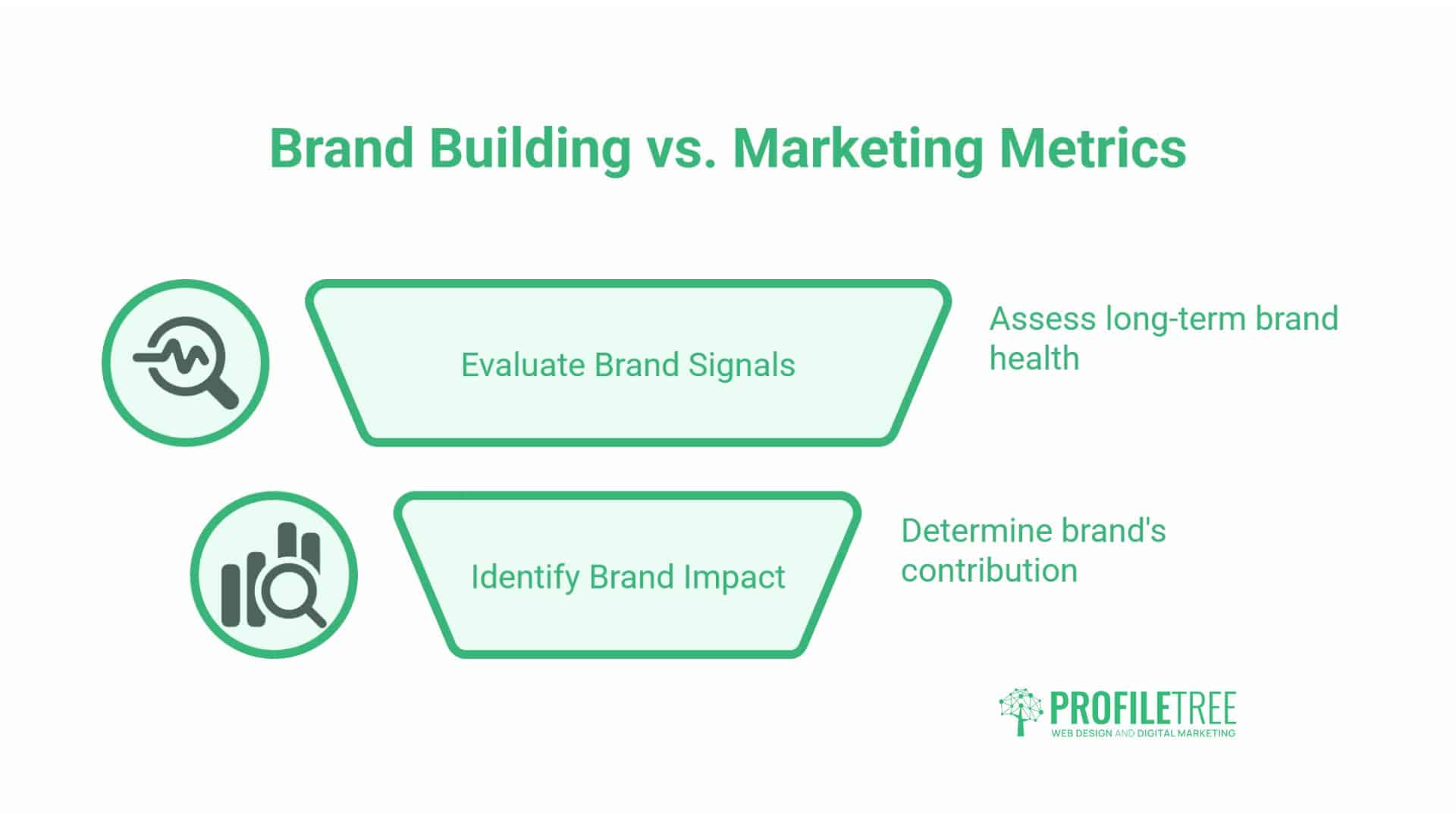
Brand building is hard to justify on a spreadsheet if you’re only looking at last month’s leads, because that’s a marketing metric, not a brand one. A handful of signals tell you whether the brand itself is doing its job.
Unprompted recognition is the clearest one: do people mention your business by name when discussing your sector, without being prompted by an advert? Referral rate is another, since a brand that customers are proud to recommend generates enquiries that never touch a paid channel at all. Price tolerance matters too. If you can hold your pricing while a competitor discounts and still win the job, that’s brand equity doing real, measurable work. Finally, watch your branded search volume in Google Search Console over time; growth there means people are actively looking for you by name rather than finding you by accident.
None of these moves quickly. Treat brand equity as a balance sheet asset you’re building over the years, not a campaign metric you check weekly.
Building a Purpose-Led Brand
A growing number of UK and Irish consumers pay attention to how a business behaves, not just what it sells. This doesn’t mean every SME needs a formal sustainability strategy, but it does mean vague claims are increasingly risky. If you use local suppliers, say which ones and why. If you’ve reduced waste or packaging, describe what changed rather than reaching for the word “sustainable” on its own. Specific, verifiable claims about how you operate build more trust than a general statement of good intentions, and they’re much harder for a competitor to copy convincingly.
Brand Building for B2B and Professional Services
Most online branding advice is written for consumer products, focusing on launching a new logo and a striking Instagram feed. That advice translates poorly to a solicitor, an accountancy practice, or a manufacturing supplier deciding how to present itself. In professional services, trust and demonstrated authority replace trendiness as the thing a brand needs to communicate.
For these businesses, the brand is carried more by the people than by the visual identity. A senior partner writing genuinely useful, plain-English guidance for their industry does more for the firm’s brand than a rebrand ever will. LinkedIn is usually the right channel for this kind of B2B brand building, since it’s where the buyers of professional services actually look for evidence of expertise before making contact. Case studies, plain-language explainers of complex services, and a founder or partner willing to put their name to opinions all carry more weight here than a polished but generic “About Us” page.
Regional Branding: Why Northern Ireland and Irish SMEs Have an Advantage
There’s a genuine competitive edge available to businesses in Northern Ireland and Ireland that most owners haven’t fully used: local provenance. As Ciaran Connolly, founder of ProfileTree, puts it: “Businesses in Northern Ireland are operating in a market where ‘local’ still genuinely matters to buyers. A Belfast-based company can earn trust through community connection and local credibility that a remote national competitor simply can’t replicate. The businesses that lean into that identity, in their messaging, their website and their content, consistently outperform those that try to sound like a generic national brand.”
This applies whether you’re a professional services firm, a food producer, or a hospitality business. The principles of tourism marketing show this in sharp relief: regional identity, local stories, and genuine connection to place are among the most effective trust signals available, and the same pattern plays out in most other sectors.
Practically, this means using your location as a positive signal rather than apologising for it. Mention Belfast, Derry, Dublin or Cork in your web copy. Reference the community you serve. Photograph your actual premises and team rather than using stock images. These details signal authenticity, and authenticity is what UK and Irish consumers increasingly look for when choosing who to spend money with. Regional identity also matters for local SEO, since Google’s local search algorithms weight geographic signals in business listings, on-page copy and structured data. A business that signals its location clearly and consistently ranks more strongly in local searches, which, for most SMEs, is where the most commercially valuable traffic comes from.
Branding on a Budget: High-Impact Tactics for Growing SMEs
Full-service brand builds are not always the right starting point. Here are the highest-return actions available to businesses working with a constrained budget.
Start with your Google Business Profile. This is free, it influences local search rankings directly, and it’s often the first thing a potential customer sees. A complete, accurate, and regularly updated profile with real photos and genuine reviews communicates brand credibility before someone even visits your website.
Build brand storytelling into your content. Stories about how your business started, problems you’ve solved for customers, and the thinking behind decisions you’ve made are free to produce and vastly more engaging than product-led copy. They also tend to perform well in organic search because they cover specific, long-tail queries that larger competitors overlook.
Invest in one great piece of video rather than a constant stream of filler content. A single, well-produced ninety-second brand video, shot properly with decent audio, delivers more brand impact than months of low-quality social posts.
Use business networking strategically. LinkedIn, Chambers of Commerce, and sector-specific networks in Northern Ireland and Ireland give SMEs access to audiences and credibility signals that would cost far more to reach through paid advertising. Showing up consistently in these spaces is a brand-building activity that costs time, not money.
Be consistent about your brand attributes. Identify five to seven words that describe your brand accurately, and use them as a filter for every piece of content you produce. If a post, page or video doesn’t reflect those attributes, it shouldn’t go out.
Common Brand Building Mistakes UK Small Businesses Make
Even businesses with strong products and genuine expertise can undermine their brand by falling into predictable traps. These are the mistakes that come up most consistently when working with SMEs across Northern Ireland, Ireland and the UK.
Confusing activity with strategy. Posting on social media every day without a clear sense of what the posts are supposed to communicate is not brand building. It’s noise. Consistency of message matters far more than frequency of output.
Building the brand before the product is right. Investing in a premium brand identity before the core product or service is consistently excellent is a common mistake among early-stage businesses. Brand perception is shaped by customer experience, not by logos and taglines. Get the experience right first.
Ignoring the website. Many SMEs invest in social media while their website remains outdated, slow, or hard to use. Since most purchasing decisions involve at least one visit to your website, this is the wrong order of priorities, and it’s often the cheapest problem on this list to fix relative to the damage it causes.
Changing brand identity too frequently. A brand needs time to build recognition. Redesigning logos, changing colour palettes, or pivoting messaging every eighteen months resets the recognition work you’ve already done. Make considered decisions at the start, then let them settle.
Not training the team. Brand consistency breaks down when individual team members communicate differently with customers. Structured digital training addresses this directly, equipping teams across Northern Ireland and the UK with the practical knowledge to represent a brand consistently across digital channels, rather than leaving it to guesswork.
Where to Start This Week
The most common reason small businesses stall on brand building is that the task feels too large to begin. In practice, the starting point is simple: write your value proposition, research your top three competitors, and identify the one thing your business does that they don’t. Everything else, including the website, the content, and the video, follows from there.
If you’d rather have a second opinion before you commit budget, ProfileTree’s AI implementation and digital transformation work increasingly plays a role even at this early stage, helping SME owners speed up competitor research and drafting without losing the specific, grounded character that makes a brand memorable in the first place.
FAQs
What is the difference between a logo and a brand?
A logo is a visual symbol that identifies your business. A brand is the total experience your customers have of your business, including how your website feels, the tone of your communications, the reliability of your service, and the associations people form with your name over time. The logo is the most visible element of the brand, but not the most important one.
Is brand building the same as marketing?
No. Marketing is the specific activity you run to generate short-term attention and leads. Brand building is the longer-term work of shaping how people perceive and trust your business, which makes every future marketing campaign more effective.
How do I build a brand with limited money?
Focus on the foundations that take time rather than money: a clear value proposition, a complete and well-maintained Google Business Profile, consistent use of your brand voice across all communications, and genuine stories from your business used as content. One well-produced video will deliver more than months’ worth of low-quality posts.
Should I use a .co.uk or .com domain for my UK business?
Use .co.uk as your primary domain if you’re operating mainly in the UK market. It signals local credibility to UK consumers and search engines, and it tends to be easier to secure than the .com equivalent. Register both if possible, redirecting .com to .co.uk, to prevent others from acquiring a confusingly similar address. This is a low-cost action that removes a future headache.