
Social Media Strategies for Welsh Businesses
Table of Contents
Welsh businesses have a social media problem, and it’s not engagement. It’s sameness. Most miss what makes social media strategies for Welsh businesses genuinely different from a generic UK playbook: the language question, the regional audience gaps, and the community loyalty that rewards local authenticity over polished content. The businesses growing their following aren’t posting more; they’re posting differently.
This guide covers what actually works for Welsh SMEs on social media in 2025: platform choices, the bilingual content question, regional audience differences, grant support, and how to measure what’s working. ProfileTree works with businesses across the UK and Ireland, and the patterns we see in Wales are distinct enough to warrant their own playbook.
Social Media Strategies for Welsh Businesses
Understanding who uses what — and why — shapes every other decision in your social media strategy.
Platform Usage in Wales
Facebook remains the dominant platform across Wales, particularly in the Valleys communities and rural areas, where community groups function as local notice boards. If you run a trade business, a café, or any service where word-of-mouth matters, Facebook is still the highest-ROI platform.
Instagram skews younger and more urban. Cardiff and Swansea-based businesses in food, hospitality, retail, and creative services will find their audience here. The platform rewards visual quality and consistency more than any other.
LinkedIn matters more for Welsh businesses than many assume. Cardiff’s financial and professional services sector is growing, and B2B businesses across South Wales — particularly in Newport, Bridgend, and the broader M4 corridor — should treat LinkedIn as a primary channel. Our analysis of LinkedIn industry data shows how sector-specific the platform’s value really is.
TikTok is where Welsh tourism and food businesses are finding unexpected reach. UK TikTok statistics confirm that the platform’s user base skews toward 18–34 year-olds, but content with genuine local character — Welsh landscapes, traditional crafts, food producers — performs disproportionately well regardless of follower count.
What Makes Welsh Audiences Different
Three things set Welsh audiences apart from broader UK audiences online. First, community loyalty is high: local hashtags, local groups, and local references signal authenticity in a way that generic content never will. Second, language matters — not just as a gesture, but as a commercial signal (more on this below). Third, Wales has a strong sense of distinct identity that brands can either connect with or miss entirely.
The Bilingual Content Question
This is the section most social media guides get wrong. They acknowledge Welsh language matters, then offer no practical guidance. Here’s what actually works.
Who Needs to Post in Welsh
Not every Welsh business needs bilingual social content, but more should than currently do. If your customers are in North Wales, particularly Gwynedd, Anglesey, or Ceredigion, Welsh-language content isn’t optional for authentic engagement; it’s expected. In Cardiff and the southern coastal strip, English-dominant content is fine, but Welsh-language posts will outperform expectations because the supply is so low relative to demand.
The business case is simple: Welsh-language content faces almost no competition. Post in Welsh and you immediately stand out in feeds that are otherwise identical.
How to Set Up Bilingual Posts Without Cluttering Your Feed
Facebook has a built-in “Write post in another language” feature that allows you to create a single post with separate Welsh and English versions. Each user sees their preferred language based on their settings. This avoids the dual-caption approach that truncates at the “read more” cutoff on Instagram, which cuts off at roughly 125 characters on mobile.
For Instagram, the cleaner approach is to write Welsh first, add a line break, then English. Keep the Welsh section short enough that the core message lands before the cutoff. Bilingual captions that frontload the Welsh version perform better for Welsh-speaking audiences than captions that bury it at the bottom.
On Twitter/X, Welsh-first posting with an English reply thread is a format used successfully by Superfast Business Wales and several Gwynedd-based businesses.
Ciaran Connolly, founder of ProfileTree, puts it directly: “Welsh brands that commit to bilingual content aren’t just doing the right thing culturally — they’re operating in a space with almost no competition. It costs a few extra minutes per post and delivers a differentiation that money can’t buy.”
Regional Playbooks: North, South, and Mid-Wales
Social media strategy for a glamping site in Snowdonia is not the same as for a tech consultancy in Cardiff Bay. Regional differences matter.
North Wales: Tourism, Heritage, and Community
North Wales businesses — particularly in tourism, hospitality, outdoor activities, and food production — have a natural content advantage: the landscape. Tourism marketing strategies consistently show that visual-first platforms outperform for destination-type businesses, and North Wales has some of the most photographable terrain in Britain.
The Eisteddfod, the Royal Welsh Show, and St David’s Day create predictable content moments that North Wales brands can build campaigns around. A canoe hire company near Bala, a wool producer in Harlech, or a slate heritage attraction near Llanberis should be building editorial calendars around these dates twelve months in advance, not the week before.
Facebook groups — particularly “North Wales Small Business” and community groups tied to specific towns — drive genuine referral traffic for local service businesses. Regular, helpful participation in these groups outperforms paid advertising for many SMEs.
South Wales: B2B, Retail, and Professional Services
Cardiff and the wider South Wales urban belt operate much more like any other UK city from a social media perspective. LinkedIn is the primary platform for professional services, finance, legal, and tech businesses. Instagram works for retail, hospitality, and lifestyle brands. TikTok is an emerging channel for food businesses and entertainment venues.
The M4 corridor between Cardiff and Newport has a growing tech and fintech community that engages actively on LinkedIn. If you’re B2B in this area, consistent LinkedIn publishing — company updates, thought leadership, case study posts — will outperform almost any other channel for qualified lead generation.
Mid-Wales and the Rural West
For agricultural businesses, rural retailers, and community services in areas like Powys, Ceredigion, and Pembrokeshire, Facebook remains by far the dominant platform. WhatsApp community groups have replaced text messaging for many rural networks, which means organic word-of-mouth amplification still plays a significant role. Social content that sparks shares within these groups — helpful seasonal advice, community news, local success stories — generates more reach than paid campaigns for most rural Welsh SMEs.
Platform Guide for Welsh SMEs in 2025
Platform choice is one of the most consequential decisions in your social media strategy — and one of the most frequently made by default rather than design. The platforms below aren’t ranked by global popularity; they’re ranked by what Welsh SMEs are actually getting results from right now.
TikTok and Instagram Reels
Short-form video is the highest-reach format available to Welsh businesses right now. The investment is low, the organic reach is still genuinely high compared to static posts, and the rise of short-form video shows no sign of slowing. The most common TikTok marketing mistakes are mostly avoidable with a simple content structure: hook in the first two seconds, one clear idea per video, no corporate voiceover.
For Welsh businesses, location tags and Welsh-specific hashtags significantly extend organic reach. #LoveWales, #VisitWales, #BusinessWales, #WelshBusiness, and niche regional tags like #NorthWales or #CardiffFoodie all have active audiences. Using two or three relevant hashtags per post is enough; stacking twenty adds nothing.
Facebook for Community Growth
Facebook Groups remain underused by Welsh SMEs as a growth channel. Joining and actively contributing to local business groups, community groups, and sector groups builds relationships that convert. Creating your own group — a local business network, a sector discussion group, a community interest page — builds an owned audience that doesn’t depend on the algorithm.
For paid social, Facebook’s location targeting in Wales is precise enough that even small budgets produce results. Postcode-level targeting in Wales allows hyper-local campaigns that reach exactly the right people. Meta’s “Drop-Pin” targeting lets you draw a custom radius around specific Welsh towns, which is more accurate than postcode exclusions for rural areas.
LinkedIn for B2B Growth
Welsh B2B businesses should be publishing on LinkedIn consistently. A post per week from a company page, supplemented by personal posts from the founder or senior team, builds credibility faster than any other organic channel. Social media marketing’s impact on sales is most measurable in B2B contexts precisely because the attribution is cleaner — LinkedIn leads come in with names and job titles attached.
Navigating Welsh Business Grants and Support
Digital marketing support is available for Welsh businesses through several routes that most owners don’t take full advantage of.
Superfast Business Wales (now operating under the Business Wales Digital Programme) offers funded digital advisory sessions that include social media strategy and content planning. These are available to SMEs across Wales and have no fee.
Business Wales itself provides free guidance, workshops, and one-to-one business advisory services. Their digital health check service is a practical starting point for businesses that haven’t formalised their social media approach.
SMART Cymru provides R&D funding, which can include funding for digital infrastructure and content systems in businesses with an innovation component.
The key point: funded support exists before you pay for a social media agency. Working through the free support first, then engaging paid expertise for implementation, is the sensible sequence for most Welsh SMEs.
Connecting Social Media to the Well-being of Future Generations Act
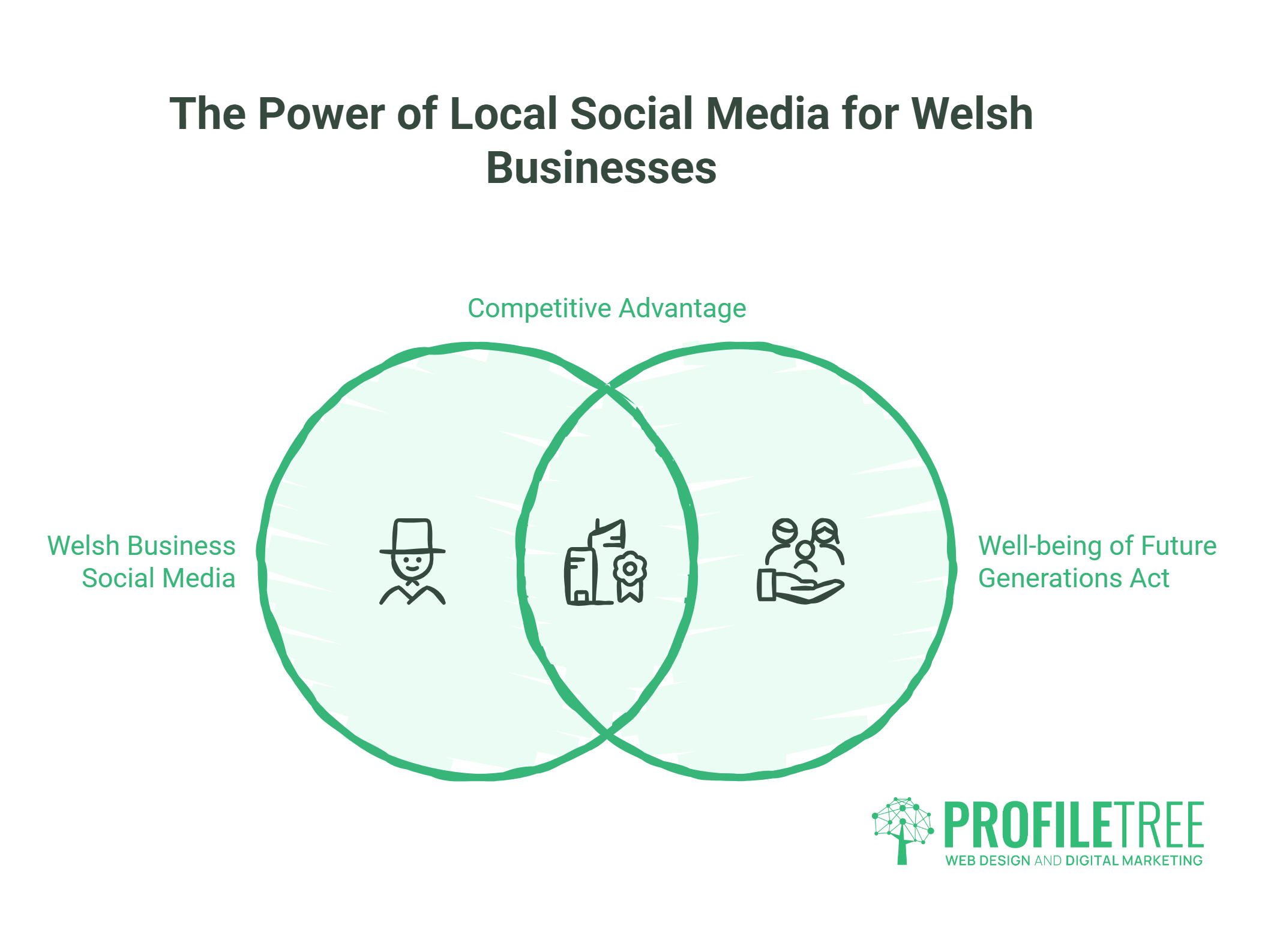
This angle is genuinely underused by Welsh businesses online. The Well-being of Future Generations (Wales) Act 2015 requires public bodies to act in ways that improve economic, social, environmental, and cultural well-being. Private businesses aren’t legally bound by it, but the Act shapes public procurement criteria and consumer sentiment in Wales in ways that matter commercially.
Welsh businesses that use social media to document their community impact, environmental commitments, or cultural contributions — filming at local events, sharing locally sourced supply chain content, posting Welsh-language content as a cultural contribution — are building a brand identity that resonates with both Welsh consumers and public sector buyers. This is a competitive advantage over UK-wide brands that don’t operate with this kind of local accountability.
Using social media to drive community engagement becomes a genuine business strategy when your customers care about who their suppliers are, not just what they sell.
Measuring ROI in a Hyper-Local Welsh Market
Measurement looks different when your market is a town of 8,000 people rather than a city of 800,000.
What to Track
Free social media analytics tools give Welsh SMEs a working view of what’s actually performing without a budget. Meta Business Suite provides reach, engagement, and demographic breakdown for both Facebook and Instagram. LinkedIn Analytics shows which posts generate profile views and connection requests. TikTok Analytics shows average watch time, which is the single most important metric for algorithm performance.
For Welsh businesses with physical premises, tracking social-referral footfall is harder but not impossible. A simple “how did you hear about us?” question at the point of sale, combined with monitoring spikes in profile visits and message enquiries after specific posts, gives a usable picture.
ROI of Welsh-Language Content
There’s no universal benchmark for Welsh-language content ROI because so few businesses have tracked it systematically. What the businesses that do it consistently report is that engagement rates on Welsh-language posts run higher than on English equivalents — because the audience that responds is self-selecting and more local. If you’re a business where local trust is a commercial asset, that’s the metric that matters.
Video and ProfileTree’s Approach
Video content carries distinct advantages for Welsh businesses trying to build a sense of place and personality. A 30-second Reel showing a craftsperson at work in a Welsh workshop says more about a brand than a month of text posts.
For businesses considering professional video content as part of their social strategy, the considerations around platform format, length, and caption structure are covered in ProfileTree’s work with clients across the UK and Ireland. The video below gives an overview of the agency’s approach to social media and digital strategy.
For Welsh SMEs, that often means Facebook for community, LinkedIn for B2B, short-form video for reach, and bilingual content as a differentiator. The infrastructure to support you — Business Wales, funded digital advice, and community groups — is in place. The gap is usually in execution. If you’d like to talk through what a practical social media strategy looks like for your business, get in touch with the ProfileTree team.
Frequently Asked Questions
Does my business really need to post in Welsh?
It depends on your location and audience. If you operate in Gwynedd, Anglesey, Ceredigion, or other areas with a high proportion of Welsh speakers, Welsh-language content is expected, and its absence is noticed. In Cardiff or Newport, bilingual content is a differentiator rather than a baseline expectation. The practical starting point is to post in Welsh for significant moments — St David’s Day, the Eisteddfod, local events — and see how your audience responds before committing to a fully bilingual content calendar.
What are the best times to post for a Welsh audience?
Welsh audiences broadly follow UK patterns: weekday mornings between 7 am and 9 am, lunch (12–1 pm), and evenings from 6–9 pm see the highest engagement. Sunday evenings perform well for consumer-facing businesses. The exception is agricultural and rural businesses, where early morning posts (before 7 am) often outperform because farmers and rural workers are active before most other audiences.
How do I find local Welsh influencers?
Search Instagram and TikTok by location tags for your area (#NorthWales, #Cardiff, #Pembrokeshire) and filter for accounts with 1,000 to 30,000 followers. Micro-influencers in Wales typically have higher engagement rates than national accounts and will often collaborate for product exchange rather than paid fees. Welsh-language creators are particularly underserved by brands, which means collaboration requests are often received positively.
Can I get a grant to cover social media management costs?
Not directly, but Business Wales offers funded advisory sessions that include social media strategy support. Superfast Business Wales’s digital advisory programme has covered social media planning in the past. For businesses with a digital transformation component, SMART Cymru funding may apply. Check current eligibility at businesswales.gov.wales before engaging paid social media management.
Is TikTok worth it for B2B businesses in Wales?
For most B2B businesses, LinkedIn will deliver better-qualified leads. TikTok is worth experimenting with if your B2B offer has a visual or educational angle — professional services that can demonstrate expertise through short explainer videos (an accountant explaining VAT thresholds, a solicitor clarifying leasehold reform) are finding audiences on TikTok under the “WorkTok” category. It’s a secondary channel for most Welsh B2B businesses, not a primary one.