
Social Media Statistics 2026: A UK and Ireland SME Guide
Table of Contents
There are now more than 5.66 billion active social media users worldwide, more than half the planet, and the average person is active across nearly seven platforms a month. Social media statistics like these tell you the audience is there. They do not tell you where to put your budget, which platform suits your business, or what to post next week. That is the gap this guide is built to close.
This is a full breakdown of the social media statistics that matter most in 2026 for businesses in Northern Ireland, Ireland and the wider UK, covering global usage, platform-by-platform data, engagement benchmarks and advertising costs. Every section ends with a short, practical read on what the number actually means for an SME deciding where to spend its time and money. Global averages from US-focused sources do not always describe how British and Irish audiences behave, so we have separated that data out wherever it is available.
The 2026 Vital Statistics at a Glance
If you only need the headline social media statistics, here they are.
| Metric | Global | UK | Ireland |
|---|---|---|---|
| Total social media users | 5.66 billion | 57.1 million | 3.9 million |
| Average platforms used per month | 6.75 | 6.1 | Not separately published |
| Average daily time on social media | 2 hours 21 minutes | 1 hour 46 minutes | Not separately published |
| Most used platform | Facebook (3.07bn monthly users) | YouTube | Facebook (older demographics) |
| Fastest-growing platform | TikTok | TikTok | TikTok |
| Share of internet users on social media | 70.6% | 84.3% | Not separately published |
Sources: DataReportal Global Digital Report 2026; Ofcom Online Nation. These figures should be checked against the latest published editions before the page goes live, since both sources update on their own schedule.
A Belfast retailer and a London retailer are reading the same global social media statistics but operating in different markets. The UK figure alone hides that difference, which is why the regional section further down matters more than the global one for most of our readers. This is particularly important when planning social media marketing for businesses, as audience behaviour, local competition and platform usage can vary significantly between regions.
Global Social Media Statistics: The Trends Behind the Numbers
Social media crossed the 5 billion-user mark in 2023 and has continued to grow since. DataReportal puts the global figure at 5.66 billion for early 2026, growth of roughly 4.8% year on year.
The numbers that matter beyond the headline total:
- The average person uses 6.75 different social platforms each month
- Users spend an average of 2 hours 21 minutes a day on social media
- South and East Asia combined account for more than 2.2 billion users, the largest regional base
- Africa is adding new users faster than any other region
The trend worth watching isn’t the total; it’s what’s happening in mature markets. Growth in the UK, the US and Western Europe has slowed, so platforms are competing for time spent rather than new sign-ups. That shift rewards content that keeps someone watching rather than content built purely for reach, which is a real change in what “performing well” looks like for a business page.
There’s a second shift running alongside this one. More search activity is now settled by an AI-generated summary rather than a list of links, and that habit is spreading into how people research brands on social platforms, too. A user who once scrolled a company’s Instagram grid to check it was legitimate might now ask an AI assistant to summarise reviews and recent posts instead. Nobody has solid figures yet on how many UK or Irish users interact with social platforms this way, so we won’t pretend otherwise, but it’s a pattern worth building content around rather than discovering after the fact.
Platform Statistics UK and Irish SMEs Need to Know
Facebook’s 3 billion users mean little once you know organic reach for business pages has fallen to a fraction of a per cent. YouTube’s user count looks modest by comparison, but it also functions as the world’s second-largest search engine. Raw user counts alone are a weak guide to where a business should show up, and most of the social media statistics quoted in marketing pitches don’t come with that context.
Most of what gets published on this topic focuses on large consumer brands, leaving a gap for professional services firms trying to figure out what it means for them. A Belfast accountancy practice or a Dublin law firm isn’t competing for TikTok reach, and shouldn’t try to. The platform breakdown below is written with that difference in mind rather than treating every business as a retail brand chasing views.
| Metric | Figure |
|---|---|
| Monthly active users | 3.07 billion |
| Daily active users | 2.11 billion |
| Largest age group | 25 to 34 (over 30% of users) |
| Average organic page post engagement rate | 0.07% |
| Daily video views | 4 billion+ |
For most SMEs in Northern Ireland and Ireland, Facebook’s value now sits in paid advertising, local community groups and event promotion rather than standard page posts. Live video is the exception: it still commands an engagement rate of around 26%, well above any other content type on the platform.
YouTube
| Metric | Figure |
|---|---|
| Monthly active users | 2.70 billion |
| Daily active users | 122 million |
| Hours of video uploaded per minute | 500 hours |
| Average daily watch time per user | Over 60 minutes |
| Most dominant age group | 25 to 34 |
YouTube’s search function is where the real opportunity sits for SMEs, since videos frequently rank in Google search results as well as inside YouTube itself. Building a channel with a consistent upload pattern does more for long-term visibility than treating YouTube as somewhere to upload once and hope, which is where our video production and YouTube channel work tends to come in for clients who have the content ideas but not the production capacity.
| Metric | Figure |
|---|---|
| Monthly active users | 2.4 billion |
| Daily active users | 990 million |
| Dominant age group | 18 to 29 (71% of users) |
| Reels’ average reach vs standard posts | 22% higher |
| Sponsored post engagement vs organic | 8x higher |
Instagram’s growth is now built on short-form video. Reels get meaningfully higher organic reach than static image posts, a deliberate move by Meta to compete with TikTok. For businesses with strong visual output, interior design, food, fitness and hospitality among them, Instagram stays one of the more cost-effective organic channels, provided the strategy centres on Reels and Stories rather than a static grid.
TikTok
| Metric | Figure |
|---|---|
| Monthly active users | 1.5 billion+ |
| Average monthly time per user | 31+ hours |
| Ad reach growth (year on year) | 12.6% |
| CTA videos: conversion rate uplift | Up to 152% |
| Dominant age group | Under 30 (47.4% of users) |
TikTok’s growth among over-25s is the trend worth watching. Its algorithm’s willingness to surface content from small or new accounts to large audiences makes it one of the few platforms left where genuine organic reach doesn’t depend on an existing following.
| Metric | Figure |
|---|---|
| Monthly active users | 310 million |
| Daily active users | 141 million |
| Dominant age group | 25 to 34 (60% of users) |
| B2B marketers using LinkedIn | 91% |
| B2C marketers using LinkedIn | 96% |
LinkedIn is the primary B2B platform in the UK and Ireland, particularly for professional services firms, technology companies, and anyone targeting decision-makers directly. Organic reach here has actually improved for content that starts a genuine discussion. Long-form posts, opinion pieces and data-led content consistently outperform promotional announcements, which is worth knowing before a business defaults to a sales-style post.
X and the smaller platforms
X’s monthly user figures have been disputed since the change of ownership, with estimates ranging from 300 million to 550 million depending on the methodology used. Engagement rates have declined for most business accounts, and ad spend on the platform has fallen among major brands. For most SMEs, X now plays a secondary role, serving as a real-time commentary and customer service channel rather than a primary content channel. Threads has grown past 300 million registered users, but hasn’t shown strong engagement rates for business content yet, and Mastodon and Bluesky remain niche for commercial purposes.
UK, Ireland and Northern Ireland: The Regional Breakdown
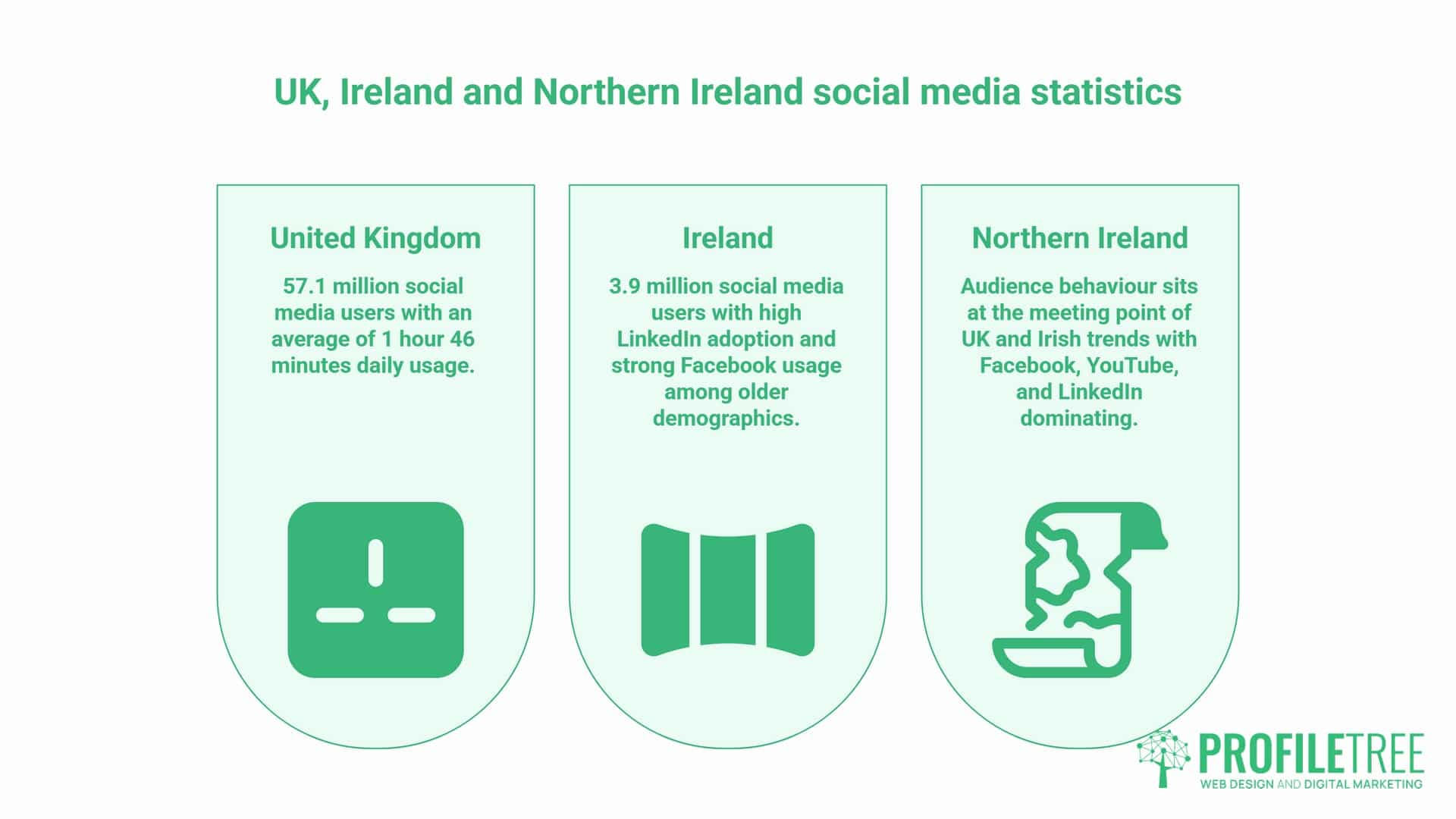
This is the part most global social media statistics guides skip entirely, and it’s the part that actually changes what an SME should do.
United Kingdom
- 57.1 million social media users as of early 2026 (DataReportal)
- UK users average 1 hour 46 minutes a day on social media, below the 2 hours 21 minutes global average (Ofcom Online Nation)
- YouTube is the most visited social platform among UK adults
- Facebook reaches 73% of UK internet users monthly
- LinkedIn has over 36 million registered UK users, one of the highest penetration rates in Europe
- TikTok’s UK user base passed 20 million in 2025
Ireland
- 3.9 million social media users (DataReportal)
- LinkedIn adoption is higher than average relative to population size, reflecting the concentration of tech and professional services firms
- Facebook retains a stronger hold on older demographics than it does in the UK
Northern Ireland doesn’t get a separate published breakdown from the major reporting bodies, which is worth saying plainly rather than inventing a number that doesn’t exist. What we can say from working with clients across the region is that Northern Ireland businesses sit at the meeting point of UK and Irish audience behaviour:
Facebook and YouTube dominate for reaching local audiences, while LinkedIn matters more than the raw user count suggests for any B2B firm working across both jurisdictions. Funding programmes from Invest NI and the UK Shared Prosperity Fund have also pushed digital skills development up the agenda for a lot of local SMEs over the past year.
“The mistake we see most often is a business running a London-shaped campaign and expecting it to land the same way in Belfast or Dublin,” says Ciaran Connolly, founder of ProfileTree. “The platforms might be identical, but the audience, the tone and the local reference points aren’t, and social media statistics from a UK-wide average will only get you so far when you’re trying to reach a specific town.”
ProfileTree, based in Belfast, works with businesses across Northern Ireland, Ireland and the UK to build social media strategies that account for regional differences rather than applying global benchmarks that don’t translate to local conditions.
Social Media Engagement Statistics and Benchmarks
Engagement rate is one of the most misread metrics in social media. A large following means little if only a fraction of it interacts with what you post. These are the benchmarks to measure against.
| Platform | Average organic engagement rate | What counts as good |
|---|---|---|
| Facebook (page posts) | 0.07% | 0.1% or above |
| Instagram (posts) | 0.43% | 1% or above |
| Instagram (Reels) | 1.23% | 2% or above |
| TikTok | 2.65% | 4% or above |
| LinkedIn (company pages) | 0.35% | 1% or above |
| X (formerly Twitter) | 0.029% | 0.05% or above |
Source: Rival IQ Social Media Industry Benchmark Report; RightMetric. These should be checked against the most current published report before the page goes live.
These social media engagement statistics vary widely by sector. Retail and hospitality brands typically see stronger Instagram engagement than professional services firms, while B2B companies tend to outperform their sector peers on LinkedIn specifically.
Across every platform, video beats static content. Short-form video under 90 seconds wins in reach, while long-form retains viewers longer and boosts search visibility on YouTube. 82% of marketers now repurpose content across multiple channels, one of the more useful numbers in this whole guide. A single filming session can produce a YouTube upload, three to five short clips, an audio extract and a set of still frames, which is how our video production team in Belfast structures most shoots for SME clients: one session, several platforms, one production budget.
Social Media Advertising Statistics
Organic reach has fallen across every major platform over the past five years, so paid social now plays a necessary role for most businesses trying to reach anyone beyond an existing following.
| Metric | Figure |
|---|---|
| Average social media CPM (cost per 1,000 impressions) | $5.33 (needs re-verification against a current source) |
| Average CTR for social media ads | 1.36% |
| Share of marketers using paid social distribution | 85% |
| Facebook local business page views (weekly) | 70%+ of Facebook users view at least one |
| B2B leads generated via LinkedIn vs other platforms | LinkedIn generates 80% of B2B social leads |
The most common error we see UK SMEs make with paid social is targeting too broadly and measuring too loosely. Facebook and Instagram’s ad platforms allow tight geographic and demographic targeting, meaning a Belfast business can reach specifically Northern Irish audiences instead of paying for impressions across the whole of the UK.
LinkedIn carries a higher cost per click than Facebook or Instagram, but where a single converted lead can represent thousands of pounds in revenue, that cost is often still justified. The platform should match the stage of the customer journey: LinkedIn for awareness and decision-maker targeting, Facebook and Instagram for retargeting and conversion. Our digital strategy service covers exactly this kind of platform selection and budget planning as part of a wider campaign.
What These Social Media Statistics Mean for Your Strategy
Numbers only help if they change a decision. Here is how this data translates into priorities for SMEs across Northern Ireland, Ireland and the UK.
Choose a platform based on your audience, not the biggest number. Facebook’s 3 billion users don’t make it right for every business. A B2B professional services firm in Belfast will almost always do better on LinkedIn than on TikTok, regardless of TikTok’s growth. Map your actual customers to the platform where they spend time, not the platform with the largest headline figure.
Organic reach now runs through video. Every platform’s algorithm favours video over static posts. A strategy that’s still mostly text and images is working against the grain of how content gets distributed in 2026, which is exactly the gap our content marketing work is built to close for clients who know they need to move but aren’t sure where to start.
UK and Irish audiences don’t match the global average. UK users spend less time on social media per day than the global average, so content needs to earn attention faster, and platform preferences differ too: YouTube is more dominant here than most social media guides assume.
Paid social works best when it is narrow, not broad. Wide awareness campaigns rarely deliver an acceptable return for SMEs with limited budgets. Tight geographic and demographic targeting, combined with retargeting people who’ve already visited your site, usually beats an untargeted reach campaign on cost per acquisition.
AI is changing how content is made and how it is found, not just how it is consumed. Search behaviour is shifting toward AI-generated answers that summarise content rather than list links, and platforms are experimenting with AI tools for everything from captioning to ad targeting. SMEs that treat this as a production shortcut without a strategy behind it tend to produce content that reads the same as everyone else’s. Our AI transformation work is aimed at using these tools without losing the local, specific detail that makes a small business’s content worth reading in the first place.
Training closes the gap between knowing and doing. Plenty of SMEs in Northern Ireland know they need a better social media strategy but don’t have the in-house capability to run one consistently. ProfileTree’s digital training covers social strategy, content creation and analytics for business owners and marketing teams who want to manage more of this in-house rather than outsourcing everything.
Social media in 2026 isn’t one channel, it’s a set of distinct platforms, each with its own audience and its own commercial logic. Video drives organic reach everywhere, UK and Irish audiences behave differently from the global average, and paid social works best when it’s targeted rather than broad. Understanding the social media statistics gives you a baseline. Building the right strategy on top of them is what actually moves a business forward.
Most SMEs don’t need a presence on every platform; they need the right two or three to run properly, with content that’s actually made for the platform it’s posted on, rather than the same graphic reshaped six ways. That’s where our team can help if you’d rather have a partner than a spreadsheet full of numbers with nobody to interpret them.
Social Media Statistics FAQ
What is the most used social media platform in the UK in 2026?
YouTube has the highest reach among UK adults, with Facebook close behind. Globally, Facebook leads by monthly active users, though TikTok remains the platform growing fastest among under-25s.
How many people use social media in Ireland?
DataReportal puts the figure at 3.9 million social media users in Ireland. LinkedIn adoption is notably strong relative to the population, reflecting the country’s concentration of tech and professional services firms.
Is Facebook still relevant for UK SMEs in 2026?
Yes, though its role has shifted. Organic page reach has declined sharply, so most value now comes from paid advertising, local community groups, event promotion and live video rather than standard posts.
What is a good social media engagement rate?
It depends on the platform. Instagram posts above 1% and Reels above 2% are considered strong, LinkedIn company pages above 1% are performing well, and Facebook page posts above 0.1% are reasonable given the platform’s organic limits.
How is AI changing social media for small businesses?
AI tools are speeding up content creation and shifting how people search, with more answers being summarised rather than linked to directly. The businesses that benefit keep their local detail and voice rather than letting AI output sound generic.