
Building a Compliance-Friendly Content Strategy for Regulated SMEs
Table of Contents
A compliance-friendly content strategy is one where the rules are built into the brief, not checked at the end. For a regulated SME in finance, healthcare, or law, that distinction decides whether your marketing ships on time or stalls in legal review the day before launch.
Most teams treat compliance as a final gate. The blog gets written, the campaign gets booked, then someone asks whether the claim on page two is defensible. By then, the choice is to publish something risky or miss the slot. A compliance-friendly content strategy removes that trap by deciding what you can say before anyone starts writing.
This guide sets out how to build that system for SMEs across Northern Ireland, Ireland, and the UK: what the FCA, CBI, and GDPR actually require, how to run a lean approval workflow without a full legal department, and where AI genuinely helps versus where it quietly creates new risk.
What Compliance Means in Content Marketing
Content compliance means your published material meets the legal, ethical, and industry-specific rules that govern your sector before it goes live, not after a complaint lands. A financial adviser cannot guarantee a return. A clinic cannot claim a treatment outcome it cannot evidence. A retailer cannot bury the terms of a promotion in unreadable small print.
The principle is the same across sectors: say what is true, support claims you can prove, and disclose what the reader needs to make an informed decision. Where it gets difficult is that each regulator phrases this differently, and the penalties for getting it wrong have grown sharper.
Three bodies shape most UK and Irish content work:
- Financial Conduct Authority (FCA): governs financial promotions in the UK, requiring claims to be clear, fair, and not misleading, and requiring risk warnings to be given proper prominence.
- Central Bank of Ireland (CBI): sets equivalent conduct standards for regulated firms operating in the Republic.
- General Data Protection Regulation (GDPR): controls how you collect, store, and use personal data, including the data that powers personalised content and gated lead magnets.
Healthcare and pharmaceutical content carries an extra layer through the Medicines and Healthcare products Regulatory Agency (MHRA), and accessibility obligations run underneath everything through the Equality Act 2010. Getting these wrong is expensive in terms of fines, but the longer-term damage is reputational: regulated buyers notice when a firm cuts corners.
The Real Cost of Reactive Compliance
The cost of getting compliance wrong is not only the fine. It is the campaign that has to be pulled mid-flight, the blog that ranks well and then has to be taken down, and the months of trust eroded with a cautious customer base. For a regulated SME, a single enforcement action can outweigh a year of marketing budget.
There is a quieter cost too. When compliance is a final hurdle rather than a starting condition, your best content moves slowest. Legal sits at the end of the queue, so the riskiest, most valuable pieces, the ones making real claims about outcomes, get held longest. Teams learn to play safe and publish bland material that no regulator would query, and no customer would remember. The honest understanding of how to write within the rules, covered well in our guide to the ethics and legalities of digital marketing, is what lets you say something worth reading without crossing a line.
Shifting Compliance to the Start of the Brief
The single biggest change you can make is to move compliance from the end of the process to the brief. Decide what you are allowed to claim before a writer opens a document, not after.
In practice, this means every content brief answers a short set of questions before work begins. What claim is this piece making? What evidence supports it? Which regulator’s rules apply? What disclosure or risk warning does it need? A writer who starts with those answers produces compliant copy on the first draft. A writer who starts without them produces something that has to be unpicked.
This approach, sometimes called compliance-by-design, costs almost nothing to adopt and saves the expensive rework that reactive review creates. It also changes the relationship between marketing and legal. Instead of legal being the department that says no at the worst possible moment, they help shape the brief at the start, when changes are cheap. For teams that want to build this discipline internally, ProfileTree’s digital marketing training and structured team training sessions cover exactly this kind of workflow design.
“The firms that handle compliance best stop treating it as a checkpoint and start treating it as a design constraint. When your writers know the boundaries before they write the first sentence, compliance stops being the thing that slows you down and becomes the thing that lets you move quickly with confidence.” Ciaran Connolly, founder, ProfileTree
The UK and Ireland Regulatory Rules
Most content published on content compliance assumes American rules, such as those of the SEC and the FTC. For a business in Belfast, Dublin, or Manchester, that guidance is close to useless. The rules that bind you are British and Irish, and they differ in important ways.
FCA Financial Promotion Rules
If you market regulated financial products or advice in the UK, the FCA requires every promotion to be clear, fair, and not misleading. Benefits and risks must be balanced, risk warnings must be prominent rather than hidden in footnotes, and any past performance figure must carry the standard caveat that it does not predict future results. The FCA’s own financial promotions guidance sets out the current expectations in detail and is worth checking against any draft before it ships. These rules now explicitly extend to social media, so a compliant blog and a non-compliant Instagram caption still make a non-compliant campaign.
GDPR and Personalised Content
GDPR shapes content strategy more than most teams realise. Personalisation depends on data, and every piece of data you use to tailor content needs a lawful basis and proper consent. Gated content that harvests email addresses, tracking pixels that follow readers, and cookie-based audience-building all fall within GDPR’s scope. The technical side matters here too: forms that capture personal data must be built correctly, which is why we cover GDPR-compliant web forms and GDPR training for teams as standalone topics.
Accessibility as a Legal Requirement
Accessibility is not a nice-to-have. Under the Equality Act 2010, content that excludes users with disabilities can expose you to legal challenge. This means alt text for images, captions for videos, readable colour contrast, and plain language. For regulated firms, it doubles as a compliance asset because accessible content is easier to review and defend. The technical foundations, covered in our guide to using ARIA for accessibility and to accessibility in legal website design, belong in the build, not the afterthought.
A Compliance Workflow That Works for Small Teams
Large enterprises manage compliance through dedicated officers and a layered sign-off process. An SME cannot copy that and should not try. What works for a small team is a lean, repeatable workflow with clear roles and no ambiguity about who approves what.
A practical version runs in five stages:
| Stage | Who | What happens |
|---|---|---|
| Brief | Marketing + reviewer | Compliance questions answered before writing starts |
| Draft | Writer | Copy produced inside the agreed boundaries |
| Pre-check | Sign off on claims, risk warnings, and disclosures | Banned claims and missing disclosures flagged early |
| Review | Compliance / legal | Sign-off on claims, risk warnings, and disclosures |
| Archive | Marketing | Approved version and approval record stored |
The archive stage matters more than teams expect. Most UK-regulated industries require you to keep records of marketing communications for around six years, including who approved what and when. An audit trail is not bureaucracy; it is the evidence that protects you if a complaint arrives. Strong content governance and transparency in your process are what turn a workflow into a defensible system.
Roles need to be explicit. One named person is accountable for the final sign-off on any piece making a regulated claim. One named person owns the archive. When everyone is vaguely responsible, no one is, and that is how non-compliant content slips through.
Compliance Across Different Content Formats
Different formats carry different risks, and a single workflow has to flex to cover them.
Blogs and articles are the easiest to control because they move slowly and can be reviewed properly. The risk is unsupported claims and outdated information, so fact-checking and a clear sourcing standard matter most. Our work on content strategy and on content analysis covers how to keep written material both accurate and useful.
Social media is harder. It is fast, informal, and easy to post without review. The fix is pre-approved messaging and a small library of cleared phrases for common situations, so that day-to-day posting stays inside the lines without a sign-off bottleneck. Ephemeral content like Stories needs its own rule: if it cannot be reviewed before it goes live, it should follow a strict pre-approved template, and you need a quick way to pull it if something is wrong. Our guidance on social media compliance goes deeper into building these guardrails.
Video carries the highest stakes because disclaimers, captions, and disclosures must be planned into production, not added later. Scripts for regulated video should be approved before filming, as reshoots are far more expensive than redrafting. The legal specifics, sponsorship labelling, accessibility captions, and consent are set out in our guide to video marketing legal must-knows.
Managing AI-Generated Content Compliance
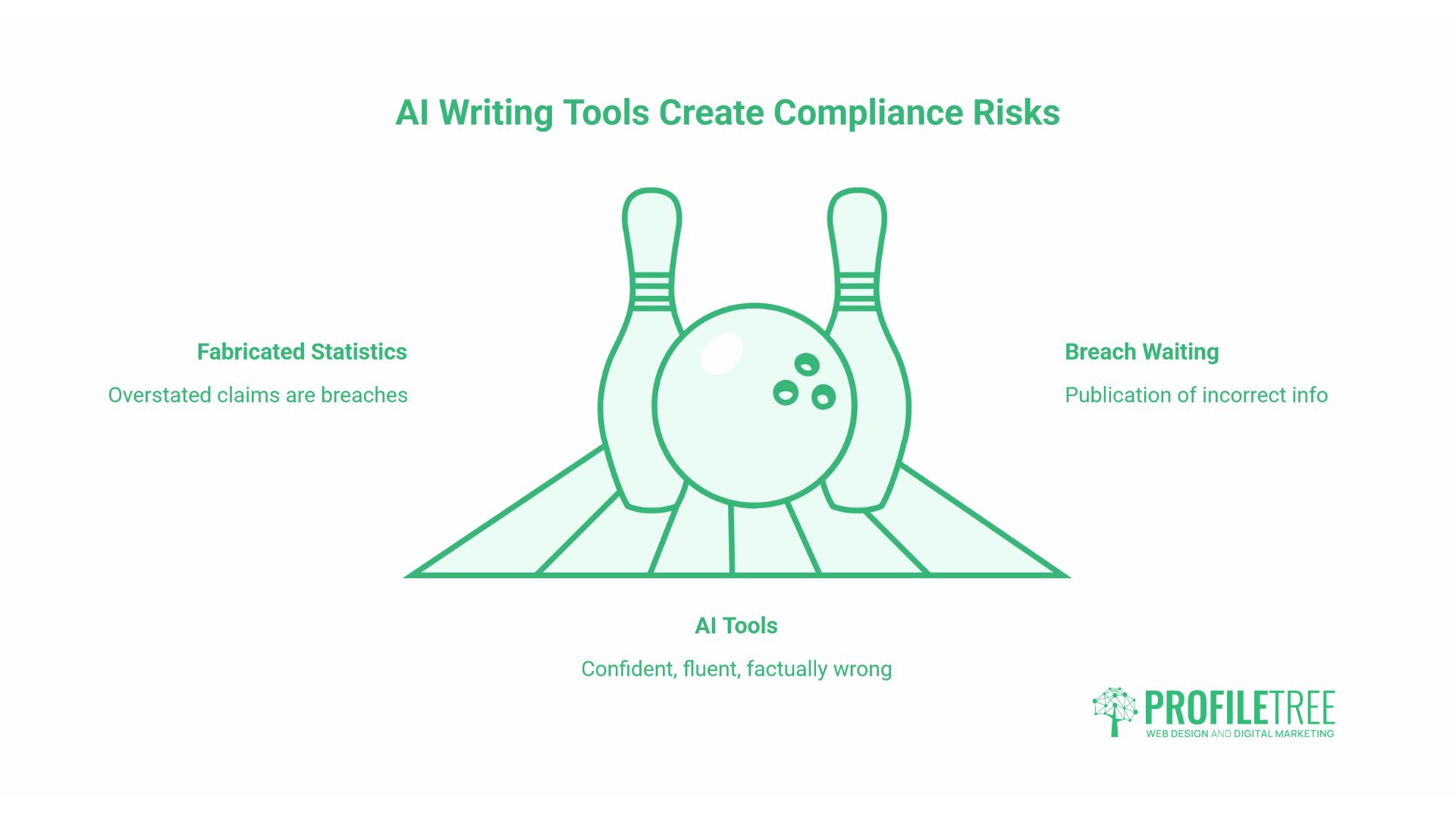
AI writing tools have changed content production for every SME and created a compliance problem that most teams have not addressed. A model will produce a confident, fluent sentence that is factually wrong. In a regulated context, a fabricated statistic or an overstated claim is not a quirk; it is a breach waiting to be published.
The rule is simple: AI can draft, but a human verifies every claim before it ships. AI is genuinely useful for the mechanical side of compliance, scanning copy for banned terms, flagging missing risk warnings, checking that disclosures are present, but it cannot exercise judgement about whether a claim is fair or whether a nuance crosses a regulatory line. Used as a checker and a first-pass drafter, it speeds the work. Trusted as a final authority, it is dangerous. The same caution applies to detection; understanding tools like AI content detection helps you keep human oversight where it belongs, and our work on ethical AI and legal requirements covers the wider obligations. For teams adopting these tools properly, structured AI training and implementation are what separate safe use from expensive mistakes.
A 30-Day Plan to Build the System
You do not need a six-month transformation. A regulated SME can stand up a working compliance system in a month.
In the first week, audit what you already publish and note where claims lack support or disclosures are missing. In the second week, write your compliance brief template, the short set of questions every piece must answer before work starts. In the third week, agree on the workflow, name the accountable people, and set up the archive. In the final week, train the team on the new process and run your next live piece through it end-to-end. After that, the system runs itself and improves with each cycle.
Measuring Whether Your Strategy Is Working
A compliance-friendly content strategy is only worth running if you can see it working. Three measures tell you most of what you need.
The first is rework rate: how often a piece comes back from review needing changes. When compliance lives in the brief, this number falls sharply, because writers start inside the boundaries instead of guessing at them. A rising rework rate usually means the brief stage has gone stale and needs revisiting.
The second is time-to-publish for regulated pieces. Reactive compliance makes your most valuable content the slowest to ship, because the riskiest claims sit longest in legal. If your highest-stakes pieces are moving faster after you adopt the workflow, the system is doing its job.
The third is audit readiness. Pick a published piece at random and try to find its approval record in under five minutes. If you can, your archive works. If you cannot, you have a gap that a regulator’s query would expose. Tracking these alongside your normal content metrics keeps compliance visible rather than buried.
How an Agency Fits Into the Picture
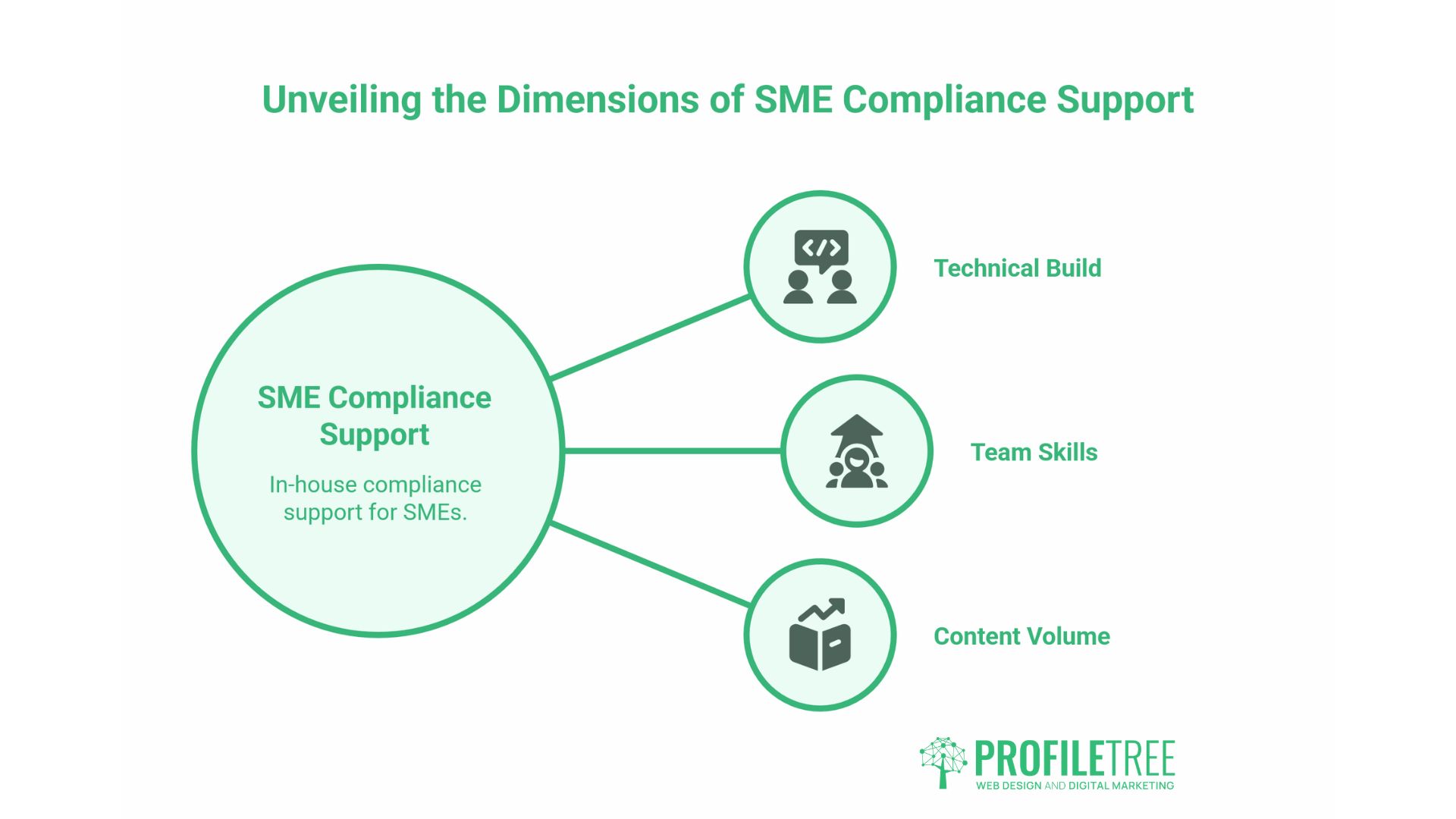
Plenty of SMEs build this system in-house, and the framework here is designed for that. The point where outside help earns its place is usually one of three: the technical build, the team’s skills, or the volume of content.
On the build, compliant content depends on compliant infrastructure. Forms that capture data lawfully, accessible page templates, and tracking that respects consent are web design and development decisions, not copywriting ones. Getting these right once at the build stage saves repeated fixes later.
On skills, the brief-first approach only works if writers understand the rules well enough to apply them. Structured training closes that gap faster than learning by correction, and it keeps knowledge within your team rather than tying it to one person who might leave.
On volume, firms producing content at scale, especially with AI in the mix, need a review layer that does not depend on a single reviewer reading everything. This is where setting up the right tools and AI implementation pays off, freeing human judgement for the calls that actually need it. ProfileTree works with regulated businesses across the UK and Ireland on exactly these three fronts, so the strategy on paper becomes a system that runs.
Conclusion: Compliance-Friendly Content Strategy
Compliant content is not the enemy of good marketing. Treated as a design constraint from the brief onward, it lets a regulated SME publish confidently and quickly, while competitors who leave compliance to the end keep stalling. The framework is straightforward: know your rules, build them into the brief, run a lean workflow with named roles, keep your records, and use AI as a checker rather than an oracle. Build the system once, and it protects every piece you publish after.
FAQs
What is a compliance-friendly content strategy?
It builds legal and regulatory requirements into the brief stage rather than checking for them before publication. The aim is a compliant copy on the first draft, which cuts rework and delays. For SMEs, it means a short compliance brief, a clear workflow, named roles, and an approval record.
How do I manage compliance for UK financial promotions?
The FCA requires promotions to be clear, fair, and not misleading. Balance benefits with risks, give risk warnings real prominence, and caveat any performance figures. These rules apply to social media and video just as they do to your website.
Can AI automate content compliance reviews?
It can support them, not replace human judgement. AI is good at mechanical checks: flagging banned terms and missing disclosures. It is unreliable at judging whether a claim is fair or true. Use it to draft and pre-screen, then have a person verify every regulated claim.
How long should we keep records of compliant content?
Most UK-regulated industries require records to be kept for around 6 years, though this varies by sector and regulator. Store the approved version alongside the name of the approver and the date. That audit trail is your evidence if a complaint arrives.