
5 Key Elements of a Successful Social Media Brand Awareness Strategy
Table of Contents
Social media has become the primary channel for businesses to connect with their audience and build lasting brand recognition. For UK businesses—from Belfast startups to established London enterprises—creating a strong social media presence is no longer optional. Brand awareness through social media requires a strategic approach that combines creative content, data-driven decisions, and consistent execution across the right platforms.
This guide explores the five key elements that form the foundation of successful social media brand awareness campaigns. Whether you’re a marketing manager planning your 2026 strategy or a business owner looking to increase visibility, these proven strategies will help you build recognition, drive engagement, and generate measurable business results.
What is Social Media Brand Awareness?
Social media brand awareness represents how well your target audience recognises and remembers your business across social platforms. It’s the foundation of digital marketing success, creating the first impression that shapes customer perceptions and drives purchasing decisions.
For UK businesses, social media offers unmatched reach. Your potential customers spend a significant amount of time on platforms like LinkedIn, Instagram, TikTok, and Facebook—making these channels essential for building visibility. Social media brand awareness differs from traditional advertising in that it fosters two-way conversations, cultivates communities, and enables businesses to showcase their personality and values directly to consumers.
Brand awareness on social media is achieved through a consistent presence and engagement. When users repeatedly see your content, interact with your posts, and recognise your visual identity, they develop familiarity with your business. This recognition translates into trust, which ultimately influences purchasing decisions.
Building Brand Recognition Through Strategic Social Media Marketing
Creating lasting brand recognition requires more than occasional posts or sporadic campaigns. Successful social media brand awareness is built on systematic approaches that position your business in front of the right audiences at the right times.
Understanding Your Target Audience
The foundation of effective social media brand awareness starts with knowing exactly who you’re trying to reach. Demographics matter, but psychographics—understanding your audience’s interests, challenges, and online behaviour—provide the insights needed to create content that resonates.
UK businesses must consider regional variations in platform usage and content preferences. A Belfast-based B2B company targeting enterprise clients will approach LinkedIn differently than a London e-commerce brand focused on Gen Z consumers. Analyse your existing customer base, study competitor audiences, and use platform analytics to build detailed audience profiles.
Your audience research should identify:
- Which social media platforms do your target customers use most frequently
- What content formats they engage with (video, images, text posts, stories)
- When they’re most active online
- What problems they’re trying to solve
- Which influencers or brands do they already follow
According to Ciaran Connolly, Director at ProfileTree: “Understanding your audience isn’t just about demographics—it’s about recognising the specific challenges your ideal customers face and positioning your brand as the solution they’ve been searching for.”
Defining Clear Brand Awareness Goals
Setting specific, measurable objectives transforms social media efforts from random activity into strategic campaigns. Goals for social media brand awareness should align with broader business objectives while remaining realistic and time-bound.
Strong brand awareness goals include:
- Increasing brand mentions by 40% within six months
- Growing social media following by 1,000 relevant followers per month
- Achieving 500,000 impressions across platforms quarterly
- Improving brand recall scores among target demographics
- Driving 25% more website traffic from social channels
Each goal requires specific tactics and measurement frameworks. Track metrics consistently, analyse what works, and adjust strategies based on performance data rather than assumptions.
Key Elements of a Successful Social Media Brand Awareness Strategy
Creating effective social media brand awareness requires five interconnected elements that work together to amplify your business’s visibility and recognition.
1. Identifying Relevant Social Media Platforms
Not all social media platforms deliver equal results for every business. Strategic platform selection focuses your resources on channels where your target audience actively engages, rather than spreading efforts too thin across every available network.
Platform Selection Framework:
LinkedIn is most effective for B2B companies, professional services, recruitment firms, and businesses targeting key decision-makers. UK businesses in finance, legal services, technology, and corporate sectors achieve strong results through LinkedIn’s professional environment. The platform supports thought leadership content, industry insights, and business-focused video content.
Instagram serves visual brands, retail businesses, hospitality, and lifestyle companies. The platform’s emphasis on aesthetics and storytelling makes it an ideal fit for the fashion, food, travel, and creative industries. Instagram Reels and Stories provide opportunities for authentic, behind-the-scenes content that humanises brands.
TikTok reaches younger demographics and rewards creative, entertaining content. UK businesses targeting Gen Z and younger Millennials find TikTok’s algorithm particularly effective for rapid brand awareness growth. The platform works well for consumer brands willing to experiment with trending formats and authentic presentation styles.
Facebook maintains a broad demographic reach and strong community-building features. Local businesses, service providers, and companies targeting demographics of 35+ years still achieve excellent results through Facebook. The platform’s group features and event tools support community engagement.
Twitter/X serves news-driven industries, public sector organisations, and brands built on real-time engagement. The platform is ideal for businesses where timely commentary and industry conversations are crucial.
Focus on two or three platforms maximum initially. Master these channels before expanding to others. Quality presence on fewer platforms generates better results than poor execution across many.
2. Developing Engaging Content That Resonates
Content quality separates memorable brands from forgettable ones. Effective social media content for brand awareness strikes a balance between entertainment, education, and promotion, while maintaining consistency with your brand identity.
Content Types for Brand Awareness:
Educational content positions your business as an industry authority. Share insights, tips, tutorials, and explanations that help your audience solve problems. A web design agency might create content about website performance optimisation, while a video production company could share filming techniques or equipment guides.
Behind-the-scenes content humanises your brand and builds authentic connections. Show your team, your process, your workspace, and the real people behind your business. This transparency builds trust and makes your brand memorable.
User-generated content leverages customer experiences to build credibility. Encourage customers to share their experiences, then reshare this content (with permission). Authentic customer voices carry more weight than branded messages alone.
Video content dominates social media engagement across platforms. Short-form video (under 90 seconds) performs exceptionally well for brand awareness. Product demonstrations, quick tips, customer testimonials, and company culture videos all support brand awareness objectives.
Visual storytelling, achieved through high-quality images, infographics, and carousels, effectively captures attention in crowded feeds. Maintain consistent visual branding—colours, fonts, filters, and design elements—so your content becomes instantly recognisable.
ProfileTree’s approach to content creation combines data analysis with creative execution. We test different content formats, analyse performance metrics, and refine strategies based on what actually drives engagement rather than what we assume will work.
3. Creating a Content Calendar and Consistent Posting Schedule
Consistency fosters familiarity, and familiarity in turn builds brand awareness. A content calendar transforms sporadic posting into strategic communication that keeps your brand visible and top of mind.
Building Your Content Calendar:
Plan content at least one month in advance, allowing for flexibility in responding to timely posts that address trends or current events. Your calendar should include:
- Content themes aligned with business objectives and seasonal relevance
- Specific post formats and content types for variety
- Publishing dates and optimal posting times for each platform
- Assigned responsibilities for content creation, approval, and publishing
- Promotional campaigns and product launches
- Relevant awareness days or industry events
Posting frequency varies by platform. LinkedIn typically requires 3-5 posts weekly, while Instagram and TikTok benefit from daily content. Quality always outweighs quantity—three excellent posts per week outperform seven mediocre ones.
Scheduling tools allow batch creation and automated publishing, maintaining consistency even during busy periods. However, balance scheduled content with real-time engagement to keep your brand authentic and responsive.
4. Community Engagement and Two-Way Interaction
Social media brand awareness grows through participation, not just broadcasting. Active engagement with your audience builds relationships that transform casual followers into brand advocates.
Engagement Strategies:
Respond promptly to comments, questions, and mentions. Quick responses demonstrate that real people manage your accounts and care about customer interactions. Set internal standards—responding within two hours during business hours shows attentiveness.
Initiate conversations rather than waiting for engagement. Ask questions, request opinions, create polls, and encourage dialogue. Posts that invite participation generate higher engagement rates than simple announcements.
Join relevant conversations in your industry. Comment on other businesses’ posts, participate in trending topics (when appropriate), and contribute valuable insights to discussions. This visibility expands your reach beyond your existing followers.
Monitor brand mentions even when you’re not tagged. Use social listening tools to track conversations about your business, industry, and competitors. This intelligence informs strategy while providing opportunities to engage with unexpected brand advocates or address concerns before they escalate.
Address negative feedback professionally and publicly when appropriate. Transparent problem-solving demonstrates customer commitment and often converts critics into supporters.
5. Social Media Monitoring and Analytics
Measurement transforms social media from guesswork into science. Analytics reveal which content is effective, which audiences are engaged, and how brand awareness efforts contribute to achieving business objectives.
Key Metrics for Brand Awareness:
Reach and impressions measure the number of people who see your content. Growing reach indicates expanding brand awareness, while impression trends show whether your visibility increases over time.
Follower growth rate tracks audience expansion. Calculate percentage growth monthly rather than focusing solely on absolute numbers. Consistent growth indicates effective brand awareness strategies.
Engagement rate measures how your audience interacts with content. Calculate engagement rate by dividing total engagements (likes, comments, shares) by reach or followers. High engagement rates signal content resonance.
Share of voice compares your brand’s mentions to those of your competitors. This metric indicates whether your brand awareness efforts are contributing to your market share growth.
Brand mention sentiment analyses whether conversations about your brand skew positive, negative, or neutral. Growing positive sentiment indicates successful brand perception management.
Website traffic from social connects social media activity to business outcomes. Track visitors, page views, and conversions originating from social platforms.
Review analytics weekly to identify immediate trends and monthly for strategic planning. Compare performance across platforms, content types, and posting times. This data guides resource allocation and strategy refinement.
How to Build and Increase Brand Awareness on Social Media
Building brand awareness requires different approaches than increasing existing awareness. Understanding these distinct phases helps businesses allocate resources effectively.
Building Brand Awareness from Zero
New businesses or brands entering new markets start with minimal recognition. Building initial awareness focuses on establishing presence, defining identity, and reaching target audiences.
Start with profile optimisation across chosen platforms. Complete all profile fields, use professional imagery, write compelling descriptions that incorporate relevant keywords, and ensure consistent branding across all channels.
Establish a solid content foundation before launching a heavy promotional campaign. Develop 15-20 pieces of evergreen content that showcase your expertise, demonstrate your value proposition, and reflect your brand personality. This content library ensures new visitors find valuable material when they discover your profiles.
Leverage existing networks before paid promotion. Encourage employees, partners, and existing customers to follow and share your content. These initial followers provide social proof and seed your audience.
Consider strategic collaborations with established brands or influencers in your space. Guest posts, joint webinars, takeovers, or co-created content introduce your brand to established audiences.
Raising Existing Brand Awareness
Businesses with an established presence focus on expanding reach, increasing engagement, and strengthening brand recall.
Experiment with new content formats that might break through algorithmic changes. If you’ve focused on static images, test the video. If you create long-form content, try short-form alternatives. Platform algorithms often favour newer content types.
Create campaigns around specific themes or initiatives. Product launches, company milestones, industry awareness days, or social causes provide hooks for concentrated promotional efforts that spike visibility.
Encourage user-generated content through contests, hashtag campaigns, or customer spotlights. This approach multiplies your content output while building community and social proof.
Invest in paid social advertising to amplify organic efforts. Even modest budgets ($500-1000 monthly) can significantly expand reach when targeting is precise and creative is strong.
Develop strategic partnerships with complementary businesses. Cross-promotion introduces your brand to adjacent audiences likely to find your offerings relevant.
The Importance of Content Creation and Curation for Social Media Brand Awareness
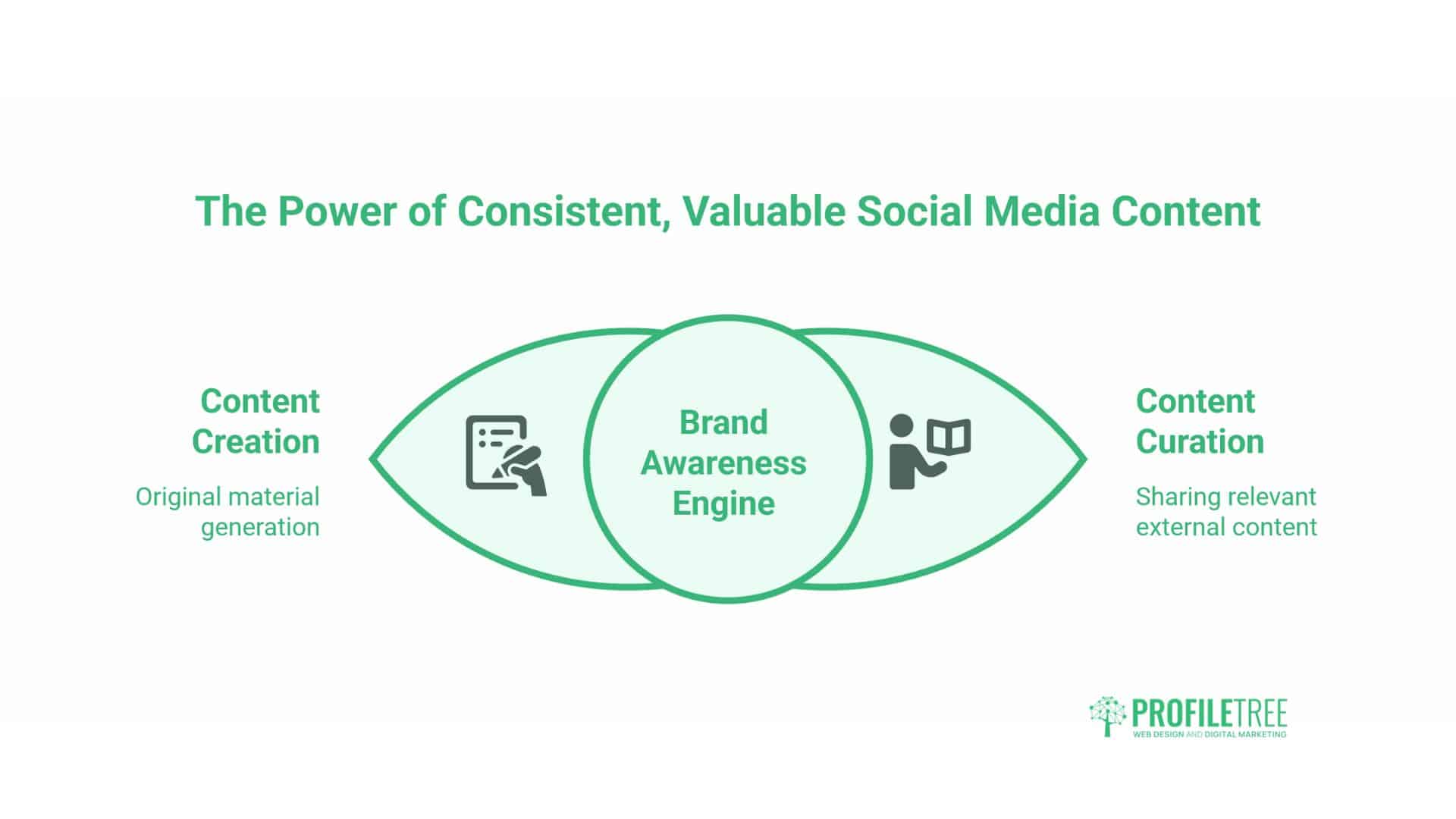
Content drives every aspect of social media brand awareness. The distinction between creation and curation matters less than ensuring a steady stream of valuable, engaging material that keeps your brand visible and relevant.
Content Creation: Building Your Brand Voice
Original content creation establishes your business as an authority while showcasing unique perspectives that differentiate your brand from competitors.
Original content benefits:
- Demonstrates expertise and thought leadership in your field
- Provides complete control over messaging and brand representation
- Creates assets usable across multiple marketing channels
- Builds SEO value through website integration
- Generates proprietary insights that competitors cannot replicate
For digital agencies like ProfileTree, content creation might include case studies demonstrating SEO improvements, video tutorials on AI implementation for businesses, or blog posts analysing web design trends affecting UK companies.
Content creation requires significant resources—time, expertise, and often technical capabilities. However, the investment pays dividends through owned assets that continually support brand awareness long after publication.
Content Curation: Providing Value Through Selection
Content curation supplements original material by sharing relevant third-party content that aligns with your audience’s interests and values. Effective curation positions your brand as a knowledgeable filter, saving your audience time by identifying valuable resources.
Curation benefits:
- Maintains consistent posting frequency without constant content creation pressure
- Demonstrates industry awareness and connection to broader conversations
- Builds relationships with content creators and influencers you feature
- Provides diverse perspectives that enrich your audience’s experience
- Reduces content creation workload while maintaining presence
Curate content strategically. Share articles, research, tools, or insights from reputable sources, adding your own commentary or perspective. Never simply repost without context—your analysis or application makes curated content valuable.
Creating High-Quality Content for Social Media Brand Awareness
Quality content shares common characteristics regardless of format or platform:
- Relevance: Content directly addresses your audience’s interests, challenges, or aspirations. Avoid creating content you want to share; create content your audience wants to consume.
- Authenticity: Genuine, honest content builds trust. Share real stories, admit challenges, and present your business truthfully rather than constructing unrealistic perfection.
- Value: Every piece of content should educate, entertain, inspire, or solve problems. Ask “What does my audience gain from this?” before publishing.
- Visual quality: Invest in decent production values. Blurry images and poor audio quality undermine credibility. A professional doesn’t require expensive equipment—good lighting, stable footage, and straightforward audio matter more than the cost of equipment.
- Optimisation: Adapt content to meet each platform’s specifications and audience expectations—vertical video for TikTok and Instagram Stories, landscape for YouTube, and square formats for Instagram feed posts. Use captions for video content, as most social videos play without sound initially.
- Consistency: Maintain recognisable branding across all content. Consistent colours, fonts, filters, and presentation styles make your content instantly identifiable, strengthening brand awareness.
Social Media Brand Awareness Services and Professional Support
Many businesses recognise social media’s importance for brand awareness but lack internal expertise or resources for effective execution. Professional social media services bridge this gap.
When to Consider Professional Social Media Support
Businesses typically seek professional help when:
- Internal teams lack social media expertise or capacity
- Previous social media efforts produced disappointing results
- Rapid growth or market entry requires accelerated brand awareness
- Complex products or services require sophisticated content strategies
- Paid advertising performance needs optimisation
- Comprehensive analytics and reporting exceed internal capabilities
ProfileTree’s social media services combine strategic planning with creative execution. Our approach begins with audience analysis and competitive research, which informs platform selection and content strategies tailored to specific business objectives.
What Social Media Brand Awareness Services Include
Comprehensive social media services address strategy, creation, and optimisation:
Strategic planning establishes objectives, defines target audiences, selects suitable platforms, and creates content frameworks that align with business goals. Strategic foundations prevent wasted resources on ineffective tactics.
Content creation produces the images, videos, graphics, and copy that fill your social channels. Professional content creation strikes a balance between brand consistency and platform-specific requirements, as well as current trends.
Community management handles engagement, responses, and relationship-building that transforms followers into brand advocates. Active community management demonstrates that your business values customer interactions and engagement.
Paid social advertising amplifies organic efforts through targeted campaigns. Professional advertising management optimises targeting, creative, and budget allocation for maximum return on investment.
Analytics and reporting measure performance, identify trends, and inform strategy adjustments. Regular reporting connects social media activities to business outcomes, demonstrating ROI and guiding resource allocation.
Social listening monitors brand mentions, competitor activities, and industry conversations. This intelligence identifies opportunities, addresses concerns, and keeps strategies relevant to evolving market dynamics.
Integrating Social Media with Broader Digital Marketing
Social media brand awareness is most effective when integrated with a comprehensive digital marketing strategy. ProfileTree’s approach connects social media with web design, SEO, content marketing, video production, and AI implementation to create cohesive digital ecosystems.
Website integration ensures social visitors find optimised landing pages that convert interest into action. SEO strategies incorporate social signals and cross-promote content. Video content created for social channels is also used on YouTube, website pages, and in email marketing. AI tools analyse social performance, predict trends, and optimise content scheduling.
This integrated approach maximises every marketing investment. Content created for one channel adapts across multiple touchpoints, social media drives traffic to owned properties, and comprehensive analytics reveal cross-channel attribution.
Measuring Social Media Brand Awareness Success
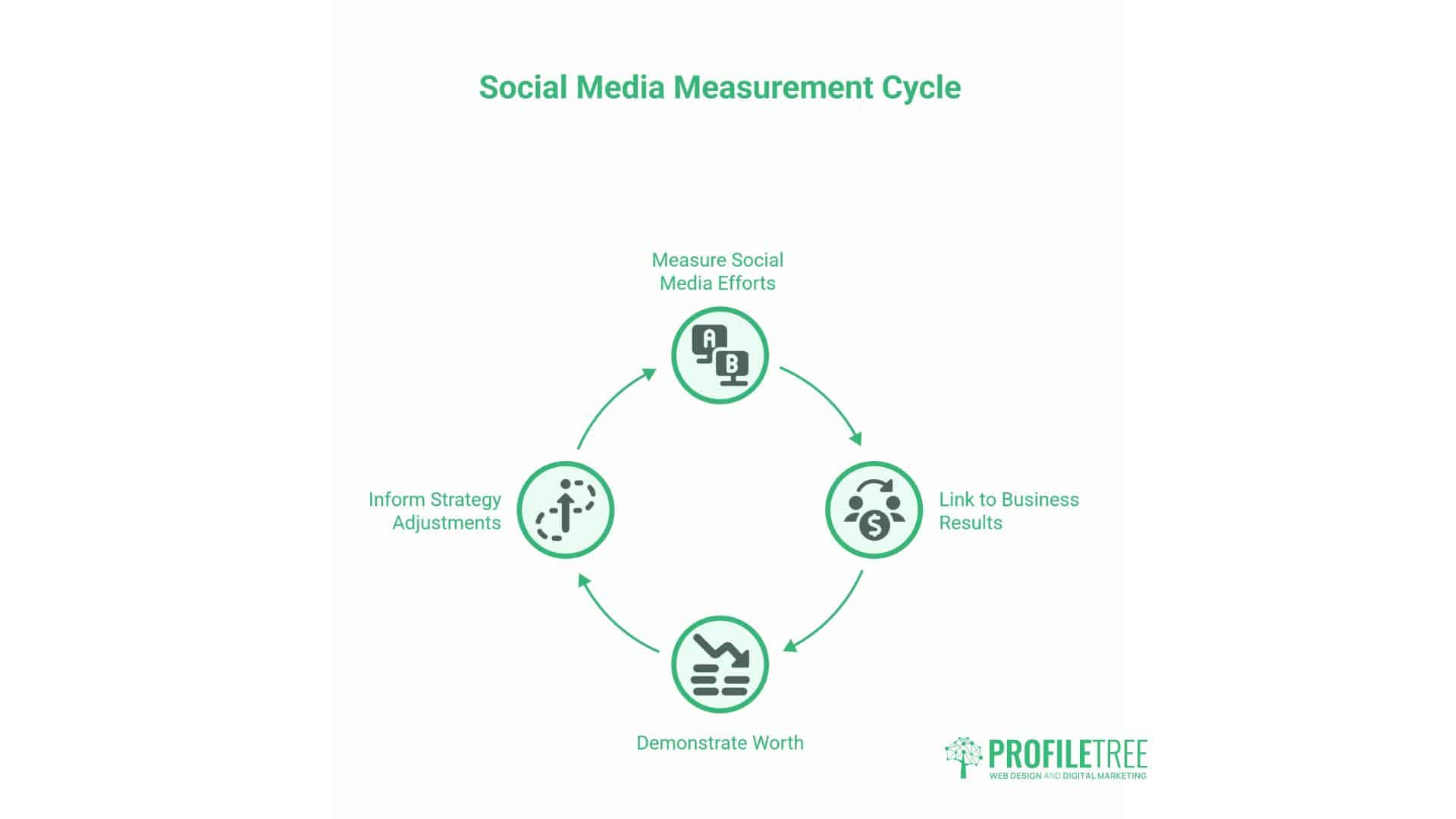
Effective measurement connects social media activities to business outcomes, proving value and guiding strategy refinement.
Brand Awareness Metrics Framework
Quantitative metrics:
- Follower growth (total and rate)
- Reach and impressions (total audience exposed to content)
- Engagement rate (percentage of audience interacting with content)
- Share of voice (brand mentions relative to competitors)
- Website traffic from social channels
- Branded search volume increases
Qualitative metrics:
- Sentiment analysis (positive, negative, neutral mentions)
- Content quality feedback from the audience
- Brand recall surveys (do people remember your brand?)
- Brand perception studies (how do people view your brand?)
Connecting Brand Awareness to Business Results
Brand awareness represents a top-of-funnel marketing activity. Connecting it to bottom-line business outcomes requires tracking complete customer journeys.
Use UTM parameters on all social media links to accurately track traffic sources. Implement conversion tracking across your website to identify which social platforms and content types drive valuable actions, such as newsletter signups, contact form submissions, purchases, or consultation requests.
Calculate customer acquisition costs from social media by dividing social marketing investment by customers acquired through social channels. Compare these costs to those of other marketing channels to assess their relative efficiency.
Monitor assisted conversions showing social media’s role in multi-touch customer journeys. Many customers discover brands through social media but ultimately convert through other channels. Attribution modelling reveals the actual contribution of social media.
Adapting Strategy Based on Performance Data
Measurement means nothing without action. Review analytics monthly, identifying:
- Top-performing content types and topics
- Optimal posting times and frequencies
- Underperforming content to discontinue or revise
- Platform performance variations suggesting resource reallocation
- Emerging trends in audience behaviour
Test systematically rather than changing everything simultaneously. Alter one variable—posting time, content format, caption style—measure results, then iterate. This scientific approach builds knowledge about what works specifically for your audience.
Common Social Media Brand Awareness Challenges and Solutions
Even well-planned strategies encounter obstacles. Anticipating common challenges helps businesses address them proactively.
Challenge: Slow Follower Growth
Many businesses become discouraged by the initially slow growth of their audience. Building a quality, engaged audience takes time, particularly when starting from zero.
Solutions:
- Focus on engagement rate rather than follower count initially
- Create highly shareable content that encourages audience expansion
- Participate actively in relevant industry conversations
- Consider modest paid campaigns to accelerate growth
- Collaborate with established accounts through features or mentions
Challenge: Low Engagement Rates
Followers who never interact provide minimal value in terms of brand awareness. Low engagement suggests that the content isn’t resonating or that algorithms aren’t favouring your posts.
Solutions:
- Ask questions and directly request engagement in posts
- Use interactive features like polls, quizzes, and question stickers
- Post during peak activity times when your audience is online
- Vary content formats to identify what drives engagement
- Respond quickly to every comment to encourage future interactions
Challenge: Platform Algorithm Changes
Social platforms regularly modify algorithms, potentially reducing your content’s organic reach overnight.
Solutions:
- Diversify across multiple platforms rather than depending on one
- Build owned channels (email lists, website traffic) alongside social
- Focus on engagement-driving content algorithms favour
- Stay informed about platform changes and adapt quickly
- Consider supplementing organic reach with paid promotion
Challenge: Measuring ROI
Brand awareness’s indirect connection to sales makes ROI calculation difficult, sometimes leading to reduced investment.
Solutions:
- Track comprehensive metrics beyond vanity numbers
- Implement proper attribution tracking across customer touchpoints
- Conduct brand awareness surveys comparing the tracked and control groups
- Calculate customer lifetime value from social-acquired customers
- Report on leading indicators (reach, engagement) predicting eventual conversions
Challenge: Resource Constraints
Consistent, quality social media requires significant time and expertise, which many small businesses lack.
Solutions:
- Focus on fewer platforms with better execution
- Batch create content during dedicated sessions
- Use scheduling tools for efficiency
- Repurpose existing content across multiple formats
- Consider professional services for strategy and creation while handling engagement internally
Future Trends in Social Media Brand Awareness
Social media evolves rapidly. Staying ahead of trends provides competitive advantages in brand awareness efforts.
Social Commerce Integration
Social platforms are increasingly integrating shopping features, blurring the lines between awareness and conversion. Businesses building brand awareness should optimise profiles for commerce capabilities, preparing for friction-free purchasing within social platforms.
AI-Powered Personalisation
Artificial intelligence enables increasingly sophisticated content personalisation. AI tools analyse individual user behaviour, serving customised content likely to resonate. Businesses should explore AI implementation for content creation, optimisation, and audience analysis.
ProfileTree specialises in AI training and implementation for UK businesses, helping companies leverage these technologies without requiring technical expertise. Our AI solutions range from content generation tools to sophisticated analytics platforms that predict content performance and effectiveness.
Video-First Platforms
Video content dominates social media engagement, with platforms prioritising video in algorithms and features. Short-form video particularly drives brand awareness. Businesses that are uncomfortable with video creation must either develop these capabilities or partner with video production specialists.
Social Search Behaviour
Younger demographics increasingly use social platforms as search engines, seeking product recommendations, how-to content, and business information through TikTok and Instagram rather than Google. Optimising social content for search requires keyword research, clear on-screen text, and comprehensive captions.
Authenticity Over Polish
Audiences increasingly favour authentic, unpolished content over professional productions. Behind-the-scenes content, user-generated material, and real customer experiences often outperform expensive productions. This trend democratises brand awareness, allowing businesses with modest budgets to compete effectively.
Platform Diversification
Depending heavily on any single platform creates vulnerability to algorithm changes, policy shifts, or platform decline. Successful brand awareness strategies spread presence across multiple channels while building owned media properties (websites, email lists) that provide control and stability.
Conclusion
Social media brand awareness forms the foundation of modern marketing success for UK businesses. The five key elements—strategic platform selection, engaging content development, consistent publishing, active community engagement, and data-driven optimisation—work together to build recognition, trust, and business growth.
Success requires commitment to quality over quantity, consistency over sporadic effort, and authenticity over perfection. Social media provides unparalleled opportunities to reach target audiences, showcase expertise, and build lasting brand recognition.
Begin with realistic objectives, choose platforms where your audience actively engages, create content that provides genuine value, and measure everything. Refine your approach based on performance data, and remember that building meaningful brand awareness takes time—but the investment delivers compounding returns.
For businesses requiring professional support, ProfileTree combines strategic planning with expert execution across social media management, content creation, web design, video production, and AI implementation. Our integrated approach connects social media brand awareness with comprehensive digital marketing strategies that drive measurable business results.
Start building your social media brand awareness today. Your future customers are already on social media—make sure they find, recognise, and remember your brand.
FAQs
How long does it take to build brand awareness on social media?
Building meaningful brand awareness typically requires 6-12 months of consistent effort. Initial follower growth and engagement usually develop within the first three months, but achieving significant brand recognition where your target audience consistently remembers and recalls your brand requires sustained commitment. Factors affecting the timeline include budget, content quality, platform selection, and market competition.
What is the difference between brand awareness and brand engagement?
Brand awareness measures whether people recognise and remember your brand—the top of the marketing funnel. Brand engagement measures how actively your audience interacts with your content and brand—a key metric in the middle funnel. You need awareness before engagement, but high awareness without engagement suggests that the content isn’t resonating, despite its visibility.
How much should UK businesses budget for social media brand awareness?
Budget requirements vary dramatically by business size, industry, and objectives. Small businesses typically start with a monthly budget of £500-1,000 for organic strategy and content creation, while larger companies often invest £5,000-20,000+ monthly, including paid advertising. A practical approach allocates 15-20% of the total marketing budget to content production and social media management. Businesses just starting should prioritise an organic presence before making significant paid investments.
Which social media platform is best for brand awareness?
No single platform suits all businesses. LinkedIn excels for B2B and professional services, Instagram is ideal for visual consumer brands, TikTok is effective for reaching younger demographics, and Facebook is suitable for broad consumer reach. Select platforms based on where your target audience is actively engaging. Most businesses succeed by mastering 2-3 platforms rather than maintaining a weak presence across many.
Can small businesses compete with larger brands on social media?
Absolutely. Social media provides unprecedented opportunities for small businesses to compete effectively against larger competitors. Advantages include agility (responding quickly to trends), authenticity (displaying a personality that larger brands struggle to convey), and niche focus (serving specific audiences that larger brands often overlook). Consistent, quality content usually outperforms large budgets with poor strategy.