
How Marketing Managers Should Write Instagram Captions for SMEs
Table of Contents
If your Instagram captions are getting seen but nobody is clicking through, the caption probably isn’t the problem. The title and framing usually are. A post can sit at a strong average position and pick up thousands of impressions while converting almost no one, because the content underneath was written for casual caption-seekers rather than the marketing managers and business owners who actually read it. This guide is written for that second group: people responsible for a small or medium-sized business’s Instagram presence in the UK and Ireland, who need captions that do more than look good; they need captions that support reach, engagement, and a genuine path back to the website.
Why Captions Deserve a Proper Strategy, Not an Afterthought
Instagram remains one of the largest active social platforms globally, and for a business account, a caption is doing several jobs at once: it gives context to the image, it encourages people to stay on the post rather than scroll past, and it’s often the only piece of text Instagram’s algorithm has to work with when deciding who else to show the post to. Treating it as decoration rather than a marketing asset is a common and avoidable mistake.
For a marketing manager at an SME, the caption sits inside a bigger picture: your social media marketing activity should connect to your website, your content calendar, and ultimately to leads. A caption that gets engagement but never points anywhere useful is a wasted opportunity. One that’s well-written but disconnected from your website or your service pages is only doing half its job.
The Hook-Value-CTA Framework
Most captions that perform well follow a simple three-part shape, whether the writer planned it that way or not.
The hook is the first line, and it’s the only part guaranteed to be read before someone taps “see more.” Instagram displays roughly the first 125 characters before truncating, so the hook needs to work as a standalone sentence. Questions, specific numbers, or a short, plain claim tend to outperform a generic opening like “Check out our latest project.”
The value is the substance: what the reader actually gets from reading on. This might be a lesson from a client project (described generally, without inventing specifics you can’t verify), a practical tip, or context behind the image. This is also where some useful background context about the platform or a relevant recent feature change can be naturally worked in, if it’s genuinely relevant to the post.
The CTA closes the caption with a specific next step, not a vague “let us know your thoughts.” A good CTA matches the objective of the individual post:
- Building website traffic: “The full breakdown is linked in bio.”
- Starting a conversation: a direct question tied to the topic, not a generic “thoughts?”
- Generating leads: an invitation to message a specific word or phrase.
Avoid stacking a CTA at the very end as an afterthought. It should read as the natural conclusion of the value you’ve just given the reader, not a separate marketing bolt-on.
Caption Length and Technical Limits
Instagram allows up to 2,200 characters, but only the first 125 display before truncation, and that number matters more than the overall limit. A caption that front-loads its best content into that opening line will always outperform one that saves the point for the third paragraph.
Length should match the purpose of the post, not a fixed house style:
| Content type | Suggested caption length |
|---|---|
| Product or service announcements | 100-150 characters |
| Educational or how-to content | 300-500 characters |
| Behind-the-scenes posts | 200-400 characters |
| Client testimonials | 150-250 characters |
| Blog post promotions | 200-300 characters |
Line breaks help longer captions stay readable: pressing return twice on iPhone creates a visible gap between sections. If you’re scheduling posts through a third-party tool, check that it preserves these breaks; some scheduling tools flatten formatting on publish, which is worth testing before you rely on it for a launch post.
Hashtag Strategy for UK and Irish SMEs
Hashtags still help with discovery, but a scattergun approach does more harm than good. Generic, oversaturated tags such as broad lifestyle hashtags bury your post within minutes among millions of others. The more useful approach is building a small, deliberate set:
- Service-specific tags tied to what you actually do, not general industry buzzwords.
- Audience-intent tags that reflect what your customers search for, rather than what you’d like them to search for.
- Location tags for local targeting, which matter more for SMEs than most other hashtag categories, since local hashtag discovery is often where a smaller account genuinely competes.
Five to eight well-chosen hashtags, integrated within the caption text rather than dumped in a block at the end, consistently outperform a long generic list. If you’re unsure which tags are working, reviewing your current hashtag performance before adding new ones is worth the half hour it takes.
A UK or Irish business writing captions also has a genuine point of difference most competitors ignore: regional spelling, regional dates, and regional context. A caption written around a UK bank holiday, or referencing a well-known local event, reads as authentic in a way that a generic global template never will. This is a small thing that’s easy to get right and rarely gets done properly.
Writing Captions With Search Visibility in Mind
Some SEO commentators have started pointing to captions as more than just an on-platform asset, on the basis that Instagram content can surface in wider search results in some circumstances. This is worth treating as an emerging area rather than a settled mechanic, and it’s not something to build a whole strategy around. What’s safe to say is that a caption written with clear, natural language around what you do and where you’re based, rather than vague marketing phrasing, tends to serve both the Instagram audience and anyone who encounters the post through search. If you want the fuller picture on how this fits alongside your organic visibility, your website’s SEO is still the primary lever, not the caption itself.
Storytelling and Authenticity
The captions that perform best usually show something real: a lesson from a project, a challenge the team worked through, or the reasoning behind a decision, rather than a polished summary with no texture. This is also where showing your work has genuine value. If your team just finished a web design project, a caption describing a specific decision you made and why (a navigation change, a loading speed fix) says more than “check out our latest site.”
“Captions get treated as an afterthought far too often. If you’re already producing content for your website or your blog, you have more than enough material to keep captions fresh. The discipline is matching what you say to what the person scrolling actually needs at that moment, not repeating the same three lines every week.” Ciaran Connolly, Founder, ProfileTree
Emoji Use
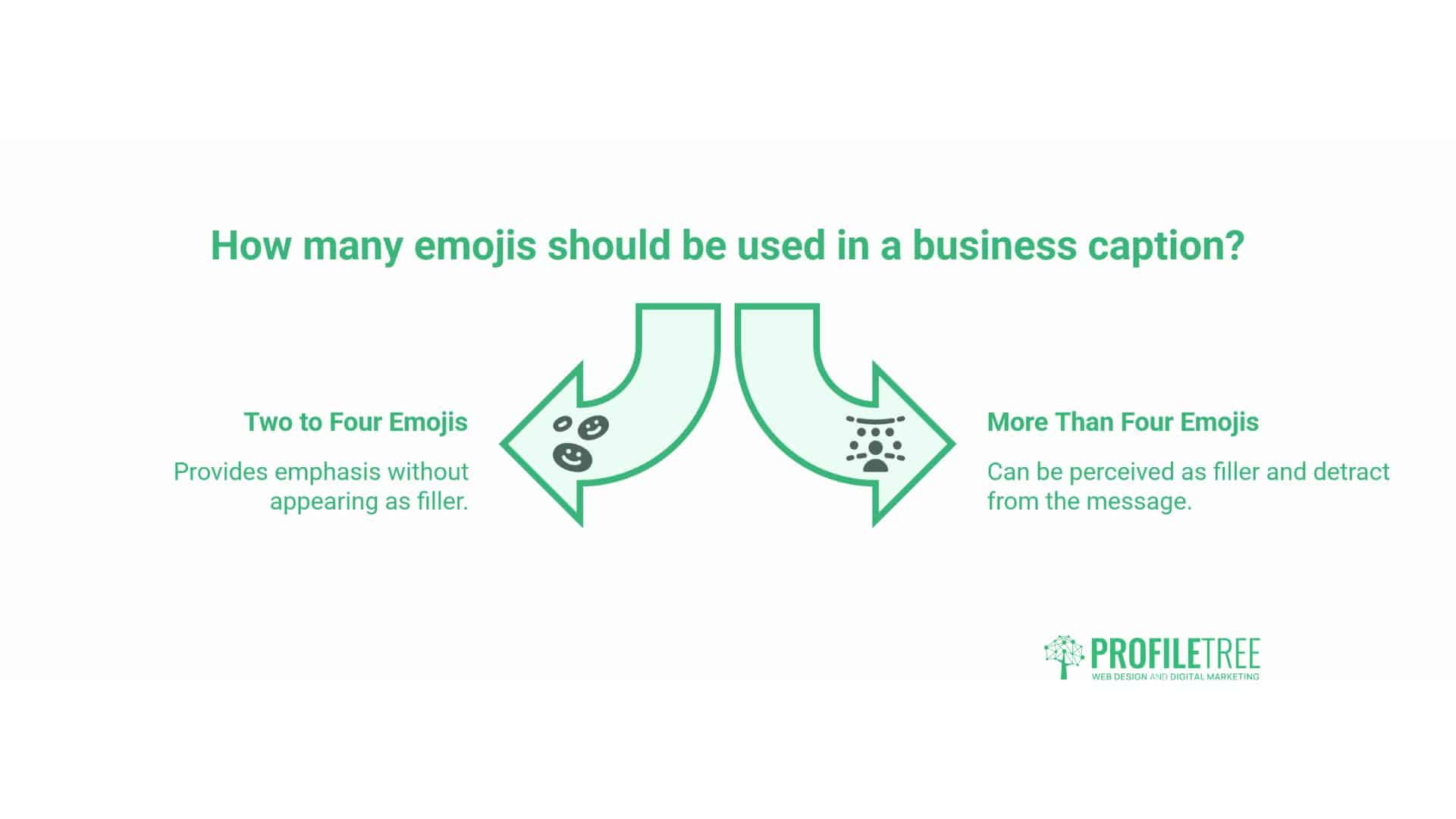
Emojis can help break up text and add tone, but restraint matters. Two to four relevant emojis per caption is a reasonable ceiling for a business account; beyond that, they start to read as filler rather than emphasis. Choose emojis that reinforce the specific point being made rather than decorating the caption generically.
Calls-to-Action That Actually Convert
Every caption should point somewhere. Examples aligned to different business goals:
- Website traffic: a specific reference to what’s linked in bio, not just “link in bio.”
- Lead generation: a direct instruction (“Message us the word ‘audit’ for a free site review”) performs better than an open-ended invitation.
- Engagement: a genuinely specific question tied to the post content, not a generic “thoughts below?”
- Video content: pointing to a fuller explanation elsewhere, such as a Reel that expands on the topic.
Place the CTA where it fits the caption’s flow, not tacked onto the very end as a reflex.
Weaving Captions Into Your Wider Marketing
Captions shouldn’t exist in isolation from the rest of a business’s online efforts. A handful of practical ways SMEs can connect the two:
- Content marketing. A caption that performs well on Instagram is often a sign that the underlying idea would work as a fuller piece of content. If a short caption about a common client mistake gets strong engagement, that’s a signal worth expanding properly, not just repeating in future captions.
- Web design and conversion. A CTA only works if the page it leads to is built to convert. If Instagram click-through rates are consistently low despite decent engagement, the landing page is worth checking before assuming the caption is at fault.
- Video production. Captions written for Reels or video posts need a different rhythm to static image captions; they’re often shorter, since the video itself carries more of the value. Businesses producing regular video content benefit from planning captions alongside the video brief, not after filming, so the two work as one piece rather than two afterthoughts.
- AI-assisted drafting. AI tools can genuinely speed up caption drafting, particularly for first drafts or variations on a theme. Where this needs care is tone: an AI first draft rarely sounds like your specific brand voice on the first pass, and a caption that reads as generic undermines the authenticity that makes captions work in the first place. Treat AI training and implementation as investments worth making properly, rather than assuming a free tool solves the problem outright; a human should still do the final pass for tone and accuracy, especially before anything with a claim or statistic goes out under the business’s name.
- Digital marketing strategy. Caption performance is one input into a broader picture, not a strategy in itself. If Instagram is driving DM inquiries but your website analytics show no corresponding traffic uplift, that’s a signal the two channels aren’t talking to each other properly, and it’s worth reviewing as part of a wider strategy check rather than a caption tweak.
UK Compliance and Professional Standards
UK businesses need to follow the Advertising Standards Authority’s rules on disclosure for any paid partnership, sponsored content, or gifted product. In practice, this means:
- Using a clear “Ad” or “Sponsored” label prominently, not buried at the end of a long caption.
- Disclosing gifted items even where no formal payment changed hands.
- Making sure any performance claim about your own services is something you can actually stand behind if asked, rather than a rounded-up estimate.
For the full details on disclosure requirements, the Advertising Standards Authority publishes current guidance directly.
Measuring Caption Performance and ROI
Likes are the easiest metric to track and the least useful one on their own. A few that tell you more:
- Engagement rate: total engagements divided by follower count, providing a like-adjusted view of resonance.
- Save rate: a strong indicator that a post was genuinely useful, not just pleasant to look at.
- Comment quality: A handful of specific comments usually signals more than fifty emoji reactions.
- Profile visits and website clicks: the metrics that actually connect Instagram activity to your website, trackable through Instagram Insights and UTM parameters on any bio link.
- DM inquiries: for a service business, these are frequently your highest-quality lead source on the platform and are worth logging manually if your current setup doesn’t track them automatically.
Testing one variable at a time, caption length, hook style, CTA placement, and hashtag count, gives you a genuine read on what your specific audience responds to, rather than assuming a tactic that worked for another business will transfer directly.
A Practical Caption Workflow for Small Marketing Teams
A repeatable process removes the guesswork week to week:
- Audit. Look back at your last 90 days of posts. Which captions generated saves? Which drove profile visits or website clicks? This tells you what’s already working before you change anything.
- Build content pillars. Three to five themes tied to your actual business objectives, not generic categories copied from elsewhere.
- Draft ahead of publishing. Writing captions two to three days before they go live, rather than at the point of posting, gives time to tighten the hook and ensure the CTA matches the post’s goal.
- Review before it goes out. Ask plainly: would this stop someone scrolling? Does the CTA align with what this post is meant to achieve?
- Report monthly. A simple dashboard tracking engagement, website clicks, and inquiry volume over time shows whether the approach is actually moving the needle, rather than relying on impressions alone.
UK vs US Terminology Quick Reference
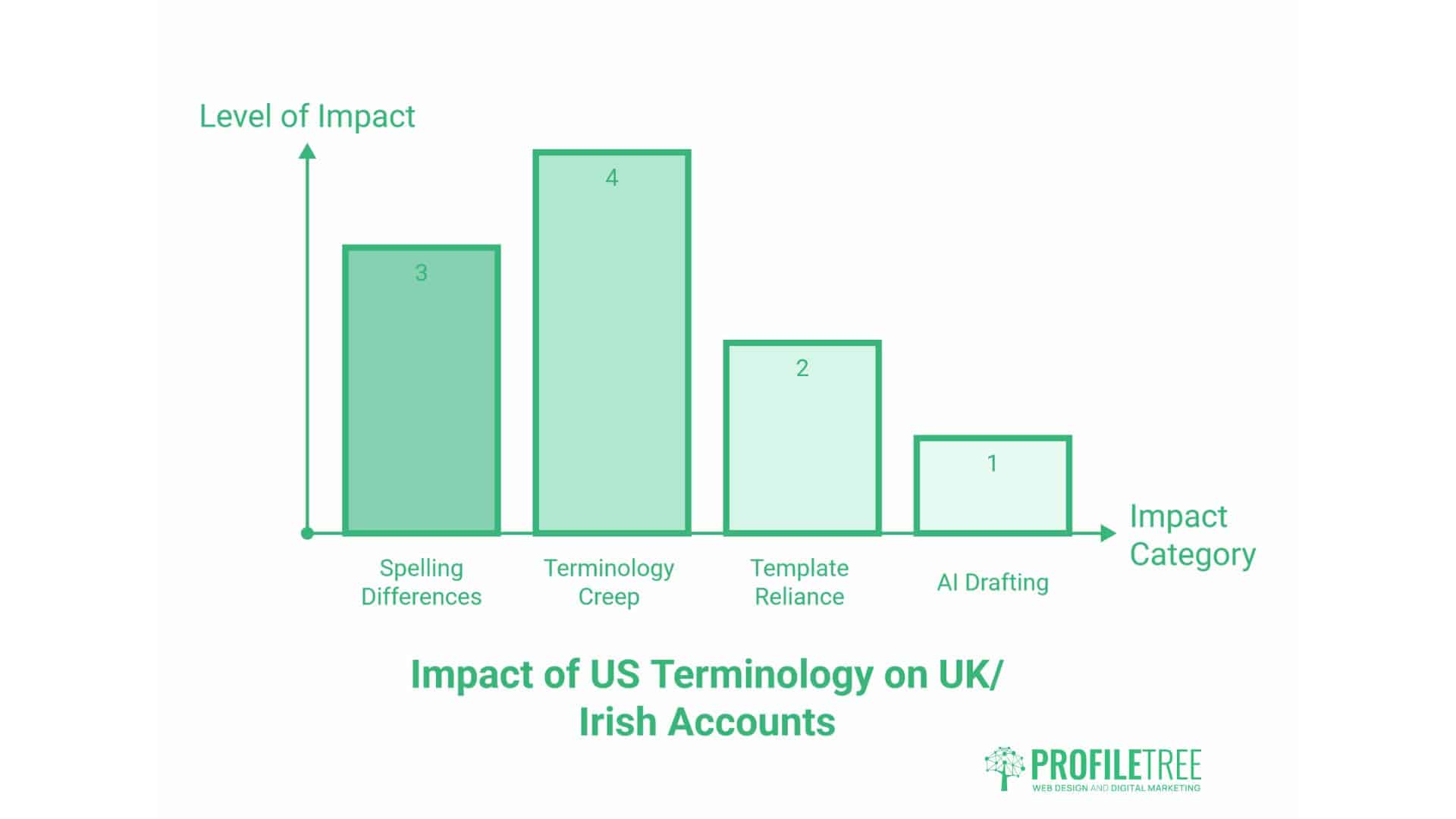
A small but genuine point of difference for UK and Irish accounts is avoiding US-default spelling and terminology that creeps in from templates and AI drafting tools.
| US term | UK/Irish term |
|---|---|
| Center | Centre |
| Color | Colour |
| Organize | Organise |
| Favorite | Favourite |
| Sneakers | Trainers |
| Fall | Autumn |
Small as it looks, consistent UK spelling in captions reinforces regional credibility in a way a single well-placed local reference can’t do on its own.
Building a Caption Template Library for Your Team
Most small marketing teams end up writing the same caption from scratch every time, even when the underlying post type repeats week after week. A product update, a team announcement, a client success story: the shape of the caption is often near-identical, but nobody keeps a record of what worked, so the whole thing gets reinvented from a blank page each time.
A simple template library solves this without making the content feel stale. This isn’t about writing five finished captions and rotating them; it’s about capturing the structure that worked (hook style, length, where the CTA sat) so whoever’s writing the next one isn’t starting cold.
What’s worth keeping in a template bank:
- Hook formats by post type. A question hook for educational posts, a specific detail for behind-the-scenes posts, a direct statement for announcements. Note which style got saves versus which got comments, since they’re not the same signal.
- CTA phrasing that’s already been tested. If a particular phrasing drove more profile visits last quarter, that’s worth reusing rather than rewriting from instinct each time.
- Length benchmarks per content type, pulled from your own caption length data rather than a generic rule, since what works for one SME’s audience won’t always transfer to another’s.
- A short list of approved hashtag sets, reviewed periodically against current hashtag performance rather than left untouched for months.
This is also where a bit of digital training pays off for a small team. A one-off session on how to use the template bank properly, and how to brief an AI tool for a first draft without losing brand voice, tends to save more time over a year than any individual caption ever could. The template itself doesn’t need to be complicated: a shared document with three or four proven structures per content pillar is usually enough for a small team to stop starting from nothing every Monday morning.
Keep the library alive rather than static. Every quarter, swap out whichever template stopped performing and add whatever’s replaced it. A caption bank that hasn’t changed in a year is a sign nobody’s actually checking what’s working.
Conclusion
A caption’s job is bigger than filling the space under a photo. Written with a clear hook, genuine value, and a specific next step, and connected properly to your website, your content, and your wider marketing activity, captions become one of the more efficient tools an SME has for building both reach and a measurable path back to the business. Treated as filler, they stay exactly that.
FAQs
How long should Instagram captions be for a business account?
It depends more on the post’s purpose than on a fixed rule. Announcements typically work well short (100-150 characters), while educational or storytelling content can extend to 300-500 characters. In every case, the first 125 characters matter most, since that’s what displays before “see more.”
How many hashtags should a business use?
Five to eight relevant, specific hashtags generally outperform larger generic sets. Focus on tags tied to your actual services, your audience’s search behaviour, and your location, rather than broad, oversaturated tags.
Do Instagram captions affect website SEO?
Not directly in the way of on-page website content does. Some commentators point to a broader connection between social content and search visibility, but this is an evolving area rather than a basis for strategy. Your website’s SEO remains the primary driver of search performance.
How do I add line breaks in a caption on an iPhone?
Press return twice. The first press moves to a new line; the second creates the visible gap that makes longer captions easier to read.