
Budget-Friendly Social Media Marketing Strategies for SMEs
Table of Contents
Social media marketing strategies have a reputation for being either free or expensive, depending on who you ask. The truth sits somewhere more practical: budget-friendly social media marketing is genuinely achievable for SMEs, but it requires consistent effort and a clear plan. Paid social can produce strong returns, but only when the targeting and creative are right. For most small and medium-sized businesses, the smart approach sits in the middle: build a strong organic foundation first, then add paid spend selectively where it can be measured.
This guide covers seven budget-friendly strategies that work for SMEs with limited time and no dedicated social media team. Each one can be applied without significant software spend, and each builds on the previous to create a coherent approach rather than a scattered collection of tactics.
The businesses that get the most from social media on a limited budget are not the ones that post the most. They are the ones who post with the clearest purpose.
Budget-friendly social media marketing for SMEs depends on three foundations: knowing precisely who your audience is and which platforms they actually use, creating content that earns engagement organically before spending on amplification, and using the free analytics tools built into every major platform to guide decisions rather than guessing. Businesses that apply these principles consistently typically outperform those spending more but without a coherent strategy.
Why Many SMEs Overspend on Social Media
Before covering what works, it is worth understanding the most common ways smaller businesses waste money on social media, because the patterns are predictable and avoidable.
Being Present on Too Many Platforms
The pressure to maintain accounts on every platform is real but counterproductive. Managing Instagram, Facebook, LinkedIn, TikTok, X, and Pinterest to a reasonable standard requires more resource than most SMEs have. The result is inconsistent, low-effort content across six channels rather than strong, purposeful content on two or three. Pick the platforms your specific audience actually uses and ignore the rest, at least until you have the capacity to do them properly.
Paying for Reach Before Proving Organic Content Works
Boosting posts or running paid campaigns before you have tested what resonates organically is a fast way to burn budget. If a piece of content does not generate engagement when shown to people who already follow you, paying to show it to strangers will not change that. Organic performance is the cheapest signal available for what is worth amplifying. Use it before spending.
Outsourcing Without a Clear Brief
Hiring an agency or freelancer to manage social media without a defined brief, target audience, and measurable goal produces generic content and unclear results. If you are going to invest in external support, the brief needs to be specific. Social media marketing support works best when the business owner has thought through their audience and goals first, even at a basic level.
Strategy 1: Define Your Audience Before Posting Anything
The single most common reason social media marketing fails to deliver results is not the content itself but the lack of clarity about who it is for. If you cannot describe your ideal customer in specific terms, your content will be too broad to resonate with anyone in particular.
Build Basic Audience Profiles
You do not need complex buyer persona documents. You need to be able to answer three questions for each audience segment: What problem are they trying to solve? Where do they spend time online? What kind of content do they engage with? For a Belfast-based accountancy firm, the answer might be: cash flow anxiety, LinkedIn and local Facebook groups, and practical financial tips with specific numbers. That is enough to guide content decisions.
Use Platform Demographics to Validate Your Assumptions
Every major platform publishes audience demographic data. LinkedIn skews professional and B2B. TikTok reaches under-35s most effectively, though this is changing. Facebook remains the largest platform by user count in the UK and retains strong reach with the 35-65 age group. Instagram performs well for visual products and lifestyle brands. Match your audience profile to platform demographics before committing time to any channel.
Align Your Social Goals With Business Goals
Social media goals need to connect to business outcomes to be worth pursuing. Increasing follower count is not a goal; it is a vanity metric. A goal is “generate 10 enquiries per month via LinkedIn direct message” or “drive 500 website visits per month from organic social.” Specific, measurable goals give you a way to evaluate whether your effort is justified. If you cannot connect a social activity to a business outcome, it is probably not worth the time.
Strategy 2: Choose Two or Three Platforms and Do Them Well
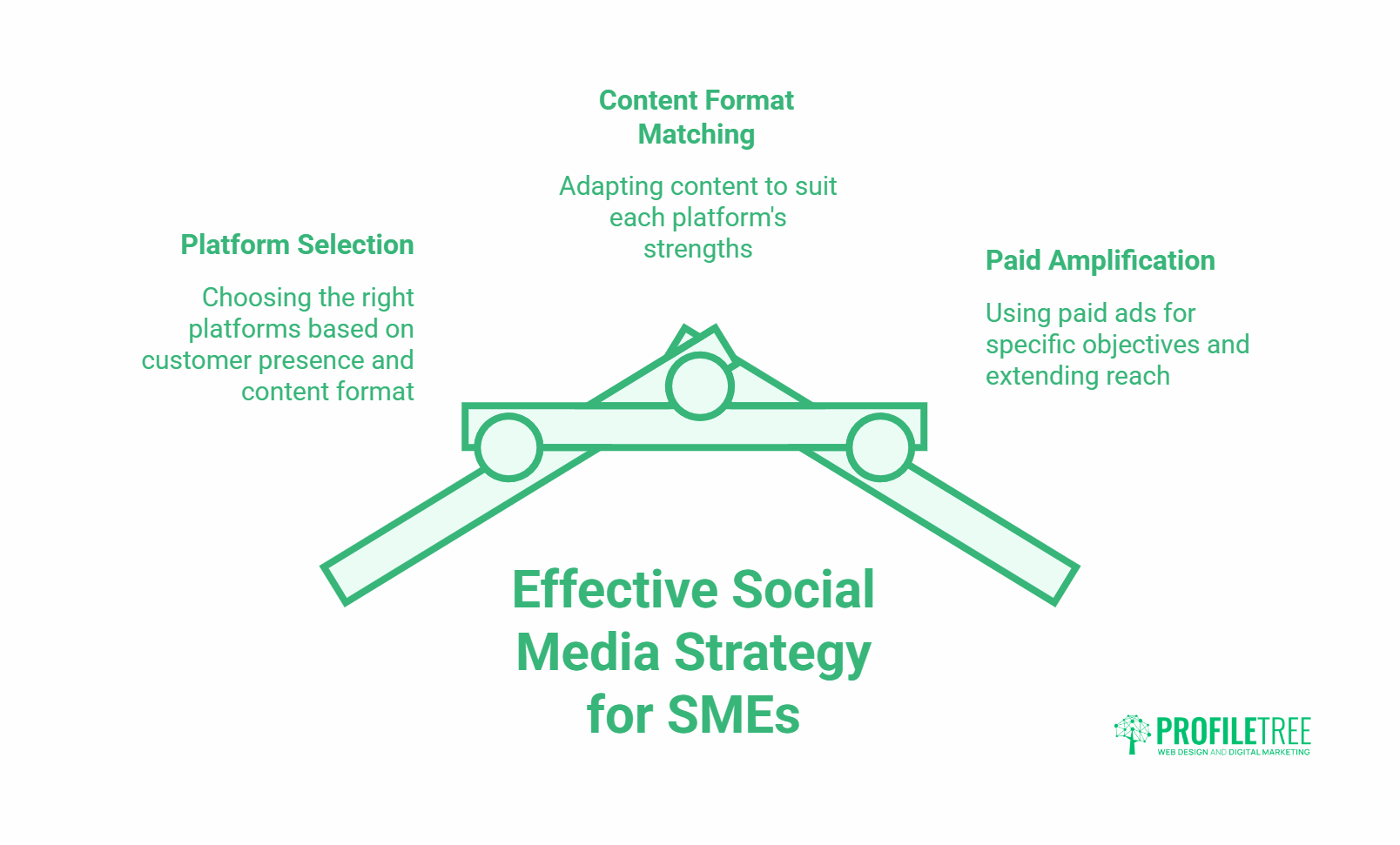
Platform selection is a resource decision as much as a marketing one. Every channel you add to your active list requires content creation time, community management, and performance monitoring. For most SMEs, two well-managed platforms will consistently outperform five poorly managed ones.
How to Choose the Right Platforms
Start with where your customers already are. If you serve other businesses, LinkedIn is almost always worth the investment of time. If you sell directly to consumers and your product or service has a visual dimension, Instagram and Facebook are the natural starting points. If your audience skews younger and you can create short video content consistently, TikTok is worth considering. The question is never “which platform is growing fastest?” but “where are my customers, and can I create content that fits that platform’s format?”
Match Content Format to Platform Strengths
Each platform rewards different content types. LinkedIn rewards long-form text posts with genuine professional insight. Instagram rewards high-quality visuals and short video. Facebook rewards community discussion and local relevance. TikTok rewards authentic, fast-moving short video. Trying to repurpose the same content across all platforms without adaptation is one of the most common causes of poor performance. The message can be the same; the format needs to fit the platform.
When to Consider Paid Amplification
Paid social is most effective for specific, time-limited objectives: promoting an event, generating leads for a particular service, or retargeting website visitors who did not convert. It is not a substitute for an organic content strategy. If your organic content is performing well and you want to extend its reach to a new audience, a small paid budget behind that proven content will go much further than the same budget behind content that has not yet been tested. Your digital marketing strategy should determine where paid social fits, rather than treating it as a default.
Strategy 3: Use Free Tools for Content Creation and Scheduling
The gap between professional-looking content and expensive content has closed significantly in the last five years. Free and low-cost tools now cover most of what small businesses need for social media content.
Design and Visual Content
Canva’s free tier covers the majority of social media content needs: post templates sized for each platform, branded colour palettes, basic animation, and a library of stock images. For businesses that want to move beyond templates, CapCut handles short video editing on mobile at no cost and has become one of the most used tools for creating content natively for TikTok and Instagram Reels. Adobe Express is another option worth testing, particularly for teams already using Adobe products.
Scheduling and Planning
Buffer’s free plan allows scheduling across three social profiles and provides basic engagement metrics. Meta Business Suite, which covers both Facebook and Instagram at no cost, includes scheduling, inbox management, and analytics in a single interface. For businesses focused primarily on Meta platforms, it covers most scheduling needs without any additional tools. The value of scheduling is consistency: batching content creation into one or two sessions per week and scheduling in advance is significantly more efficient than posting in real time.
Content Ideas and Planning
A simple content calendar does not need to be sophisticated software. A shared spreadsheet or a free Notion template works. The purpose is to plan content themes a month in advance, identify any relevant dates, promotions, or events worth referencing, and maintain a mix of content types rather than defaulting to the same format every week. A basic content mix for most SMEs: 40% educational or useful content, 30% behind-the-scenes or brand personality, 20% promotional, 10% engagement prompts or questions.
“The businesses we see getting the best results from social media on a tight budget are almost always the ones who plan a month ahead rather than posting on impulse,” says Ciaran Connolly, founder of ProfileTree. “It is not about volume; it is about showing up consistently with something worth reading.”
Strategy 4: Create Content That Earns Engagement Organically
Organic reach on most platforms has declined over the past decade as competition for feed space has increased. That makes content quality more important, not less. The posts that break through are specific, useful, and often take a clear position on something.
Lead With Usefulness
The most reliably engaging organic content for business accounts answers a question, solves a problem, or shares a specific insight that the audience would not have found easily elsewhere. Generic posts about industry trends or motivational quotes rarely generate meaningful engagement. A plumber sharing the three most common causes of low water pressure in older Belfast terraces will reach a smaller audience than a viral meme but will reach exactly the right one.
User-Generated Content as a Budget Multiplier
User-generated content (UGC) is any content created by your customers or audience rather than your team. Reviews, photos of your product in use, tagged posts, and testimonials all qualify. For businesses with an active customer base, UGC is one of the most cost-effective content sources available: it costs nothing to produce, carries more credibility than brand-produced content, and gives you a reason to engage directly with the customer who created it. Encourage it by asking, making it easy to share, and acknowledging every piece publicly. Your content marketing strategy should build in a UGC collection process from the start.
Repurposing Content Across Formats
A single piece of substantive content can generate multiple social media posts across different formats. A 1,500-word blog post contains at least five to eight distinct points that can each become a standalone LinkedIn post. A video interview can be cut into three to five short clips for Instagram Reels or TikTok. An FAQ page can become a series of carousel posts. Repurposing is not about being lazy with content; it is about recognising that different people consume information in different ways and on different platforms, and giving the same useful content more than one chance to reach them.
Video Content Without a Production Budget
Short-form video consistently outperforms static content for reach on Instagram, TikTok, and LinkedIn. The good news is that production values matter less than authenticity and usefulness for short video. A business owner talking directly to camera for 60 seconds about a common customer mistake will perform as well as, or better than, a polished production on most platforms. For businesses that want to develop video as a channel, video marketing support can help with strategy and production without requiring full agency spend on every piece of content.
Strategy 5: Build a Community Rather Than a Following
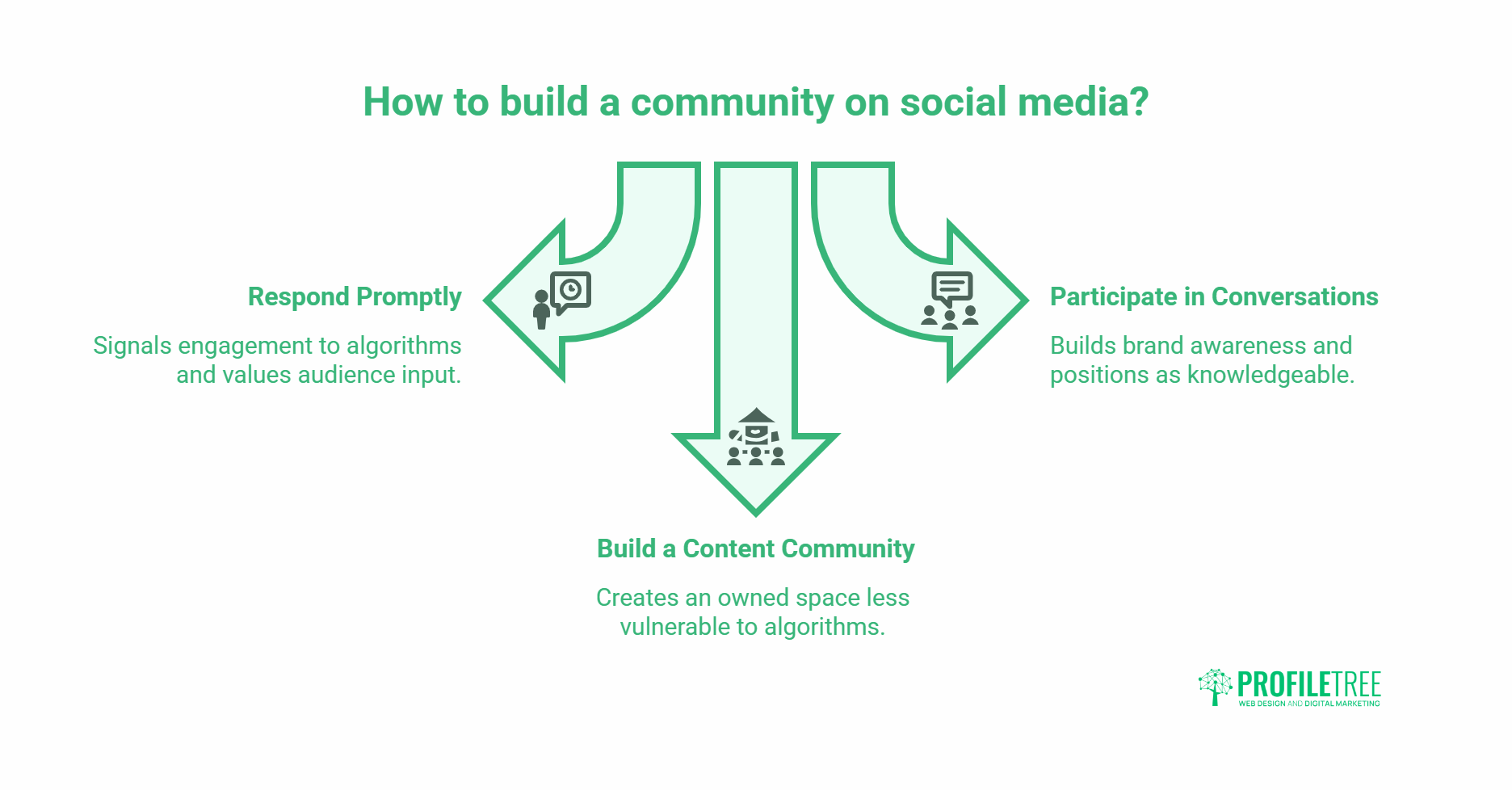
Follower count is one of the least useful metrics for most SMEs. A business with 800 highly engaged local followers who regularly comment, share, and enquire is in a far stronger position than one with 8,000 passive followers who never interact. Building community requires a different approach to building audience size.
Respond to Everything, Especially Early
The first hour after posting is disproportionately important on most platforms. Responding promptly to comments signals to the algorithm that the post is generating meaningful engagement, which increases its reach. More practically, it signals to your audience that there is a real person behind the account who values their input. This is particularly true for negative comments: a thoughtful, non-defensive public response to a complaint does more for your reputation than ignoring it or deleting it.
Participate in Conversations Beyond Your Own Posts
Commenting meaningfully on posts from others in your industry or community, particularly on LinkedIn and in niche Facebook groups, builds brand awareness with a relevant audience at zero cost. The key word is meaningfully: adding “great post!” contributes nothing. Sharing a specific insight, a counterpoint, or a practical addition to what someone else has written positions you as a knowledgeable voice in your space.
Build a Content Community Around Your Niche
Facebook Groups remain one of the most underused community tools for SMEs. A group focused on a specific interest or problem relevant to your audience, rather than your brand, gives you an owned community space that is less vulnerable to algorithm changes than a business page. A digital agency running a group for Northern Ireland business owners focused on digital growth will attract a more relevant audience than a branded page promoting its own services.
Strategy 6: Optimise Profiles for Search and First Impressions
Social media profiles now appear in Google search results and in platform-specific search. An incomplete or generic profile is a missed opportunity every time someone searches for what you offer.
Complete Every Section of Every Profile
This sounds obvious, but many business profiles leave key sections blank: service descriptions, location, contact methods, and website links are commonly missing. Every field you fill in is another signal to the platform and to search engines about who you are and what you offer. On LinkedIn in particular, a fully completed company page ranks significantly better in both LinkedIn search and Google than a partial one.
Use Keywords in Profile Copy
The “About” or “Bio” section of each profile should include the specific terms your target audience might search for. A web design agency in Belfast should include “web design Belfast,” “WordPress development,” and “digital marketing Northern Ireland” in their profile copy, written naturally rather than as a keyword list. This applies to every platform, including Instagram, where the name field and bio are both indexed.
Connect Your Social Presence to Your Website
Every profile should link to your website, and your website should link back to your social profiles. This creates a connected entity signal that benefits both your social search visibility and your organic search rankings. For businesses investing in search engine optimisation, social profile links are one of a number of off-site signals that reinforce your site’s authority. The connection between website design and social media presence is often underestimated: a strong website makes every social media click more valuable.
Strategy 7: Use Analytics to Decide What to Do Next
Every major social platform provides free analytics. Most small businesses check these occasionally but do not use them to change what they do. The gap between businesses that grow on social media and those that plateau is often here: one group acts on data, the other guesses.
The Metrics That Actually Matter
Reach tells you how many unique accounts saw your content. Impressions tells you how many times it was displayed, including multiple times to the same person. Engagement rate (likes, comments, shares, saves divided by reach) is a better indicator of content quality than raw like counts. For businesses with a website goal, click-through rate from social to website is the most commercially relevant metric. Save rate on Instagram is a strong signal of genuinely useful content; saves indicate people found it worth returning to.
Monthly Review Process
Set aside 30 minutes at the end of each month to review performance. Look at: which three posts got the highest engagement rate; which three got the most reach; which content types (video, carousel, text, image) outperformed the average; and whether any posts generated website clicks or direct messages. Let these answers shape the following month’s content plan. This does not require sophisticated analytics tools. The native analytics in Meta Business Suite, LinkedIn, and TikTok provide enough data to make these decisions.
Using Analytics to Justify or Cut Spend
If you are running any paid social activity, even small boosts, analytics should tell you the cost per click, cost per enquiry, or cost per conversion for each campaign. If a campaign cannot demonstrate return at your current spend level after two to four weeks, either the targeting, the creative, or the offer needs to change before spending more. Increasing the budget on a poorly performing campaign is rarely the answer. Digital training in analytics interpretation is one of the fastest ways for SME teams to improve their marketing decision-making without increasing spend.
Putting the Strategies Together
These seven strategies work as a sequence, not a checklist of independent tactics. Audience definition informs platform selection. Platform selection informs content format. Content quality determines organic performance. Organic performance tells you what to amplify. Community engagement multiplies organic reach. Profile optimisation converts visitors into followers. Analytics tells you what to do more of next month.
Businesses that try to apply all seven at once without a clear foundation tend to get overwhelmed and revert to posting inconsistently. The practical starting point is simpler: define your audience clearly, pick two platforms, commit to two to three posts per week for 90 days, and review what performed. That alone will put most SMEs ahead of the majority of their competitors on social media.
For businesses that want support building a structured approach to budget-friendly social media marketing, ProfileTree’s digital marketing services include social media strategy, content planning, and analytics support tailored to SMEs in Northern Ireland, Ireland, and across the UK.
Frequently Asked Questions
How Much Should a Small Business Spend on Social Media Marketing?
There is no fixed rule, but a practical starting point for most SMEs is zero paid spend until organic content is working. Once you have identified which content generates meaningful engagement and can articulate a clear goal for paid campaigns (leads, website visits, event sign-ups), a modest paid budget of £200 to £500 per month on one or two targeted campaigns is enough to generate measurable results. Scale up only when the return justifies it. Many businesses in competitive markets find that consistent organic social combined with well-targeted paid campaigns delivers better returns than large, unfocused ad spend.
Which Social Media Platform Is Best for a Small Business?
It depends entirely on your audience. For B2B businesses and professional services, LinkedIn is almost always the right starting point. For consumer-facing businesses with visual products or local audiences, Facebook and Instagram cover the majority of UK SME needs. TikTok is worth considering if your audience is under 40 and you can commit to short-form video content consistently. Start with the platform where your customers are most active, not the one with the most press coverage.
How Often Should a Small Business Post on Social Media?
Consistency matters more than frequency. Posting three times a week reliably over six months will generate better results than posting daily for a fortnight and then going quiet. For most SMEs with limited time, two to four posts per week per platform is a realistic and sustainable target. Quality should never be sacrificed for volume: one genuinely useful post will outperform five filler posts on every meaningful metric.
What Is User-Generated Content and How Do SMEs Use It?
User-generated content is any content created by your customers rather than your team: reviews, photos of your product or service, tagged posts, or testimonials shared on social media. SMEs can use it by actively encouraging customers to share their experiences, resharing tagged posts with permission, featuring reviews in their own content, and building campaigns around customer stories. UGC consistently outperforms brand-produced content for credibility because it comes from an independent source. The simplest way to generate more of it is to ask directly, particularly at the point when a customer has just had a positive experience.
Do I Need to Be on Every Social Media Platform?
No. Being present on every platform is one of the most common mistakes small businesses make. Each platform you add to your active list requires content creation, community management, and performance monitoring. For most SMEs, two well-managed platforms will consistently outperform five poorly managed ones. Choose based on where your audience is, what content format you can sustain, and which platforms align with your business goals. Review this decision annually as your capacity and audience behaviour change.
How Do I Measure Whether Social Media Is Working?
Define what “working” means for your business before you start measuring. If your goal is brand awareness, track reach and follower growth. If your goal is website traffic, track click-through rate from social posts. If your goal is leads or sales, track enquiries and conversions that originated from social channels, which requires either UTM tracking in your URLs or asking new customers how they found you. Avoid using follower count or like counts as primary success metrics; they are visible but rarely connect directly to business outcomes.