
Social Media Attention Span: What Business Owners Need to Know
Table of Contents
The way people consume content on social media has changed. Business owners and marketing managers face the same challenge every day: capturing and holding attention long enough to communicate a message and drive a conversion.
Understanding social media attention span statistics is not just academic. It affects your return on marketing spend directly. Once you grasp how long people actually engage with content, you can build a social media strategy that works with human behaviour rather than against it.
The Current State of Social Media Attention Spans
One statistic gets quoted more than any other: that the average human attention span has fallen from 12 seconds in 2000 to eight seconds today, supposedly shorter than a goldfish. It is worth being careful with that number. A 2017 BBC investigation by Simon Maybin traced it to a 2015 Microsoft Canada report, which in turn credited a firm called Statistic Brain that could never produce a credible source for the figure. Cognitive researchers add that attention is task-dependent, so a single “average span” does not really hold up.
The honest version is more useful for marketers anyway. People have not lost the ability to focus. They have become far more selective about what earns it. Web analytics firm Chartbeat, whose page-engagement findings were widely reported around 2014, found that most visitors spend less than 15 seconds actively on a page. On social feeds, the window is narrower still, because a user is deciding whether a post is worth their time almost the moment it appears.
Platform behaviour varies, and the pattern is consistent across every major channel:
- Facebook viewing on mobile is measured in a small number of seconds per post, not minutes.
- X (formerly Twitter) posts tend to see most of their engagement in the first stretch after posting.
- Instagram posts get roughly a couple of seconds to earn a stop in the feed.
- TikTok videos lose a large share of viewers in the first few seconds if nothing lands.
- LinkedIn posts see peak engagement on the first day, with the critical window in the opening hours.
The takeaway is simple: you have seconds, not minutes, to make an impact. An organic social media strategy needs to account for that limited window, using strong openings, clear messaging and content that gives audiences a reason to stop scrolling. Our data on time spent on social media puts the raw hours into context, if you want the wider picture beyond a single post or feed.
Why the Social Media Attention Span Has Shortened
Several forces push in the same direction:
Information overload. The average person sees thousands of marketing messages a day. Feeds compound this by serving unlimited content through recommendation systems, so people develop fast filtering habits to cope with the volume.
Platform design. Infinite scroll, autoplay video, and algorithm-driven delivery all reward rapid movement through a feed rather than deep engagement with any single post. If you want the mechanics, our guide to social media algorithms explains how ranking actually works.
Mobile usage patterns. Most social time happens on mobile, often in short gaps: a queue, a commute, a break between tasks. That fragmented use puts a natural ceiling on attention.
Competition for engagement. Every post competes not only with other brands but with friends, family, news, and entertainment. People give their attention to whatever provides immediate value or an emotional response.
Cognitive adaptation. Frequent users get very good at assessing content value quickly. That efficiency is a skill, not a deficiency, and it explains why generic content gets skipped so fast.
Platform-Specific Attention Span Data
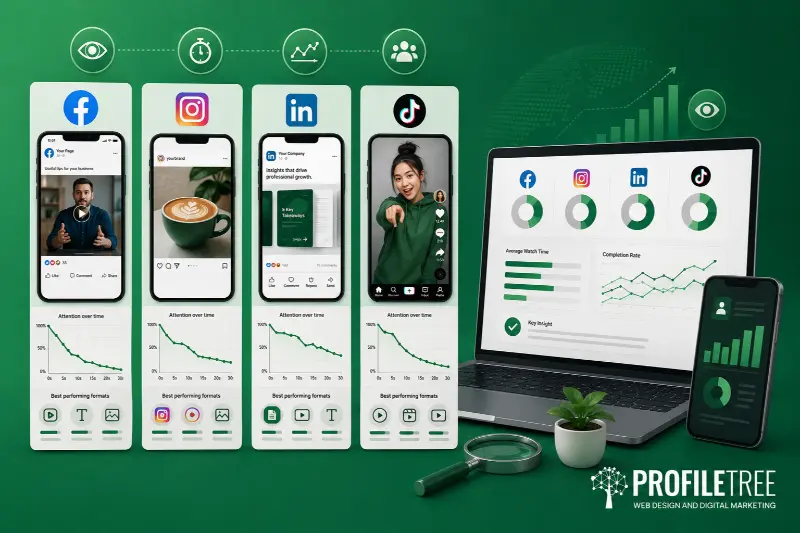
Different platforms produce different engagement patterns, shaped by their format and what users expect from them. Treating them the same is the most common mistake we see, and it is why platform-aware planning matters more than a single content calendar.
Facebook Attention Metrics
On Facebook, video tends to perform well, but only when it earns attention immediately. Clips that open with movement or a clear question hold far more viewers through the opening seconds than those that build slowly. Text posts have it harder still: the algorithm rewards quick engagement, so the first sentence has to do the work. Image posts get a couple of seconds before the scroll continues, which is why a strong focal point matters more than polish.
Instagram Engagement Windows
Instagram is visual and fast. Feed decisions happen almost instantly, so a post has a fraction of a second to trigger a stop. Stories run on different rules: the short format suits the medium, but people still swipe on within a few seconds if nothing resonates, and interactive elements hold attention longer than static frames. Reels are the platform’s growth engine, and successful ones hook in the opening moment and keep their pace throughout.
LinkedIn Professional Context
LinkedIn users behave slightly differently because they arrive with a professional intent. Time on the platform is lower than that of entertainment channels, but the attention is more deliberate. Strong opening lines matter, and multi-page document posts hold attention noticeably longer than a standard update. Video on LinkedIn still follows the same rapid drop-off as everywhere else, so the first few seconds decide whether the rest gets watched.
TikTok’s Unique Dynamics
TikTok has reset expectations for the whole industry. Its algorithm ranks on watch time, so the platform is effectively a live test of how fast content earns attention. Users expect value or entertainment within the opening seconds, and the “hook, build, payoff” structure exists because creators learned to frontload the best moment rather than save it. Sessions are long, but they are made up of many short videos, each one earning its place or getting skipped.
For a running view of how these behaviours shift, we track the latest social media trends and keep our engagement statistics updated as platforms change.
What This Means for Your Content and Video Strategy

Short-form video is now the dominant content format across the platforms above. TikTok, Instagram Reels, and YouTube Shorts have each trained audiences to expect fast, front-loaded content that earns engagement immediately, and our guide on the rise of short-form video covers the format’s growth in more depth.
That shift creates a genuine dilemma for UK and Irish SMEs. Producing a consistent volume of short-form content takes planning, equipment, and editing capability that many small businesses lack in-house. But it also opens a door: organic short-form content is one of the few places a small business can reach audiences genuinely comparable to a much larger competitor, without matching their ad spend.
A common problem we see when working with SME clients on social content is that the brand’s most important message arrives too late in the post. The instinct is to build context before making a claim. Platform behaviour demands the opposite: state the value first, then support it. This is not a stylistic preference; a hook that fails to signal relevance in the opening moment will not recover, however good the material that follows.
Animation has a natural role here. Motion graphics, explainer-style clips, and branded social video tend to hold attention longer than static images, and they can get a complex idea across faster than a talking-head video. For SMEs that want a steady stream of social content without the cost of repeated shoots, our animation production work offers a format that scales across TikTok, Reels, and YouTube Shorts alike.
Short-form does not replace long-form; the two serve different points in the customer journey. A viewer who opens a YouTube video has made a deliberate choice to watch it. Someone who encounters a Reel or a TikTok clip is in passive discovery mode, scrolling rather than searching. Those two states call for different content approaches, and trying to make one asset do both jobs is one of the more common and costly mistakes we see in SME video strategy. Our comparison of short-form and long-form video for YouTube growth looks at how the two can work in parallel rather than as a straight choice.
Building a Content Strategy Around Shorter Attention Spans
Once you accept that you have seconds rather than minutes, a handful of practical responses follow.
Front-load the value. Your strongest point belongs in the first sentence of a text post or the first two to three seconds of a video. Burying the lead guarantees weak performance, whatever the platform.
Build a visual hierarchy. Images and video need a focal point that guides the eye within the first second, and any text overlay should be readable at a glance rather than requiring a pause.
Match the format to the message and the platform. Quick tips suit short videos or carousels. On video specifically, jump cuts help keep pace, captions matter because most viewing happens with sound off, and most clips do best between 30 and 90 seconds. Image posts work best with bold, high-contrast overlays and the key information placed in the upper third, where eyes land first. Text posts need the strongest point or a question up front, with detail saved for the comments if people engage.
Carousels should lead with the best slide and deliver something on each subsequent one, and Stories work better when every frame is treated as a possible exit point, with polls or questions used to turn passive viewing into participation. Detailed material, meanwhile, often performs better as a longer piece promoted through social rather than forced into a short format; our thinking on social media content strategy goes further into matching format to intent.
Test one variable at a time. Changing a single hook, thumbnail, or opening line at a time is how you learn what actually resonates with your audience, rather than guessing from a full redesign.
Train the team, and use the tools available. If more than one person makes content, everyone needs a working understanding of how attention functions and how to structure for it, which is exactly what our digital training covers. AI-assisted editing, captioning, and thumbnail generation have also made it more realistic for teams without a dedicated creative department to keep pace.
Balance quick wins with depth, and keep watching for platform changes. Not every post has to be shallow; a detailed piece can still work on social if the entry point hooks well. What works today may need adjusting within six months, so treat this as an ongoing practice rather than a one-off audit.
The Business Case for Understanding Attention
Ignoring these patterns costs money directly. In its annual State of Video Marketing survey, Wyzowl has consistently found that around 84% of people say a brand’s video convinced them to buy a product or service. That same body of research is clear that video only works when it holds the viewer, and a large share drops off in the opening seconds if the clip does not engage quickly.
For paid social, this translates straight into wasted budget. If your ad creative does not earn attention in the first few seconds, you are paying for impressions that produce no recall and no consideration. Organic reach compounds the effect: platforms reward content that earns engagement, so a post that fails to stop the scroll gets little distribution, however good the message underneath.
This is where planning pays off. A clear digital marketing strategy that sets out which platforms, formats, and hooks you will test stops you from spending against guesses. For businesses selling to other businesses in Northern Ireland, our notes on social media for SMEs cover the practical side.
How Different Industries Adapt
Businesses across sectors have adjusted to the shorter window in their own ways. Retailers use pattern interrupts, unexpected visuals or statements that break the scrolling rhythm. Businesses selling to other businesses often lead with the problem rather than the product, earning attention before asking for it. Restaurants and hospitality lean on close, visceral imagery that stops a scroll even when the viewer was not thinking about food. Professional services firms, including digital agencies like ProfileTree, tend to demonstrate expertise through short, useful tips, because a 30-second clip that teaches one thing builds more authority than a long explanation of credentials.
Measuring Attention in Your Own Content
Your own analytics tell you more than any industry average. Most platforms report watch time, drop-off points, and engagement rate. If most viewers leave a video at the five-second mark, the hook needs work. Compare performance across content types, because your audience may engage far longer with educational content than with promotional posts, or the reverse. Above all, track how attention correlates with business outcomes. High engagement does not automatically mean conversions, so the goal is to find the content that both holds attention and drives action.
Attention Span and Your Website: The Connection SMEs Miss
The attention span conversation usually stays on social media, but the same behaviour shapes what happens once someone lands on your website, and it is the part most SMEs overlook.
Visitors tend to form a fast, almost instinctive judgement about a page long before they finish reading the headline. If a page fails to signal its value in that window, most people leave, and the bounce rates on slow-loading or cluttered pages reflect exactly that pattern.
For an SME in Northern Ireland or Ireland, the practical consequences are specific. A page that takes more than a couple of seconds to load on mobile will lose a share of visitors before they have read a single word. A homepage that opens with stock photography and a generic tagline does not signal relevance quickly enough to hold someone who arrived with a specific question in mind.
Good web design for a short attention span means a clear, specific headline above the fold that matches what the visitor was looking for, fast load speeds on mobile, a visual hierarchy that guides the eye to the key action without demanding a full read, and social proof, whether reviews, client logos, or credentials, visible in the first scroll rather than buried further down.
These are not aesthetic preferences; they are functional responses to how attention behaves online. The same logic applies to on-page content. Articles structured with front-loaded answers, short opening paragraphs, and navigable headings tend to perform better in both search results and time-on-page than pieces that bury the main point three paragraphs in. Our notes on transparency in content marketing look at how SMEs build editorial trust through structure and clarity rather than volume. If your site is not built to convert the attention your social content earns, that is worth fixing before you increase ad spend.
The Role of Authenticity
The pressure to earn attention quickly has, oddly, created room for less polished content. People have developed sharp filters for anything that feels like marketing, so an authentic post can itself be the pattern interrupt that stops a scroll. Behind-the-scenes clips, team spotlights, and honest discussion of challenges often outperform highly produced promotional videos because they read as real.
Future Trends in Social Media Attention
AI-driven personalisation. Platforms increasingly serve highly relevant content to each user, so generic posts will struggle even more. Used well, the same tools help you produce and schedule faster, and our work on AI in marketing covers where that helps and where it does not.
Interactive formats. Polls, quizzes, and choose-your-own-path content turn passive viewing into active participation, which naturally extends attention because the viewer is investing effort.
Short-form dominance. TikTok’s success has pushed Instagram, YouTube, and Facebook to prioritise short videos. Every business needs a short-form plan, whatever the sector.
Sound-on experiences. As headphone use grows, more people watch with sound on, which opens up audio-led storytelling alongside the visuals.
“Social media attention spans haven’t actually shortened as much as people think, they’ve become more selective,” says Ciaran Connolly, founder of ProfileTree. “Business owners need to understand that users are making rapid value judgments. They’re not unable to focus, they’re efficiently filtering content to find what matters to them. The businesses that succeed on social media respect that filtering process by delivering value immediately rather than asking for attention before proving they deserve it.”
Take Action on Your Social Media Strategy
The social media attention span is not going to grow. People will keep making fast decisions about what deserves their focus, and the businesses that win will be the ones that respect those patterns. Start by reviewing recent posts with these social media attention span statistics in mind. Are you front-loading value? Do your videos hook within three seconds? Is your text scannable and benefit-led? Is your website built to hold the attention your social content earns once someone clicks through? If you want more context on the platforms themselves, our guides to X (formerly Twitter) and to social media content statistics are good next reads.
How ProfileTree Can Help With Your Social Media Strategy
Understanding attention patterns is one thing. Putting effective strategies to work across several platforms is another. ProfileTree works with businesses across Northern Ireland, Ireland, and the UK to build social media marketing that is based on real user behaviour and the specific requirements of each channel.
We start by analysing your current performance to find where you are losing attention. We then build platform-specific content that respects how people actually use Instagram, TikTok, LinkedIn, Facebook, and YouTube, including content frameworks your team can follow.
Our video marketing and animation work is aimed squarely at the problem this article describes: earning attention fast and holding it. We structure every video to engage in the opening seconds while delivering genuine value throughout, and animation gives us a way to stand out in a crowded feed.
Beyond production, we handle the strategy and the refinement. Our content marketing spans video, animation, written content, and social management, all working together, and we connect social effort to conversion through web design that turns social traffic into leads. We also put AI tools to work for scheduling, caption drafting, and reporting, so your team moves faster without dropping quality.
If you would like to talk it through, you can reach ProfileTree at our Belfast office in the McSweeney Centre to discuss how our content marketing, video production, animation, digital training, and AI services can help you create social content that captures attention and converts.
Frequently Asked Questions
Is the Human Attention Span Really Eight Seconds?
Probably not. The famous eight-second figure was traced by a 2017 BBC investigation to a 2015 Microsoft Canada report that credited an outside firm with no verifiable source. Researchers say attention is task-dependent, so there is no single reliable “average span”. The more accurate point for marketers is that people have become highly selective about what they give attention to, not incapable of focusing.
How Long Do I Have to Capture Attention on Social Media?
Seconds, and the exact number depends on the platform. Feed-based platforms like Instagram and Facebook give a post a very short moment to earn a stop, while short-video platforms like TikTok judge a clip in its opening seconds. The safe rule is to lead with your strongest point or visual immediately, rather than building up to it.
Which Platform Should My Business Focus On?
It depends on your audience. Businesses selling to consumers usually see the strongest engagement on Instagram, Facebook, and TikTok, while businesses selling to other businesses tend to do better on LinkedIn. Rather than spreading thin, it is usually better to do one or two platforms well and match the content format to how people use each one.
Does Video Really Perform Better Than Other Formats?
For attention and for buying decisions, the evidence is strong. Wyzowl’s long-running State of Video Marketing survey consistently finds that around 84% of people say a brand’s video convinced them to buy. The catch is that video only works if it engages in the first few seconds, so structure matters as much as production quality.
How Do I Measure Whether My Content Holds Attention?
Use your platform analytics. Watch time, drop-off points, and engagement rate tell you where viewers leave. If most people drop at the five-second mark, the hook needs strengthening. Then check whether high-attention content also drives clicks, leads, or sales, because holding attention and driving action are not always the same thing.
Does Attention Span Vary Between Generations?
Broadly, yes, though the precise figures circulating online for each generation are not reliably sourced and are best treated with caution. What the platform data does support is that younger, heavier social media users tend to make faster keep-or-scroll decisions and are quicker to disengage from content that does not signal relevance immediately. That is a difference in filtering speed and platform habit rather than proof of a shrinking biological attention span.
Does Attention Span Affect SEO?
Indirectly, yes. Google measures behavioural signals including dwell time and bounce rate as indicators of content quality. A page that fails to engage visitors quickly, whether due to slow load speed, poor readability, or a mismatch between the search query and page content, will show high bounce rates and low dwell time, which can affect search rankings over time.
How Does Attention Span Affect Web Design?
Visitors form an impression of a web page within a few seconds. Pages that fail to communicate their value quickly, load too slowly, or present a cluttered layout above the fold lose a large proportion of visitors before any conversion opportunity happens. Page speed and headline clarity are commercial priorities for an SME site, not design preferences.