
Millennial Social Media Marketing: What UK and Irish SMEs Should Know
Table of Contents
Millennial social media habits have quietly reshaped how small businesses win customers. Millennials, the generation born between 1981 and 1996, are now roughly 30 to 45 years old, and they run departments, sign off budgets, own homes, raise children, and make the everyday buying decisions that keep SMEs trading. For any business in Northern Ireland, Ireland, or the wider UK, this is the demographic with the most disposable income and the most settled buying habits. Reaching them well is less about chasing trends and more about understanding how a busy, sceptical, mobile-first generation actually behaves.
This guide covers who millennials actually are (they are not one block), what the reliable UK data says, how they use each platform, and how a small business can turn that behaviour into enquiries without a large budget.
Millennials are not one audience
Most marketing advice treats everyone aged 30 to 45 as a single group. That is a mistake, and it is the first thing to fix. The habits of someone who is 31, renting, and building a career look very different from those of someone who is 44, paying a mortgage, and running a team.
It helps to split the generation into two rough halves. Younger millennials, broadly 30 to 37, grew up with the early web and adopted smartphones in their teens or early twenties. They are comfortable jumping between five apps in a single sitting and treat platforms like Instagram and TikTok as places to discover products, not just to socialise. Older millennials, roughly 38 to 45, adopted these tools as working adults. They use social media with more caution, spend more time in private groups and messaging, and are far more likely to be the decision-maker a B2B business is trying to reach.
That B2B angle is worth dwelling on, because it is where most guides fall silent. Millennials are now the buyers, the managers, and the directors that other businesses need to sell to. A firm targeting procurement leads, agency retainers, or professional services is often targeting a millennial without realising it. The platform that matters for that audience is rarely the one the consumer guides obsess over. For a fuller picture of who is active where, our breakdown of LinkedIn industries is a useful starting point, and the wider impact of LinkedIn on UK business shows how professional buyers behave once you reach them.
The practical takeaway is simple. Before you pick a platform or write a post, decide which half of the generation you are speaking to and whether they are buying for themselves or for a company. Everything downstream depends on that call.
What the UK data actually shows
A word of caution about statistics. A great deal of the “millennial social media” data floating around online is American, undated, or lifted from a source that lifted it from somewhere else. Ofcom does not publish figures under a “millennial” label, so anyone quoting a precise millennial percentage is usually guessing. What Ofcom does publish, in its annual Online Nation report, is reliable UK age-band data, and that is a far safer foundation for a business decision than a viral number with no source.
The headline finding from the most recent Online Nation research is that UK adults now spend an average of 4.5 hours a day online, a figure that has climbed steadily year on year. Smartphones account for the clear majority of that time, around three-quarters of it, which tells you where your content will be seen and why mobile presentation is not optional.
The platform picture is equally instructive. YouTube reaches roughly 94% of UK adult internet users and takes up more of their daily time than any other single service, at close to an hour a day. Facebook and its Messenger service reach around 93%, and WhatsApp sits at about 90% reach, with daily use of WhatsApp climbing sharply in recent research. That combination, video plus a messaging habit, is the real shape of how UK adults use social platforms, and it holds firmly across the millennial age bands.
One Ofcom finding cuts against a common assumption. Facebook’s reach is heavily skewed by age: the youngest adults spend only a quarter as much time on it as the average adult. Facebook is not dead, but it has quietly become a platform for older millennials and above, used for groups, marketplace, and messaging rather than public posting. If your audience skews younger, planning a Facebook-first strategy in 2026 is planning for the wrong room.
You can read the full dataset in Ofcom’s Online Nation report, which is the authoritative UK source and updates every year. For platform-specific UK figures beyond the headline numbers, our own TikTok statistics piece pulls together the current UK picture for that channel.
What the numbers add up to is a generation that is online for hours a day, does most of it on a phone, watches a lot of video, messages constantly, and no longer treats any one platform as home. That is the behaviour a small business has to design around.
Platform by platform
Each platform attracts a different mindset. Treating them as interchangeable and posting the same content everywhere is the single most common way SMEs waste effort. Here is how millennials tend to use each, and what that means for a business.
Facebook: groups, messaging, and customer service
For millennials, Facebook has largely stopped being a place to broadcast their lives and become a place to manage them. They join private groups around interests, hobbies, and local areas, buy and sell on Marketplace, and message businesses directly rather than filling in a contact form. For a local business, that shift is an opportunity. A well-run group around your product category or your town builds a community you own, and Messenger has become a genuine customer-service channel that millennials expect you to answer quickly.
The mistake here is pouring energy into public page posts that fewer and fewer people see, while ignoring the messages piling up in the inbox. Reverse that priority.
Instagram: discovery and short video
Instagram is where millennials discover brands they didn’t know they wanted. It works as a visual search engine for products, interiors, food, travel, and services, and Reels have pushed the whole platform towards short video. For businesses in any visual space, from cafés to trades to interiors, Instagram is often the strongest discovery channel of the lot. A steady feed of short, useful, unpolished video tends to outperform a small number of highly produced posts.
If you want a sense of how reach concentrates on the platform, our look at Instagram’s biggest accounts shows the scale, though the lesson for an SME is the opposite: consistency and relevance beat reach.
LinkedIn: the B2B channel that grew up
LinkedIn stopped being a place people only visited when job hunting. Millennials now use it for industry news, professional development, and quiet research on suppliers and partners. For any business selling to other businesses, this is where the millennial decision-maker is most reachable, and where thoughtful, expertise-led content does far more than a hard pitch. Sharing how you solved a specific problem, with real numbers, earns more trust than any advert.
YouTube: the long-form workhorse
YouTube is where millennials go to decide. Product demonstrations, honest reviews, how-to walkthroughs, and explainer videos all shape purchases in a way a static post cannot. Because it is also the platform where UK adults spend the most time, a small library of genuinely useful videos keeps working for years. Quality and usefulness matter far more than upload frequency here. The wider move towards video across every platform is covered in our piece on short-form video, and the two strategies feed each other: long YouTube content can be cut into clips for Reels and TikTok.
TikTok: growing among older users, easy to get wrong
TikTok is no longer just for teenagers. Its fastest growth in recent years has been among users in their thirties and forties, and older millennials increasingly use it to discover products and, notably, as a search engine in its own right. The platform rewards content that feels native and unpolished, and it punishes anything that looks like a repurposed television advert. Plenty of businesses trip over the same hurdles when they start; our list of TikTok marketing mistakes covers the ones that cost the most in terms of reach.
Here is how the five main platforms compare for a millennial audience.
| Platform | Primary millennial use | Content that works | Best for |
|---|---|---|---|
| Groups, Marketplace, messaging | Community posts, responsive support | Local businesses, customer service | |
| Product discovery, inspiration | Short video, real photos | Visual and lifestyle products | |
| Professional research, industry news | Expertise, problem-solving posts | B2B and professional services | |
| YouTube | Reviews, tutorials, decisions | Demonstrations, honest explainers | Considered or higher-value purchases |
| TikTok | Discovery, entertainment, search | Native, unpolished short video | Reaching younger and older millennials fast |
The point of the table is not to be everywhere. It is to choose the two or three channels that match your audience and your product, and do them properly.
Turning behaviour into a strategy
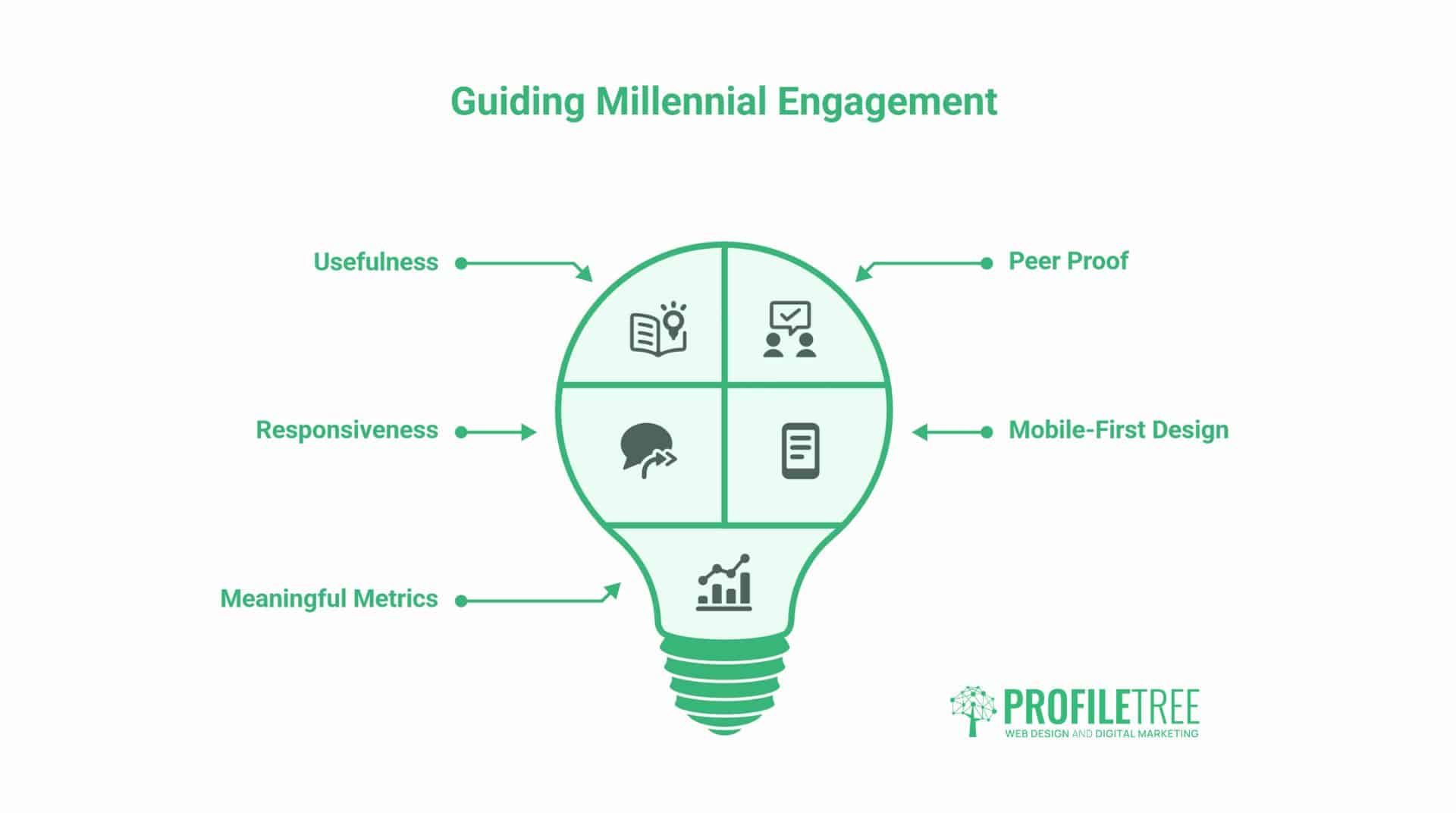
Knowing how millennials behave is only useful if it changes what you do. Five principles carry most of the weight for a small business.
Lead with usefulness, not promotion
Millennials filter out anything that reads like an advert. What holds their attention is content that teaches, solves, or genuinely entertains. A plumber explaining how to spot a failing boiler, an accountant breaking down a tax change, a café showing how a dish is made: each of these earns trust that a “special offer” post never will. This is the core of good content marketing, and the same discipline that makes content useful also makes it honest. Our note on content transparency sets out why that honesty pays off with a sceptical audience.
Treat peer proof as your best salesperson
This generation trusts other people far more than it trusts brands. Reviews, customer photos, and word of mouth carry more weight than any campaign, and micro-influencers with small, engaged followings often outperform large accounts because they read as real. Building a steady flow of reviews and customer content should sit near the top of any millennial-focused plan. The mechanics of why this works are worth understanding, and our explainer on social influence covers the psychology behind it.
Answer fast, in public
Millennials expect quick replies, often within the hour, and they judge a business by how it handles problems out in the open. A complaint answered well and publicly can raise your standing more than a wall of five-star reviews, because everyone watching sees accountability in action. For a small team, this is an advantage: you can respond faster and more personally than a large corporation with layers of sign-off. Set a realistic response window and hold to it.
Build for the phone, then convert
Almost all of this activity happens on a mobile screen, and social traffic dies on a slow or clumsy website. When a millennial taps through from an Instagram post or a Google search, they decide within seconds whether to stay. A fast, clean, mobile-first site with an obvious next step is where social effort actually turns into enquiries. This is the join between marketing and the technical side of a business, and it is why our website development work focuses on speed and conversion rather than decoration alone.
Measure what matters, not vanity numbers
Follower counts and likes tell you very little. Saves, shares, quality comments, direct messages, and conversions tell you almost everything. A post with 40 likes and 15 saves is often working harder than one with 400 likes and no saves, because a save is a signal of real intent. Tracking the right metrics and connecting social activity to actual enquiries is where budgets get spent well or wasted. Our guide to digital marketing ROI sets out how to make that connection without over-engineering it.
“Businesses that treat social media as a broadcast channel rather than a conversation space will struggle to connect with millennial customers,” says Ciaran Connolly, founder of ProfileTree. “This generation values authenticity and engagement, which means your social strategy needs to prioritise genuine interaction over promotional content.”
Millennials and Gen Z are not the same
It is tempting to lump millennials in with Gen Z, but the two behave differently and mixing them up produces content that lands with neither. Millennials lean towards more considered, curated content and still value polish in the right places; Gen Z rewards raw, fast, of-the-moment content and treats anything overproduced with suspicion. Millennials remember a pre-social world, which makes them more privacy-aware and more sceptical of data collection; Gen Z has never known one. If your audience spans both, the answer is usually platform-specific content rather than a single message stretched to fit. Our Gen Z social media statistics piece is worth reading alongside this one if you sell to both generations.
Where ProfileTree fits
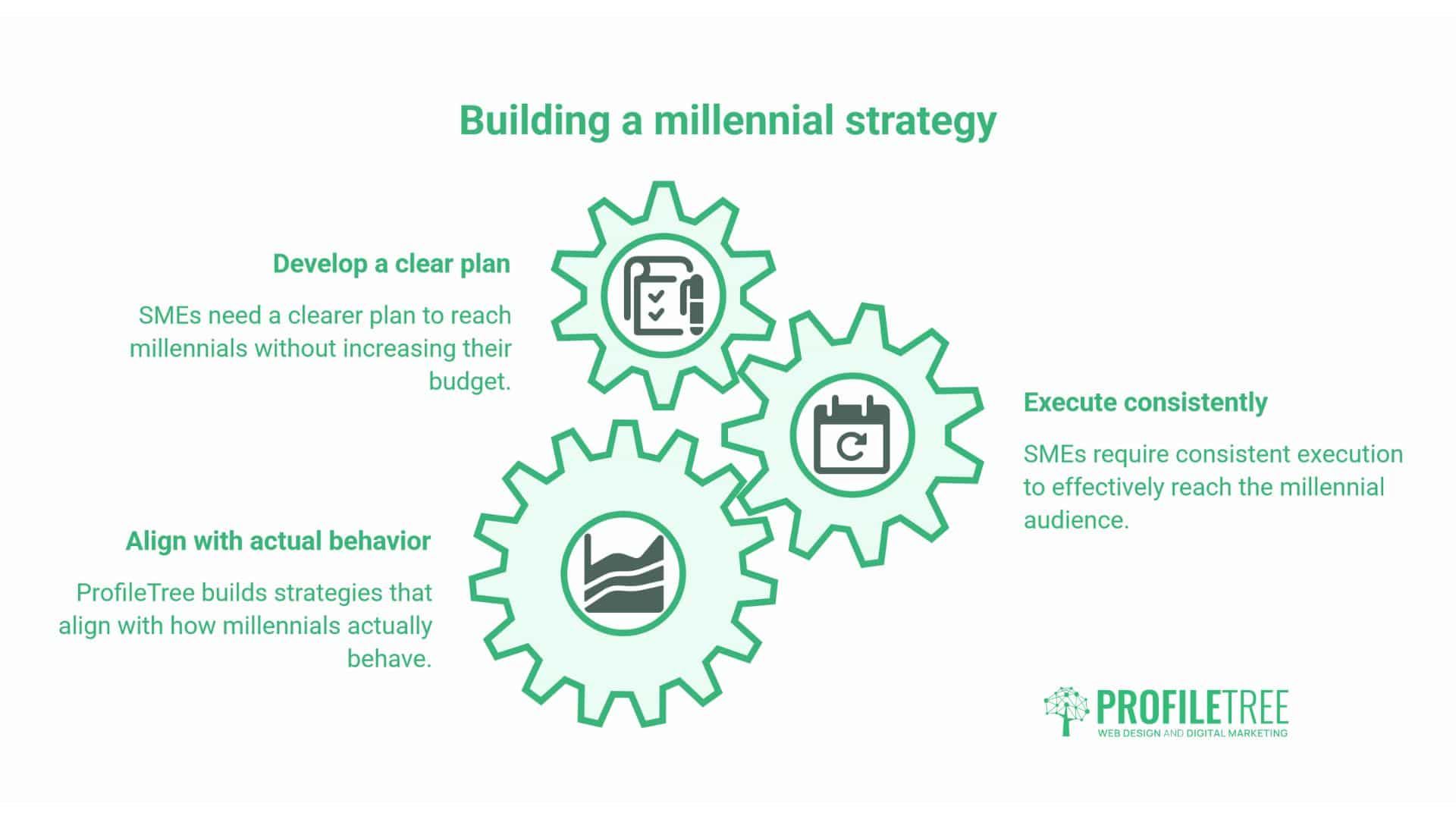
Most SMEs do not need a bigger budget to reach millennials. They need a clearer plan and consistent execution. ProfileTree works with businesses across Northern Ireland, Ireland, and the UK to build social and content strategies that align with how this generation actually behaves, rather than how trend pieces say they do.
That work usually starts with content and video, because both sit at the centre of millennial attention. Short-form clips for Instagram and TikTok, longer explainers for YouTube, and written content that answers real questions all pull in the same direction. Our video marketing team produces the formats that travel across platforms, and our digital training programmes hand those skills to your own staff so the momentum does not stop when a campaign ends.
The other half is being found in the first place. When millennials research a purchase, they search, and a business that does not appear has already lost. Strong SEO services make sure you show up when they look, and a fast, conversion-focused website turns that visibility into enquiries. For businesses weighing up where to start, our full range of services lays out how the pieces connect.
A realistic next step
Understanding millennial behaviour gives you the map. Turning it into results still takes a plan built around your specific business, your audience, and your market. Pick the two platforms where your customers actually are, commit to useful content and fast replies, and make sure the website behind it all works on a phone. Start there, measure what matters, and adjust as you learn.
If you would like a second pair of eyes on your current social presence, the ProfileTree team is based at the McSweeney Centre in Belfast and works with businesses across the region.
FAQs
Which social media platform do millennials use most in the UK?
There is no single answer. UK adults spend the most time on YouTube, while younger millennials favour Instagram and TikTok and older ones lean on Facebook groups and messaging. The real question is which platform they use for the kind of purchase you sell.
Are millennials leaving Facebook?
Not leaving, but changing how they use it. Ofcom’s data shows Facebook’s reach skews older, and millennials increasingly keep it for groups, Marketplace, and Messenger rather than public posting. It still works for community and support, less so for organic reach to younger users.
Are millennials leaving Facebook?
Not leaving, but changing how they use it. Ofcom’s data shows Facebook’s reach skews older, and millennials increasingly keep it for groups, Marketplace, and Messenger rather than public posting. It still works for community and support, less so for organic reach to younger users.
How do I reach millennial business owners and decision-makers?
Focus on LinkedIn and expertise-led content, not consumer-style promotion. Millennials now hold senior and buying roles and research suppliers quietly first, so showing how you solved a real problem earns more trust than any advert.
Do millennials actually use TikTok?
Yes, increasingly so, with strong growth among users in their thirties and forties who use it for entertainment and product search. The catch is that TikTok rewards native, unpolished video and rejects anything that looks like a repurposed advert.