
Podcasts for Your Business: The Complete UK Guide
Table of Contents
Business podcasts have transformed from niche hobby content into strategic marketing tools. 52% of UK professionals now listen to business podcasts weekly, whilst organisations with branded podcasts report 89% higher brand awareness compared to other content formats. Understanding the attention span crisis in the digital age helps explain why podcast listening continues to grow despite shorter attention spans.
This guide addresses both sides of business podcasting: which shows deliver genuine strategic value for UK business owners, and how to launch a professional podcast that drives relationships rather than chasing downloads. We cover the 15 podcasts Belfast entrepreneurs actually listen to, the equipment decisions that matter, and the compliance questions US-centric guides ignore.
You’ll discover why video-first podcasting dominates discovery, how to avoid the “podfade” problem that kills 90% of new shows, and whether DIY recording or professional production makes strategic sense for your business model.
Best Business Podcasts for UK Entrepreneurs
The podcast landscape splits between generic entrepreneurial inspiration and actionable UK business insight. These recommendations focus on shows that deliver frameworks you can implement, not motivational platitudes that fade by lunchtime.
Growth and Marketing Strategy
The Diary of a CEO with Steven Bartlett remains the UK’s most-downloaded business podcast, averaging 3.2 million plays per episode. Bartlett extracts frameworks from successful founders rather than collecting war stories. His interviews with James Clear on habit formation provide frameworks applicable to Belfast SMEs navigating expansion. For visual learners who prefer business content in different formats, business TV shows offer complementary insights.
When Bartlett discusses fundraising, he references actual London investors and UK tax structures rather than Silicon Valley narratives that don’t translate to Northern Ireland businesses.
Marketing School with Neil Patel and Eric Siu operates on a daily 10-minute format focused on single tactics. Each episode answers one specific question: optimising Google Business Profiles or LinkedIn outreach strategies. Listen during morning coffee, implement that afternoon.
Leadership and Operations
The Tim Ferriss Show pioneered long-form interview podcasting and maintains the standard for extracting implementable detail from world-class performers. Episodes stretch 2 to 3 hours. Ferriss asks, “How exactly did you do that?” until guests provide specific frameworks.
When interviewing investors, you receive actual deal evaluation criteria. The approach to strategic decision-making mirrors the frameworks Ferriss extracts from his guests.
Rory Sutherland’s Podcast explores behavioural economics through Ogilvy UK’s Vice-Chairman. Sutherland understands both brand strategy and direct response, making his post-pandemic consumer psychology insights valuable for service businesses rethinking positioning. His approach to understanding how effective communication shapes customer perception applies directly to podcast conversation techniques.
Should Your Business Start a Podcast?

The default advice claims every business needs a podcast. The data shows 90% don’t survive past episode three. This section addresses whether podcasting makes strategic sense for your specific business model and how to structure it as a compounding asset rather than a content treadmill.
The Three Podcast Models
- Authority Building positions you as the expert in your field through interviewing industry leaders and sharing frameworks. This works for consultants, agencies, and professional services where credibility directly drives conversion. The model requires consistent quality because your podcast competes with established shows like Diary of a CEO. This approach aligns with broader entrepreneurship strategies that prioritise thought leadership.
- Sales Development means interviewing potential clients, strategic partners, or referral sources under the format of featured business insights. The podcast becomes your excuse to build relationships with people you want to do business with, functioning as professional networking in audio format. This works exceptionally well for B2B service businesses where deals are high-ticket and relationship-driven, similar to how content marketing strategies build client relationships over time.
- Internal Communications involves private podcasts for employees onboarding, training, or culture building. Harvard Business Review documented this in their 2022 corporate podcasting study, though few businesses have implemented it. This suits companies with distributed teams or high employee turnover, where consistent training material reduces onboarding time. This approach complements AI’s role in employee development by providing scalable training content.
Most businesses should choose either authority building or sales development. Internal podcasts require different infrastructure.
Understanding Podfade
The pattern proves predictable: initial enthusiasm, launch momentum, then realisation that producing weekly content whilst running a business is unsustainable. Most entrepreneurs underestimate the ongoing time commitment required.
Batch recording solves this. Record 10 episodes in two weeks, then schedule weekly release over 2.5 months. ProfileTree’s video production team structures client podcasts this way: book studio time for two full days, record 12 episodes back-to-back with different guests, then handle editing and distribution whilst the client focuses on running their business. This approach transforms podcasting from constant pressure into manageable quarterly projects.
The calculation becomes straightforward. If one new client per year emerges from podcast relationships and your average client lifetime value reaches £25,000, then spending £3,000 on podcast production delivers 733% ROI.
The Equipment Decision
The core question: £500 starter setup or £5,000 professional production? The answer depends on whether you’re building authority (where audio quality signals professionalism) or developing sales (where relationships matter more than production polish).
For authority building, poor audio undermines credibility. Your podcast competes with professional shows where listeners expect broadcast quality. Budget £3,000 to £5,000 for equipment and editing.
For sales development, audio quality matters less because your audience is the guest, not eventual listeners. A £500 USB microphone setup suffices. The guest cares about substantive conversation, not compressor settings. This mirrors how video production quality varies based on strategic goals rather than universal standards.
Launching Your Podcast: Essential Steps
This framework addresses businesses launching strategic podcasts rather than hobbyists creating passion projects. The process spans 4 to 6 weeks from decision to published episode.
Defining Your Value Proposition
Your podcast needs to answer one specific question better than existing shows. “Business tips for entrepreneurs” isn’t a value proposition but a generic category. “How Belfast manufacturers implement AI without reducing workforce” addresses a specific audience’s specific problem with a specific geographical context. For businesses operating internationally, cross-cultural strategies become essential when podcasting for global audiences.
The formula combines audience, problem, and unique angle. Examples include law firms in Northern Ireland navigating post-Brexit compliance or Belfast hospitality businesses implementing sustainable operations whilst maintaining margins. The specificity mirrors how effective tourism marketing strategies target defined audiences rather than generic travellers.
A narrower focus makes it easier to identify exactly who to invite as guests, attract that specific audience, build niche authority, and convert listeners into clients. ProfileTree’s podcast focuses on digital transformation for SMEs in Northern Ireland, narrow enough to comprehensively cover the topic without competing with generic business podcasts. This mirrors creative strategy principles that emphasise differentiation through specificity.
Complete this sentence in under 20 words: “This podcast helps [specific audience] with [specific problem] using [specific approach competitors don’t offer].” If you cannot complete it concisely, your concept remains too broad.
Equipment and Recording Setup
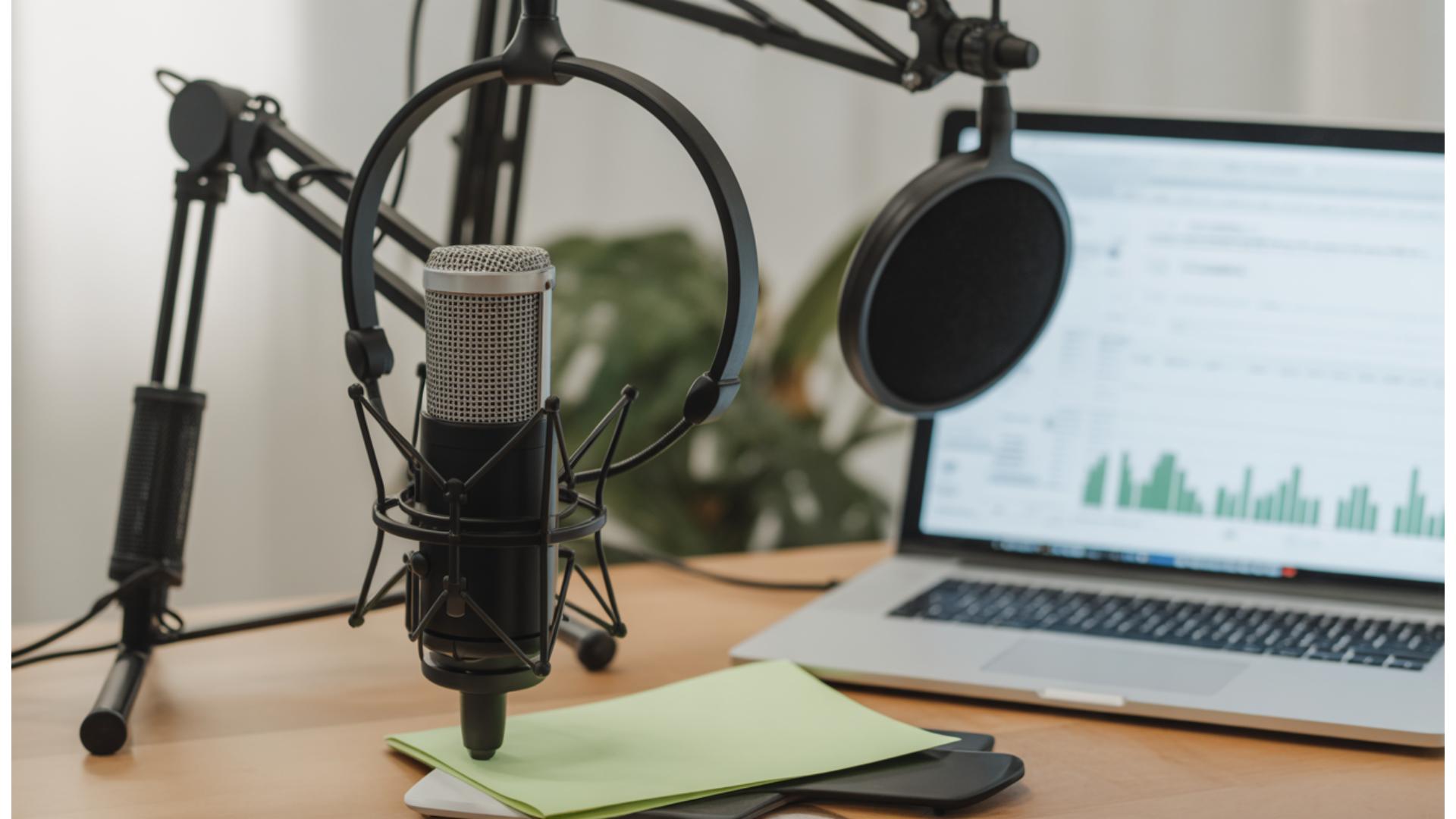
Audio quality functions as a trust signal. Listeners subconsciously associate professional sound with professional expertise. Poor audio quality can undermine even the strongest content, making equipment decisions crucial for success.
The £500 starter setup includes Audio-Technica ATR2100x-USB microphone (£95), headphones (£45), boom arm (£85), pop filter (£10), Riverside.fm subscription (£180 yearly), and lighting (£85). This delivers broadcast-acceptable quality in quiet rooms. The ATR2100x-USB works via USB for computer recording and XLR if you upgrade to a mixer later, providing flexibility as your needs grow. Riverside.fm handles local recording, so internet issues don’t ruin episodes.
The £5,000 professional setup includes two Shure SM7B microphones (£700), audio interface (£360), cloudlifters (£280), headphones (£240), boom arms (£220), camera with lens (£1,100), lighting (£340), acoustic treatment (£180), editing software (£240 yearly), and monitor (£340). Choosing the right camera for video podcasting significantly impacts production quality.
The Shure SM7B represents the industry standard, creating sound that listeners recognise as professional. Dynamic microphones reject background noise better than condenser mics.
The hybrid approach starts with the £500 setup to validate consistency. After 10 episodes, if podcasting works strategically, upgrade to professional equipment. You’ll have spent £500 on starter gear, but proven the concept first.
Recording and Editing Workflow
Remote recording software maintains quality when guests join from their offices. Riverside.fm (£15 monthly, £180 yearly) records locally on each participant’s computer, then uploads high-quality files after conversations end.
Editing determines sustainability. If each 45-minute episode requires 6 hours of editing, you’ll burn out quickly. The workflow should take 90 minutes maximum.
Import raw recording at 1.5x speed whilst flagging long pauses over 3 seconds, excessive filler words, and technical issues. Cut obvious problems, leave everything else. Real conversations include minor imperfections that increase authenticity. Modern AI tools like Canva can help create professional graphics for video podcasts without design expertise.
Apply noise reduction, equalisation to boost voice frequencies, compression to reduce dynamic range, and limiting to prevent clipping. Most editing software includes podcast presets. Adobe Premiere Pro’s Speech Enhancement handles 80% of podcasts perfectly. Avoid over-editing that makes content sound artificial, as AI-generated content-detection principles apply equally to overly processed audio that loses human authenticity.
For video podcasts, add an intro graphic showing episode details, lower thirds displaying guest information, and an outro card with a subscribe prompt.
Distribution and Content Repurposing
Your podcast needs to exist in multiple places simultaneously: YouTube for video consumption, Apple Podcasts and Spotify for audio, and your website for SEO benefits. Podcast hosting platforms handle distribution to all major platforms automatically. Track performance using free social media analytics tools to understand which platforms drive the most engagement.
Captivate (£15 monthly, £180 yearly) offers UK-based hosting with GDPR-compliant data handling and detailed analytics showing which companies are listening, useful for B2B attribution. It includes unlimited shows and episodes, private podcasting for internal communications, and a website builder specifically for podcast landing pages. The platform’s analytics go beyond basic download numbers to show listener engagement patterns and company-level data.
Choose Captivate if you need UK-based support and GDPR documentation for compliance-sensitive industries like legal, financial services, or healthcare. The UK data residency ensures your podcast operations meet stringent privacy requirements.
One 45-minute podcast recording contains approximately 6,750 words of spoken content. Repurposed strategically, that single recording generates one full YouTube video, one audio episode across all platforms, 10 short-form video clips for LinkedIn and Instagram Reels, three LinkedIn text posts with key quotes, one blog article from the transcript, one email newsletter with episode highlights, and five Twitter threads breaking down main frameworks. Understanding LinkedIn’s impact on UK business helps you prioritise this platform for B2B podcast promotion.
This “atomic content” approach breaks one core asset into multiple smaller pieces. The recording is your content creation session. Everything else is reformatting. This mirrors how content-sharing strategies maximise single-asset value across multiple channels.
Watch the full recording and flag 10 moments where the guest shares specific numbers, says something counterintuitive, explains a practical framework, answers frequently asked questions, or experiences emotional moments. Each flagged moment becomes a 60 to 90-second clip with captions, your logo, guest name as text overlay, and a strong hook in the first 3 seconds. This approach follows proven video marketing principles that prioritise engagement over length.
Post these clips across LinkedIn, Instagram Reels, and TikTok. Schedule 2 to 3 clips weekly between episode releases, meaning one recording provides 3 to 4 weeks of social content. This strategy demonstrates how social media marketing increases sales through consistent multi-platform presence.
UK Compliance and Legal Requirements
US-centric podcast guides skip this entirely, but UK businesses face specific legal requirements. The ICO issued £1.2 million in GDPR fines to media companies in 2023.
GDPR for Podcast Guests
Recording someone’s voice and publishing it online constitutes processing personal data under GDPR. You need documented consent before recording.
Send guests a pre-recording form documenting what you’re recording, where it will be published, and their right to request removal. Store signed forms for 7 years.
Your recording software and podcast host must store data on EU servers or maintain adequate UK GDPR compliance. Riverside.fm, Captivate, and Transistor all offer EU data residency options.
Music Licensing Requirements
If you use music, you need licences from PRS for Music covering songwriter rights, plus PPL covering recording rights.
The standard approach uses royalty-free music from Epidemic Sound (£11 monthly), Artlist (£15 monthly), or Soundstripe (£12 monthly). These include commercial podcast licensing.
Many successful business podcasts use no music because it dates quickly, and the content stands alone.
Advertising Disclosure Standards
UK advertising standards require disclosure when you’re being paid for mentions, have affiliate relationships, or hold ownership stakes in mentioned companies.
The disclosure must be clear, prominent, made before promotional content, and specific, stating “This episode is sponsored by X”. Never hide commercial relationships. The ASA takes podcast advertising seriously, with enforcement actions increasing 340% from 2021 to 2023. This aligns with broader ethical considerations in digital marketing that UK businesses must navigate, particularly transparency in content marketing when developing digital marketing strategies to attract investors, where credibility is paramount.
Conclusion
Business podcasts function as strategic assets when structured properly: batch-recorded to prevent burnout, focused on relationship building over vanity metrics, and repurposed into multiple content formats. The decision between DIY and professional production depends on your business model and whether audio quality signals credibility in your industry. Podcasting should integrate with your broader marketing strategy rather than existing as isolated content. ProfileTree’s video production team helps Belfast businesses launch professional podcasts without operational drain.
Ready to launch your business podcast? Contact ProfileTree’s video production team to discuss your podcast strategy, or explore our video marketing services to see how professional production elevates your content.
FAQs
How much does starting a business podcast cost in the UK?
Starter setup costs £500 to £700 for the first year, including equipment (£400) and hosting (£180 yearly). Professional setup costs £3,000 to £5,000 initially. Budget £150 to £300 per episode for outsourced editing, similar to costs for professional video production services.
What is the best length for a business podcast?
Most successful business podcasts run 30 to 50 minutes, matching average UK commute time. Episodes under 20 minutes work for tactical advice, but struggle to build relationship depth. Interviews naturally run 40 to 60 minutes because meaningful conversations need development time.
Do I need a licence to use music in my podcast?
Yes, you need licences from both PRS for Music and PPL for commercial music. The practical solution subscribes to royalty-free platforms like Epidemic Sound (£11 monthly) or Artlist (£15 monthly). Understanding content creation ethics helps you navigate music licensing requirements properly.
Can I record a podcast on my iPhone?
Technically, yes, but poor audio quality subconsciously signals amateur operation in professional services. iPhone quality suffices for testing viability over 3 to 5 episodes. For serious authority building, invest £95 in a USB microphone like the Audio-Technica ATR2100x-USB.
How do I find guests for my business podcast?
Start with existing network: successful clients, industry contacts, suppliers with interesting perspectives. Personal invitations via email or LinkedIn for business networking work well. For guests outside your network, use LinkedIn’s advanced search to find people with specific expertise, then send personalised connection requests.