
Social Media in Multi-Channel Marketing: A Practical Guide
Table of Contents
Integrating social media into a multi-channel marketing strategy means connecting it to your other channels, including email, SEO, and paid, rather than running it in isolation. Businesses that join these channels see significantly stronger results because each channel amplifies the others. This guide covers how to structure that integration and measure what’s working.
Most businesses using social media are not getting the most from it, and the reason is usually the same: it’s being run as a standalone channel. Posts go out, engagement comes in, and the results stop there. The connection to email, to the website, to paid campaigns, to search. Those threads are left unjoined.
That disconnect is expensive. Research on higher purchase rates from multi-channel campaigns consistently shows that customers reached across three or more connected channels convert at significantly higher rates than those reached through a single channel. The difference isn’t that more channels means more noise. It’s that a connected system gives each channel more context and more power.
This guide is for marketing managers and business owners who want to move social media from a standalone activity into a properly integrated part of their digital marketing mix. It covers what multi-channel marketing actually involves, where social media fits, how to join the channels together practically, and how to measure results when attribution gets complicated.
What Multi-Channel Marketing Actually Means
Multi-channel marketing is the practice of reaching your audience across more than one channel, using each channel for what it does best. Email for nurturing. Social for discovery and community. Search for capturing intent. Paid for amplifying what’s already working. The goal is not to say the same thing everywhere, but to use each channel’s strengths to move people further along the path from awareness to action.
It’s worth separating this from omni-channel marketing, which is a related but distinct concept. Multi-channel means being present across several channels. Omni-channel means those channels are connected so the user experiences a continuous journey regardless of which channel they’re on. Most SMEs are aiming for effective multi-channel before they’re ready for true omni-channel integration, and that’s a practical place to start.
Why Isolated Channels Underperform
A social media presence with no connection to your website’s conversion goals produces followers, not customers. An email list with no social amplification grows slowly and loses momentum between campaigns. A website with strong SEO but no social signals lacks the real-world signals of engagement that support search authority over time. Each channel on its own has a ceiling. Connected channels raise it.
What “Integration” Looks Like in Practice
Integration doesn’t require complex technology. At its most basic, it means your social posts drive traffic to landing pages designed to capture email addresses. Your emails reference content your audience has already seen on social. Your retargeting ads reach people who visited your website from a social click. Your SEO content gets social distribution that accelerates its indexing and builds topical signals. These are decisions, not systems, and most of them cost nothing to implement beyond planning time.
The Role Social Media Plays in the Mix
Social media sits primarily at the top and middle of the funnel in a multi-channel strategy. It’s where discovery happens, where brand associations are built, and where audiences are qualified before they move to channels with higher conversion intent, such as email or direct search. Understanding this position helps you set realistic expectations and avoid the trap of measuring social media solely on direct conversions.
Social Media as a Discovery Channel
A significant portion of your potential audience doesn’t know you exist yet, and search alone won’t reach them. Social platforms surface content to users who haven’t actively searched for you, which makes social the primary channel for cold audience discovery. This is particularly relevant for businesses targeting younger demographics or operating in categories where intent searches are low but interest-based discovery is high.
Social Media as a Data Layer
Beyond reach, social media generates audience data that improves every other channel. Meta’s own audience tools allow you to build custom audiences from website visitors, email lists, and video viewers, and then find similar users at scale. The engagement signals from social posts tell you which messages, formats, and topics connect before you spend budget amplifying them. Treating social data as an input to the wider strategy, not just a channel metric, is one of the most underused advantages of the platform.
Social Media as a Community and Trust Signal
For many potential customers, social media is where they go to verify that a business is legitimate and active before making contact. A dormant or thin social presence raises doubt. An active, consistent one confirms credibility. This trust function operates quietly in the background, but it affects conversion rates on every other channel. Prospects who’ve seen your content on social, read your posts, and recognised your name are more likely to open your emails, click your ads, and convert on your website.
Where Social Fits in a B2B vs. B2C Context
The specifics differ depending on your sales model. In a B2C context, social media can connect directly to commerce. A product post leads to a website visit, which triggers a retargeting ad, which leads to a purchase. The cycle is short. In a B2B context, social media, particularly LinkedIn, builds authority and familiarity over a longer period. A LinkedIn article seen by a decision-maker might lead to a whitepaper download six weeks later, which leads to a sales conversation. The role is the same (awareness and trust), but the timeline and the conversion trigger are different. Your content marketing approach should reflect which model you’re working in.
Making the Channels Work Together
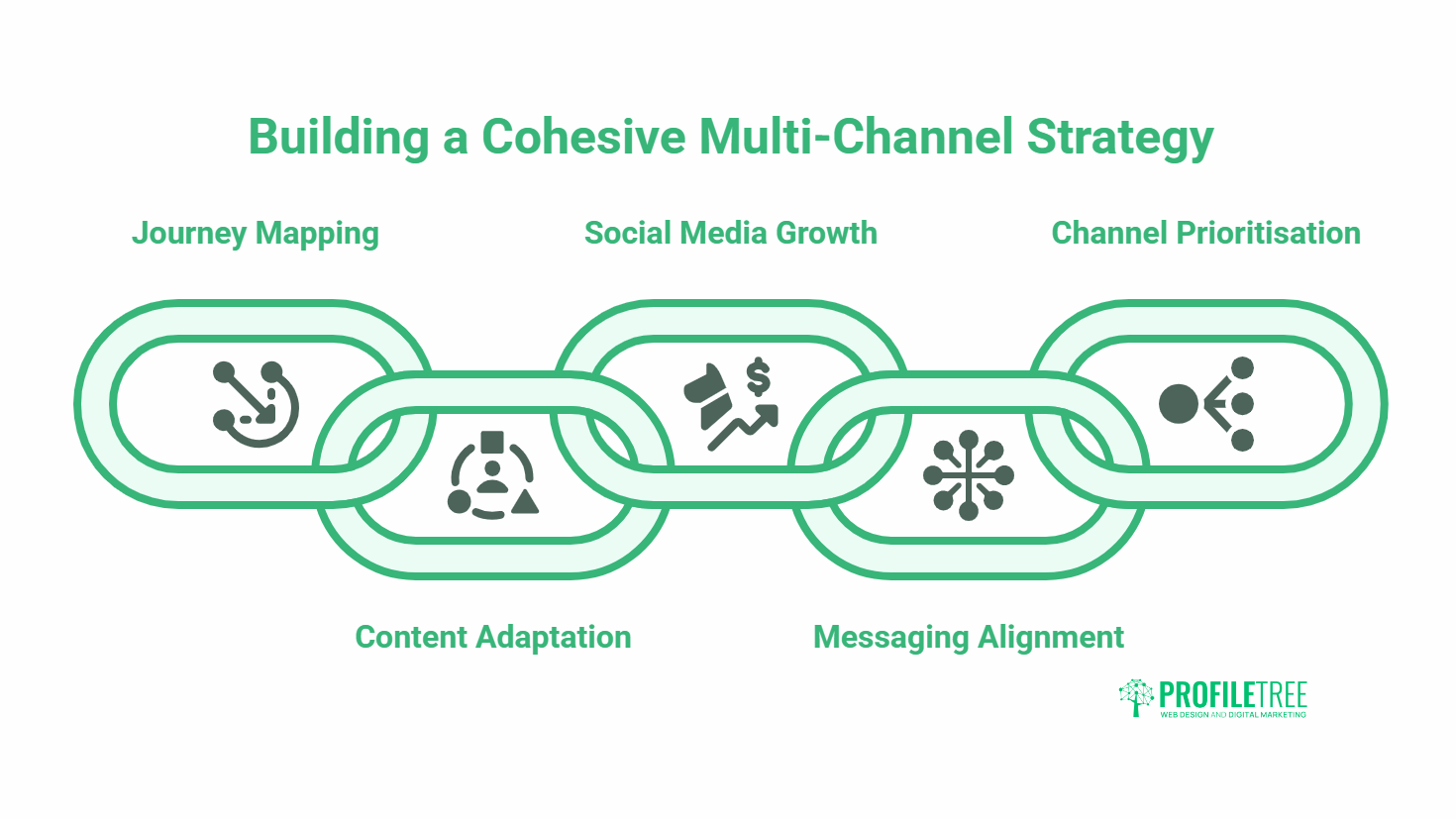
This is where most multi-channel plans break down. The strategy sounds right in theory, but the channels stay separate in practice because nobody has defined the specific connections between them. The fixes are straightforward once you know what to look for.
Map the Journey Before You Plan the Content
Before deciding what to post or send, map out the path you want a cold audience member to take from first contact to conversion. Identify the specific role each channel plays at each stage. Where does social hand off to email? What does someone need to see on the website before they’re ready to enquire? What triggers a retargeting ad? This map doesn’t have to be elaborate, but it needs to exist. Without it, each channel is optimised in isolation rather than as part of a system.
Build Content That Travels Between Channels
The most efficient multi-channel content starts with one substantial asset, typically a long-form article, a video, or a research piece, and breaks it into components for each channel. A 2,000-word guide becomes three LinkedIn posts, an email newsletter, five short-form social captions, and a YouTube video. Each component points back to the original asset on your website, which captures the email address or triggers the next step. This approach reduces the production burden and creates consistent messaging across channels without repetition.
Use Social to Grow Your Owned Channels
Followers on social media are a rented audience. The platform can change its algorithm tomorrow and your reach disappears. Email subscribers and website visitors are owned contacts. One of the clearest uses of social media in a multi-channel strategy is as a mechanism for growing owned channels: driving email signups, building retargeting lists, and increasing direct website traffic. Every piece of social content should have a clear answer to the question of what happens next, and for most businesses that answer should point toward an owned channel.
Align Messaging Across Channels Without Repeating Yourself
Consistent messaging doesn’t mean identical content. It means the same positioning, the same tone, and the same core claims appear across all channels, expressed in ways appropriate to each format. A social post and an email about the same service should feel like they come from the same brand, but neither should be a copy of the other. Develop a messaging framework at the campaign level that defines the core argument, the proof points, and the call to action. Then adapt it for each channel rather than rewriting from scratch each time.
“The businesses we see getting the most from social media are rarely the ones with the biggest budgets. They’re the ones who treat social as part of a connected system, where a post drives an email signup, the email drives a website visit, and the website does the selling. When those pieces are joined up, every channel performs better.”Ciaran Connolly, Founder, ProfileTree
Prioritise Channels Based on Where Your Audience Actually Is
A common mistake is building a presence on every available platform because a competitor is there or because a trend report recommended it. Spreading budget and effort across six channels typically produces six underperforming campaigns. A more effective approach is to go deep on two or three channels where your specific audience is active and engaged, and connect those channels properly before expanding. For most SMEs in Northern Ireland and the UK, that usually means Facebook or Instagram for B2C, LinkedIn for B2B, and email as the owned channel that ties them together. A considered digital strategy defines those priorities before any content gets produced.
Measuring Multi-Channel Performance
Measurement becomes more complex when channels are connected, because the path from first touch to conversion runs across multiple platforms. A customer who found you through a social post, read your website three times, opened two emails, and then converted through a direct search visit will often be attributed entirely to that last search click in standard analytics. That’s not accurate, and basing decisions on it leads to underinvesting in the channels that started the process.
Understand the Limits of Last-Click Attribution
Most standard analytics tools default to last-click attribution, which assigns full credit for a conversion to the final touchpoint. This consistently undervalues top-of-funnel channels like social media and overvalues bottom-of-funnel channels like branded search. According to HubSpot’s annual State of Marketing report, attribution remains one of the most commonly cited measurement challenges for marketing teams. Switching to a multi-touch attribution model, or at minimum reviewing assisted conversions data, gives a more accurate picture of which channels are contributing.
Track the Connections, Not Just the Channels
The most useful metrics in a multi-channel setup measure the handoffs between channels: how many social visitors sign up to your email list, how many email clicks lead to website sessions, how many retargeting ad viewers convert. These connection metrics tell you whether the integration is actually working. Channel-level metrics alone, such as social reach or email open rates, don’t tell you whether the system is functioning as intended.
Use UTM Parameters Consistently
UTM parameters are short tags added to URLs that tell your analytics platform where traffic came from. Using them consistently across every social post, every email link, and every paid ad means you can track user journeys across channels with reasonable accuracy. The investment is small: a consistent naming convention and the discipline to apply it. The payoff is being able to see which social campaigns drive email signups, which emails drive website conversions, and where the system breaks down.
Set KPIs That Reflect Each Channel’s Role
Measuring social media on direct conversions sets it up to fail, because direct conversion isn’t its primary role. Set KPIs that match what each channel is actually supposed to achieve. Social media: reach, engagement rate, link clicks to owned channels, new email subscribers driven from social. Email: open rate, click-through rate, revenue per email. Website: conversion rate, time on page, goal completions. Paid: cost per acquisition, ROAS. Social media marketing performs well when it’s measured on its actual contribution to the system, not on metrics borrowed from channels with different roles.
Build a Simple Reporting Dashboard
You don’t need expensive software to measure multi-channel performance. A monthly reporting template that pulls the key metric from each channel, notes the connections between them, and tracks progress against quarterly goals is enough to make informed decisions. The discipline of reviewing it regularly matters more than the sophistication of the tool. A shared spreadsheet reviewed monthly outperforms a complex dashboard that nobody looks at.
Frequently Asked Questions
What Is the Difference Between Multi-Channel and Omni-Channel Marketing?
Multi-channel marketing means being active across several channels, each running its own activity. Omni-channel marketing means those channels are connected so that the customer’s experience is continuous and consistent regardless of which channel they use. Most businesses benefit from building an effective multi-channel approach first, then working toward deeper integration over time.
How Many Channels Should a Small Business Use?
Two or three channels done well consistently outperform five or six channels done inconsistently. For most small businesses, the practical starting point is one owned channel (usually email or a content-rich website), one social platform where the audience is most active, and one paid channel for amplification. Add channels only once the existing ones are producing measurable results and have clear connections between them.
How Do I Integrate Social Media With Email Marketing?
The most direct connection is using social media to grow your email list: a lead magnet promoted through social posts, a signup form linked from your bio, or a social ad campaign targeting cold audiences with a free resource in exchange for an email address. Once someone is on your list, use email to deepen the relationship and drive website visits. Use social to stay visible between email sends and to retarget email subscribers who haven’t converted. The two channels reinforce each other when they’re planned together.
What Social Platforms Work Best in a Multi-Channel Strategy?
The answer depends on your audience and business model. For B2C businesses targeting consumers in the UK and Ireland, Facebook and Instagram offer the most established advertising infrastructure and the largest audience overlap with email lists. For B2B businesses, LinkedIn is the highest-intent platform for professional audiences. For businesses with a strong video production capability, YouTube builds long-term search traffic that complements social distribution. Start with the platform where your existing audience spends the most time, not the one generating the most trend coverage.
How Do I Track Social Media’s Contribution to Conversions?
Use UTM parameters on every link you share from social platforms so your analytics can track which social posts drive website visits and goal completions. Review assisted conversion reports rather than last-click attribution to see social’s full contribution. Track email signups driven from social separately, since these are conversions in their own right. If you run social ads, the platform’s own attribution window will capture some conversions that don’t appear in Google Analytics; reconciling both data sets gives the fullest picture.
How Often Should I Post on Social Media as Part of a Multi-Channel Strategy?
Frequency matters less than consistency and connection to the wider system. Three to four posts per week that each serve a clear purpose, whether driving to a landing page, promoting a piece of content, or building community engagement, produce better results than daily posting with no strategic direction. Plan social content as part of your campaign calendar rather than in isolation, so it reinforces what’s happening across email, paid, and your website at the same time.
Do I Need a Large Budget to Run a Multi-Channel Strategy?
No. The foundations of a multi-channel strategy, joining up content across channels, using UTM tracking, building an email list from social traffic, and planning campaigns in an integrated calendar, cost nothing beyond time. Paid amplification accelerates results but isn’t a prerequisite. Many businesses see meaningful improvement in conversion rates simply by connecting existing channels more deliberately, before spending any additional budget.
Building a Connected Marketing System
Social media works harder when it’s part of a connected system rather than a standalone effort. The shift from isolated channels to integrated ones doesn’t require a large budget or complex technology. It requires a plan that defines what each channel is for, how they hand off to each other, and what success looks like across the whole system. ProfileTree works with businesses across Northern Ireland and Ireland to build digital marketing strategies that join these pieces together. If you want a clearer picture of how your channels could work as a system, get in touch with the team.