
Digital Marketing Examples: Real Strategies SMEs Can Actually Use
Table of Contents
Most articles on digital marketing examples pull the same three names: Nike, Apple, and Airbnb. These are fine as inspiration. They are not particularly useful if you run a service business in Belfast, a retail shop in Dublin, or a B2B firm selling into the UK market.
This guide takes a different approach. Each example is chosen because the underlying strategy is transferable, not because the brand had a £50 million campaign budget. You’ll find examples across search, social, content, email, and paid media, with a clear explanation of what made each one work and what a small or medium-sized business can take from it.
What Makes a Digital Marketing Example Worth Studying
Before running through specific examples of digital marketing by channel, it’s worth establishing what separates a genuinely instructive case from a piece of brand mythology.
The examples worth studying share three characteristics. First, the strategy was deliberate: there was a defined objective, a chosen channel, and a method for measuring success. Second, the result was specific and attributable: not “we grew our brand” but “organic traffic increased by 40% in six months” or “email open rates reached 34% against a sector average of 21%.” Third, the approach is replicable at smaller scale. A campaign built around a £2 million Super Bowl slot is not a digital marketing example; it’s a media spend story.
Ciaran Connolly, founder of Belfast-based digital agency ProfileTree, makes this point often when working with SME clients: “The digital marketing examples that actually change how small businesses operate are rarely the headline-grabbing campaigns. They’re the businesses that figured out one channel, built a system around it, and ran it consistently for two years.”
The examples below are selected with that filter in mind.
Search Engine Optimisation (SEO) Examples
SEO is one of the few digital marketing channels where getting your strategy right early pays dividends for years. The examples below show how two very different approaches — niche keyword targeting and local visibility — can deliver outsized results relative to their cost.
How Gymshark Built a Content Moat Through Community Keywords
Gymshark is now a billion-pound fitness brand, but its early SEO strategy was distinctly SME-scale. Rather than competing for generic, high-volume terms like “gym wear” or “workout clothes,” the brand built content around the language its specific community used: training splits, progressive overload, and callisthenics for beginners. These were lower-volume searches, but they attracted exactly the audience likely to buy.
The transferable principle: identify the specific vocabulary your customers use, not the vocabulary you think they should use. A Northern Ireland accountancy firm targeting owner-managed businesses will rank far faster for “sole trader tax return deadline Northern Ireland” than for “accounting services Belfast.” Niche specificity beats generic authority in the early stages.
Businesses working with ProfileTree’s SEO services go through a keyword mapping process that identifies these community-level search terms before any content is produced — the difference between content that ranks and content that sits at position 80.
Local SEO: The Principle Behind Google Business Profiles
Local SEO is one of the most practical examples of digital marketing for any business with a physical location or defined service area. When someone searches “web design agency Belfast” or “accountant in Derry,” Google’s local pack results are driven by proximity, relevance, and prominence signals — primarily the Google Business Profile, citation consistency, and review volume.
A well-optimised local SEO presence can put a small independent business above national chains in a map result. That is a direct competitive advantage unavailable through traditional advertising at any equivalent cost. For businesses serving Northern Ireland, Ireland, and the wider UK market, local SEO is often the highest-ROI digital marketing activity available.
Content Marketing Examples
Content marketing works when it answers real questions rather than broadcasting brand messages. The two examples below show how businesses built genuine audience trust by making useful information freely available — and how that trust translated into commercial outcomes.
Ryanair’s Unfiltered Social Content Strategy
Ryanair’s content marketing is one of the more studied examples of digital marketing in the UK and Ireland context — not because of production values, but because it works. The airline’s social media team produces content that is self-deprecating, reactive, and entirely distinct from the polished corporate tone of most aviation brands. The approach costs relatively little to produce and generates engagement rates that paid advertising cannot match.
The transferable principle is not “be controversial.” It is this: audiences respond to content that feels human rather than corporate. For a B2B firm or a service business, this might mean sharing the genuine decision-making process behind a project, writing honestly about a client challenge that didn’t go to plan, or producing content that shows the working rather than just the outcome. Authenticity, when it is specific and honest, builds trust in a way that polished content rarely does.
ProfileTree’s approach to content marketing is built around this principle: content that demonstrates real expertise will always outperform content that simply describes a service.
Educational Content: Monzo’s Transparency Strategy
Monzo built much of its early growth through content that explained banking in plain terms — something traditional banks consistently failed to do. Their blog covered topics like how overdraft interest is calculated, what happens when a direct debit bounces, and how currency conversion fees work. None of this was promotional. All of it attracted people searching for answers to real financial questions.
The outcome was a content library that ranked for thousands of high-intent informational searches and positioned Monzo as the bank that was “on your side.” The brand mention came through editorial credibility, not advertising.
For SMEs, this is one of the clearest digital marketing examples to replicate. Pick the five questions your customers ask most often. Write a genuinely useful answer to each one. Publish them as standalone articles. Done consistently over 12 months, this builds organic traffic and trust simultaneously.
Social Media Marketing Examples
Social media rewards businesses that behave like people rather than brands. The examples below cover two distinct approaches — reactive content that earns organic reach, and community-driven content that turns customers into advocates — both of which are replicable at the SME scale.
B2B Thought Leadership on LinkedIn
LinkedIn is where the most effective B2B digital marketing examples are happening right now, and most of them are not from large corporations. Individual founders and directors who consistently post about their areas of expertise — engineering, logistics, finance, manufacturing — are generating a more qualified pipeline than the company page content has ever delivered.
The reason is algorithmic: LinkedIn’s feed prioritises personal content over brand content, and users trust professional opinion more than corporate messaging. A managing director at a NI manufacturing firm writing weekly about exporting to European markets will reach procurement managers, potential partners, and press contacts in a way that paid LinkedIn advertising rarely achieves.
The practical requirement is consistency, not volume. Three well-considered posts per week from a genuine practitioner outperform daily generic company updates. ProfileTree’s social media marketing services help business leaders build this kind of personal authority alongside a company page strategy.
User-Generated Content: The Principle Behind Viral Campaigns
User-generated content (UGC) campaigns represent some of the highest-ROI social media marketing examples in recent years, precisely because the brand is not producing the content — its customers are. A fitness brand asking customers to share their results, a restaurant encouraging guests to post their dishes, a software company spotlighting user workflows: all of these reduce content production costs while generating social proof at scale.
The critical design question is: what would make a customer want to share? The answer is almost always recognition, community membership, or a genuine stake in the outcome. Campaigns that manufacture sharing through prize draws tend to generate low-quality engagement; campaigns that make customers feel seen tend to generate organic advocacy.
Email Marketing Examples
Email remains the most direct line between a business and its existing audience. The examples below show how the channel performs best not as a broadcast tool, but as a way to deliver the right message to the right person at the right moment in their relationship with your business.
Personalisation at Scale: Transactional Emails as a Marketing Channel
Email marketing examples worth studying are rarely the mass-broadcast newsletters. The highest-performing email marketing comes from triggered sequences tied to user behaviour: a welcome sequence that delivers genuine onboarding value, a re-engagement series for lapsed customers, or a post-purchase follow-up that anticipates the next logical need.
Monzo’s transactional emails are a frequently cited example of digital marketing done quietly well. Every spending notification, budget alert, and account update is written in a tone that feels personal and consistent with the brand. The emails are not trying to sell; they are delivering utility. That consistency builds brand affinity over time in a channel where most businesses treat communication as administrative rather than strategic.
For SMEs, email marketing delivers a higher ROI than almost any other digital channel when the list is well-managed, and the sequences are built around customer needs rather than business objectives. An estate agent in Northern Ireland who sends a monthly market update will retain client relationships far more effectively than one who relies on occasional social posts.
Automated Drip Campaigns for B2B Lead Nurturing
B2B digital marketing examples in the email space often centre on lead nurturing: the process of maintaining contact with a prospect from initial inquiry through to purchase decision, which can take weeks or months in complex sales environments.
A well-structured drip campaign delivers a sequence of useful content at defined intervals — a case study, a how-to guide, a relevant industry update — that keeps the business visible and credible without requiring the sales team to manually follow up with every cold lead. This is one of the clearest examples of a digital marketing strategy creating compounding returns: the campaign is built once and continues to work indefinitely.
Pay-Per-Click (PPC) and Paid Media Examples
Paid media delivers results faster than any organic channel, but the margin between a well-targeted campaign and wasted budget is narrow. The examples below illustrate how precision targeting and audience sequencing make the difference between PPC that pays for itself and PPC that drains it.
Intent-Based Search Advertising
PPC advertising is one of the most direct examples of digital marketing in practice. When someone searches “web design company Belfast” and your ad appears above the organic results, you are reaching a prospect at the exact moment of intent. When managed well, this channel’s conversion efficiency is significantly higher than that of awareness-based advertising.
The challenge for SMEs is that broad PPC campaigns are expensive and easy to mismanage. The effective examples of PPC digital marketing are almost always narrowly targeted: specific service, specific location, specific audience. A legal firm in Dublin running ads for “commercial lease solicitor Dublin” will achieve a far better cost-per-lead than one running ads for “solicitor Ireland.”
ProfileTree’s digital marketing work with SME clients consistently shows that the most effective digital marketing strategy starts with channel selection based on objective and budget, not on what competitors appear to be doing.
Retargeting: The Follow-Up Strategy
Retargeting is the practice of showing ads to people who have already visited your website. It is one of the most efficient examples of digital marketing budget allocation because the audience has already demonstrated some level of interest. Conversion rates for retargeted audiences are consistently higher than for cold audiences across platforms.
For an SME, even a modest retargeting budget — running ads to previous website visitors across Google Display or Meta — can recover a meaningful percentage of leads that would otherwise have left without converting. The key design principle is relevance: show the person the product or service page they visited, not a generic brand ad.
How to Choose the Right Digital Marketing Strategy for Your Business
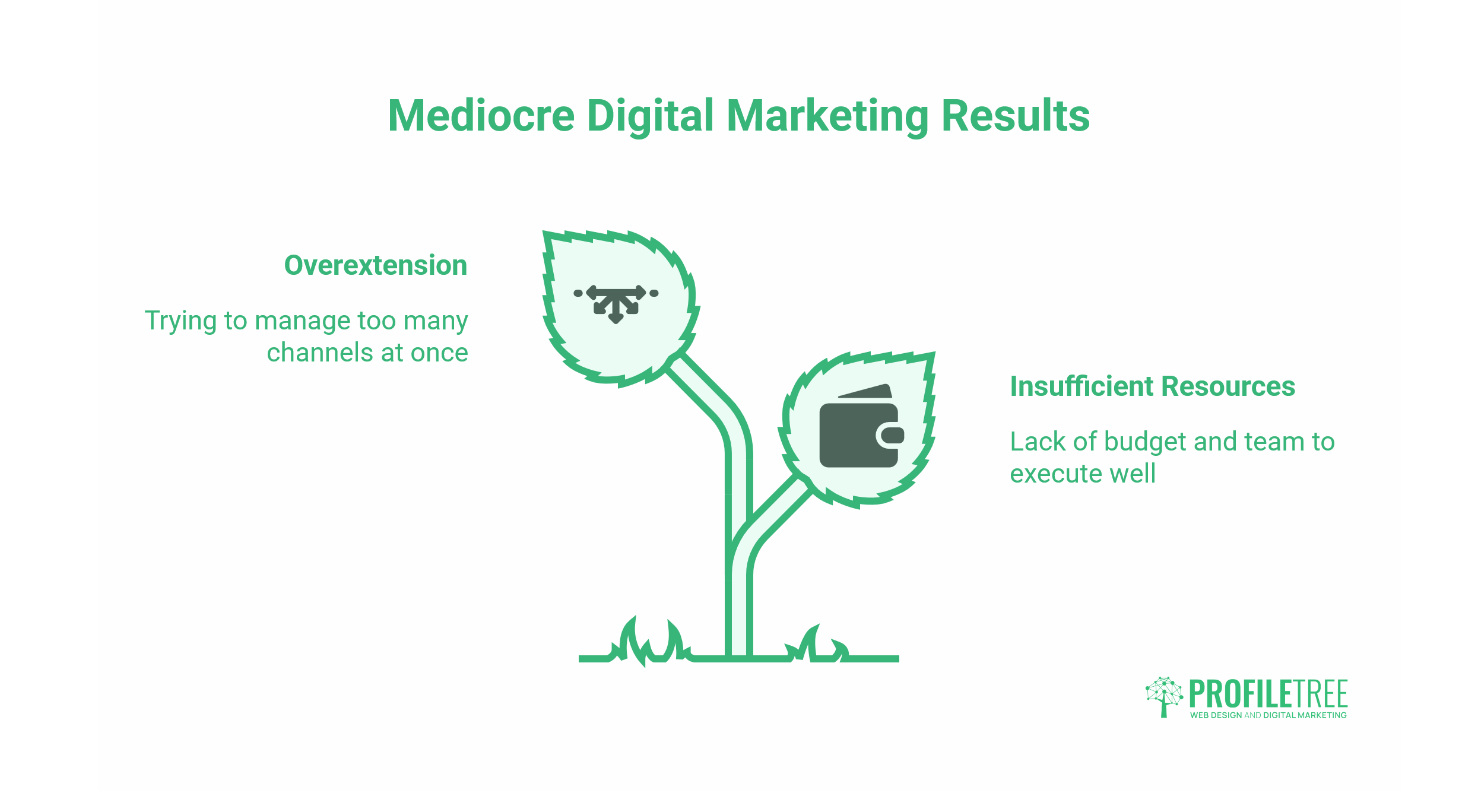
The most common mistake SMEs make is not choosing the wrong channel — they are trying to run too many channels simultaneously with insufficient resources. Spreading effort across SEO, paid social, email, and content simultaneously without the budget or team to do any of them well produces mediocre results across the board.
The more effective approach is sequencing. For a business with a defined local service area, local SEO and Google Business Profile optimisation is almost always the first priority. For a B2B firm with a long sales cycle, content marketing and LinkedIn thought leadership will consistently outperform paid advertising in the medium term. For an e-commerce business with a product ready to sell, paid search and retargeting produce faster returns than SEO.
ProfileTree’s digital marketing campaigns team works with SMEs across Northern Ireland, Ireland, and the UK to build channel strategies based on business objectives, competitive landscape, and available budget — not on which channels are currently fashionable.
The examples of digital marketing strategies that produce lasting results share one characteristic: they were deliberately chosen, properly resourced, and consistently measured over time.
Conclusion
The digital marketing examples in this guide share a common thread: clarity of objective, precision of targeting, and consistency of execution. None of them required the budgets of an FTSE 100 brand. What they required was a clear understanding of who the audience is, what that audience needs, and which channel offers the most direct path between the two.
For SMEs in Northern Ireland, Ireland, and the UK, the same principles apply at every scale. Whether you’re building an SEO content library, running a LinkedIn thought-leadership campaign, or setting up your first email sequence, the fundamentals remain the same. If you’re ready to build a digital marketing strategy grounded in what actually works for businesses your size, speak to the ProfileTree team.
FAQs
What is a real-life example of digital marketing?
A local solicitor running Google search ads for “commercial lease solicitor Dublin,” a Belfast café posting weekly Instagram content, or an NI manufacturer publishing LinkedIn articles on exporting to Europe. Any promotional or audience-building activity conducted through an online channel qualifies as digital marketing.
What are the main types of digital marketing?
Search engine optimisation (SEO), pay-per-click advertising (PPC), content marketing, social media marketing, email marketing, and influencer or affiliate marketing. Most businesses use a combination, with the mix determined by audience, budget, and sales cycle length.
Which digital marketing channel has the best ROI for SMEs?
Email marketing consistently delivers the highest measurable ROI when lists are well-managed and sequences are behaviour-triggered. SEO delivers the strongest long-term returns but requires 6–18 months to build. PPC produces the fastest results but needs an ongoing budget to sustain.
What are some examples of digital marketing for small businesses?
A plumber appearing in local map results through Google Business Profile optimisation. A restaurant running Instagram UGC campaigns. A B2B accountancy firm publishing monthly tax guides that rank for specific queries. An estate agent sending a post-valuation email sequence that generates repeat instructions.
Is Netflix an example of digital marketing?
Yes. Netflix uses its recommendation algorithm as a marketing engine, surfacing personalised content to reduce churn and drive continued subscription. This is product-led growth, where the product itself functions as the primary marketing channel.