
eCommerce Blog Content That Converts: Strategy, SEO and Engagement
Table of Contents
Running an eCommerce blog is one of the most cost-effective ways to build organic traffic, establish topical authority, and create a pipeline of warm leads without ongoing ad spend. Yet most eCommerce blogs underperform badly. They pull in visitors who never buy, publish content that settles on page four of Google, and never connect the articles they produce to the products and services actually being sold. The gap between a blog that looks busy and one that genuinely contributes to revenue is almost always a strategy problem, not a writing problem.
This guide covers what works for eCommerce blog content today, whether the business is a retail brand, a B2B supplier, or a service company running an online shop. The principles hold regardless of sector: write for a specific audience, earn visibility through genuine depth, and give every article a clear commercial purpose. ProfileTree, a Belfast-based web design and digital marketing agency, works with retail and B2B clients across Northern Ireland, Ireland, and the UK on exactly this kind of content, and the pattern holds regardless of what’s being sold: content built around real audience need, and solid technical foundations consistently beat content built on gut instinct and keyword stuffing. A structured content marketing approach, paired with the technical groundwork covered later in this guide, is what separates a blog that ranks from one that actually sells.
Why Most eCommerce Blogs Fail to Convert
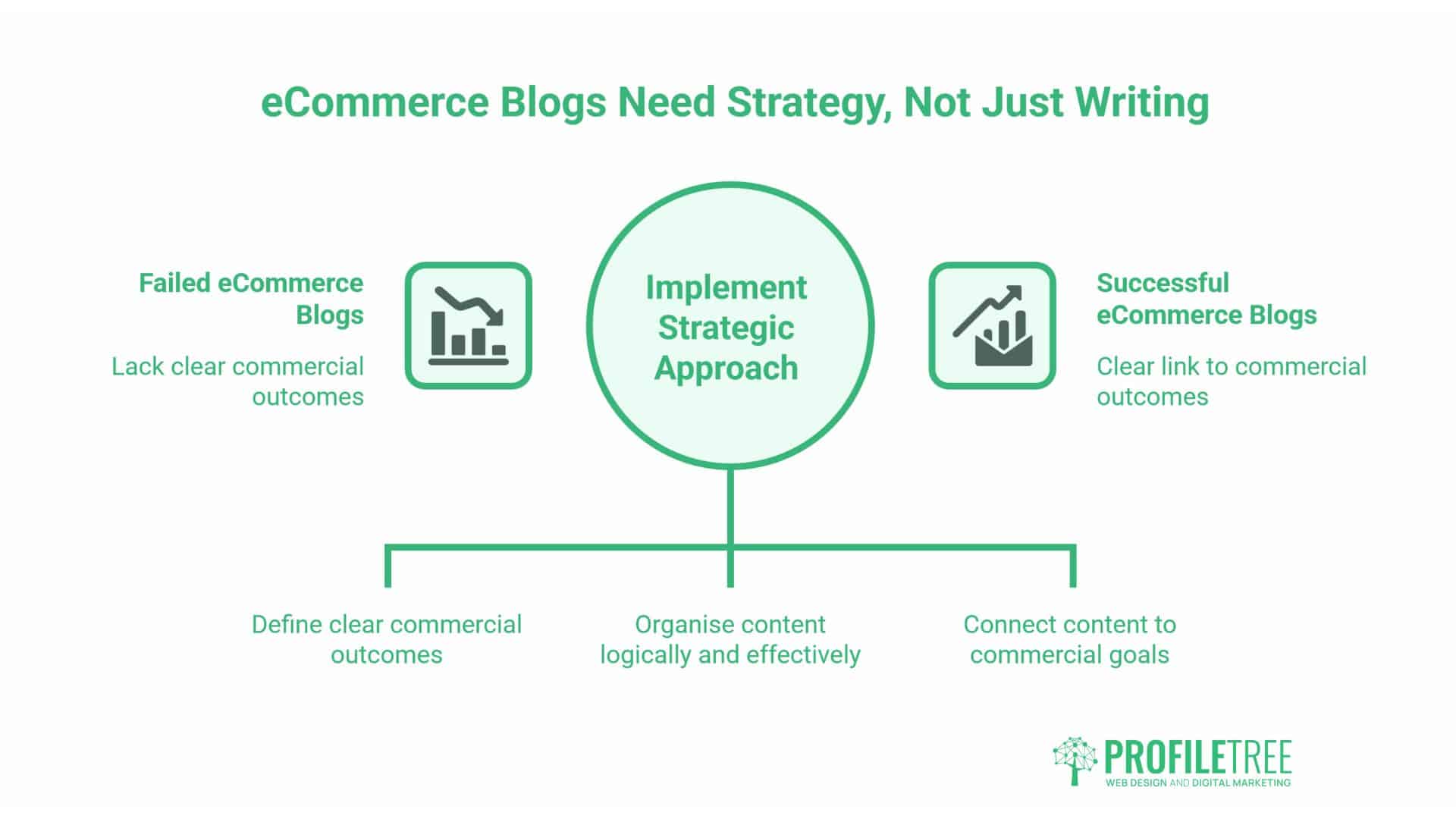
Most eCommerce blogs fail for predictable reasons, and the issues are rarely about writing quality. They’re about strategy, structure, and the absence of a clear link between content and commercial outcomes.
Traffic without intent. An eCommerce blog that ranks for broad, high-volume terms but attracts visitors with no interest in buying is generating vanity metrics. A post ranking for “what is content marketing” pulls in students and casual readers. A post ranking for “how to choose a web design agency in Belfast” attracts decision-makers with a genuine need. The second post is worth a hundred of the first, even when its traffic numbers are smaller.
The fix is to map every piece of eCommerce blog content to a stage in the buying journey. Top-of-funnel content builds awareness, mid-funnel content builds consideration, and bottom-of-funnel content drives the purchase decision. Plan content without that map, and the result is a blog that reads well but generates nothing.
Thin content that can’t compete. Google’s Helpful Content System, reinforced through several core updates since late 2025, rewards depth and penalises thin or lightly edited content. A 600-word post that restates what everyone else has already said offers no Information Gain, now a significant ranking factor. An eCommerce blog full of short posts covering familiar ground without adding anything new is actively working against the domain’s authority, not for it.
The realistic minimum for a competitive eCommerce blog post is 1,500 words. Guides and pillar content should target 2,500 to 3,500 words. The bar isn’t word count for its own sake; it’s the depth required to answer the question better than anyone currently ranking for it. This kind of content depth analysis is a standard part of any proper SEO audit.
No connection between content and product. One of the most common failures in an eCommerce blog strategy is content that lives in complete isolation from the products and services on offer. The blog becomes a separate entity, publishing general-interest articles that never link meaningfully to product pages, service descriptions, or conversion points.
A UK-specific version of this failure. Competitive research into the current “eCommerce blog” search results shows them dominated by large SaaS platforms such as Shopify and BigCommerce, whose blogs are built primarily for a US and global audience. That leaves a real gap for UK and Ireland-specific content: post-Brexit VAT treatment, Northern Ireland’s dual-market position, and payment gateways used by UK and Irish shoppers. An eCommerce blog that only recycles generic global advice misses a genuine opportunity to serve local buyers and rank for queries that global platforms don’t answer well.
Every eCommerce blog post should have a clear commercial thread. That doesn’t mean turning every article into a sales pitch. It means choosing topics that naturally connect to what’s being sold, answering the questions buyers ask before they purchase, and placing internal links that guide readers to the next logical step.
Understanding Your eCommerce Blog Audience
Effective eCommerce blog content starts with a precise understanding of who it’s written for and what they’re trying to accomplish. Generic audience research produces generic content. The more specifically a reader is defined, the more directly their needs can be addressed, and the more likely the content is to rank, get shared, and convert.
Mapping the Customer Journey to Content Types
The customer journey for most eCommerce purchases moves through awareness, consideration, and decision. Each stage needs a different type of content, a different depth, and a different call to action. An eCommerce blog that only publishes one type fails to capture buyers at other stages.
| Journey Stage | What the Reader Needs | Content Format | CTA Direction |
|---|---|---|---|
| Awareness | Education and context | How-to guides, explainers | Related articles |
| Consideration | Comparison and criteria | Comparison guides, decision frameworks | Service or product pages |
| Decision | Proof and reassurance | Reviews, testimonials, FAQs | Contact, quote, purchase |
Using Search Data to Find Real Audience Questions
Google Search Console is one of the most underused tools in eCommerce blog planning. The queries report shows what people actually typed before landing on the site. Filter for queries of seven or more words and natural language questions start to appear, the kind that make ideal H2 subheadings and FAQ entries.
Beyond Search Console, tools like Ahrefs and Google’s own People Also Ask feature surface the specific concerns, comparisons, and objections that real buyers bring to their research. Ahrefs’ analysis of AI Overview citations found that pages covering multiple sub-questions within a topic are considerably more likely to be cited in AI-generated answers. Build eCommerce blog topics from data, not assumptions about what might perform well. A digital marketing strategy built around this kind of query research tends to outperform one built on instinct alone, because it starts from what buyers are actually asking rather than what a business assumes they want to know.
Segmenting Your Audience for B2B and Retail Buyers
Not every visitor to an eCommerce blog is at the same stage or comes with the same background, and this matters more for B2B eCommerce than most content plans account for. A first-time retail buyer researching a product category needs different content to a procurement manager comparing suppliers on lead times, minimum order quantities, and account terms. Most “best eCommerce blog” round-ups treat B2B as an afterthought, which is a genuine content gap: B2B buyers research more thoroughly, involve more decision-makers, and respond to detailed technical content rather than lifestyle-driven copy.
For a B2B eCommerce blog, that means content built around specification comparisons, procurement FAQs, and case-study-style explanations of how a product or service solves an operational problem, rather than the awareness-stage lifestyle content that dominates retail blogging advice. A retail-focused content calendar and a B2B one should rarely look the same, even when both sites sell physical goods.
Crafting eCommerce Blog Content That Drives Sales
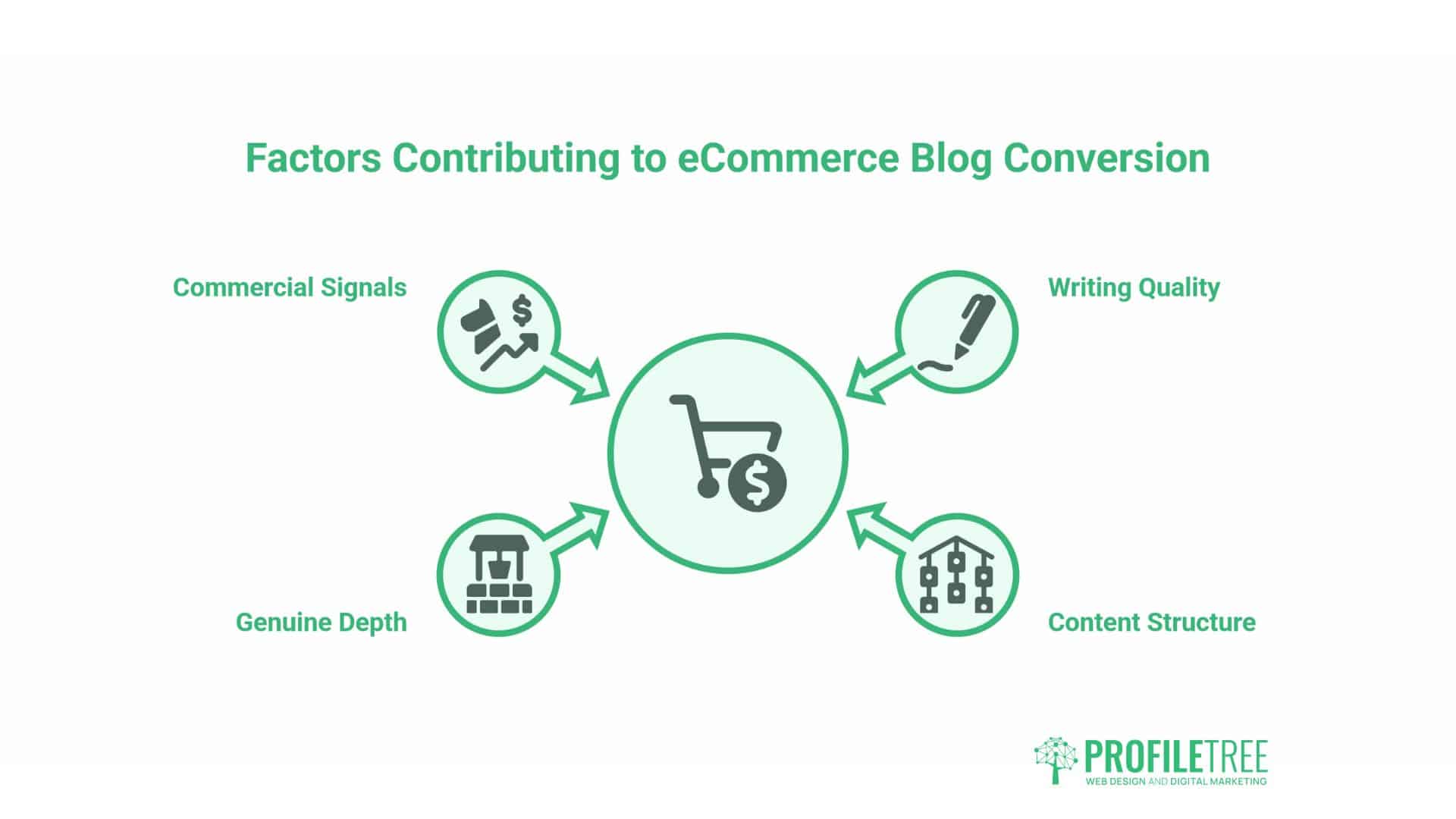
The quality of writing in an eCommerce blog matters. Poor writing undermines credibility, increases bounce rates, and signals to Google that the content isn’t worth ranking. Writing quality alone isn’t enough, though. Content that drives sales needs the right structure, genuine depth, and deliberate integration of the commercial signals that move readers towards action.
The BLUF Principle: Bottom Line Up Front
Chrome only considers the first 30 passages of a page for embeddings, and AI systems draw a large share of their citations from the opening third of a page. eCommerce blog posts need to answer the primary question immediately. Don’t build to a conclusion; start with it.
Every major section of an eCommerce blog post should open with a clear, direct statement of the point being made, followed by evidence, examples, and supporting details. This structure serves human readers, who skim before they read, and AI systems, which extract the most prominent passages for citation. A post that buries its key insight in paragraph seven is largely invisible to both.
Information Gain: What Makes Content Worth Ranking
Google’s Information Gain Score measures how unique a piece of content is compared to everything else ranking for that query. An eCommerce blog post that covers the same ground as the top ten results in slightly different words has capped ranking potential, regardless of how well the page is technically optimised.
Every eCommerce blog post should include at least one of the following: original data from real experience, a specific example from an actual project, a framework or perspective not already widely covered, or content segmented for an audience that existing ranking pages don’t serve well. This is what earns both rankings and citations in AI-generated search answers.
As Ciaran Connolly, founder of ProfileTree, puts it: “The difference between eCommerce blog content that ranks and content that disappears is almost always about what it adds, not how it’s written. Generic advice dressed up in good prose still has nothing new to say. The posts that work are the ones where someone has actually done the thing, measured the result, and written it down honestly.”
The “Why Blogs Fail” Angle Nobody Covers
Most eCommerce content advice is relentlessly “how to succeed,” and almost none of it addresses why blogs fail in their first year, despite this being a genuinely useful angle for a new store owner deciding where to invest limited time. The honest answer is rarely dramatic: posts published without a keyword or intent behind them, no internal linking plan, no measurement framework, and no willingness to retire or rewrite posts that never worked. Addressing failure directly, rather than only offering advice on success, gives a piece of content something most competitors skip.
Storytelling and Social Proof
Storytelling in an eCommerce blog context isn’t about creative fiction. It’s about taking the reader from where they are (a problem, a question, a decision they’re trying to make) to where they want to be, using the content as the bridge. Case studies are the most effective form of this: a case study that describes a real problem, explains how it was addressed, and presents a measurable outcome gives readers a template for their own situation.
Social proof through testimonials, review summaries, and named client outcomes belongs in eCommerce blog content as well as on service pages. When a reader encounters the same trust signals in multiple contexts, the authority compounds. For businesses combining content with a strong website development foundation, those trust signals carry more weight because the full site experience reinforces the message rather than undercutting it.
Writing Style and Voice
The voice of an eCommerce blog should be expert but approachable: direct, practical, and opinionated, where the evidence supports an opinion. Vary sentence length deliberately. A five-word sentence followed by a longer one that carries context and evidence reads more naturally than a run of sentences all landing around 20 words. Use contractions naturally, write in the second person for advice, and keep paragraphs to two or four sentences as a rule.
The Content-to-Cart Conversion Loop
Most eCommerce blog advice stops at “write good content” and leaves the reader to work out how that content actually leads to a sale. It helps to think of this as a loop rather than a straight line: a reader lands on an informational post, follows a well-placed internal link to a product or category page, and either converts immediately or leaves with enough trust to return later via a branded search or a retargeted ad.
Each part of that loop depends on a different discipline. The blog content itself needs SEO and information gain to be found in the first place. The product and category pages it links to need a site that’s fast, mobile-friendly, and genuinely easy to buy from, which is as much a website development and web design problem as a content one. A blog post can rank perfectly and still fail to convert if the page it drives traffic to takes 6 seconds to load on mobile or buries the “add to basket” button below 3 scrolls of copy.
This is where content and technical delivery have to be planned together rather than handed to separate teams working in isolation. A retailer investing in blog content without simultaneously reviewing site speed and checkout friction is often solving only half the problem.
SEO and Technical Foundations for Your eCommerce Blog
An eCommerce blog without solid SEO foundations is content that nobody finds. Technical structure, keyword integration, internal linking, and schema markup aren’t optional extras; they’re the infrastructure that determines whether content reaches the people it’s written for.
Keyword Research and Search Intent
Keyword research for an eCommerce blog starts with intent, not volume. A keyword with 500 monthly searches from people ready to buy is worth far more than a keyword with 50,000 searches from people browsing with no purchase intent. The consistent filter is always the same: what is the person searching for this term actually trying to accomplish?
Long-tail keywords, phrases of four words or more, consistently convert better for eCommerce content. They’re more specific, face less competition, and are used by people who’ve moved beyond general awareness into active research. The same logic applies to keyword selection during a website development project; pages built with intent-matched keywords from the outset rank faster and hold their positions longer.
URL Structure, Title Tags, and Meta Descriptions
The URL of every eCommerce blog post should sit under 60 characters, contain the primary keyword near the start, use hyphens rather than underscores, and avoid dates or version numbers. URLs are meant to be permanent; one with a year in it looks outdated the moment that year passes.
Title tags should front-load the primary keyword within the first 40 characters and stay under 60 in total. Meta descriptions should be 150 to 160 characters, address the post’s primary question, include a soft call to action, and align precisely with the page’s content. A misleading meta description increases bounce rates and sends a negative signal to Google.
Internal Linking Strategy
Internal links are the mechanism through which an eCommerce blog distributes authority across a site. Every post should carry three to seven internal links, placed early in the content rather than clustered at the bottom, pointing to service pages, pillar content, and related eCommerce blog articles within the same topic cluster.
Anchor text matters. Descriptive, keyword-rich anchor text tells both the reader and the search engine what the linked page is about. A link anchored to “a practical guide to lead generation using content marketing” is more useful than one anchored to “our guide” pointing at the same destination, and it’s worth reading ProfileTree’s guide to lead generation using content marketing for a closer look at how that connects to blog strategy specifically.
Schema Markup and AI Citation Visibility
Schema markup tells search engines precisely what type of content they’re reading. For an eCommerce blog, the most relevant types are BlogPosting for standard posts, FAQPage for question-and-answer sections, and HowTo for process-driven content. The FAQ schema is particularly valuable because it enables expanded result formats in Google’s SERPs, increasing the physical space a result occupies and improving click-through rates.
AI-powered search surfaces, including Google AI Overviews, ChatGPT, Perplexity, and Gemini, now influence a growing share of eCommerce research queries, and long-form content with tables and statistics from named sources earns a disproportionate share of those citations. Businesses that fold AI implementation into their content workflow tend to find it easier to keep up a consistent publishing schedule, which both traditional and AI-driven search reward over sporadic bursts of activity.
The UK and Ireland eCommerce Content Gap
A close look at the current search results for “eCommerce blog” shows something worth acting on: the ranking pages are almost entirely US-centric, built around Shopify, BigCommerce, and similar platforms whose advice rarely touches the practical realities of trading in the UK or Ireland. That’s a genuine content gap, not a small one.
For an eCommerce business based in Belfast, Dublin, or anywhere else in Northern Ireland or the Republic, real content opportunities exist around topics the big platforms barely cover: VAT treatment for goods sold to UK customers, Northern Ireland’s dual position inside both the UK internal market and the EU single market for goods, and the practical differences between UK and Irish payment processing. HMRC’s own guidance on VAT for overseas goods sold directly to customers in the UK is a useful starting reference for any UK-facing eCommerce blog covering compliance topics, though a qualified accountant should always be the final word on a specific business’s VAT position; this is content territory, not tax advice.
Covering this well requires more than swapping “US” for “UK” in an existing template. It means writing content that genuinely understands the compliance and logistics questions a UK or Irish merchant is actually asking, which is exactly the kind of localised entity work a proper digital marketing strategy should build into a content calendar from the outset, rather than bolting on later.
Measuring and Improving eCommerce Blog Performance
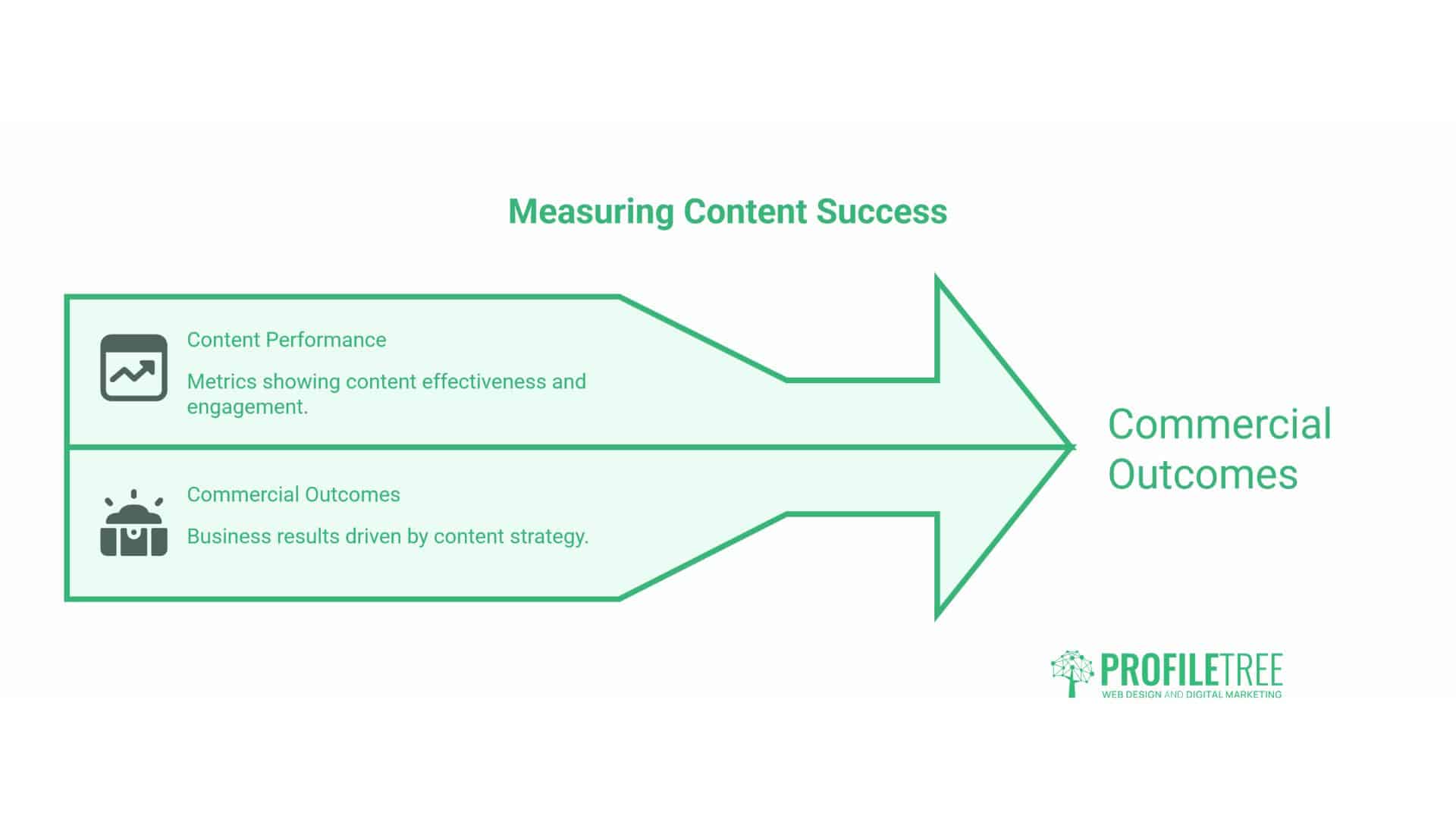
An eCommerce blog without a measurement framework is operating blind. The metrics that matter for a content strategy aren’t the vanity metrics most dashboards surface by default; they’re the ones that connect content performance to commercial outcomes.
The Metrics That Actually Matter
Traffic volume shows how many people found the blog. It says nothing about whether those were the right people or whether they did anything useful after arriving. Organic click-through rate indicates whether titles and meta descriptions are earning clicks. Scroll depth and time on page show whether readers engage with the full piece or leave after the introduction. Assisted conversions show which posts appear in the conversion path even when they aren’t the last touch. Internal link click rates confirm whether readers are following the intended content journey, and return visitor rates indicate whether blog readers are becoming a regular audience rather than one-off searchers.
Using Google Search Console to Identify Content Opportunities
Google Search Console provides the clearest picture of how an eCommerce blog is performing in organic search. High-impression, low-click queries represent the most immediate opportunity: content appears in search results but fails to earn a click, almost always due to a title and meta description problem rather than content.
Filter queries by an average position between 8 and 20. These are pages sitting on the edge of page one or just off it. A targeted improvement, adding depth, updating statistics, and expanding FAQ coverage, can move these pages onto page one and generate a meaningful traffic increase without creating new content from scratch.
Content Refresh Strategy
AI systems favour content that’s materially fresher, not just date-tweaked. A meaningful share of the most-cited pages in AI-generated answers were updated within the prior month, according to research referenced throughout ProfileTree’s editorial guidance, though this figure is worth verifying against a current source before it’s quoted publicly. Genuine refreshing means adding new sections with current information, updating statistics, expanding subtopic coverage, and adding recent examples, not just changing a publication date.
Prioritise the refresh schedule in this order: high-traffic evergreen eCommerce blog posts first, then posts sitting on the edge of page one, then posts with strong impressions but poor CTR, then hub pages and topic cluster pillars. Improving existing content almost always delivers faster results than publishing something new, because it builds on an established indexing and ranking base rather than starting from zero.
Turning Blog Content into Video and Multi-Channel Reach
An eCommerce blog post published without a distribution plan accumulates traffic slowly, if at all. Email newsletters, organic social media, video content, and outreach to relevant publications each extend the reach of content that’s already been produced. Email remains one of the most direct channels for eCommerce businesses: a segmented list allows specific blog content to reach specific audience groups, which tends to lift relevance and click-through rates noticeably compared with a single blanket send.
Video is a particular opportunity here. A blog post and a companion YouTube video covering the same topic create a multi-channel presence that increases both organic visibility and branded web mentions, a factor AI systems increasingly weigh when assessing credibility. Turning a well-performing eCommerce blog post into a short explainer video doesn’t require a full production crew; a script drawn straight from the post’s H2 structure, one filming session, and captions for silent viewing is often enough to get a working first version live. ProfileTree’s video production work with clients across Belfast, Northern Ireland, and the UK follows exactly this kind of integrated approach, treating video as an extension of existing written content rather than a separate workstream.
Businesses looking to scale content production without sacrificing quality are also turning to AI-assisted drafting and QC tools to handle the repetitive parts of content production, freeing editorial time for the research and judgement that actually earns rankings. ProfileTree’s digital training sessions cover exactly this kind of workflow for in-house teams who want to keep more of the process internal rather than outsourcing it entirely.
Where to Take Your eCommerce Blog Next
The eCommerce blog that generates leads isn’t the one that publishes most often. It’s built on a clear understanding of the audience, a structure designed for search visibility, and a consistent thread from informational content to commercial action. Start with the foundations: audit what’s currently ranking in Search Console, improve posts that sit close to page one before adding new content, and map topics to the B2B- and UK-specific gaps most competitors leave unaddressed. Three well-researched posts a month will consistently outperform ten thin ones.
ProfileTree works with businesses across Northern Ireland, Ireland, and the UK on integrated digital strategies that connect eCommerce blog content to website hosting, SEO, video production, and AI-assisted marketing, with examples of this work in ProfileTree’s case studies. For more on how content strategy connects to lead generation, see ProfileTree’s guides on market research for UK SMEs, influencer content strategy, and AI-driven customer insight.
FAQs
How often should I publish on my eCommerce blog?
Consistency matters more than frequency. Two well-researched posts a month will outperform eight thin ones. Set a cadence that’s sustainable and delivers quality that genuinely serves the audience, rather than chasing a publishing target for its own sake.
What’s the right word count for an eCommerce blog post?
The minimum for competitive ranking is 1,500 words. How-to guides should target 2,500 to 3,500 words, and pillar pages covering broad topics should aim for 3,000 to 4,000 words or more.
Should I write eCommerce blog content myself or use an agency?
It depends on available time, SEO knowledge, and writing skills. Many business owners have deep product expertise but limited capacity to produce content at the depth required to rank. ProfileTree’s content marketing work is built to blend agency expertise with a client’s existing knowledge of their own products and customers.
How do I link my eCommerce blog content to my product pages?
Place links to product or service pages within the body of an article at a point where the linked page genuinely extends the point being made. Use descriptive anchor text, and never cluster links at the end or force them into the opening paragraph.