
Critical B2B Marketing Statistics for UK Business Growth
Table of Contents
Business-to-business marketing operates differently from consumer marketing, yet many companies apply the same tactics to both. Understanding the specific behaviours, preferences, and patterns of B2B buyers requires looking at the data. Statistics reveal how decision-makers research solutions, which channels they trust, and what influences their purchasing choices.
UK businesses investing in digital marketing need clarity on what actually works. Generic advice serves little purpose when your sales cycles span months and involve multiple stakeholders. This article examines B2B marketing statistics that inform strategy, focusing on data relevant to small and medium businesses operating in Northern Ireland, Ireland, and the broader UK market.
ProfileTree works with B2B companies to build digital marketing strategies based on measurable outcomes rather than assumptions. Our experience across SEO, content marketing, and digital training shows that companies making data-informed decisions consistently outperform those relying on industry generalisations.
The B2B Buyer Journey
B2B purchasing decisions involve longer timelines and more research than consumer purchases.
Research Begins Online
Research from Gartner indicates that B2B buyers spend only 17% of their time meeting with potential suppliers when considering a purchase. When buyers are comparing multiple suppliers, the amount of time spent with any one sales representative drops to just 5% or 6% of the total buying time.
This shift means your digital presence matters more than your sales pitch. Buyers form opinions about your company based on your website, content, and online reputation before ever speaking with sales teams. A manufacturing company in Belfast competing for contracts must win the digital research phase or never reach the conversation stage.
Multiple Stakeholders Complicate Decisions
The average B2B purchase involves 6 to 10 decision-makers, according to data from Gartner. Each stakeholder brings different priorities: procurement focuses on cost, technical teams assess capabilities, and executives consider strategic fit. Your marketing must address all these perspectives simultaneously.
This complexity extends buying cycles. While consumer purchases happen in minutes or days, B2B sales often take months. Software purchases for SMBs typically involve 3-6 month decision processes. Capital equipment or long-term service contracts take even longer.
Self-Service Research Dominates
Forrester research shows that 68% of B2B customers prefer to research independently online rather than speak with sales representatives. Buyers want to learn at their own pace, compare options, and develop informed viewpoints before engaging with suppliers.
This preference for self-directed research places pressure on your content. Websites that fail to answer questions or provide detailed information lose potential customers who move on to better-informed competitors. A professional services firm that hides pricing or provides vague service descriptions eliminates itself from consideration.
ProfileTree’s web design services for B2B companies focus on information architecture that supports how buyers actually research. We build sites that provide depth while remaining accessible, matching the needs of different stakeholders in the buying committee.
Content Marketing Performance
Content marketing drives B2B lead generation more effectively than traditional advertising.
Content ROI Outperforms Paid Advertising
The Content Marketing Institute reports that content marketing costs 62% less than traditional marketing, whilst generating approximately three times as many leads. For UK SMBs with limited marketing budgets, this cost efficiency makes content marketing not just effective but necessary.
Organic search drives 10 times more traffic than organic social media for B2B companies, according to BrightEdge research. This statistic reinforces the importance of SEO-optimised content that ranks for terms your potential customers search. A logistics company ranking for “temperature-controlled transport UK” receives qualified traffic without ongoing advertising spend.
Long-Form Content Generates More Leads
HubSpot data shows that B2B companies publishing long-form blog posts (over 2,000 words) generate 9 times more leads than those publishing shorter content. Detailed, authoritative content attracts serious buyers researching complex purchases. Superficial articles fail to build the credibility needed to win business contracts.
Articles that thoroughly address specific business problems outperform generic promotional content. A piece explaining “How to Reduce Warehouse Costs Through Inventory Management Software” will attract operations managers actively solving this problem. Generic content about “improving efficiency” lacks the specificity that converts readers into leads.
Video Content Increases Engagement
Wyzowl research indicates that 87% of businesses use video as a marketing tool, and 92% of marketers who use video say it provides good ROI. Video content particularly suits B2B marketing for explaining complex products, demonstrating software, or showcasing manufacturing capabilities.
LinkedIn reports that video posts generate 5 times more engagement than other content types on their platform. For B2B companies where LinkedIn represents a primary marketing channel, video content becomes necessary rather than optional.
ProfileTree’s video production services help B2B companies create content that explains technical concepts clearly. We work with manufacturers, software providers, and professional services to produce videos that inform rather than simply promote.
Email B2B Marketing Statistics
Email remains highly effective for B2B lead nurturing and customer retention.
Email Delivers Strong ROI
Campaign Monitor data shows email marketing generates an average ROI of £35 for every £1 spent. This 3,500% return makes email one of the most cost-effective B2B marketing channels available to SMBs. Whilst social media attracts attention, email consistently delivers measurable business results.
Segmented email campaigns achieve 14.31% higher open rates and 100.95% higher click-through rates compared to non-segmented campaigns, according to Mailchimp data. Generic emails to entire lists waste opportunities. Tailoring messages to specific customer segments based on industry, company size, or previous behaviour dramatically improves performance.
Personalisation Impacts Performance
Experian research shows that personalised emails deliver 6 times higher transaction rates than generic emails. B2B buyers respond to content addressing their specific challenges. An email discussing “Manufacturing Compliance Issues for Northern Ireland Exporters” will outperform generic “Business Solutions Newsletter” messages.
Subject lines with personalisation see 26% higher open rates according to Campaign Monitor. Simple personalisation, like including company names or referencing specific industries, creates immediate relevance. An email beginning “3 Digital Marketing Challenges for Belfast Law Firms” signals understanding of the recipient’s context.
Mobile Optimisation Matters
Litmus data reveals that 42% of B2B email recipients read emails on mobile devices. Emails that render poorly on smartphones lose engaged readers. Given that business decision-makers often review emails during commutes or between meetings, mobile-friendly formatting becomes critical.
Single-column layouts, larger fonts, and clear calls-to-action improve mobile email performance. Complex designs with multiple columns and small text force readers to pinch and zoom, leading to deletion without engagement.
Ciaran Connolly, Director of ProfileTree, notes: “B2B email marketing succeeds when you treat recipients as busy professionals seeking specific information. Generic promotional emails get ignored. Targeted content addressing real business challenges generates responses and builds relationships.
Search Engine Optimisation for B2B
SEO drives organic traffic that converts at higher rates than paid advertising.
Organic Search Dominates B2B Traffic
BrightEdge reports that organic search drives 53% of all website traffic, making it the largest source of visitors for most B2B companies. Paid search contributes just 15% of traffic. This disparity highlights the importance of ranking well for relevant business terms rather than relying solely on advertising.
First-page Google rankings receive 95% of search traffic according to Backlinko research. Companies appearing on page two or beyond effectively become invisible to potential customers. A Birmingham software company ranking position 11 for “project management tools UK” loses almost all potential traffic to the 10 companies above it.
Local SEO Matters for Regional B2B
Google reports that 46% of all searches have local intent. For B2B companies serving specific regions, local SEO determines whether nearby businesses find them. A manufacturing supplier in Derry targeting customers across Ireland must appear in searches like “precision engineering Ireland” or “metal fabrication Northern Ireland.”
Businesses with complete Google Business Profiles receive 7 times more clicks than those with incomplete profiles. This free tool provides immediate visibility for local searches. SMBs overlooking basic local SEO setup lose customers to competitors who appear in map results.
Technical SEO Affects Rankings
Core Web Vitals impact rankings for all websites. Google’s data shows that pages meeting Core Web Vitals thresholds have 24% lower abandonment rates. Slow-loading B2B websites lose impatient professionals who find faster alternatives. A 3-second page load time can reduce conversions by up to 32% according to Portent research.
Mobile-friendliness affects rankings since Google uses mobile-first indexing. Websites that render poorly on smartphones rank lower regardless of desktop performance. With business professionals researching on tablets and phones, mobile optimisation becomes non-negotiable.
ProfileTree’s SEO services address both content and technical factors that determine rankings. We help B2B companies in Northern Ireland and across the UK improve visibility for searches that drive actual business enquiries rather than just traffic volume.
Social Media in B2B Marketing
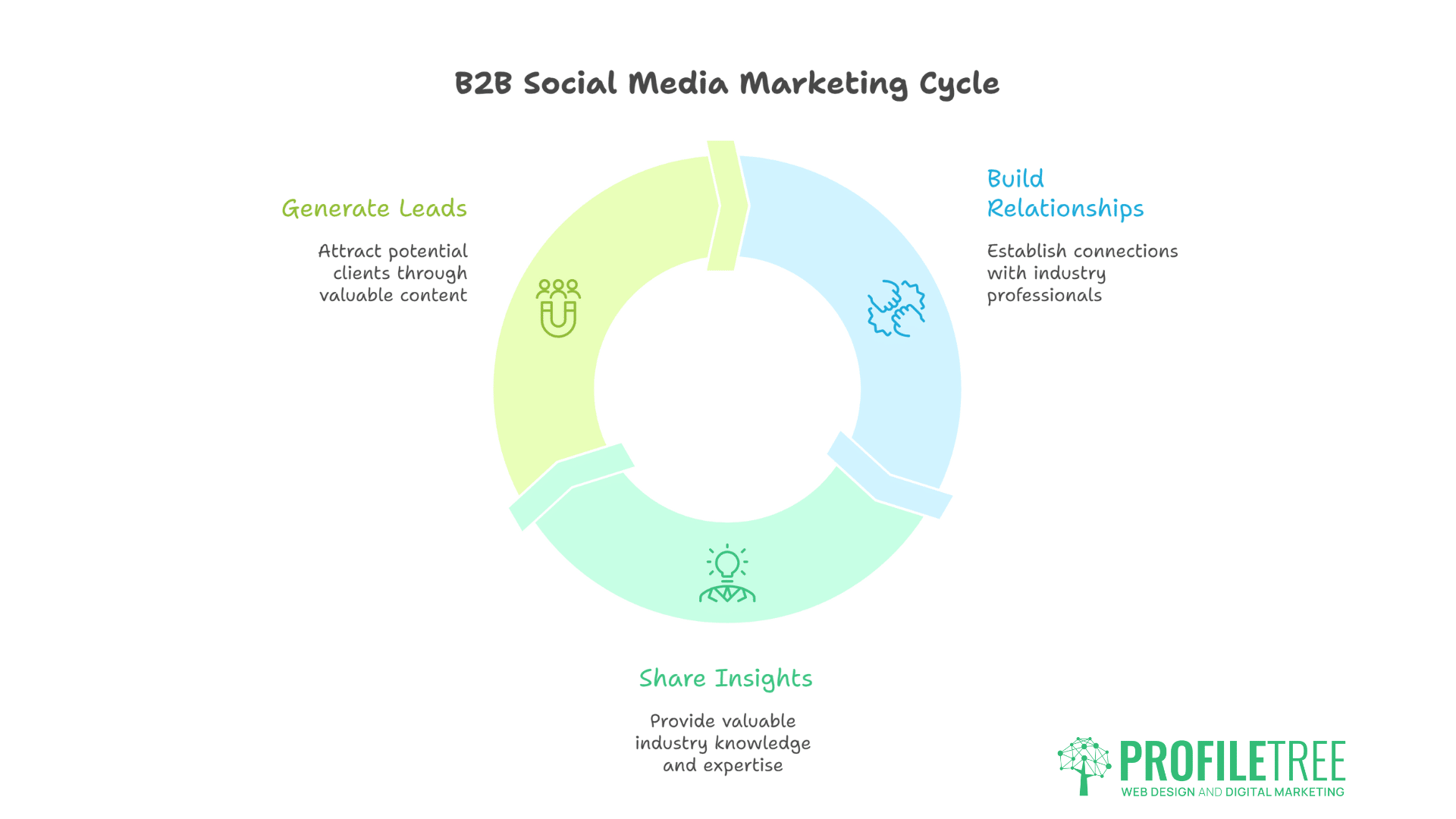
Social platforms serve different purposes in B2B compared to consumer marketing.
LinkedIn Dominates B2B Social
LinkedIn generates 80% of B2B social media leads, according to Oktopost research. The platform’s professional context makes it natural for business research and networking. Facebook and Instagram work for consumer brands but rarely drive B2B results.
LinkedIn posts with images receive 2 times more engagement than text-only posts. Despite being a professional network, visual content still captures attention more effectively than plain text. Sharing infographics, charts, or relevant imagery improves post performance.
Engagement Builds Authority
Consistent posting builds credibility. Companies publishing weekly on LinkedIn gain 2 times more engagement than those posting monthly, according to HubSpot data. Regular presence keeps your company visible when buyers begin research processes.
Thought leadership content performs better than promotional material on social platforms. Articles analysing industry trends or offering business insights generate more engagement than product announcements. A post examining “How Brexit Affects UK Manufacturing Supply Chains” attracts more interaction than “Our New Product Features.”
Advertising Reaches Decision-Makers
LinkedIn advertising allows precise targeting by job title, industry, and company size. This specificity matters for B2B marketing, where reaching procurement managers differs from reaching CEOs. LinkedIn reports that 65 million users are decision-makers at their companies.
Cost per lead on LinkedIn averages higher than other platforms, but targets more qualified audiences. A £5 cost per lead from LinkedIn users with relevant job titles at appropriate company sizes often converts better than £1 leads from Facebook’s broader audience.
Website Performance and Conversion
B2B websites must convert visitors into leads through clear user experiences.
Website Speed Affects Conversions
Google research shows that as page load time increases from 1 to 3 seconds, bounce probability increases by 32%. From 1 to 5 seconds, the bounce probability increases by 90%. These statistics apply particularly to B2B buyers who often research during work hours and lack patience for slow sites.
Website loading speed directly correlates with lead generation. Unbounce data indicates that 70% of consumers admit that page speed impacts their likelihood of making a purchase. For B2B buyers comparing multiple vendors, the fastest sites gain an advantage through pure user experience.
Clear Calls-to-Action Drive Conversions
HubSpot reports that personalised calls-to-action convert 202% better than generic versions. A button reading “Download Manufacturing Guide” outperforms “Click Here.” Specificity tells visitors exactly what happens next, reducing friction in the conversion process.
Above-the-fold placement of calls-to-action increases visibility. Visitors should see the clear next steps without scrolling. A services company hiding contact forms at page bottoms loses impatient prospects who bounce before finding how to engage.
Forms Balance Information Gathering with User Experience
Reducing form fields from 11 to 4 can increase conversions by 120% according to Omnisend research. Long forms deter busy professionals from completing requests. B2B companies must balance lead qualification needs against user convenience.
Multi-step forms convert 86% better than single-page forms according to Venture Harbour research. Breaking information requests into smaller chunks reduces psychological friction. A three-step process feels less burdensome than a single long form requesting identical information.
ProfileTree’s web development focuses on conversion optimisation for B2B clients. We build sites that load quickly, guide visitors towards clear actions, and streamline lead capture without overwhelming users.
Content Types That Perform
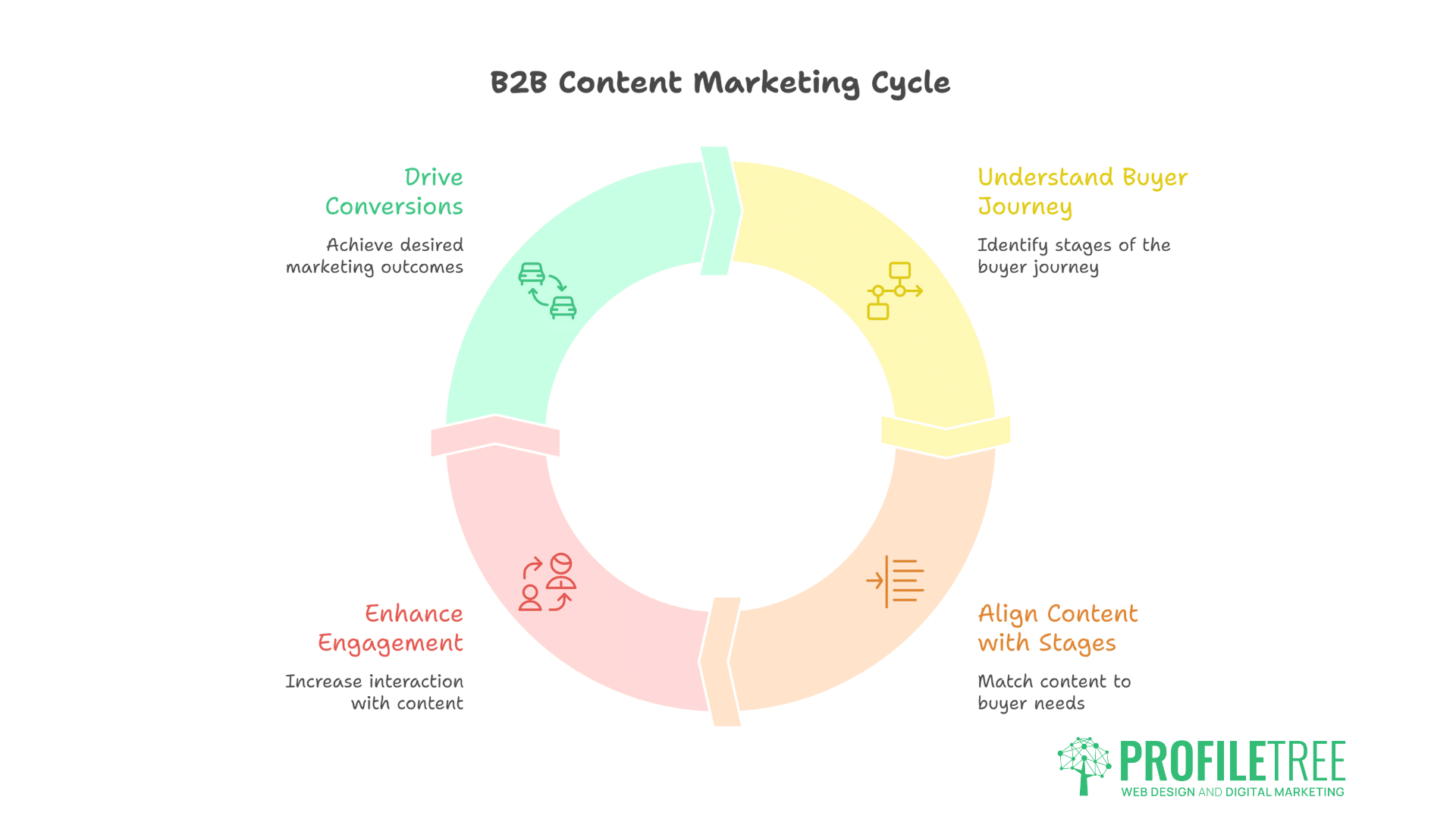
Different content formats serve different stages of the B2B buyer journey.
Case Studies Build Credibility
Demand Gen Report data shows that 78% of B2B buyers want to read case studies when researching purchases. Real examples of how companies solved problems provide proof that solutions actually work. Testimonials and success stories reduce perceived risk.
Detailed case studies that explain challenges, implementation, and results outperform brief customer quotes. A manufacturing company considering new equipment wants to understand the complete experience of similar businesses. Vague success claims lack the specificity that builds confidence.
Whitepapers Establish Expertise
73% of B2B buyers have used whitepapers when researching purchase decisions, according to KoMarketing research. These detailed documents suit complex B2B products where buyers need substantial information before engaging with sales teams.
Whitepapers work as lead magnets, capturing contact information from engaged prospects. Someone downloading a 20-page guide on “Warehouse Automation ROI Analysis” demonstrates serious interest worth sales follow-up. Generic newsletter signups indicate less buying intent.
Webinars Generate Qualified Leads
ON24 reports that 73% of B2B marketers and sales leaders say webinars are the best way to generate quality leads. Live presentations allow detailed product explanations whilst providing opportunities for audience questions. Recorded webinars extend content lifespan.
Average webinar attendance rates run between 40% and 50% of registrations. Registration alone indicates interest, whilst actual attendance signals serious consideration. Following up with attendees generates warmer conversations than cold outreach.
Marketing Automation and Technology
Technology enables personalisation and efficiency in B2B marketing.
Automation Improves Lead Nurturing
Businesses using marketing automation see a 451% increase in qualified leads according to The Annuitas Group research. Automated email sequences guide prospects through buying journeys without manual intervention. This efficiency matters for SMBs lacking large marketing teams.
Lead nurturing emails generate 4-10 times the response rate compared to standalone email blasts, according to DemandGen Report. Sequences that progressively provide relevant information keep prospects engaged over long sales cycles. A single promotional email gets ignored; a series of building knowledge creates relationships.
CRM Integration Aligns Marketing and Sales
Companies with aligned sales and marketing teams generate 208% more revenue from marketing, according to MarketingProfs’ research. CRM systems that track lead behaviour help sales teams prioritise follow-up and personalise conversations. Disconnected systems waste marketing-generated leads.
Businesses that use advanced lead scoring see 77% higher lead generation ROI, according to MarketingProfs. Scoring systems identify which prospects demonstrate serious buying intent based on website behaviour, email engagement, and content downloads. Sales teams contact hot leads first rather than treating all enquiries equally.
AI and Machine Learning Applications
71% of B2B marketers believe AI will improve campaign results, according to Salesforce research. Predictive analytics identify likely buyers, while AI-powered content recommendations personalise website experiences. These technologies scale personalisation beyond human capability.
Chatbots handle initial qualification conversations, answering basic questions whilst identifying serious prospects for human follow-up. Drift reports that companies using chatbots generate 10 times more sales appointments. Automated initial screening frees sales teams to focus on qualified conversations.
ProfileTree helps SMBs implement AI solutions that match their scale and needs. We focus on practical applications that improve marketing efficiency rather than technology for its own sake.
B2B Advertising Statistics
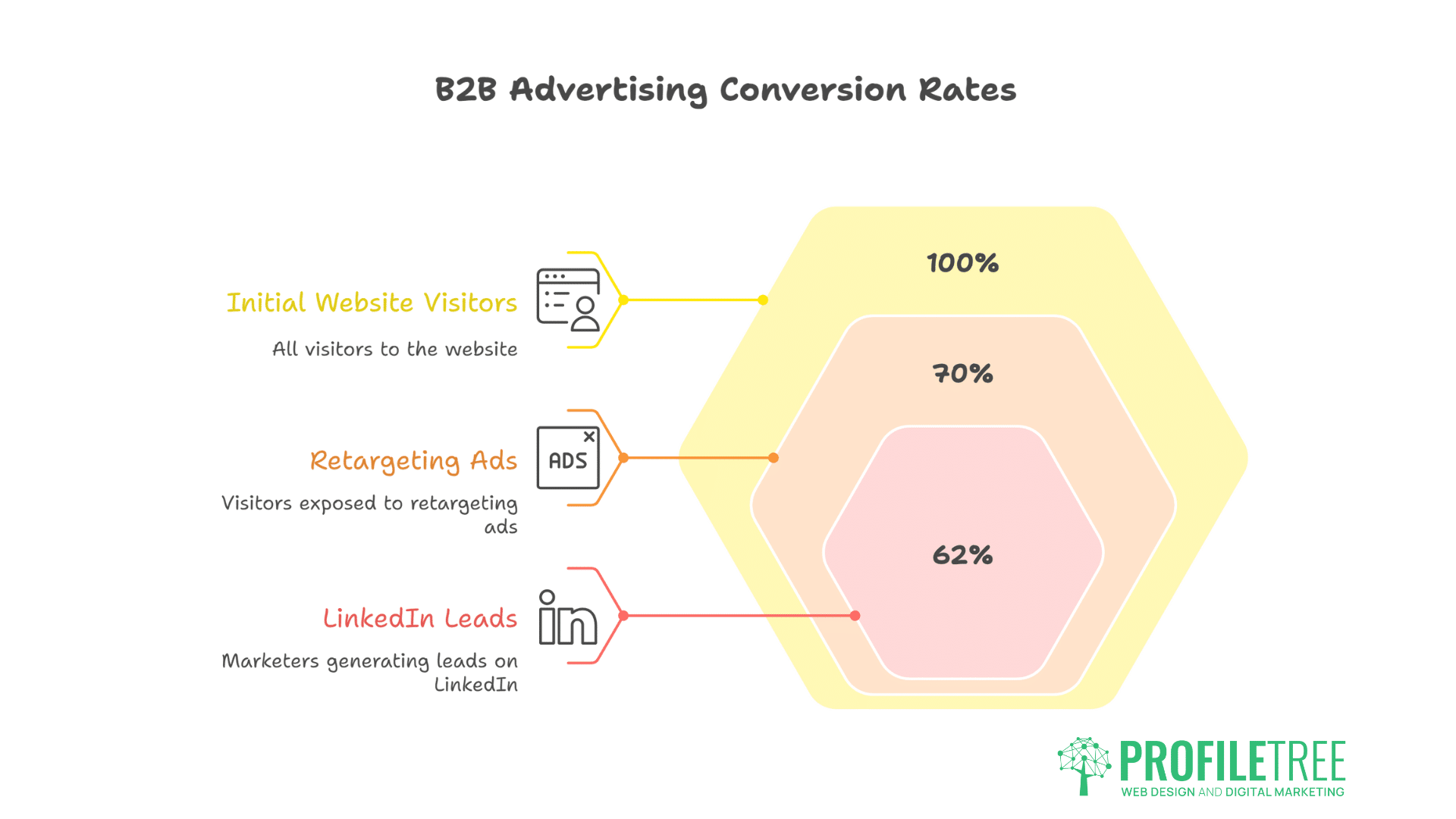
Paid advertising complements organic marketing when targeted appropriately.
Account-Based Marketing Shows Strong ROI
ITSMA reports that 87% of B2B marketers say account-based marketing delivers higher ROI than other marketing activities. Focusing resources on specifically identified high-value accounts generates better results than broad-based campaigns.
Personalised advertising to target accounts increases engagement rates by 8 times, according to Demandbase research. Generic ads waste impressions on unqualified audiences. Customised campaigns addressing specific companies or industries convert more efficiently.
Retargeting Increases Conversions
Website visitors exposed to retargeting ads are 70% more likely to convert, according to Criteo research. B2B buyers researching for weeks or months benefit from reminders. Retargeting keeps your company visible during extended consideration periods.
Sequential retargeting that changes messaging based on previous interactions outperforms static campaigns. Initial ads might build awareness, whilst subsequent ads offer case studies, and then finally promote consultations. This progression matches how buyers move through research stages.
LinkedIn Advertising Reaches Business Audiences
LinkedIn’s advertising platform reaches professionals that Facebook and Google cannot match. 62% of B2B marketers found LinkedIn generated leads through paid ads, according to HubSpot research. The platform’s targeting capabilities justify higher costs per click.
Sponsored content on LinkedIn sees 33% higher engagement than display ads on the platform. Native content that appears in news feeds receives more attention than obvious advertisements. Educational content performs better than promotional messages even in paid placements.
Mobile and B2B Marketing
Business professionals access content on mobile devices throughout their day.
Mobile Traffic Continues Growing
Google reports that 70% of B2B searches happen on smartphones. Business decision-makers research solutions on mobile devices during commutes, between meetings, and outside traditional office hours. Websites designed only for desktop computers lose the majority of potential visitors.
Mobile-friendly B2B websites convert 5 times better than non-optimised sites according to Google research. Simple adjustments like larger tap targets, readable text sizes, and simplified navigation dramatically improve mobile conversions. Complex desktop layouts fail on smaller screens.
Mobile-First Indexing Affects SEO
Google’s mobile-first indexing means rankings derive primarily from mobile site versions. B2B companies with poor mobile experiences rank lower regardless of desktop performance. Technical optimisation for mobile devices determines search visibility.
Pages that load in 5 seconds or less on mobile see 70% longer average sessions according to Google. Speed matters even more on mobile networks where connections vary. Optimising images, minimising code, and using content delivery networks improve mobile load times.
Measuring B2B Marketing Success
Tracking specific metrics allows continuous improvement and budget justification.
Lead Quality Matters More Than Quantity
Marketing Sherpa reports that 61% of B2B marketers send all leads directly to sales, but only 27% of those leads will be qualified. This disconnect wastes sales resources on unqualified contacts. Lead scoring and nurturing systems qualify prospects before sales engagement.
Companies with defined lead qualification processes generate 50% more sales-ready leads at 33% lower cost, according to Forrester research. Clear criteria for what constitutes a qualified lead focus marketing efforts on genuinely interested prospects.
Revenue Attribution Connects Marketing to Results
52% of B2B marketers track ROI for content marketing, according to Content Marketing Institute research. Attribution modelling shows which marketing activities generate actual sales rather than just traffic or enquiries. This data justifies marketing spend and guides budget allocation.
Multi-touch attribution provides a more accurate assessment than last-click models. B2B purchases involve multiple interactions across channels before closing. Crediting only the final touchpoint ignores earlier marketing that built awareness and trust.
Customer Lifetime Value Guides Strategy
Businesses focused on customer lifetime value grow revenue 1.6 times faster than those focused on acquisition alone, according to Bain & Company research. Retaining existing customers costs less than acquiring new ones. Marketing to current customers through upselling and cross-selling generates efficient growth.
Increasing customer retention by just 5% can increase profits by 25% to 95% according to Bain research. Long-term relationships with B2B customers generate predictable recurring revenue. Companies optimising for lifetime value rather than single transactions build more stable businesses.
Getting Professional B2B Marketing Support
Small and medium businesses often lack internal expertise to implement data-driven B2B marketing.
ProfileTree works with B2B companies across Northern Ireland, Ireland, and the UK to build marketing strategies based on these statistics rather than assumptions. Our digital strategy services connect your business goals to specific marketing tactics with measurable outcomes.
We help businesses implement content marketing programmes that generate qualified leads through SEO-optimised articles, case studies, and technical content. Our approach focuses on topics your potential customers actually search for rather than generic business content.
Our digital training programmes teach internal teams to interpret marketing data and make informed decisions. This builds capability within your organisation whilst providing expert guidance during implementation. Training covers practical skills like analysing website analytics, optimising conversion rates, and measuring campaign performance.
We work with B2B companies to build websites designed for lead generation rather than just information display. This includes conversion rate optimisation, clear calls-to-action, and user experiences that guide visitors towards contact without being pushy.
Conclusion
B2B digital marketing statistics reveal clear patterns about how business buyers research, evaluate, and purchase. Companies that align their marketing with these behaviours outperform those operating on assumptions about what should work.
The data shows that content marketing, SEO, and email deliver the strongest ROI for B2B companies. Social media matters primarily through LinkedIn rather than consumer platforms. Long sales cycles require sustained nurturing through multiple touchpoints. Mobile optimisation affects both user experience and search rankings.
UK small and medium businesses can compete effectively by making data-informed decisions about where to invest limited marketing resources. Statistics provide clarity about which channels and tactics generate actual business results rather than just activity metrics.
ProfileTree helps B2B companies across Northern Ireland, Ireland, and the UK implement marketing strategies backed by data rather than trends. Whether you need a comprehensive digital strategy or specific services like SEO, web development, or content creation, we focus on measurable outcomes that drive business growth.