
Content Strategy for Niche Markets: A UK and Irish SME Guide
Table of Contents
Broad content rarely wins in competitive search. When every major brand is publishing general marketing advice, the businesses that cut through are those speaking directly to a defined audience about problems only that audience faces. A focused content strategy for niche markets does exactly that: it trades volume for precision and uses specificity as the primary ranking advantage.
This guide covers how to identify and research a niche audience, build a content framework that outperforms generalist competitors, use AI tools to find genuine information gaps, and measure whether the investment is paying off. It also addresses the questions most US-centric guides ignore: how UK and Irish regulations shape content decisions, and whether niche content actually costs more to produce than broad campaigns.
Each section below maps to a phase of the process, from the first audience definition through to community retention and ROI measurement.
Understanding Niche Content Strategy
A niche content strategy is a concentrated approach to publishing that targets a specific market segment rather than the broadest possible audience. The aim is relevance over reach: lower traffic volumes, higher conversion rates, and stronger brand authority within a defined space.
The distinction matters because Google’s ranking systems now reward genuine topical authority. Pages covering multiple sub-questions within a topic are significantly more likely to appear in AI Overviews than pages offering shallow coverage of broad topics. Niche content, by its nature, tends to be specific and self-contained: two properties that make it easier for AI systems to extract and cite.
Mass Marketing vs Niche Content: Understanding the Trade-Off
The table below sets out the key differences between a broad content approach and a niche one. The figures are indicative UK benchmarks; the relative relationships between them are well-established across digital marketing research.
| Metric | Broad Strategy | Niche Strategy |
|---|---|---|
| Average CPC (Google Ads) | £2.50–£5.00 | £0.80–£2.00 |
| Typical conversion rate | 1–2% | 4–8% |
| Content lifespan | 6–12 months before refresh | 18–36 months with minor updates |
| Community loyalty | Low (broad audience, low attachment) | High (shared identity, repeat visits) |
| Cost per acquisition (organic) | Higher (competes with large budgets) | Lower (less competition, better targeting) |
All prices and figures in this guide are indicative UK examples and correct at the time of writing; use them as a benchmark rather than fixed quotations.
The Economics of Information Asymmetry
The most durable advantage in niche content is information asymmetry: you explain things your audience cannot find explained clearly elsewhere. This is not about writing longer articles. It is about covering angles that general-interest publishers have no commercial reason to address.
A food safety consultant writing for SME restaurant owners can cover allergen labelling under UK Regulation (EU) No 1169/2011 in a way that a generic food blog never would. That specificity makes the content genuinely useful, difficult to replicate, and far more likely to be cited when a reader is making a real decision. Mass-market content, by contrast, tends toward the obvious because obvious content is quick to produce at scale.
Why Specificity Is Now a Financial Necessity for SMEs
AI-generated content has commoditised generic marketing advice. If a piece could have been written by any brand in any sector with a five-word prompt, it is competing with millions of similar outputs. For SMEs with limited production budgets, trying to match the content volume of large publishers is a losing strategy.
The alternative is depth over breadth. A single well-researched guide covering a specific problem for a specific audience can outperform dozens of general posts, both in organic rankings and in the AI citation systems that are increasingly driving commercial traffic.
Building Your Niche Content Framework Step by Step
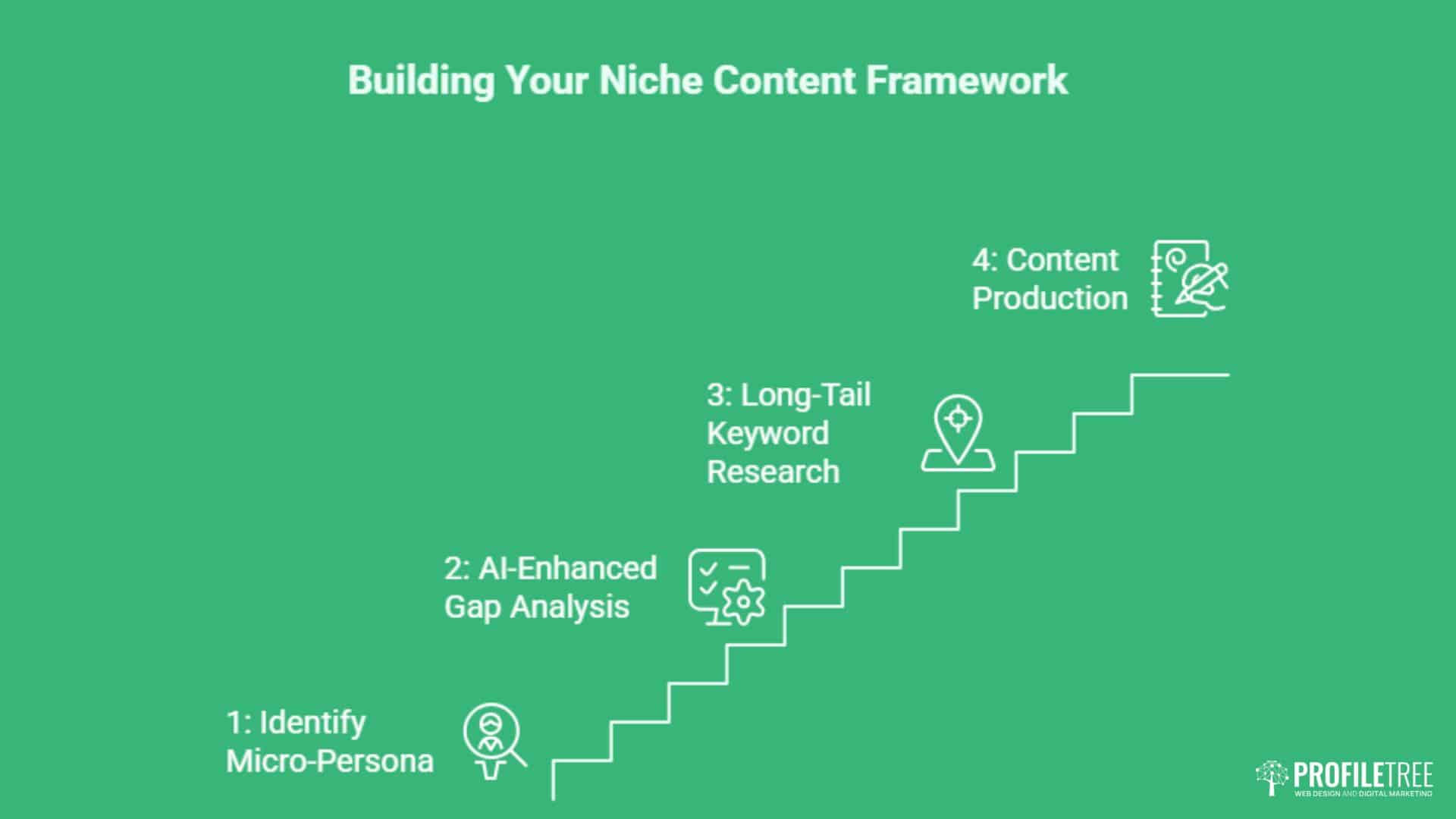
A framework gives your content strategy structure and repeatability. Without one, niche content tends to drift: articles start strong on a specific topic, then gradually broaden to chase traffic, losing the precise positioning that made them worth reading. The four phases below are sequential. Each one depends on the outputs of the one before it.
Phase 1: Identifying the Micro-Persona
A micro-persona is a tightly defined version of your target reader that goes beyond broad demographics. Rather than “marketing managers aged 25–45,” a micro-persona might be “a marketing manager at a UK B2B engineering firm with 20–80 staff who handles content strategy without a dedicated team and is trying to justify content spend to a non-marketing director.”
That level of specificity shapes every content decision that follows: the topics you cover, the vocabulary you use, the objections you address, and the formats that work. Producing interactive content formats such as self-assessment tools or calculators tends to perform well with micro-personas because it gives readers something personalised that a general article cannot provide.
To build a micro-persona accurately, start with direct sources: sales call recordings, support tickets, LinkedIn comments in relevant industry groups, and feedback from existing customers. Secondary sources like industry association surveys and sector-specific trade publications fill in gaps. Avoid inferring the persona entirely from website analytics; the data shows you who is visiting, not necessarily who you most want to reach or who converts at the highest rate.
Phase 2: AI-Enhanced Gap Analysis
Most niche keyword research stops at long-tail phrase volume. AI-enhanced gap analysis goes further: it uses large language models to surface the questions that exist within a niche but have not yet been clearly answered anywhere.
The method works as follows. Take a core topic in your niche and prompt an LLM to generate the questions a genuine expert in that field would ask that a beginner guide would not answer. Then cross-reference those questions against existing indexed content using a standard search. Where search results are thin, contradictory, or dominated by non-specialist sources, you have found a genuine gap.
For example, a specialist in sustainable packaging for UK food manufacturers might find that plenty of content covers general recyclability claims, but almost nothing addresses how to write compliant marketing copy under the Green Claims Code published by the Competition and Markets Authority. That gap represents both a ranking opportunity and a genuine service to the audience.
Understanding the full scope of content creation for a niche audience means going beyond volume metrics to map the terrain of unanswered questions. The gaps are where authority is built.
Phase 3: Long-Tail Keyword Research for Specificity
Long-tail keywords are the practical output of your gap analysis. They are typically three to six words, low in monthly search volume individually, and highly specific in intent. For a niche strategy, this is a feature rather than a limitation: the searcher using a seven-word query knows exactly what they want, and a page that answers it precisely will convert far better than one targeting a two-word head term shared with thousands of competing pages.
The research process for a niche differs from broad keyword work. Standard volume tools will often show zero or negligible search volume for niche terms, which does not mean those queries do not happen. It means the sample size is too small for the tool to detect reliably. People Also Ask, industry forum threads, Reddit communities, and LinkedIn posts within your target sector are often more reliable sources of real niche language than any keyword platform.
Once you have identified your target phrases, map each one to a specific page. One URL per distinct question or topic cluster. Trying to answer multiple specific questions on a single page dilutes the topical signal and makes it harder for search engines to classify the content accurately.
Phase 4: Content Production at Depth, Not Volume
The output from Phases 1 through 3 tells you what to write. Phase 4 is about how to write it well enough to matter. For niche audiences, the quality of reasoning counts more than production polish. A reader who is genuinely expert in their field will notice when an article contains a generalisation that does not hold in their specific context, and they will not return.
Every piece should pass what might be called the “expert test”: could this article have been written by someone without specialist knowledge of this niche? If the answer is yes, it needs more depth. Practical detail, real constraints, sector-specific terminology used accurately, and acknowledgement of genuine trade-offs are the signals that tell an expert reader you understand their world.
For ProfileTree clients, this often means involving subject matter experts from the client’s team in the content process, even for a single interview or document review. The resulting articles carry a level of operational accuracy that generic content production cannot match.
Navigating the UK and Irish Niche Landscape
Most content strategy guides are written from a US perspective and treat regulatory compliance as a footnote. For UK and Irish businesses operating in regulated niches, compliance is not peripheral: it directly shapes what you can claim, how you must phrase it, and what evidence you need to hold before publishing. Getting this wrong is not just an editorial problem; it can attract enforcement action from sector regulators.
Regional Search Intent and Cultural Nuances
UK and Irish audiences search differently from their US counterparts on several niche topics. Healthcare audiences in the UK are far more likely to search for NHS pathways and NICE guidelines than for private insurance structures. Property audiences in Northern Ireland require content that reflects the distinct legal framework that operates under both UK and, in certain contexts, Irish regulatory influence.
Even for apparently universal topics, regional languages differ. “Solicitor” rather than “attorney,” “letting agent” rather than “realtor,” “payslip” rather than “pay stub.” These are not cosmetic differences; they affect whether your content matches the exact phrasing your audience uses, which affects whether it ranks for the queries they type.
For businesses targeting audiences across Northern Ireland and the Republic of Ireland, the Northern Ireland Protocol and its trade implications add a further layer of complexity to any niche content touching on cross-border commerce, regulations, or professional services. Cities such as Belfast, Derry, and Dublin each carry distinct commercial and regulatory contexts; the range of industries and communities across Northern Ireland is far broader than generalist content typically acknowledges.
Regulatory Compliance in Niche Sectors
Regulated sectors require content that stays on the right side of sector-specific rules. The table below maps several common UK and Irish niches to the governing bodies that affect content claims.
| Sector | Governing Body (UK/Ireland) | Key Content Implication |
|---|---|---|
| Financial services | FCA (UK) / Central Bank of Ireland | Promotions must be fair, clear and not misleading; disclaimers required |
| Healthcare / medical | MHRA / HIQA (Ireland) | Cannot make efficacy claims without evidence; NICE guidelines inform framing |
| Legal services | SRA / Law Society of Ireland | Referral arrangements and fee transparency rules affect CTAs |
| Food and nutrition | FSA / FSAI | Vague sustainability claims (“eco-friendly,” “sustainable”) require substantiation. |
| Engineering / construction | Engineering Council / Engineers Ireland | Competency and qualification claims must be accurate and verifiable |
| Environmental claims | CMA (Green Claims Code) | Vague sustainability claims (“eco-friendly,” “sustainable”) require substantiation |
For SMEs, the practical implication is that a legal review of content templates in regulated niches is not optional. The ASA’s CAP Code applies to digital content that makes advertising claims, even when that content sits on an editorial blog rather than a dedicated ad page. Working with an agency that understands this distinction can prevent costly corrections after publication.
GDPR and Audience Data in Niche Content
Niche strategies often rely on email lists, community platforms, and direct audience relationships more heavily than broad content approaches do. This makes GDPR compliance particularly relevant. Consent mechanisms, data retention periods, and the use of third-party tracking tools all need to align with UK GDPR (as retained in domestic law post-Brexit) and, for audiences in the Republic of Ireland, with the EU GDPR as enforced by the Data Protection Commission.
The ethical and legal dimensions of digital marketing are often where compliance gaps first appear in niche content programmes, particularly when audience data is used for personalisation at scale.
Beyond the Blog: Community-Led Growth in Niche Markets
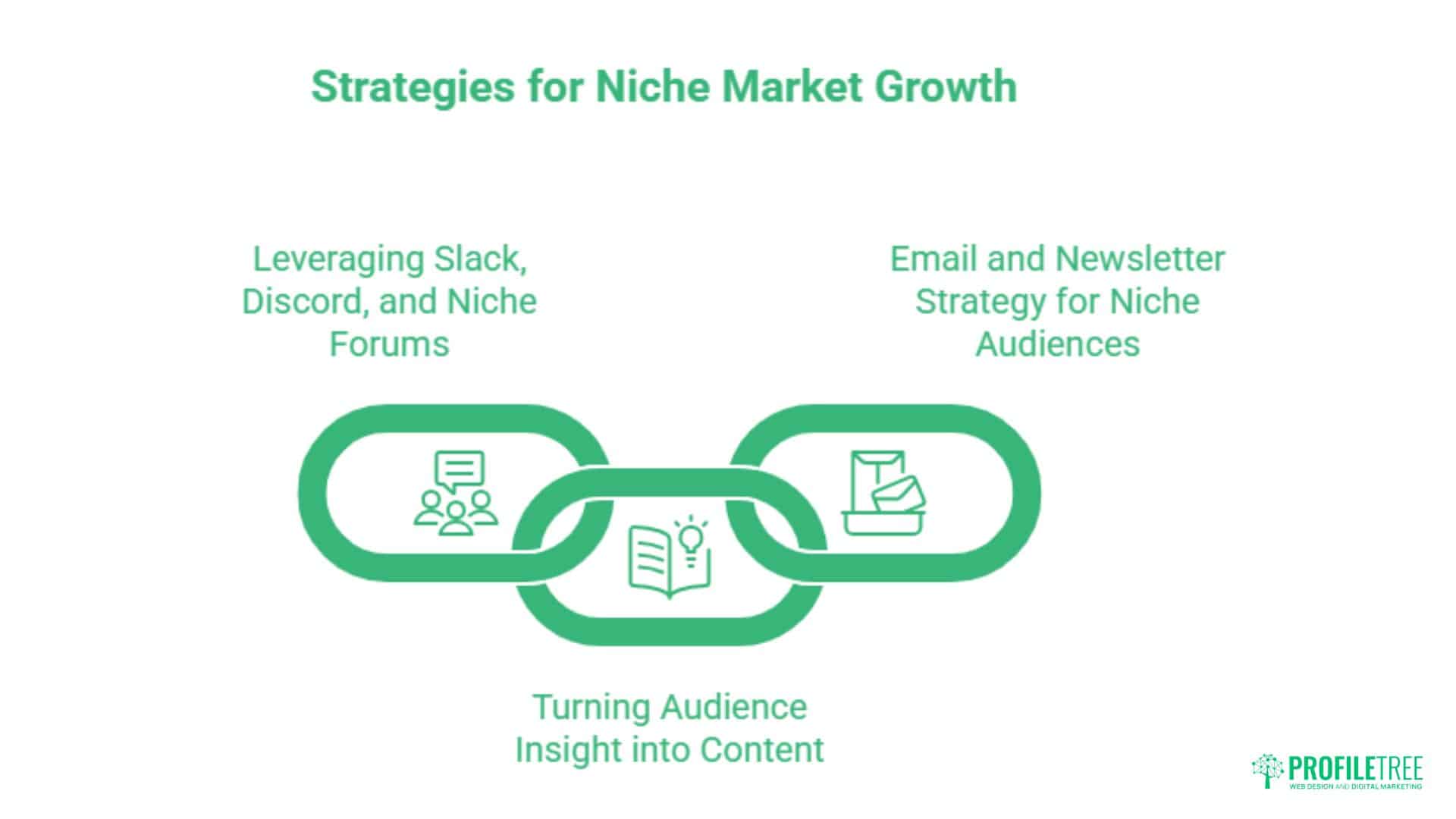
Published content drives traffic. Community retains it. Most niche content strategies stop at the blog post or the social media update, but the audiences most worth reaching in specialist markets are often already gathered in places that are not indexed by search engines at all: private Slack groups, Discord servers, LinkedIn communities, sector-specific forums, and industry association networks.
Community-led growth treats these spaces as both a research resource and a distribution channel. Being genuinely present in the communities your micro-persona inhabits, contributing answers, flagging useful resources, and sharing original data builds the kind of brand recognition that makes a cold reader far more likely to engage when they do encounter your published content.
Leveraging Slack, Discord, and Niche Forums
The practical starting point is identifying where your target audience already gathers and what they talk about there. For B2B niches, LinkedIn groups and industry association forums tend to be most active. For technical niches, Discord servers and GitHub discussion threads often carry more signal. For consumer niches, subreddits, Facebook Groups, and specialist forums remain valuable despite the general decline of open social platforms.
The content opportunity within these spaces is not direct promotion. Answering a detailed question in a specialist forum thread with genuine expertise, then linking to a fuller guide where appropriate, drives highly qualified traffic from readers who already trust the context in which they found the link. This is a more reliable quality signal than most paid acquisition channels.
Building community engagement through social media is one route into these networks, but it requires a consistent presence rather than periodic campaigns. A brand that shows up in a community only when it has something to promote is read as promotional. A brand that answers questions accurately over time earns editorial authority that is very difficult to purchase.
Turning Audience Insight into Content
Community participation generates something more valuable than backlinks: direct visibility into what your audience finds confusing, contentious, or underserved by existing content. A recurring question in a specialist forum is a validated content brief. A debate that keeps resurfacing points to a topic where the established consensus either does not exist or is not trusted.
Feeding these observations back into your content plan closes the loop between Phase 1 (micro-persona definition) and ongoing production. The micro-persona is never static; it evolves as the market evolves and as your understanding of it deepens through active participation.
Consistent brand storytelling across both published content and community spaces builds the entity associations that search engines and AI citation systems use to understand what a brand represents and who it serves.
Email and Newsletter Strategy for Niche Audiences
For niche markets, email remains one of the most effective retention mechanisms. Subscribers who have opted into a specialist newsletter are a self-selecting audience: they have already indicated that your specific perspective on a specific topic is worth their inbox space. That signal is commercially significant.
A niche newsletter does not need to be long or frequent to be effective. A fortnightly digest of three or four tightly curated observations, practical frameworks, or original data points will outperform a weekly send of repurposed blog summaries. The quality bar must match the specificity of the audience; niche readers notice when content is padded, and they unsubscribe quickly when it is.
Measuring Success and ROI in a Small Market
One of the most frequently asked questions about niche content is whether the investment is justified given the lower traffic volumes involved. The answer depends on which metrics you are tracking. Niche content programmes that are evaluated on raw session counts will always appear underperforming relative to broad content. Evaluated on cost per acquisition, conversion rate, and average deal value, the picture is often reversed.
Key Metrics for Niche Content Performance
Standard traffic metrics are necessary but insufficient for niche evaluation. The metrics that matter most in a specialist market are those that connect content engagement to commercial outcomes. The following set covers the most reliable indicators.
Organic conversion rate by landing page tells you which pieces of content are actually influencing decisions, not just attracting visits. In niche markets, a page with 300 monthly sessions and a 6% conversion rate is worth more than one with 3,000 sessions and a 0.4% rate. Tracking this at the page level, rather than the site level, reveals which topics and formats your audience values most.
Time on page and scroll depth indicate whether readers are engaging with the content or bouncing. Niche audiences with genuine interest will read thoroughly; high time on page combined with low bounce rate is a reliable signal that the content is meeting a real need. Conversely, a high-ranking page with poor engagement metrics is often one that matches a search query without delivering on what the reader actually wanted.
Branded search volume over time is one of the strongest indirect signals of content programme effectiveness. When readers encounter your content repeatedly in their specialist communities, they begin searching for your brand directly. Growth in branded query volume over a six-to-twelve-month content programme is a reliable indicator that authority is building.
Adjusting Strategy Based on Performance Data
Niche content programmes benefit from shorter feedback loops than broad content strategies. Because the audience is smaller and more defined, changes in engagement are easier to attribute. A topic that consistently generates newsletter replies, community comments, or direct enquiries is telling you something about what your micro-persona values that aggregate analytics cannot.
Using customer feedback to shape your content strategy is a practical method for keeping a niche programme aligned with genuine audience needs rather than assumed intent. What readers engage with in a community forum often differs significantly from what keyword tools suggest they are searching for.
Review performance quarterly rather than monthly. Niche content builds authority gradually; a piece published in January may not show meaningful search traction until March or April as it accumulates links, engagement signals, and indexation coverage. Monthly reviews can produce premature conclusions about what is and is not working.
Answering the Cost Question
Niche content costs more per piece to produce than generic content. The research depth, subject matter expertise, and compliance checking involved in specialist writing are real costs that a 500-word general post does not incur. The question is whether the total programme cost per conversion justifies the investment, not whether each article is cheap to produce.
Given that niche audiences convert at significantly higher rates than general traffic, the cost per acquisition from niche content can be considerably lower than from broader campaigns, even when the per-article production cost is higher. The long content lifespan of well-researched niche pieces (18 to 36 months before requiring significant updates) also improves the return calculation substantially relative to trend-chasing content that becomes obsolete within weeks.
The digital marketing strategy considerations that apply to investor-facing communications are closely related: both require building credibility with a defined, sceptical audience rather than broadcasting to the widest possible group.
Conclusion
A content strategy for niche markets succeeds when it is built on genuine audience knowledge, structured research, and consistent presence in the spaces where that audience already gathers. The businesses that win in specialist sectors are not those publishing the most content, but those publishing the most useful content for a defined group of readers.
If you are ready to build a niche content programme that ranks, converts, and retains, talk to ProfileTree’s content team about how to get started.
FAQs
What is a niche content strategy?
A niche content strategy is a focused approach to publishing that targets a specific, well-defined segment of a market rather than a broad general audience. It prioritises depth, relevance, and specialist accuracy over volume, with the aim of building genuine authority within a defined topic area. Higher conversion rates and stronger audience retention are the usual commercial outcomes.
How do you find your niche if you operate in a broad industry?
Start by mapping which sub-segments of your existing audience have the highest conversion rates or the strongest retention. Look for intersections between what you deliver well and what your audience consistently finds underserved by general content. Industry forums, sales call patterns, and direct customer interviews tend to surface these gaps more reliably than keyword volume tools alone.
How do you write content for a very small audience without losing ROI?
The ROI calculation for niche content should be based on conversion rate and average deal value, not traffic volume. A page with 400 monthly sessions and an 8% conversion rate outperforms one with 8,000 sessions and a 0.3% rate on almost every commercial metric. Produce fewer pieces but to greater depth, and measure performance over a six-to-twelve-month horizon rather than monthly.
Is niche marketing more expensive than broad marketing?
Individual pieces of niche content typically cost more to produce because they require subject-matter expertise, accurate sector-specific knowledge, and, often, compliance review. However, the cost per acquisition from niche content is usually lower than from broad campaigns, because conversion rates are higher and the content lifespan is longer.
Which tools are best for niche keyword research?
Standard keyword platforms (Ahrefs, Semrush, Google Search Console) are useful for identifying search volumes and competitor gaps, but often undercount niche queries because sample sizes are too small to be reliably detected. Supplement these with People Also Ask analysis, Reddit and LinkedIn community threads, industry forum monitoring, and direct audience interviews.