
Content Marketing for Financial Institutions: UK and Ireland
Table of Contents
Content marketing for financial institutions asks more of a marketing team than almost any other sector. Finance brands have to teach a sceptical audience, prove they can be trusted, and stay inside strict UK rules, all at the same time. Advice written for retail or travel brands rarely survives contact with a compliance officer.
This guide sets out how financial services content marketing actually works in the UK and Ireland. It covers the regulatory picture, a sign-off workflow that keeps legal teams onside, the formats that earn rankings and AI citations, and a way to measure return that holds up over a long sales cycle.
Read on for a practical approach built for banks, wealth managers, fintech firms and financial advisers who want content that performs without creating risk.
Why Content Marketing Works for Financial Brands
Trust decides most financial buying decisions. Someone choosing a mortgage broker, a business bank or a wealth manager is weighing a choice with real personal or commercial stakes. Content marketing for financial institutions speaks to that hesitation directly, building credibility through useful information long before a sales call happens. Three forces make this work: the trust gap, the compounding value of organic content, and the rise of AI search.
The Trust Problem in Financial Services
Financial products are hard to compare and easy to get wrong, so buyers move slowly. A reader searching for what happens to a pension when they change jobs is not ready to buy. They are trying to understand their own position.
Content that meets the reader at the research stage, answers the question plainly, and shows a real grasp of UK pension rules does more commercial work than any product page. This is often where ProfileTree starts with finance clients, using plain-language guides to build financial literacy before a single product is mentioned.
Compounding Returns From Organic Content
That patience pays off in a way paid media cannot match. A guide to pension consolidation published today can still bring in qualified enquiries two years from now, with no extra spend. A paid search campaign stops producing the moment the budget runs dry.
Long-form articles on a well-structured site build organic traffic that grows over time. For finance brands, where one client can be worth thousands of pounds across their lifetime, that slow compounding is the strongest argument for treating content marketing services as an asset rather than a cost.
How AI Search Changes the Stakes
Search itself is shifting. Google AI Overviews, ChatGPT, Perplexity and Gemini now send real referral traffic, and they pull answers from a small set of sources. Pages that cover several sub-questions of a topic are far more likely to appear in an AI Overview, according to Ahrefs research.
For a query like how to choose a stocks and shares ISA, an AI citation places a brand at the very start of the buying journey. Finance brands that rank well in traditional search tend to earn those citations too, because the two now move together.
For finance brands, this raises the cost of being absent. If a competitor is cited in an AI answer about pension transfers or business lending, they shape the reader’s understanding before your brand appears. Structuring content around clear questions, direct answers and supporting data is now the surest way to stay in that consideration set.
The UK and Ireland Regulatory Picture
This is where finance content differs from every other sector. The Financial Conduct Authority’s rules on financial promotions reach across blogs, social posts, newsletters and video. Knowing where the line sits is the starting point for any content strategy for financial services, not a final check handed to legal at the end. None of what follows is legal advice, but it should shape how a marketing team plans.
FCA Financial Promotion Rules Explained
Under FCA rules, any content that counts as a financial promotion must be fair, clear and not misleading. For a marketer, those three words shape every brief. Fair means balance: describe an upside, and you give equal weight to the risk. Clear means plain English over jargon. Not misleading means every claim is realistic and backed by evidence.
That test reshapes planning. A title promising the five best ISAs for maximum returns fails it. A guide on how to compare ISAs by risk, access and returns passes, and serves the reader better. Building financial services compliance into planning from the first brief saves painful rewrites later. The table below shows how the level of sign-off usually rises with how close a piece sits to a product.
| Content type | Likely a financial promotion? | Typical sign-off |
|---|---|---|
| Educational explainer, no product named | Unlikely | Marketing review |
| How to choose or a comparison guide | Possibly | Marketing plus compliance |
| Named product with returns or benefits | Yes | Full compliance sign-off |
| Social post linking to a product | Yes | Full compliance sign-off |
Consumer Duty and Content Clarity
The UK’s Consumer Duty raised the bar again. It expects firms to help customers make good decisions and to avoid foreseeable harm, which reaches into how content explains a product. A blog post that walks a reader through a decision now sits inside that duty, not outside it.
In practice, this rewards the same habits good financial content marketing already values: clarity, honesty about limits, and real usefulness. Firms that were already writing to teach rather than to sell had far less to change.
Working Across the Irish Border
Brands operating in Northern Ireland and the Republic face two regimes at once. Content aimed at both audiences has to respect FCA standards and the Central Bank of Ireland’s rules, and to handle currency, tax and terminology differences without confusing either reader.
A current account in Belfast and a current account in Dublin are not the same product, and content that blurs the two loses trust fast. Getting cross-border compliance right is part of why ProfileTree works with finance clients across both markets. Brands that understand the Northern Ireland cities they serve tend to produce content that feels local rather than generic.
Building a Compliance-First Content Workflow
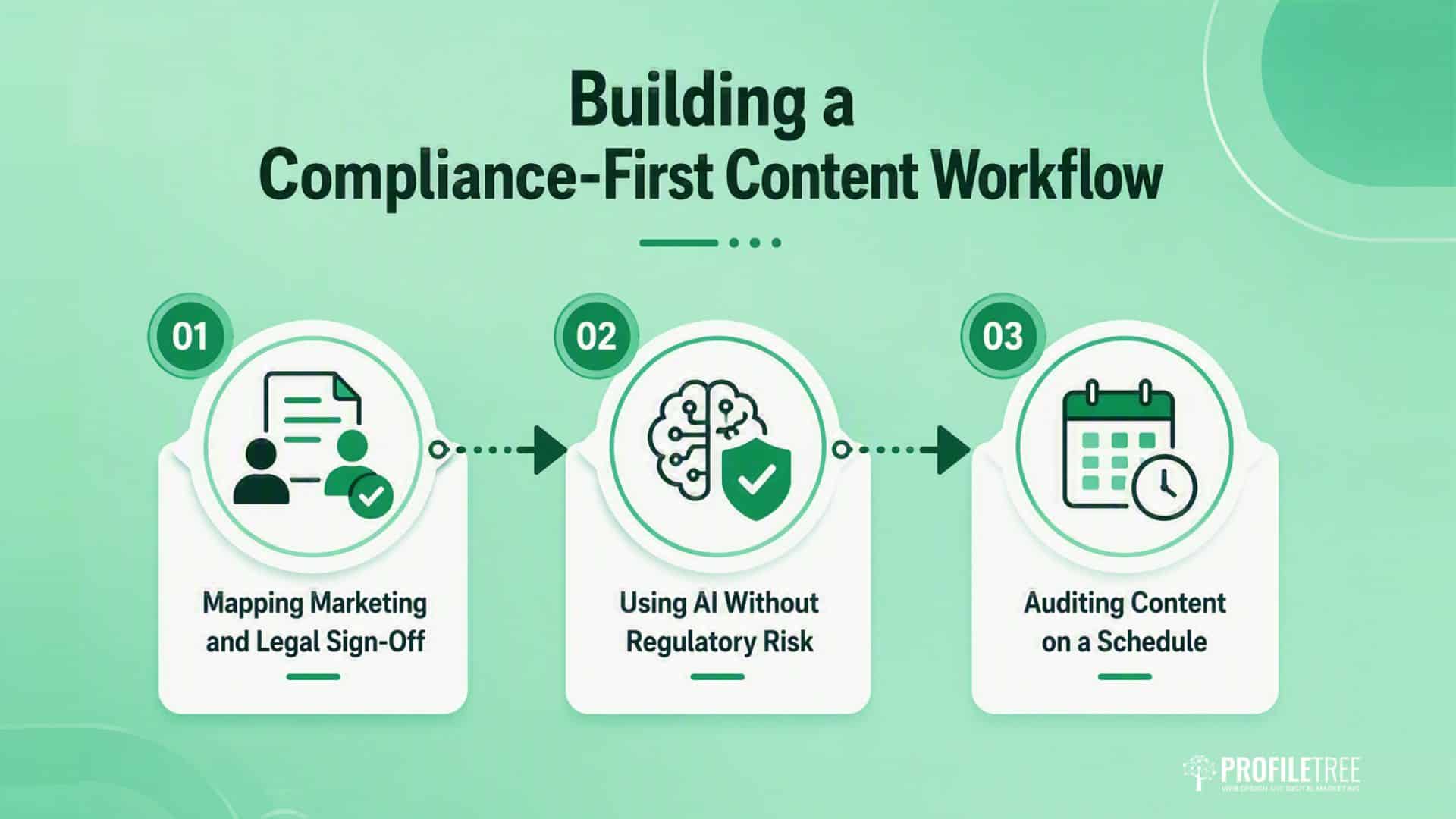
A documented approval process is the single most important structural piece of a compliant content operation. It protects the firm, and it stops good ideas dying in a vague back-and-forth with legal. The aim is a workflow that treats compliance as a design input, not a bolt-on at the end.
Mapping Marketing and Legal Sign-Off
Every piece should pass at least two reviewers: one checking marketing effectiveness and clarity, one checking the content against FCA guidelines. Run it in order. A writer drafts, a marketing manager reviews for clarity and brand fit, a qualified person reviews for regulatory compliance, and then a final approval before publishing.
Document each step. If the regulator ever queries a firm’s content activity, a clear audit trail is the first line of defence. Treating compliance content strategy as a repeatable process, rather than a fresh negotiation each time, is what lets a finance team publish at any real pace.
Using AI Without Regulatory Risk
AI tools can speed up research and drafting, but they raise two risks in a regulated setting. The first is accuracy: models invent figures and misstate rules, so a subject matter expert has to sign off on every factual claim. The second is data: client details and unpublished results should never be pasted into a public model.
A human-in-the-loop workflow answers both. Use AI for structure and first drafts, keep sensitive data out, and route everything through the same compliance review as any other content. Teams that want to use these tools well often start with structured AI training, and some handle routine reader questions through compliant AI chatbots rather than free-text tools.
Auditing Content on a Schedule
Rules change, products close, and figures date. A guide that was compliant a year ago can quietly drift out of line. A fixed review cycle, at least annually and after any major regulatory change, keeps the back catalogue safe.
An audit is also a content opportunity. Refreshing an older guide with current rules and new examples signals freshness to both search engines and AI systems, which favour recently updated pages. The same pass can strengthen internal links and fix anything that no longer reads clearly.
Ciaran Connolly, founder of ProfileTree, puts it plainly: “Financial brands that treat content as a cost rather than an asset miss the compounding nature of the investment. A guide that ranks for 40 related queries and brings in two qualified leads a month, every month, is worth more than a paid campaign that runs for six weeks and stops. The measurement has to reflect that, or the spend never gets made at scale.”
Content Formats That Earn Attention and Citations
Not every format that works in retail transfers to finance. High scepticism, complex subject matter and strict rules reward depth, clarity and formats that let a reader absorb detail at their own pace. Four formats do most of the heavy lifting for finance content marketing.
The right format choice often depends on where a reader sits in their decision. Someone early in research wants a plain-language guide they can scan; someone comparing providers wants tables and worked examples; a business client weighing a large commitment responds better to expert-led video or a webinar. Matching format to intent matters as much as the topic itself. It also shapes how well a piece performs in AI search, since different systems favour different structures.
A guide with clear headings extracts cleanly into an AI Overview, while a data table earns citations that a paragraph never would. Choosing deliberately, rather than defaulting to the blog post, is what separates content that compounds from content that simply fills a calendar.
Long-Form Guides and Search Visibility
Long-form guides are the most reliable format for financial content marketing. A well-researched piece on pension drawdown, business finance options or investment structures can rank for dozens of related queries and serve readers at several stages at once.
Structure matters as much as length. Put the main answer in the first paragraph rather than after a slow build. Time-pressed finance readers leave pages that do not quickly show they hold the answer. Strong technical foundations help, too, so pairing content with SEO services keeps those guides indexed and ranking.
Video Explainers for Complex Products
Video is underused in finance and rewards the brands that commit to it. A clear explainer on how compound interest works or what happens during a mortgage application reaches people on YouTube who would never find the same answer through text search.
A named expert on camera builds the kind of person entity that Google’s author signals and AI citation systems both reward. This is why ProfileTree treats video marketing as a serious channel for finance clients rather than an occasional extra.
Data, Tables and Visual Summaries
Complex figures become far easier to grasp when shown rather than described. A table comparing ISA types or a visual guide to a mortgage application serves readers who are not confident with financial language, and it earns links from other publications.
This also helps with AI visibility. Content with tables is cited more often in AI answers, and statistics tend to earn higher citation rates than qualitative claims. Well-designed visuals inside a long guide do double duty, for readers and for machines.
Podcasts and Webinars for Professionals
For brands targeting business clients or sophisticated investors, podcasts and webinars suit longer-form expertise. A monthly show where senior advisers discuss market conditions or regulatory change positions the firm as a real voice, not a content factory.
These formats also build word-of-mouth that never shows in standard analytics but drives warm enquiries, which matters most in wealth management and corporate finance, where referral still leads. Guides that teach readers, such as ProfileTree’s work on financial education platforms, can feed straight into a podcast or webinar series.
Measuring Content Marketing ROI in Finance
Measuring return on finance content means looking past raw traffic. Traffic is necessary but not the point. The real question is whether content generates qualified leads, supports client acquisition and lowers the cost of business development. A simple framework connects activity to those outcomes.
The Three Layers of Measurement
Metrics fall into three layers. Reach, including organic traffic, impressions and branded search, shows whether content is building visibility. Engagement, including time on page, pages per session and return visits, shows whether it is holding interest. Conversion, including lead forms, consultation requests and tracked calls, shows whether it is producing revenue.
Branded search is worth watching closely in finance. A brand earning a healthy share of branded clicks tends to hold up better through Google core updates, because recognition is itself a trust signal.
The three layers work best read together rather than in isolation. Strong reach with weak conversion often signals a mismatch between search intent and product fit, while high engagement on a single guide can flag a topic worth expanding. Reviewed monthly, these layers show which pieces genuinely move prospects toward a qualified enquiry.
Turning Search Console Data Into Action
Google Search Console is the most underused tool in finance content. Filter for queries with more than 100 impressions sitting between positions 11 and 30 to find pages on the edge of page one that could move with focused work. Filter for queries of seven words or more to see the natural language real people use, then work that phrasing into headings and answers.
Reviewing this data monthly and acting on it separates a content library that compounds from one that stalls. Feeding those findings into a wider digital strategy, alongside finance, social media activity, keeps the whole programme pointed at commercial outcomes.
Conclusion
Content marketing for financial institutions rewards patience and discipline. Build compliance into the brief, write to teach rather than sell, choose formats that carry depth, and measure return across the full sales cycle. The brands that do this earn trust, rankings and AI citations that paid media cannot buy. ProfileTree helps finance teams across the UK and Ireland plan and produce that content. Talk to the team about digital marketing services built around your firm.
FAQs
Is content marketing regulated for financial institutions?
Yes. The FCA treats any content that could act as a financial promotion, including blogs, social posts and videos, as regulated. Anything that could influence a buying decision needs a compliance sign-off before it goes live.
Does Consumer Duty apply to blog posts?
It can. If a post explains a product or helps a reader make a financial decision, it sits within the firm’s duty to support good outcomes and avoid foreseeable harm. Write to inform clearly, and you are usually on safe ground.
Which content formats work best for financial services?
Long-form educational guides, explainer videos with a named presenter, how-to-choose and comparison content, and clear FAQ articles. They satisfy search intent, show expertise, and extract well into AI answers.
Can financial firms use AI to create content?
Yes, with oversight. AI helps with research and first drafts, but a qualified expert must check every factual claim, and sensitive data should stay out of public models. Keep a human in the loop through the compliance review.
How do you measure content marketing ROI for a finance brand?
Track reach, engagement and conversion together, then tag content-sourced leads in a CRM and follow them through the full sales cycle. This captures value that a last-click model misses.