
Choosing a Web Hosting Company Guide for Your UK Business
Your web host is not a commodity purchase. It sits beneath every page load, every checkout, every enquiry form on your site — and a bad choice shows up in slow speeds, security gaps, and rankings that never move. Most guides tell you to pick the cheapest plan that fits your current traffic. This one takes a different approach, giving you a framework for choosing a web hosting company based on what your business actually needs now and where it is heading.
The sections below cover the five criteria that matter most for UK SMEs, the hosting types worth considering, hidden costs that inflate bills at renewal, GDPR implications most hosting guides ignore, and how to move between hosts without losing search rankings you have already built.
Table of Contents
Why Your Hosting Choice Is a Business Decision, Not Just a Technical One
Most business owners treat hosting as the final checkbox before launch. Pay for a plan, point the domain, move on. The problem with that approach becomes clear six months later when Google Search Console shows a rising bounce rate, a web developer finds the server is based in Texas, and the legal team flags a GDPR question nobody thought to ask.
Hosting affects three things that matter directly to business outcomes.
Impact on Search Performance
Google uses Core Web Vitals as a ranking signal, and server response time (TTFB — time to first byte) is one of the primary contributors. A server located in the US adds measurable latency for visitors loading a Belfast or Dublin-based site. If a competitor uses a London or Dublin data centre and you do not, they start every search with a page speed advantage. Understanding how AI enhances website crawling and indexing provides useful context for why technical hosting decisions directly affect search visibility.
Legal Compliance
Under UK GDPR and the EU GDPR, businesses are responsible for where customer data is stored and processed. A US-based host subject to the Cloud Act creates potential exposure if its data includes EU or UK customer information. Most SMEs are not aware of this until it becomes a problem. Our guide to navigating data privacy laws in eCommerce covers the broader compliance picture for businesses trading online.
Business Continuity
If your host goes down during a Black Friday campaign or a product launch, the cost is not just the hosting fee. It is lost orders, damaged trust, and potentially a rankings penalty if downtime is extended. Uptime guarantees mean nothing without understanding what the SLA actually covers.
The Five Criteria That Should Drive Your Decision
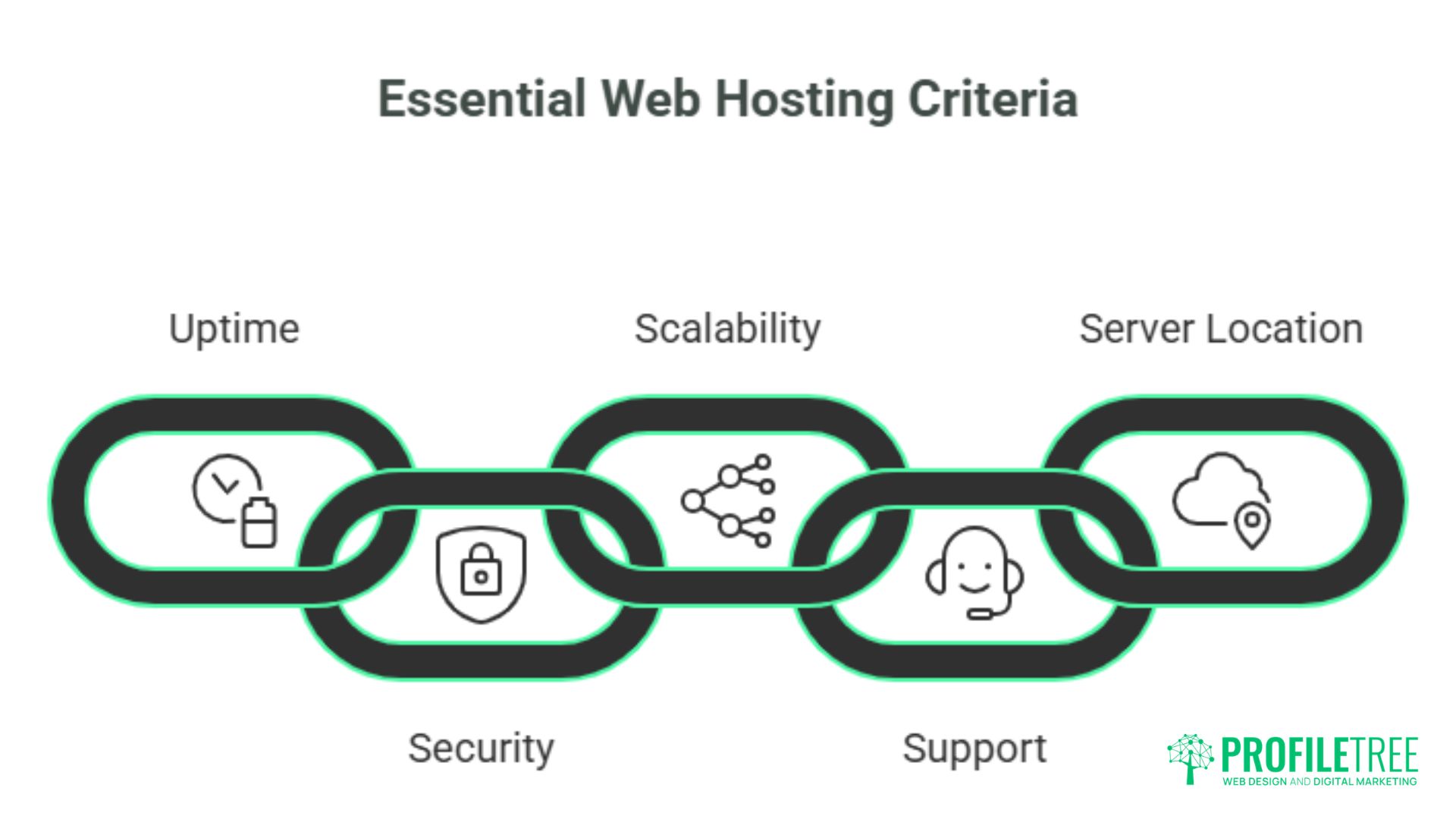
Choosing a web hosting company for a UK SME comes down to five factors. Generic advice says “consider uptime, support, security, and price.” What follows is more specific.
Uptime: What the Guarantee Actually Means
Every major host advertises 99.9% uptime. In practice, 99.9% allows for approximately 8.7 hours of unplanned downtime per year. Some hosts achieve this; many do not. Before committing, search for the host’s name alongside “outage” or “downtime” over the past 12 months. Independent monitoring services like UptimeRobot publish historical data on many shared hosting environments.
The SLA (service level agreement) matters as much as the headline figure. Some hosts credit you one month of free hosting for a breach. Others do nothing unless downtime exceeds 24 consecutive hours. Read the terms before signing.
Security: Beyond the Free SSL
A free SSL certificate is now table stakes. It should not appear in a hosting provider’s list of premium features. The security capabilities that actually separate hosts at the SME level include daily automated backups with one-click restore, web application firewalls (WAFs), DDoS mitigation, and malware scanning.
Shared hosting environments are inherently higher risk because a security compromise on one account can affect others on the same server. For any site handling customer data, payments, or staff login credentials, the security tier of shared hosting requires careful scrutiny. Our article on protecting your website from cyberattacks covers the specific vulnerabilities SMEs face.
Scalability: Planning for Growth Without Disruption
A hosting plan that works for a 500-visit-per-month brochure site will buckle under a product launch or a seasonal traffic spike. Moving between hosting plans with the same provider mid-crisis is possible, but not always fast. Choose a provider whose upgrade path is clear and where the jump from shared to managed or VPS does not require migrating to a different platform entirely.
For SMEs using resource-intensive tools such as WooCommerce, membership platforms, or appointment booking systems, scalability is not a future consideration. It is a day-one requirement. If you are assessing your current site’s capacity, our website performance analysis guide walks through the metrics to monitor.
Support: UK Business Hours Matter
“24/7 support” is a standard claim. What it often means in practice is 24/7 access to a ticketing system, with responses from Tier 1 support agents based in US time zones. For a UK business facing a site outage at 9 am on a Monday, an 8-hour response window is a commercial problem.
Before choosing a web hosting company, test their support channel. Open a pre-sales chat. Ask a specific technical question. Time the response. If they cannot answer a specific question before they receive your money, the post-purchase support experience will be worse.
Server Location: The Case for UK or Irish Data Centres
For a business primarily serving UK or Irish customers, a server located in London, Manchester, or Dublin reduces page load times by a measurable amount compared to a US-based alternative. The difference in TTFB between a London server and a US East Coast server is typically 80 to 150 milliseconds for a UK visitor. Google’s research classifies a 100ms delay in server response time as perceptible user experience degradation.
Server location also affects GDPR compliance. Data stored on UK or EU servers falls under a clearer legal framework than data processed by a US company on US infrastructure. For businesses holding customer email addresses, transaction data, or form submissions, this is worth confirming before signing up. Our guide to GDPR training for your team covers the internal responsibilities that sit alongside your hosting choice.
Types of Hosting: Which One Your Business Actually Needs
| Hosting Type | Best For | Typical Monthly Cost (UK) | Key Limitation |
|---|---|---|---|
| Shared | New sites, low traffic, personal projects | £2–£8 | Resources shared; performance affected by neighbours |
| Managed WordPress | SME WordPress sites, content-heavy | £15–£50 | WordPress-only; higher cost than basic shared |
| VPS | Growing SMEs, WooCommerce, custom apps | £20–£80 | Requires more technical knowledge to manage |
| Cloud | High-traffic, variable load, SaaS tools | £30–£150+ | Cost can escalate quickly without monitoring |
| Dedicated | Enterprise, high-volume transactions | £80–£300+ | Expensive; overkill for most SMEs |
Shared Hosting: The Starting Point, Not the Destination
Shared hosting puts your site on a server alongside hundreds or thousands of other sites, all drawing from the same pool of CPU, RAM, and bandwidth. For a brand-new site with minimal traffic, shared hosting is a reasonable starting point. The cost is low, and most providers offer one-click WordPress installation.
The limitation becomes apparent as traffic grows. If a neighbouring site on the same server experiences a traffic spike, your site’s performance degrades, even though nothing on your end has changed. This “noisy neighbour” problem is the primary reason shared hosting plans are not suitable for business-critical sites. Our beginner’s guide to web hosting services covers the fundamentals for anyone starting from scratch.
Managed WordPress Hosting: The Practical Choice for Most UK SMEs
For businesses running WordPress — which covers the majority of SME websites in the UK — managed WordPress hosting removes most of the technical overhead. The host handles software updates, security patching, performance optimisation, and daily backups. You focus on the site.
Providers in this space typically run WordPress on infrastructure optimised for the platform, with server-level caching, CDN integration, and staging environments included. The cost is higher than shared hosting, but the reduced technical management and improved performance justify the difference for most commercial sites. If you want to understand what managed WordPress hosting looks like from a premium provider, our WP Engine hosting review covers how it compares at the mid-to-high market.
This is the tier ProfileTree recommends for SMEs running content-heavy WordPress sites or WooCommerce stores. If you are considering a new website build and want to understand how hosting fits into the broader project, our website development service covers how we approach technical decisions from the ground up.
VPS Hosting: When You Need More Control
A virtual private server gives your site a dedicated slice of server resources, isolated from other accounts on the same physical machine. Performance is more predictable than shared hosting, and you have greater control over the server environment.
VPS is appropriate for sites with consistent mid-level traffic, custom application requirements, or businesses running software beyond WordPress. The trade-off is that unmanaged VPS plans require technical knowledge to configure and maintain. Understanding server-side and client-side programming helps clarify why the server environment matters when choosing between VPS configurations.
The Hidden Costs of Choosing a Web Hosting Company
The advertised price for most hosting plans is an introductory rate that applies to the first billing period only. At renewal, the price typically doubles or triples. A plan advertised at £2.99 per month for the first year may renew at £8.99 or £10.99. This is standard practice across the industry and is not prominently disclosed at the point of sale.
Before committing, check the renewal rate directly. This is usually visible in the terms and conditions or the billing FAQ. If the host will not disclose renewal pricing on request, treat that as a signal.
Additional Costs to Factor In
Beyond the renewal rate, the following are regularly excluded from headline pricing.
SSL certificates. Free SSL is standard on most reputable hosts. Some budget providers charge £10–£60 annually for SSL that should be included. Our guide to compliance and security in online payments explains why SSL is only one layer of a secure eCommerce setup.
Email hosting. Some plans include email accounts; others charge separately or impose account limits. For a business using 10 or more email addresses, the email hosting costs become material.
Domain registration. Many hosts offer a free domain for the first year. The renewal cost on a host-registered domain is typically higher than registering independently. Our guide to domain names covers the mechanics of ownership and transfer.
Backup storage. Daily automated backups are increasingly standard, but some providers count backup storage against your disk allocation or charge for retention beyond 7 days.
Migration costs. Moving an existing site to a new host has an associated cost in time if you manage it yourself, or a service fee if you engage the host’s migration team. Budget hosts rarely include free migration; premium providers often do. Our redirect domains guide is a useful reference when managing DNS changes during a migration.
GDPR and Data Residency: What UK Businesses Need to Know
This is the section most hosting guides skip. Under UK GDPR (retained from EU GDPR post-Brexit), businesses are responsible for ensuring that personal data transferred outside the UK is protected to an equivalent standard. A US-based host processing UK customer data falls under US jurisdiction by default, including the Clarifying Lawful Overseas Use of Data Act (Cloud Act), which permits US law enforcement to access data held by US companies regardless of server location.
For most SMEs, the practical implication is straightforward: if your site collects any personal data — contact form submissions, email sign-ups, customer accounts, order records — a UK or EU-based host eliminates a layer of compliance complexity. Our guide to designing GDPR-compliant web forms covers the data collection layer that sits on top of hosting decisions.
The Information Commissioner’s Office (ICO) provides guidance on international data transfers. If your business operates in a regulated sector, take specific legal advice rather than relying on a host’s generic GDPR claims.
“For SMEs in Northern Ireland, choosing a UK or Irish hosting provider is not just a performance decision,” says Ciaran Connolly, founder of ProfileTree. “It removes a compliance question that some businesses only discover when a client or customer asks where their data is stored.”
How to Switch Web Hosts Without Losing SEO Rankings
Switching hosting providers is one of the most common causes of unexplained ranking drops for SME websites. The risk is manageable with a clear process, but the steps are regularly skipped.
Before the Migration
Back up the complete site, including the database. Confirm the backup restores correctly on the new host before making any DNS changes. Lower your domain’s TTL (time to live) to 300 seconds, 24 to 48 hours before switching. This reduces the propagation window when you change the DNS records. Our website migration guide covers the full process in detail, including common failure points that cause ranking drops.
During the Switch
Point your DNS to the new host only after confirming the site loads correctly on the new server. Do not delete the old hosting account until DNS has fully propagated — typically 24 to 48 hours, but sometimes longer depending on your registrar.
After the Migration
Run a crawl of the new site using a tool such as Screaming Frog to confirm all URLs return 200 status codes. Check Google Search Console for crawl errors in the 48 hours following the switch. Monitor Core Web Vitals through PageSpeed Insights from a UK-located test to confirm performance has improved or held steady. Our website analysis guide covers the post-migration checks to run before closing the project.
For websites built and managed by ProfileTree, we handle hosting migration as part of our website management service, including pre-migration audits and post-migration SEO checks. If you are also planning a website launch alongside a host migration, carefully sequencing those two events is critical.
Choosing a Web Hosting Company: Decision Summary

Use the table below to match your business situation to the right starting point.
| Situation | Recommended Starting Point |
|---|---|
| New site, under 1,000 monthly visitors, minimal budget | Shared hosting from a UK-based provider |
| Existing WordPress site, SME, content or WooCommerce | Managed WordPress hosting |
| Custom application, growing traffic, technical resource available | VPS (managed or unmanaged) |
| High-traffic, variable load, multiple sub-sites | Cloud hosting |
| Enterprise-level, sensitive data, full control required | Dedicated server |
The right hosting choice depends on where your business is now and what it is planning to do next. A decision made at launch needs to be reviewed when traffic grows, when you add eCommerce functionality, or when GDPR compliance becomes a board-level question. If you are rebuilding or launching a site and want to understand how hosting fits into a full web project, our web design and development team works with SMEs across Northern Ireland, Ireland, and the UK to make these decisions with a commercial context rather than just technical specifications.
Apologies — it was dropped during the heading restructure. Here it is:
Conclusion
Choosing a web hosting company shapes your site’s speed, security, and search performance from day one. For UK SMEs, the decision comes down to server location, GDPR compliance, honest uptime records, and a pricing structure that holds up at renewal — not just in the first year. Start at the tier your current site genuinely needs, confirm the upgrade path is clear, and revisit the decision whenever your traffic, functionality, or compliance requirements change.
ProfileTree’s web design and development team can help you make that call with the full picture in front of you.
FAQs
Does my server have to be in the UK?
Technically, no, but for businesses serving UK or Irish customers, a UK or EU-based server reduces page load latency and simplifies GDPR compliance. A US-based server adds 80 to 150 milliseconds of additional load time for UK visitors, and processing UK customer data on US infrastructure raises questions under UK GDPR. For most UK SMEs, a London or Dublin data centre is the practical choice.
What is the difference between a domain name and web hosting?
Your domain name is the address people type to find your site. Web hosting is the server where your site’s files actually live. You can register a domain with one company and host your site with another. Keeping them separate gives you more flexibility and makes it easier to switch hosts without risking your domain.
How much should a UK small business pay for web hosting?
For a standard SME WordPress site, expect to pay £15 to £40 per month for managed WordPress hosting from a reputable UK provider. Shared hosting is available from £3 to £8 per month but carries the performance and security limitations covered above. Budget at the managed tier, and factor in renewal rates rather than introductory pricing when comparing plans.
Will a slow host affect my Google rankings?
Yes. Google uses Core Web Vitals as a ranking signal, and server response time contributes directly to those scores. A host with slow UK response times produces lower Largest Contentful Paint (LCP) scores, which affects ranking potential for competitive terms. The impact is more pronounced in competitive local search.
What is green hosting, and does it matter for my business?
Green hosting refers to providers who power their data centres with renewable energy or offset their carbon footprint through certified schemes. For UK SMEs with ESG reporting requirements or sustainability commitments, the hosting choice is a small but verifiable contribution. When evaluating green credentials, look for third-party certification rather than self-reported claims.
Pretty! This has been a really wonderful post. Many thanks for providing these details.