
Future-Proof Your Business with the Best Intelligent Content Strategy
Table of Contents
Standing out in saturated digital markets requires more than regular publishing schedules. Businesses need content that adapts, personalises and works across every platform without constant manual intervention. This represents the fundamental promise of intelligent content—structured information that remains relevant regardless of technological changes.
For businesses across Northern Ireland, Ireland and the UK, this approach addresses a critical challenge: maintaining consistent messaging whilst serving customers across websites, mobile apps, social media, voice assistants and emerging platforms. Rather than creating separate content for each channel, organisations build once and deploy everywhere.
ProfileTree works with SMEs throughout Belfast and beyond to implement the best intelligent content strategy within comprehensive digital transformation programmes. This guide explores how structured, metadata-rich content future-proofs digital operations, improves search performance and delivers personalised experiences that drive measurable business growth.
What is Intelligent Content?
Intelligent content exists independent of presentation, structured to allow easy discovery, reuse and adaptation across channels and devices. Traditional content gets created for single purposes or platforms. Intelligent content breaks into modular, self-contained components enriched with descriptive metadata that provides context about purpose, audience and characteristics.
Consider product descriptions for an e-commerce business. Traditional approaches mean writing one version for websites, another for mobile apps, a third for print brochures. Each represents distinct, often redundant content. Intelligent content treats product names, features lists and specifications as separate, tagged modules. These components then assemble and present differently depending on channel, device or user preferences.
This structural approach and semantic tagging make intelligent content highly adaptable and efficient. A Belfast retailer using this method maintains one product information database that automatically feeds their WordPress website, social media posts, Google Shopping listings, email campaigns and printed materials—all from single sources of truth.
Defining Characteristics
Four characteristics differentiate intelligent content from traditional approaches:
Structured Organisation: Content organises into defined types and elements, making it machine-readable and processable. Rather than unstructured text blocks, information exists in clearly defined fields and relationships that systems understand and manipulate programmatically.
Rich Metadata Tagging: Descriptive tags applied to content components provide context and enable precise retrieval and personalisation. This metadata describes what content represents, who needs it, how it relates to other information and where it should appear.
Component Reusability: Content modules repurpose across multiple outputs without manual recreation, saving time and maintaining consistency. One safety warning serves user manuals, quick-start guides, websites and packaging simultaneously.
Automatic Adaptability: Content automatically adjusts format and presentation to suit different devices, platforms and user needs. The same information renders appropriately for desktop browsers, mobile screens, voice assistants and smart displays without separate authoring.
Moving away from monolithic, channel-specific content delivers significant advantages in consistency, efficiency and personalised experience delivery. For ProfileTree’s clients developing web design and content marketing strategies, this foundation supports current requirements whilst remaining adaptable for emerging technologies.
“Intelligent content transforms how businesses operate in multi-channel environments,” notes Ciaran Connolly, Director of ProfileTree. “Instead of maintaining separate content for websites, social media and email campaigns, organisations create once and publish everywhere. This approach dramatically reduces workload for our Belfast-based clients whilst improving consistency across all customer touchpoints.”
The Pillars of the Best Intelligent Content Strategy
Building effective intelligent content strategy requires fundamental shifts in how content gets conceived, created and managed. This extends beyond tools to methodical content architecture approaches. Four pillars support this framework.
Content Modelling
Content modelling creates blueprints for intelligent content. It defines content types you’ll create—articles, product descriptions, FAQs, service pages—along with attributes or fields associated with each type. For articles, this might include title, author, body, publication date, tags, categories and related content. For products: name, description, price, specifications, features, images and availability.
Well-defined content models maintain consistency, make content predictable for systems and facilitate reuse. This forces thinking about content as structured data rather than just text on pages. For SMEs working with ProfileTree on website development, content modelling happens during strategy phases. We map existing content, identify gaps and design structures supporting business goals whilst remaining flexible for growth.
A professional services firm in Belfast might model case studies, service pages, team biographies and blog posts as distinct but interlinked content types. Each type contains specific fields that populate different website sections automatically, maintaining consistency whilst allowing efficient content management.
Metadata Strategy
Metadata represents data about data. For intelligent content, it’s descriptive information attached to each component. This includes keywords and topics, audience segments, content purpose, version history, geographic relevance, product associations and workflow status.
Rich, consistent metadata enables four critical capabilities:
Enhanced Discoverability: Users and systems find relevant content quickly through precise filtering and search. Customers searching for “commercial property advice Belfast” immediately see tagged content specific to that location and topic.
Deep Personalisation: Content delivers to specific user segments based on interests, behaviour or needs. First-time website visitors see introductory content whilst returning customers receive advanced information.
Intelligent Automation: Systems automatically assemble and deliver content to various channels based on rules and user context. Email campaigns pull relevant content blocks based on recipient interests without manual selection.
Robust Governance: Metadata supports content lifecycle management, compliance tracking and quality assurance. Teams identify outdated content, track approval status and maintain regulatory compliance through systematic tagging.
Developing comprehensive metadata schemas represents critical steps in intelligent content initiatives. ProfileTree’s digital strategy services help clients design metadata frameworks that balance thoroughness with practical application, supporting current needs whilst scaling for future requirements.
Content-First Approach
Content-first methodology means planning and creating content independently of final presentation. Instead of designing webpages then filling them with text, you design content structure first, focusing on meaning and purpose. This maintains inherent flexibility, allowing publication to any channel—websites, mobile apps, voice assistants, smart displays—without significant rework.
Separating content from design allows greater agility and future adaptability. When new platforms emerge, content adapts quickly without complete redesign. A product specification created with content-first principles works equally well on WordPress websites, mobile applications, chatbot responses or voice assistant replies.
For ProfileTree’s web design clients, this approach means content strategies developed before visual design begins. We identify information architecture, user needs and content types required, then design presentation layers that showcase content effectively across devices. This methodology proves particularly valuable for businesses planning growth or platform changes, as content remains portable and reusable.
Structured Content Components
This pillar involves breaking content into granular, semantically meaningful components. Articles aren’t single text blocks but comprise titles, abstracts, individual paragraphs, images with captions, pull quotes, author information and related links. Each represents distinct content objects with specific purposes and metadata.
Modularity makes content reusable and adaptable as individual components pull and reassemble to form new experiences. A product feature description might appear on product pages, comparison charts, email campaigns and sales presentations—all pulling from the same source component.
ProfileTree’s content marketing and video production services operate on these principles. Videos created for YouTube strategies also serve websites, social media, email campaigns and training materials as discrete, reusable assets. This component approach maximises return on content investment whilst maintaining message consistency.
Benefits of Intelligent Content for Business Growth
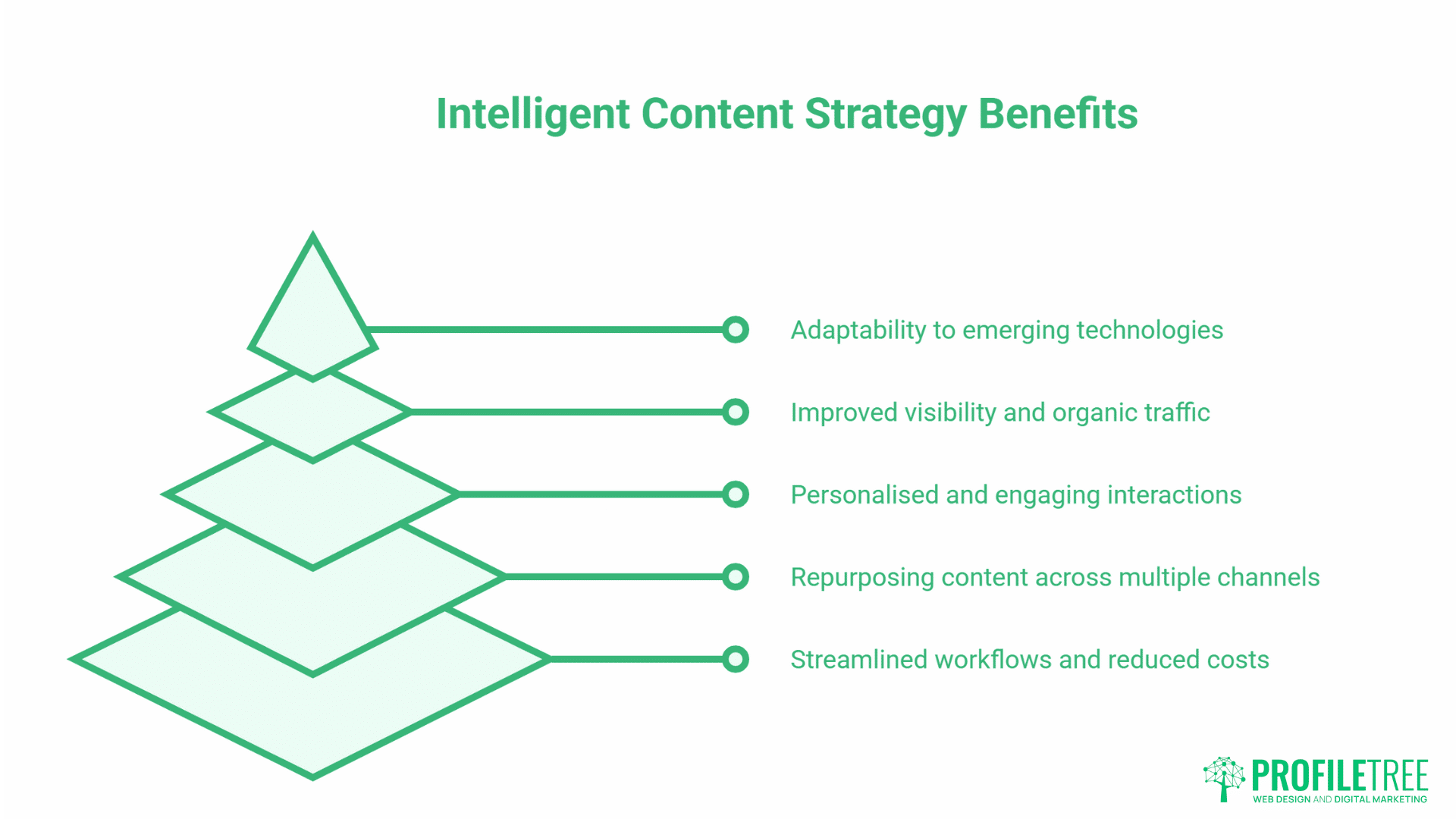
Adopting intelligent content strategy yields tangible advantages impacting various business aspects, from operational efficiency to customer satisfaction and competitive positioning.
Superior SEO Performance
Search engines grow increasingly sophisticated, moving beyond keyword matching to understanding semantic meaning and context. Intelligent content, with structured nature and rich metadata, becomes inherently more machine-readable. This allows search engines to better index and understand content, leading to improved visibility, better rankings and higher quality organic traffic.
Structured data makes content eligible for rich snippets and featured results, further boosting discoverability. When business information gets tagged with location metadata, local search performance improves significantly. Belfast businesses using intelligent content principles rank more effectively for geographic queries whilst maintaining national visibility.
ProfileTree’s SEO services build on structured content foundations. We optimise metadata, implement schema markup and structure content to maximise search visibility for clients across Northern Ireland, Ireland and the UK. This technical SEO combined with content strategy delivers comprehensive search performance improvements.
Exceptional Customer Experiences
Intelligent content enables genuine personalisation at scale. Understanding user context—device, location, past interactions, behaviour patterns—and leveraging content metadata allows systems to deliver highly relevant, tailored experiences. Whether personalised product recommendations, localised support articles or device-optimised content, intelligent systems provide right information in right formats at right times.
This leads to higher engagement, greater satisfaction and stronger brand loyalty. Customers find what they need quickly without irrelevant information. A technical user receives detailed specifications whilst beginners see simplified explanations—all from the same content repository automatically adapted based on user characteristics.
For ProfileTree’s digital marketing clients, this means campaigns that adapt dynamically to audience segments. Email content blocks change based on recipient interests and purchase history. Website experiences personalise based on visitor behaviour and demographics. This level of personalisation drives conversion rates significantly higher than generic, one-size-fits-all approaches.
Extensive Content Reuse
One of the most immediate advantages involves reusing content components across multiple channels and purposes. Instead of rewriting similar information for different platforms, you create it once as structured modules then repurpose freely. This dramatically reduces content creation time, maintains messaging consistency and minimises errors or outdated information risks.
Single sources of truth for content mean less duplication and more reliable information across all touchpoints. A product safety warning exists once but appears consistently in user manuals, quick-start guides, websites, packaging and support documentation. Updates happen in one location and propagate automatically to all instances.
For businesses operating across Northern Ireland, Ireland and the UK with multilingual requirements, this reuse extends to translation and localisation. Translate each component once rather than entire documents repeatedly, reducing costs significantly whilst maintaining translation quality and consistency.
Increased Operational Efficiency
Modularity and reusability translate directly into operational savings. Content teams spend less time on repetitive tasks like copying, pasting and reformatting. Updates to single content modules automatically propagate across all instances, streamlining workflows and accelerating time-to-market.
This reduces overall content management costs whilst freeing creators to focus on higher-value strategic tasks rather than manual manipulation. For SMEs with limited resources, these efficiency gains prove particularly valuable, allowing small teams to maintain content volumes and quality levels previously requiring much larger resources.
ProfileTree’s digital training services help teams develop skills necessary for efficient intelligent content creation and management. Our Belfast-based workshops cover structured authoring, metadata strategy and content reuse principles relevant to Northern Irish and UK organisations, building internal capabilities whilst delivering practical results.
Future-Proof Adaptability
Digital landscapes constantly evolve with new devices, platforms and consumption methods emerging regularly. Intelligent content, by separating content from presentation, makes information inherently adaptable to these changes. When new channels emerge—new smart display types, virtual reality platforms, emerging social networks—structured content renders easily for new environments without complete overhauls.
This adaptability maintains content strategy relevance and effectiveness regardless of future technological shifts. Businesses investing in intelligent content today position themselves to adopt emerging technologies quickly without massive content recreation projects. As AI capabilities expand, organisations with structured, machine-readable content capitalise on these advancements more effectively than competitors managing unstructured information.
ProfileTree’s AI implementation services help clients develop strategies that leverage intelligent content foundations. We focus on practical AI applications that deliver measurable value without requiring data science teams or massive investments, positioning Northern Irish businesses to adopt AI-driven personalisation, content automation and intelligent customer experiences as technologies mature.
Implementing Intelligent Content: Practical Roadmap
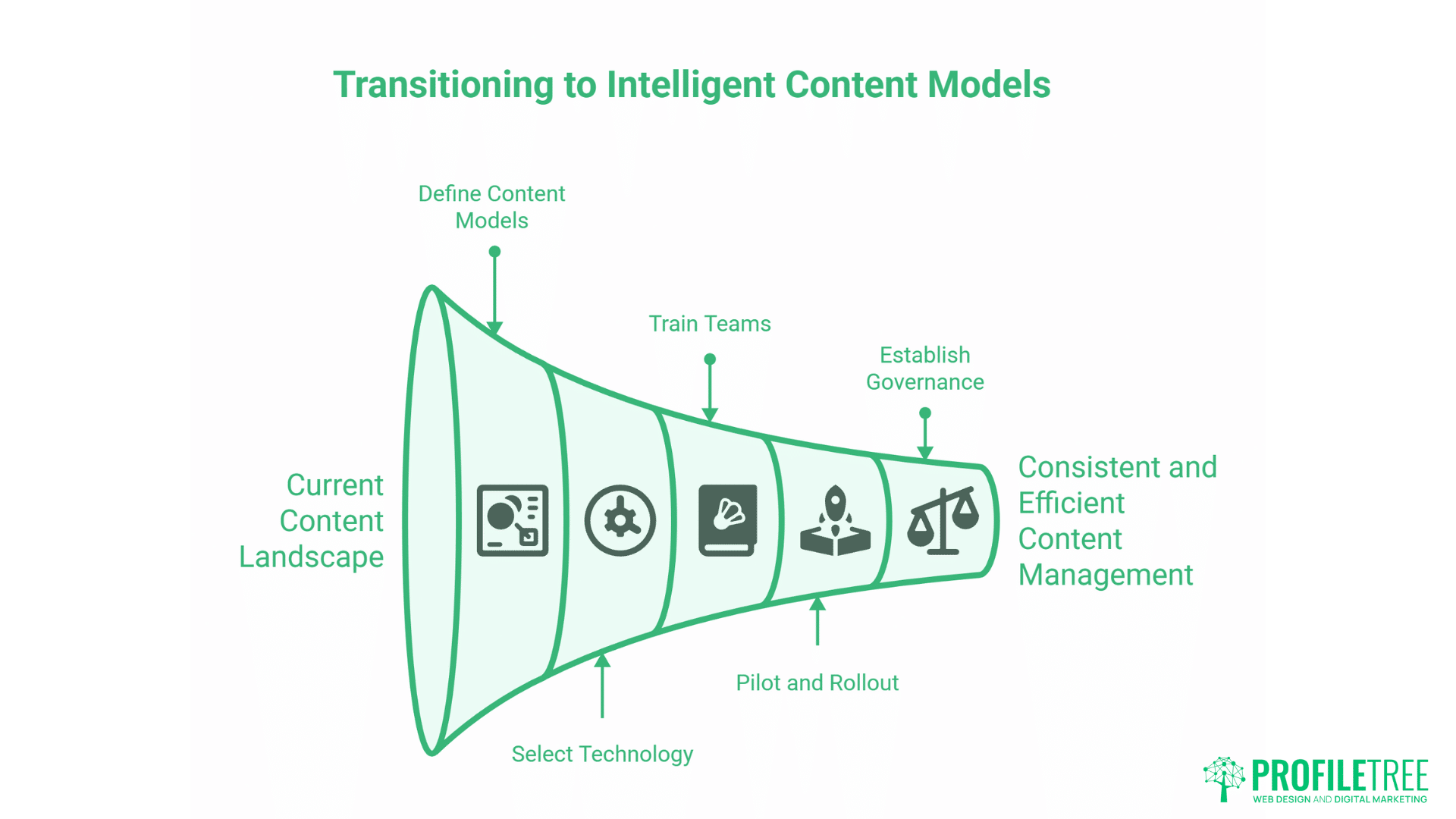
Transitioning to intelligent content models represents strategic undertakings requiring careful planning and execution. This journey, not single step, benefits from systematic approaches that minimise disruption whilst delivering incremental value.
Assess Current Content Landscape
Begin with thorough content audits. Catalogue existing content, identify current formats, locations and usage patterns. Look for redundancies, inconsistencies and modularisation opportunities. This assessment reveals transformation scope and identifies high-value content for priority conversion to intelligent formats.
For ProfileTree’s clients beginning digital transformation projects, content audits often reveal significant duplication across websites, brochures, sales materials and social media. One Northern Ireland retailer discovered they maintained fourteen different versions of shipping policies across various platforms, each slightly different and potentially contradictory. Consolidating these into single, reusable components improved consistency whilst reducing maintenance burden.
Document pain points in current content operations: How long does creating new campaign materials take? How often do inconsistencies appear across channels? What percentage of content creation involves duplicating existing information? These metrics establish baselines for measuring improvement after intelligent content implementation.
Define Content Models and Metadata Schemas
This critical design phase requires collaboration between content strategists, subject matter experts and technical teams. Define content types, their attributes and relationships. Simultaneously, develop comprehensive metadata schemas supporting content goals including personalisation, search, reuse and workflow management.
This step requires careful thought balancing flexibility for future needs with specificity for actionable implementation. Content models should accommodate current requirements whilst remaining extensible as business needs evolve. Metadata schemas need sufficient richness to enable desired functionality without becoming burdensome to apply consistently.
ProfileTree’s approach to WordPress development centres on custom content models reflecting client business structures. We create custom post types, taxonomies and field groups allowing flexible content management whilst maintaining necessary structure. For professional services firms, this might include distinct content types for case studies, service descriptions, team profiles and thought leadership articles, each with specific fields and metadata supporting different website functions.
Select Appropriate Technology Stacks
Intelligent content relies on specialised tools supporting structured authoring, robust metadata management and multi-channel publishing. Consider investing in Content Management Systems supporting structured content—headless CMS platforms or Component Content Management Systems. Digital Asset Management systems handle media components. Content orchestration platforms coordinate delivery across channels.
Chosen technology should align with content models and support desired workflows for creation, management and delivery. For many SMEs, WordPress configured with custom fields and taxonomies provides sufficient structured content capabilities without enterprise-level complexity or investment. More sophisticated requirements might justify dedicated CCMS platforms designed specifically for intelligent content at scale.
ProfileTree’s WordPress hosting and development services provide structured content capabilities suitable for many business requirements. We implement custom fields, taxonomies and programmatic content assembly within familiar, manageable platforms. For clients with more complex needs, we advise on CCMS solutions and integration strategies that balance capability with practical implementation constraints.
Train Teams Comprehensively
Intelligent content strategy impacts everyone involved in content lifecycles—writers, editors, designers, developers and marketers. Provide comprehensive training on new content models, metadata standards and tool usage. Foster content-first mindsets and emphasise structured content benefits. Change management proves key to successful adoption.
Training should cover not just technical tool usage but underlying principles and strategic thinking. Teams need to understand why intelligent content matters, how it benefits organisations and customers, and how their roles contribute to overall strategy. Without this understanding, adoption struggles and implementations fail to deliver potential value.
ProfileTree’s digital training services address these change management needs directly. We provide workshops and ongoing support helping teams transition to intelligent content approaches, building confidence and capability incrementally. Our Belfast-based trainers work alongside client teams, transferring knowledge whilst delivering practical results that demonstrate value quickly.
Pilot and Phased Rollout
Don’t attempt converting all content simultaneously. Start with pilot projects—specific content types or small website sections. This allows testing content models, refining workflows and gathering feedback before broader rollouts. Successful pilots demonstrate value, build internal champions and provide learning opportunities that inform wider implementation.
Once pilots succeed, implement phased approaches, gradually converting and creating new content in intelligent formats. This iterative process mitigates risks and provides smoother transitions. Each phase builds on previous learnings, refining approaches and addressing challenges discovered during earlier implementations.
For Northern Ireland businesses, ProfileTree recommends starting with highest-impact content types—frequently updated materials, multi-channel content or information requiring extensive personalisation. Early wins in these areas demonstrate value quickly, building momentum for broader intelligent content adoption across organisations.
Establish Governance and Workflows
Define clear roles, responsibilities and workflows for content creation, review, approval and publishing within intelligent content frameworks. Establish guidelines for applying metadata, maintaining content quality and managing versions. Strong governance maintains consistency, compliance and long-term intelligent content system integrity.
Governance shouldn’t feel bureaucratic but rather provide clear structures supporting quality and efficiency. Who approves new metadata tags? How do teams request new content types? What quality assurance processes verify metadata application? These questions need clear answers embedded in daily workflows.
ProfileTree helps clients develop governance frameworks appropriate to their scale and complexity. For smaller organisations, this might involve simple style guides and metadata checklists. Larger enterprises might require formal content boards, detailed workflow documentation and automated quality checks. The key lies in matching governance sophistication to organisational needs without creating unnecessary complexity.
Measuring Success and Demonstrating ROI
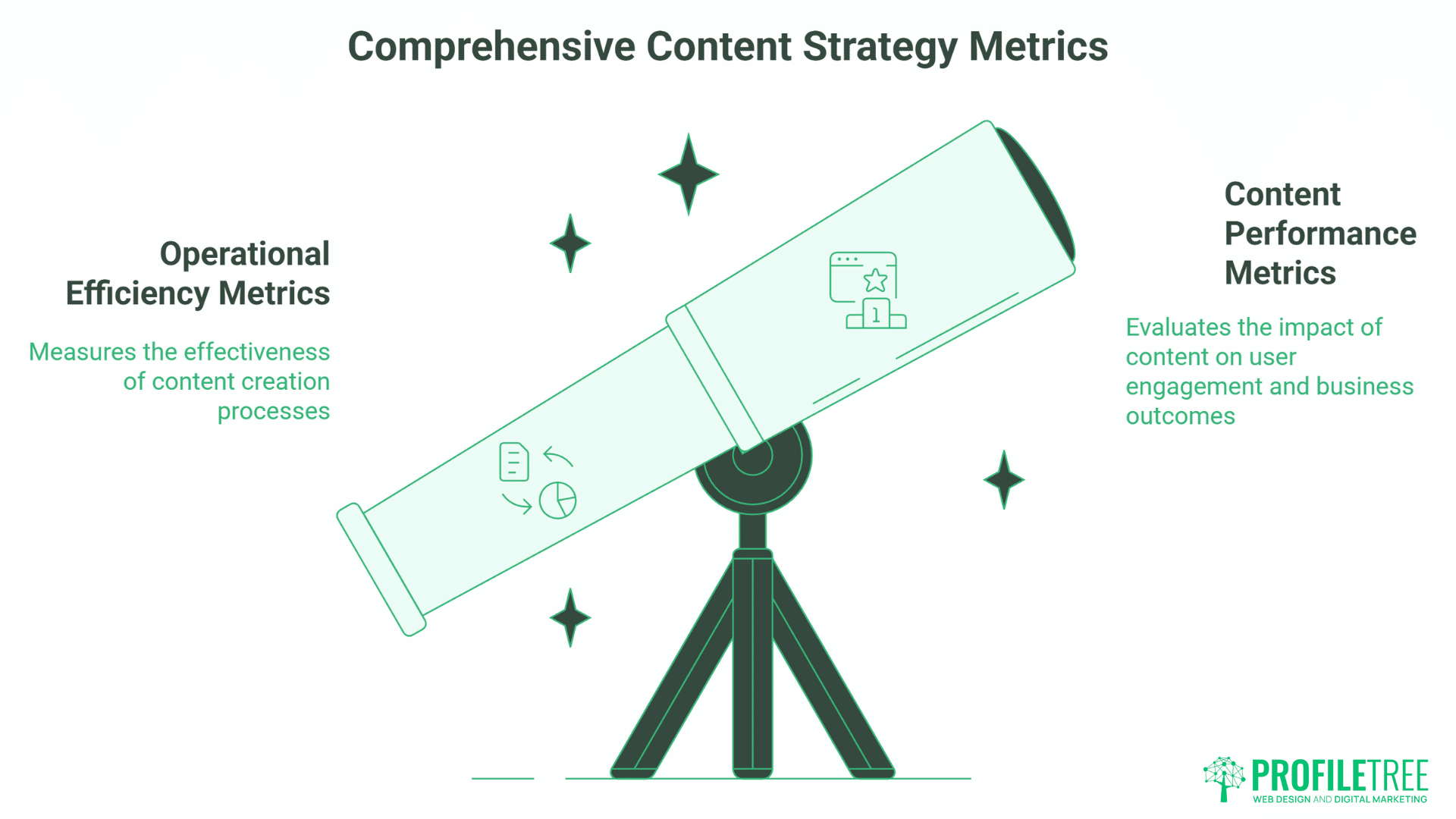
Establishing clear metrics and robust measurement frameworks demonstrates intelligent content strategy return on investment whilst driving continuous improvement. Track both operational efficiency and content performance metrics to build comprehensive success pictures.
Operational Efficiency Metrics
Content Reuse Rate: Track how often content components get reused across different channels or publications. Higher reuse rates indicate greater efficiency and reduced duplication. Target increasing this metric over time as teams become more adept at identifying reuse opportunities.
Time-to-Market: Measure time required to create, approve and publish new content or update existing materials. Intelligent content should significantly reduce these cycles. For product launches or campaign deployments, faster time-to-market translates directly to competitive advantages.
Content Creation Costs: Analyse cost reductions in content creation, translation and localisation due to modularity and reuse. Calculate savings from reduced duplication, faster updates and streamlined workflows. These quantifiable savings justify intelligent content investments.
Error Reduction: Monitor decreases in content-related errors or inconsistencies across channels. Fewer errors mean reduced customer confusion, decreased support enquiries and improved brand credibility. Track error rates before and after intelligent content implementation to demonstrate quality improvements.
Content Performance Metrics
SEO Rankings and Organic Traffic: Track improvements in search engine visibility for key terms, higher click-through rates and increased organic traffic driven by better structured, discoverable content. Monitor featured snippet appearances and rich result eligibility enabled by structured data.
User Engagement: Monitor metrics like time on page, bounce rate, pages per session and conversion rates for content delivered via intelligent systems. Personalised, relevant content should drive better engagement across all these dimensions.
Customer Satisfaction: Use surveys, feedback forms and support ticket analysis to gauge whether intelligent content improves customer experiences and reduces support enquiries. Customers finding answers quickly report higher satisfaction levels.
Personalisation Effectiveness: Measure personalised content impact on user behaviour—increased conversions, deeper topic exploration, higher return visit rates. Compare personalised experience performance against generic, non-personalised baselines to demonstrate personalisation value.
For ProfileTree’s clients, we help establish measurement frameworks appropriate to their business goals and available analytics capabilities. Our approach focuses on metrics that matter to specific business contexts rather than generic vanity metrics that fail to demonstrate real value.
The Future of Digital Content is Intelligent
Digital communication trajectory points unequivocally towards futures where content gets interacted with, personalised and delivered seamlessly across ever-growing touchpoint arrays. Intelligent content aligns perfectly with these emerging trends, making it essential for long-term success.
Personalisation at Scale
Consumers expect highly relevant experiences. Intelligent content, with granular structure and rich metadata, provides backbones for true personalisation. Systems dynamically assemble content tailored to individual user preferences, past behaviours and real-time contexts. This moves beyond simple name insertion to delivering truly unique, valuable content experiences fostering deeper audience connections.
For Belfast businesses competing nationally and internationally, this personalisation capability levels playing fields. SMEs can deliver enterprise-quality personalised experiences through intelligent content systems, competing effectively against much larger competitors with more resources.
AI-Driven Content Operations
Artificial intelligence plays increasing roles in content creation, optimisation and distribution. Intelligent content provides structured, machine-readable data that AI models need to operate effectively. AI assists generating content variations, optimising headlines, suggesting relevant metadata and automating content delivery to specific channels.
As AI capabilities grow, organisations with intelligent content will be best positioned to capitalise on these advancements. ProfileTree’s AI training and implementation services help Northern Irish SMEs understand and adopt these technologies practically. We focus on accessible AI solutions delivering measurable value without requiring data science teams or massive investments.
Omnichannel Consistency
Omnichannel experiences represent necessities rather than luxuries. Users interact with brands across websites, mobile apps, social media, voice assistants, smart devices and more. Intelligent content maintains consistency and continuity across all these channels. Information created once renders appropriately for smart speaker audio output, wearable device small screens, traditional webpages or augmented reality overlays.
This cohesion proves particularly important for businesses operating across Northern Ireland, Ireland and the UK, where customers might interact through different channels in different regions. Intelligent content maintains brand consistency whilst adapting to local contexts and channel-specific requirements.
Adaptability to Emerging Technologies
Technological change pace shows no signs of slowing. New devices, platforms and content consumption methods continue emerging. Organisations investing in intelligent content find themselves agile and ready to adapt. Their content, being independent of presentation, can be quickly repurposed for augmented reality experiences, virtual reality environments or whatever comes next without requiring complete overhauls.
This inherent flexibility represents significant competitive advantages. Whilst competitors scramble to recreate content for new platforms, organisations with intelligent content simply add new rendering templates for emerging channels, deploying existing content assets immediately.
ProfileTree’s digital strategy services help clients build intelligent content foundations supporting current needs whilst remaining adaptable for emerging channels and technologies. Our approach balances practical immediate implementation with strategic positioning for future requirements.
FAQs
Is intelligent content only for large enterprises?
No. Whilst large enterprises with complex content needs see dramatic benefits, organisations of all sizes can adopt intelligent content principles. Core concepts of structuring content and using metadata scale appropriately. Small businesses benefit from improved efficiency and adaptability even with limited resources. The key lies in starting with clear strategies and scaling implementations based on specific needs rather than attempting enterprise-level complexity immediately.
How does intelligent content differ from responsive design?
Responsive design focuses on how content appears on different screen sizes by adjusting layouts and styling. Intelligent content focuses on the content itself—structure, meaning and reusability—independent of presentation. Responsive design adapts display; intelligent content adapts content components and meaning for various contexts and channels. Both work together: intelligent content provides flexible information whilst responsive design renders it appropriately for devices.
What are main challenges in adopting intelligent content?
Key challenges include initial investments in technology and training, effort required to audit and convert existing content, and cultural shifts towards content-first, structured approaches. Overcoming these requires strong leadership, clear communication and phased implementation plans. ProfileTree helps clients navigate these challenges through comprehensive digital training, strategic guidance and practical implementation support tailored to Northern Irish business contexts.
Can intelligent content improve translation and localisation?
Absolutely. Breaking content into smaller, reusable modules significantly streamlines translation and localisation processes. Translators work on smaller, context-rich chunks, reducing costs and maintaining consistency across languages. Updates to source content get easily identified and translated rather than re-translating entire documents. For businesses operating across Ireland, Northern Ireland and the UK with multilingual requirements, these savings prove substantial.
How long before seeing intelligent content results?
Timelines vary based on implementation scope. Initial efficiency gains from content reuse might appear within months of pilot programmes. More complex benefits like deep personalisation or significant cost reductions take longer, often requiring extensive content modelling and system integration. It represents gradual transformation rather than overnight fixes. ProfileTree’s phased approach delivers incremental value throughout implementation journeys rather than requiring complete transformations before seeing any benefits.
Transform Your Digital Strategy with ProfileTree
Intelligent content represents forward-thinking approaches preparing organisations for evolving digital communication demands. Focusing on structure, metadata and reusability creates content that’s effective for current needs whilst remaining adaptable for future requirements, maintaining message consistency and engagement across all audience touchpoints.
For businesses across Northern Ireland, Ireland and the UK, implementing intelligent content principles provides competitive advantages through improved efficiency, better search performance and superior customer experiences. Whether developing new websites, launching digital marketing campaigns or transforming content operations, intelligent content principles deliver measurable business value.
ProfileTree’s Belfast-based team helps SMEs implement intelligent content strategies within comprehensive digital transformation programmes. Our services span web design and development, content marketing, SEO, video production, AI implementation and digital training—all informed by intelligent content principles that future-proof digital operations.
We understand practical realities of implementing advanced content strategies in resource-constrained environments. Our approach focuses on achievable, affordable implementations delivering quick value whilst building capabilities for long-term success. We don’t just consult; we work alongside your teams, transferring knowledge whilst delivering practical results.
Ready to future-proof your content operations? Contact ProfileTree at our Belfast office in the McSweeney Centre to discuss how intelligent content can support your business goals. Our team will assess your current content assets, identify opportunities and develop practical implementation roadmaps tailored to your specific requirements and budget.
Discover how structured, reusable, adaptable intelligent content reduces costs, improves SEO performance and delivers personalised experiences that drive business growth across all your digital channels. Let’s build content strategies that work for you today and adapt automatically for whatever tomorrow brings.