
Corporate Video Production: Cost, Process and ROI for UK Businesses
Table of Contents
Corporate video production is one of the most direct ways a business can build trust with potential customers, explain what it does, and move people from awareness to enquiry. Businesses commissioning business video production in 2026 face a different set of choices than five years ago: shorter attention windows, AI-assisted editing that changes turnaround times, and a wider spread of platforms each demanding a different edit.
ProfileTree, a Belfast-based video production and digital marketing agency, works with businesses across Northern Ireland, Ireland, and the UK on video that solves specific commercial problems: reducing the time a sales team spends explaining the same thing on calls, cutting bounce rates on service pages, and building the kind of credibility that written copy alone rarely achieves.
What Corporate Video Production Actually Covers
Corporate video production is the process of planning, filming, and editing video content to serve a specific business goal. That goal might be to explain a product, demonstrate a service, onboard new staff, win new clients, or build brand recognition in a competitive market.
The term covers more ground than most people assume. It covers short social clips and twenty-minute training modules. It covers animated explainers and filmed testimonials. What ties professional video production together is intent: every piece exists to achieve a measurable outcome for the business that commissioned it.
For SMEs, the practical question isn’t whether video is worth doing. It’s which format, at what length, and where deployed that will get the result you’re actually after. That clarity has to come before a camera is switched on, and it’s the single biggest predictor of whether a business video production project comes in on budget.
Types of Corporate Video and What Each One Achieves
Choosing the right format matters as much as production quality. A beautifully shot video aimed at the wrong audience, on the wrong channel, wastes the budget just as thoroughly as a poorly shot one.
Brand Films and Company Storytelling
Brand films introduce your business, your values, and the people behind it. They work well on your homepage and About page, as well as for paid social campaigns aimed at cold audiences who haven’t heard of you yet. ProfileTree’s approach to video storytelling treats the brand film as the top of a wider content structure, not a standalone piece.
Explainer and Animated Content
Explainer videos break down a product, service, or process. Animated explainers work particularly well for technical or abstract subjects: software, professional services, or anything that’s genuinely difficult to film directly. ProfileTree’s animated video production team builds these for clients across sectors, including manufacturing, professional services, and technology, where filming the actual product adds little value.
Testimonial Videos
Testimonial videos feature real customers talking about their experience. They rank among the most effective trust signals a business can place on a service page or in a sales proposal. A short, specific testimonial from a named client in a recognisable industry carries more weight than any amount of brand copy, because it’s independently verifiable in the viewer’s mind.
Product Demonstration Videos
Product demonstration videos show your product in use. For e-commerce and retail businesses, a short product video on a product page can meaningfully improve conversion rates, particularly when the product needs to be demonstrated rather than described.
Training and Internal Communications
Training and internal communications videos serve your team, not your customers. They’re cost-effective at scale: a well-produced onboarding video runs across every new-starter cohort without additional production costs, which is exactly why company video creation for internal use often has the best return of any format on this list.
Recruitment Videos
Recruitment videos show prospective employees what it’s actually like to work at your company. With hiring increasingly competitive across the UK and Ireland, video that authentically communicates culture, rather than relying on stock footage of open-plan offices, has become a genuine differentiator.
Sector-Specific Formats
Some sectors need a different structural approach entirely. A hospitality business filming a location piece, such as a client in video marketing for food businesses, has different pacing needs than a manufacturer filming a process demonstration; ProfileTree’s work producing and editing video for tourism businesses follows a different brief to a B2B explainer, right down to shot length and music choice.
The right format depends entirely on your goal and where the video will live. An agency handling your corporate video production should help you make that decision before the brief is written, not after.
The Three Stages of Production
Understanding the production process helps you brief an agency better, set realistic timelines, and avoid the most common budget overruns. Every corporate video, whatever the format or budget, goes through three stages.
Pre-Production
Pre-production is where most of the strategic work happens, and where the majority of the budget is either saved or wasted. This stage covers your brief, script, shot list, and logistics.
A clear brief defines the audience, the single action you want viewers to take, the tone, and the distribution channel. A video destined for a service page needs to work differently from one designed for LinkedIn or a TikTok feed, and those decisions shape everything that follows. Businesses planning a wider content push often build the video brief alongside their broader video marketing strategy rather than treating it as a one-off.
Scripting comes next. For most business videos, a tight ninety-second script outperforms a rambling three-minute one. Attention drops sharply after the first thirty seconds, so the message and the call to action need to be front-loaded. A good script also makes filming faster and editing cheaper, because there’s less to shoot and less to cut.
Storyboarding maps the script to specific shots. For animated or complex productions, this step isn’t optional. For simpler live-action pieces, even a rough shot list can significantly shorten the filming day.
If your shoot involves external locations in the UK or Ireland, you may need filming permits from the local council, and drone footage requires authorisation from the Civil Aviation Authority. These are details a production partner should flag early; discovering them on the day of the shoot adds cost and delays delivery.
Production
Production is the filming day or days. Good pre-production makes this stage straightforward. Poor pre-production makes it expensive.
The key variables are crew size, equipment, location, and talent. A straightforward testimonial or talking-head video needs a small crew: a camera operator, a director, and a sound recordist. More complex productions, including product launches, brand films, and multi-location shoots, need larger teams and more kit.
Lighting quality is the single biggest factor separating professional video from amateur footage. Sound quality comes second. Both are easier to control in a studio than on location, which is why businesses often underestimate the cost of location shoots when budgeting.
Talent means anyone on camera, whether that’s your own team, professional actors, or a voiceover artist. Giving speakers key messages in advance, rather than a full script to memorise, produces more natural results than scripted delivery.
Post-Production, and Where AI Now Fits
Post-production turns raw footage into a finished piece: editing, colour grading, sound mixing, graphics, subtitles, and any animation elements.
Editing is where the story gets shaped. A skilled editor can recover a mediocre filming day; a poor edit can undermine excellent footage. The rough cut is the first real opportunity to check that the video is doing what the brief said it should.
Tools built on AI video technology now generate the subtitle base, and an editor refines it, rather than typing captions from scratch. Colour matching tools can bring footage from multiple cameras into a consistent look faster than manual grading. For businesses producing the same video in several languages, AI-assisted voice localisation is increasingly used for internal training content, though client-facing brand films still tend to use human voice talent for tone and nuance, and the cost-benefit case for AI tools in SMEs is usually strongest on internal content rather than customer-facing work. None of this removes the need for a skilled editor; it changes what they spend their time on.
Subtitles are worth adding as standard. A significant proportion of videos watched on social platforms is viewed without sound, particularly on LinkedIn and Facebook. Subtitles keep that audience engaged without a separate production.
Graphics, lower thirds (the name and title captions on screen), and end cards all need to follow your brand guidelines. If your production partner doesn’t have access to those, you’ll lose revision rounds correcting brand inconsistencies rather than improving the edit.
For businesses embedding video on their website, post-production should include a web-optimised export. Poorly compressed video files slow page load times, which affects both user experience and search performance, so this step belongs on the checklist alongside anything from your SEO services work.
Cost, Regional Logistics and Budgeting
Corporate video production costs vary more than almost any other marketing spend. A simple, well-prepared talking-head testimonial might cost £1,500 to £2,500. A multi-location brand film with professional actors, original music, and full post-production could run to £20,000 or more. Most SME video packages for businesses fall between £3,000 and £10,000 per finished piece.
| Production Tier | Typical Budget | What’s Included | Best For |
|---|---|---|---|
| Entry | £1,500 to £3,000 | Small crew, single location, basic edit | Testimonials, talking heads, internal comms |
| Mid-range | £3,000 to £8,000 | Full crew, one to two locations, graphics, music | Brand films, explainers, service page video |
| High-end | £8,000 to £20,000+ | Multi-location, professional talent, animation | Product launches, national campaigns |
The factors that drive cost up are location complexity, crew size, number of shooting days, talent fees, animation requirements, and revision rounds. The factors that keep costs down are clear pre-production, decisions made before the shoot, footage filmed in a single location, and a client team that’s prepared and briefed.
“The businesses that get the most from their video budget are the ones who’ve done the thinking before we arrive on set,” says Ciaran Connolly, founder of ProfileTree. “A clear brief, a tight script, and a prepared team can halve the time we spend on a shooting day, and that saving goes straight back into the quality of the finished piece.”
Filming Across the UK and Ireland
Businesses commissioning corporate video production UK-wide often assume London rates and London logistics apply everywhere. They don’t. Crew day rates in Belfast, Manchester, and Dublin are typically lower than in London, and permit processes for locations outside major city centres tend to be simpler.
For productions filmed in Northern Ireland, Northern Ireland Screen supports the wider screen sector and is worth checking early if your production has any scale, particularly for crew sourcing and location advice. Businesses filming across both the UK and the Republic of Ireland benefit from the Common Travel Area, which removes most of the logistical friction of moving a crew and equipment between the two.
If your business operates across several regions, decide early whether you need a single video shot in a single location that represents all of them, or genuinely separate footage for each region. The second option costs more but yields greater local relevance, which matters if the video will appear on location-specific pages.
Measuring the ROI of Corporate Video
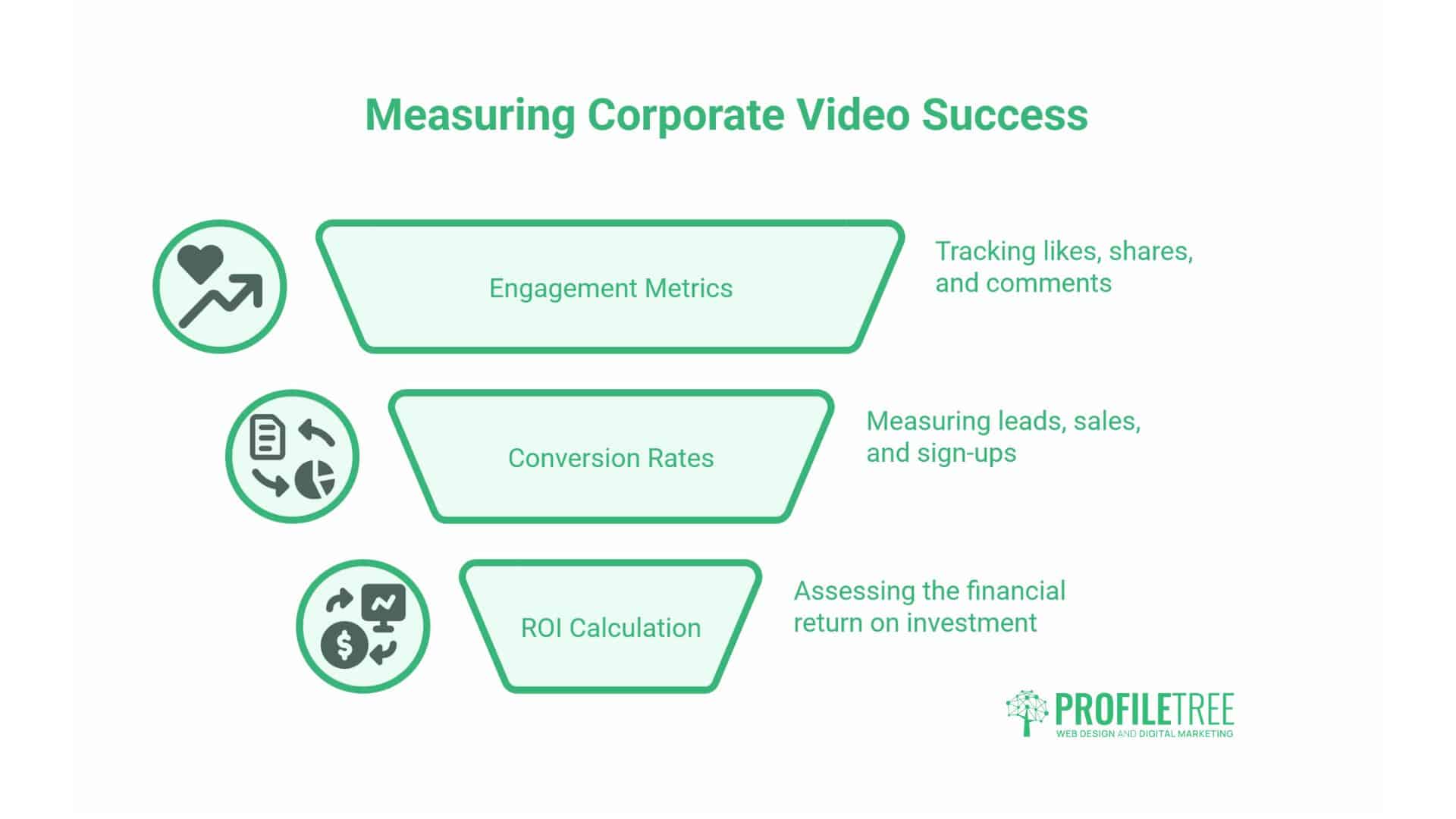
Views are easy to count. Commercial outcomes are what matter, and this is where most businesses stop measuring too early.
The right metrics depend on where your video sits in the customer journey and what you’re asking it to do. A testimonial video on a service page should be measured against the enquiry rate. A training video should be measured against onboarding completion and support ticket volume. A brand film in a paid social campaign should be measured against cost per lead and lead quality, the same ROI benchmarks as the rest of the marketing budget.
Useful metrics by video type:
Service page video: scroll depth, time on page, and conversion rate before and after adding the video. If the page has a contact form or booking function, track whether the completion rate changes.
Testimonial video: conversion rate on the page where it lives. Are visitors who watch more likely to enquire than those who don’t?
Social video: completion rate, click-through rate to your website, and cost per result on paid campaigns.
Training video: completion rate and assessment scores, where applicable, and any reduction in repeat questions to managers or HR.
YouTube-hosted content: watch time, subscriber growth, and whether organic search is driving traffic to your channel. YouTube marketing sits alongside video production as a discipline in its own right; publishing a video is one step, building a channel that generates consistent inbound traffic is another. A structured approach to YouTube SEO makes a measurable difference to whether that content keeps working after launch.
Most video analytics tools, including YouTube Studio and the analytics suites built into most hosting platforms, provide the data you need to track these outcomes. If your video is embedded on your website, Google Analytics 4 can be configured to fire events when a video is played or completed, giving you audience-level data rather than aggregate counts. This is the same measurement discipline that underpins a good digital marketing strategy generally; video shouldn’t sit outside it.
Beyond the Final Cut: Distribution Is Part of the Budget
The most common mistake in corporate video production is treating distribution as an afterthought. A £10,000 brand film with no distribution plan behind it will underperform a £2,000 testimonial video that’s been properly placed in front of the right audience.
Before the shoot, decide where the finished video will live and in what form. A video built for a sixteen-by-nine YouTube upload doesn’t work as a nine-by-sixteen short-form LinkedIn or TikTok clip without re-editing; the hook timing, caption placement, and pacing all need to change for a vertical, sound-off feed. Planning for this during the edit, rather than after delivery, avoids paying for a second edit later.
For businesses running the video across paid and organic social simultaneously, that’s a job for your social media marketing team to plan alongside production, not something that gets bolted on once the file lands in a folder. The same applies to email: a static thumbnail with a play button, in line with what the data on video email marketing, embedded in a sales follow-up, often outperforms a cold text-only email, provided the video itself is short enough to watch on a phone during a commute.
Choosing a Video Production Partner: What to Ask
Before signing off on a quote, a short list of questions protects the budget and the outcome.
Ask how they handle pre-production. An agency that goes straight to booking a filming date without first discussing the script or shot list is setting the project up for overruns.
Ask what happens to the raw footage. Ownership depends on the contract, and most agencies retain raw footage unless a transfer is explicitly agreed and priced. Clarify this before the shoot, not after.
Ask how they approach subtitles and platform-specific edits. If the quote covers only one master file, ask what a second cut for vertical platforms would cost to avoid surprises later.
Ask for examples in a similar sector. A partner with relevant sector experience, whether that’s manufacturing, professional services, or hospitality, briefs faster and avoids rookie mistakes on location.
Ask how they measure success. A partner who can talk through view-through rate, enquiry attribution, or completion rate is thinking about the video as a business asset rather than a one-off deliverable. If you’d like a second opinion on a quote before signing, get in touch to talk through the brief.
Next Steps for Planning Your Corporate Video
Corporate video production works best when it’s planned as part of a wider project rather than commissioned in isolation. If you’re building a new website, redesigning service pages, or launching a product, building the video brief alongside that work, as part of the wider service conversation, is far cheaper than retrofitting video into a site that wasn’t designed to accommodate it.
Start with the goal, not the format. Decide what you want the viewer to do after watching, choose the format that supports that action, and only then start thinking about crew, location, and shot list. Businesses that get this sequence right consistently spend less and achieve better results than those who start with a bare request for “a video” and work backwards from there.
FAQs
How long should a corporate video be?
For most business goals, sixty to ninety seconds is the most effective length. Training videos and in-depth product demonstrations can run longer where the content genuinely requires it, but anything aimed at a cold audience on social media should assume most viewers drop off within the first fifteen seconds.
What are the three stages of corporate video production?
Pre-production covers planning, scripting, and logistics. Production is the filming itself. Post-production covers editing, colour grading, sound, graphics, and final delivery, including any AI-assisted steps like transcription and colour matching.
How much does corporate video production cost in the UK?
Most SME projects cost between £1,500 and £8,000 per finished piece, depending on location, crew size, and post-production complexity. High-end multi-location productions with professional talent can run to £20,000 or more.
Who owns the footage after production?
Ownership depends on your contract. Most agencies retain raw footage unless a transfer of files is explicitly agreed and priced. Always clarify this at the brief stage, not after the shoot.