
Business-to-Business SEO Services for NI and Ireland
Table of Contents
Business buyers research suppliers the same way consumers research anything else: they search first. The difference is what happens next. A procurement manager comparing CNC machining suppliers behaves nothing like someone browsing trainers, and B2B SEO has to account for that gap. It’s the practice of optimising a website so it appears when the people who influence a business purchase, not a casual browser, are actively researching a solution.
ProfileTree provides B2B SEO services for manufacturing, professional services, and technology companies across Northern Ireland, Ireland, and the wider UK. If you’re comparing B2B SEO services UK-wide against a Belfast-based option, this guide covers how B2B SEO actually works, where it differs from consumer SEO, and what a realistic strategy looks like for an SME competing against both local rivals and larger agencies. You can jump to SEO services in Belfast if you want to see how we structure ongoing campaigns.
Why B2B Search Works Differently from B2C
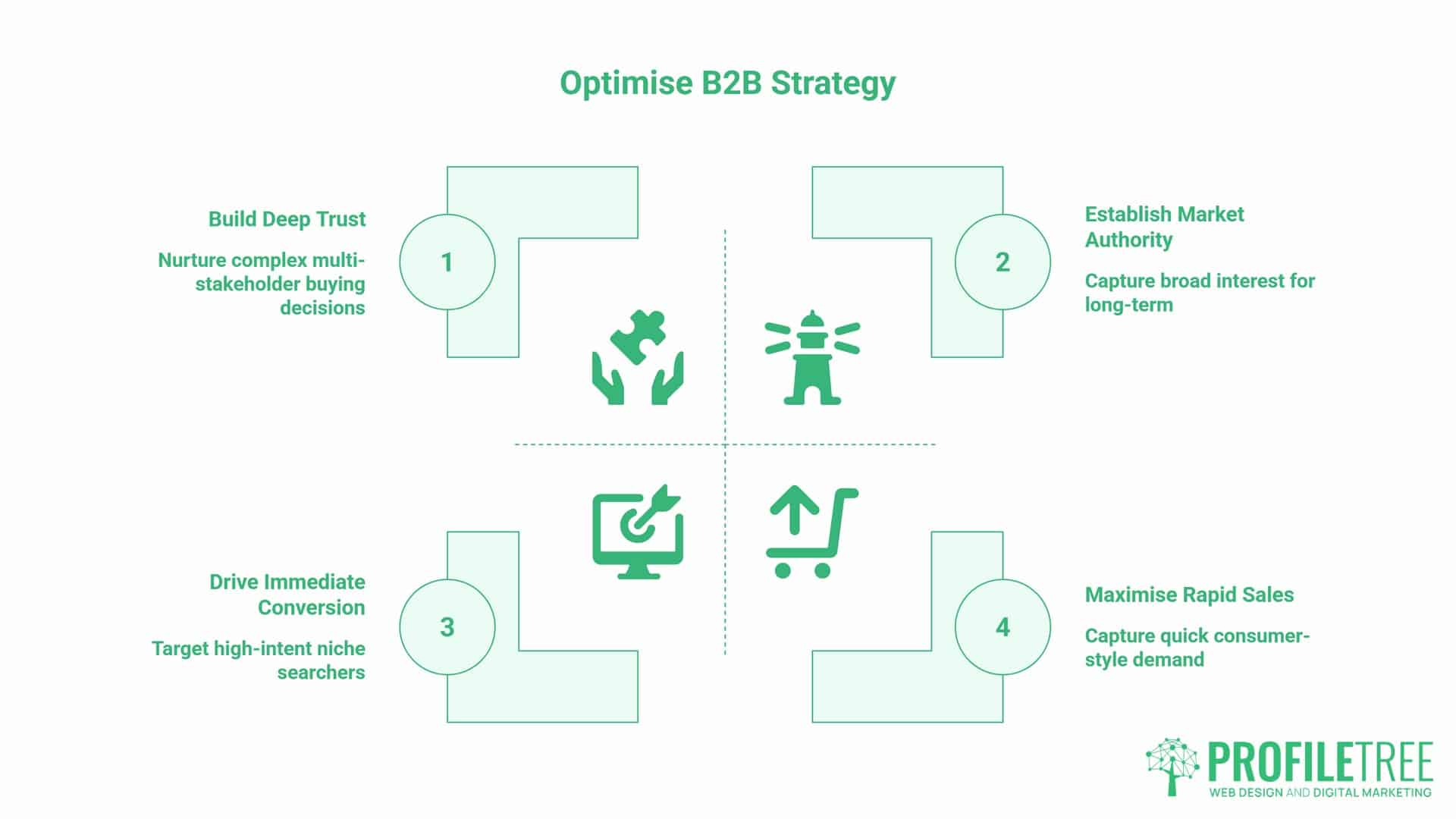
A consumer buying a laptop might search once, compare three options, and check out within the hour. A business buying a new ERP system behaves very differently, and that gap is the entire reason B2B SEO exists as a separate discipline.
The B2B Buying Committee
Most business purchases involve more than one decision maker. A £40,000 software contract might pass through a technical evaluator checking integration requirements, a finance director checking total cost of ownership, an end user checking whether it solves their actual problem, and a procurement lead checking supplier risk. Each of those people searches for something different, often weeks apart, and a page written for only one of them misses the rest of the committee.
| Stakeholder | What They Search For |
|---|---|
| Technical evaluator | Specifications, integration requirements, compatibility |
| Financial decision maker | Pricing, total cost of ownership, ROI |
| End user | Usability, day-to-day features, support |
| Procurement | Supplier risk, compliance, contract terms |
| Executive sponsor | Strategic fit, vendor credibility |
Long Sales Cycles and Lower Search Volumes
B2B keywords rarely have the search volume of consumer terms. “ISO 9001 metal fabrication Belfast” or “outsourced payroll for accountancy firms” won’t show up in a keyword tool with hundreds of monthly searches, but the person typing them is close to a buying decision, not idly browsing. This is the opposite of most B2C SEO advice, where volume is the first filter. In B2B, a handful of monthly searches on a highly specific term can be worth more than a thousand searches on a generic one, because the buyer already knows roughly what they need.
| Factor | B2C Reality | B2B Reality |
|---|---|---|
| Search volume | High | Low to moderate |
| Sales cycle | Minutes to days | Weeks to years |
| Decision makers | Usually one | Often five or more |
| Content priority | Conversion speed | Trust and depth |
| Success metric | Traffic and sales | Lead quality and pipeline value |
Sales cycles that span months mean SEO has to support every stage, not just the point when someone is ready to buy. A manufacturer researching “reducing downtime in CNC production” today might not request a quote for three months. If your content only exists at the transactional end, you lose that early-stage visibility to whoever wrote the guide they found instead.
The Four Pillars of a B2B SEO Strategy
A B2B SEO campaign that works rests on four pillars: the technical foundation, keyword research, authority building, and the conversion path. Miss one and the others struggle to compensate.
Technical Foundations for Complex Site Architectures
B2B websites tend to have more moving parts than a typical consumer site: product catalogues, spec sheets, case study libraries, and service pages that need to fit into a logical hierarchy so both users and search engines can navigate them. A site where the product catalogue isn’t properly linked to related case studies, or where JavaScript rendering blocks crawlers from seeing key specifications, loses visibility before the content even gets evaluated on quality. Our website development work for B2B clients usually starts here, fixing the structure before touching a single word of copy.
Keyword Research That Maps to the Buyer Journey
Generic keyword research tools built for consumer volume don’t capture B2B search behaviour well. Effective B2B keyword research draws on sales team input (what prospects actually ask on calls), customer interviews, and close reading of the sector’s specific, jargon-heavy language. A law firm’s clients don’t search “legal advice”; they search “commercial lease dispute solicitor Belfast” or “share purchase agreement review.” Mapping those terms to problem-aware, solution-aware, and purchase-ready stages of the journey keeps content relevant at every point a buyer might land.
Authority Building Through Industry Signals
Backlinks from a generic business directory carry little weight for B2B trust. Authority in this space comes from industry associations, contributions to trade publications, partner and integration pages, and original research that other sites want to cite. A content marketing programme built around genuine expertise, rather than generic blog volume, tends to earn these links naturally over time.
Conversion Optimisation for Qualified Leads
The final pillar is turning search visibility into leads that are actually worth pursuing. That means clear next steps on every page (a specification download, a consultation booking, a direct enquiry route), and it means being deliberate about which pages you optimise for volume versus which you optimise for qualification. A page ranking for a broad term but attracting the wrong audience is not a win; it is noise in your analytics.
B2B SEO by Sector: Manufacturing, Professional Services, and Technology
Generic B2B SEO advice only goes so far. The specifics change considerably depending on what you sell and to whom.
SEO for Manufacturing and Industrial Suppliers
Manufacturing and industrial B2B buyers search on precise technical terms: tolerances, materials, certifications, and capacity. A supplier page that says “high quality metal fabrication” tells a buyer nothing they can act on. A page that states the tolerances you can hold, the ISO certifications you carry, and the capacity you can turn around in a given timeframe answers the actual question a technical evaluator has typed into Google. Export-focused NI manufacturers also need to consider search intent among GB and EU buyers, not just local ones, which affects both keyword choice and site structure.
SEO for Professional Services: Legal, Accounting, and Consultancy
Trust is the currency in professional services SEO. A prospective client comparing commercial solicitors or corporate finance advisers is evaluating credibility as much as capability, which means team profiles, verifiable credentials, and clear, jargon-free explanations of complex services matter more here than in almost any other B2B sector. Thought leadership content, written by named experts rather than generic bylines, does more work in this sector than volume-driven blogging.
SEO for Technology and SaaS Companies
Technology buyers often compare several near-identical solutions, so content differentiation matters more than keyword volume. Integration pages (does this connect to the tools we already use), comparison content that is honest about trade-offs, and demo or trial conversion paths tend to outperform generic “what is X software” explainers, because the audience already understands the category and wants specifics.
B2B SEO in Northern Ireland and Ireland
Most UK B2B SEO guidance is written from a London perspective and doesn’t reflect how search behaviour differs for businesses based in, or selling into, Northern Ireland and the Republic of Ireland. Anyone specifically searching for B2B SEO Northern Ireland advice will quickly find this gap: the generic guides don’t mention cross-border search intent at all.
Regional Search Behaviour: Local Reach Versus Cross-Border and Export Markets
A Belfast-based accountancy firm serving local SMEs has a very different keyword profile to an NI manufacturer exporting to GB and the EU. The first needs location-specific terms tied to Belfast and the wider NI market; the second needs to think in terms of sector and capability first, location second, because their buyers are searching by what they need, not where the supplier is based.
Cross-Border Considerations: Belfast and Dublin
Businesses operating across the Irish border face a further wrinkle: search intent and terminology can differ between Belfast and Dublin, even for the same service, and a site that reflects only one market’s language misses buyers researching in the other. Structuring content so it serves both without duplicating thin, swapped-city pages takes deliberate planning, not just copying a template and changing the place name.
B2B SEO and AI: Appearing in ChatGPT and Google’s AI Overviews
Buyers increasingly ask AI tools directly, rather than typing a search query and clicking through ten results. “What should I look for in a B2B SEO agency” or “compare ERP systems for manufacturers” are the kind of prompts a buyer might put into ChatGPT or Gemini before they ever reach a search engine, and the businesses cited in those answers get considered before the ones that aren’t.
How Citation Works in AI-Generated Answers
AI systems tend to cite content that states things clearly and specifically, in a form that can be lifted and summarised without losing meaning. Vague, promotional copy rarely gets cited; content that states a fact, a process, or a comparison in plain, declarative sentences tends to fare better. This is a natural extension of good B2B content practice generally, not a separate discipline that requires rewriting everything from scratch.
Building the Signals That Support Citation
The same authority signals that help traditional rankings, clear expertise, verifiable credentials, and content that other reputable sites reference, also support AI citation. Businesses investing in digital strategy work that aligns sales and marketing teams around consistent messaging tend to build these signals more consistently than those treating SEO and AI visibility as separate projects.
Measuring B2B SEO Success: Why Rankings Alone Don’t Pay the Bills
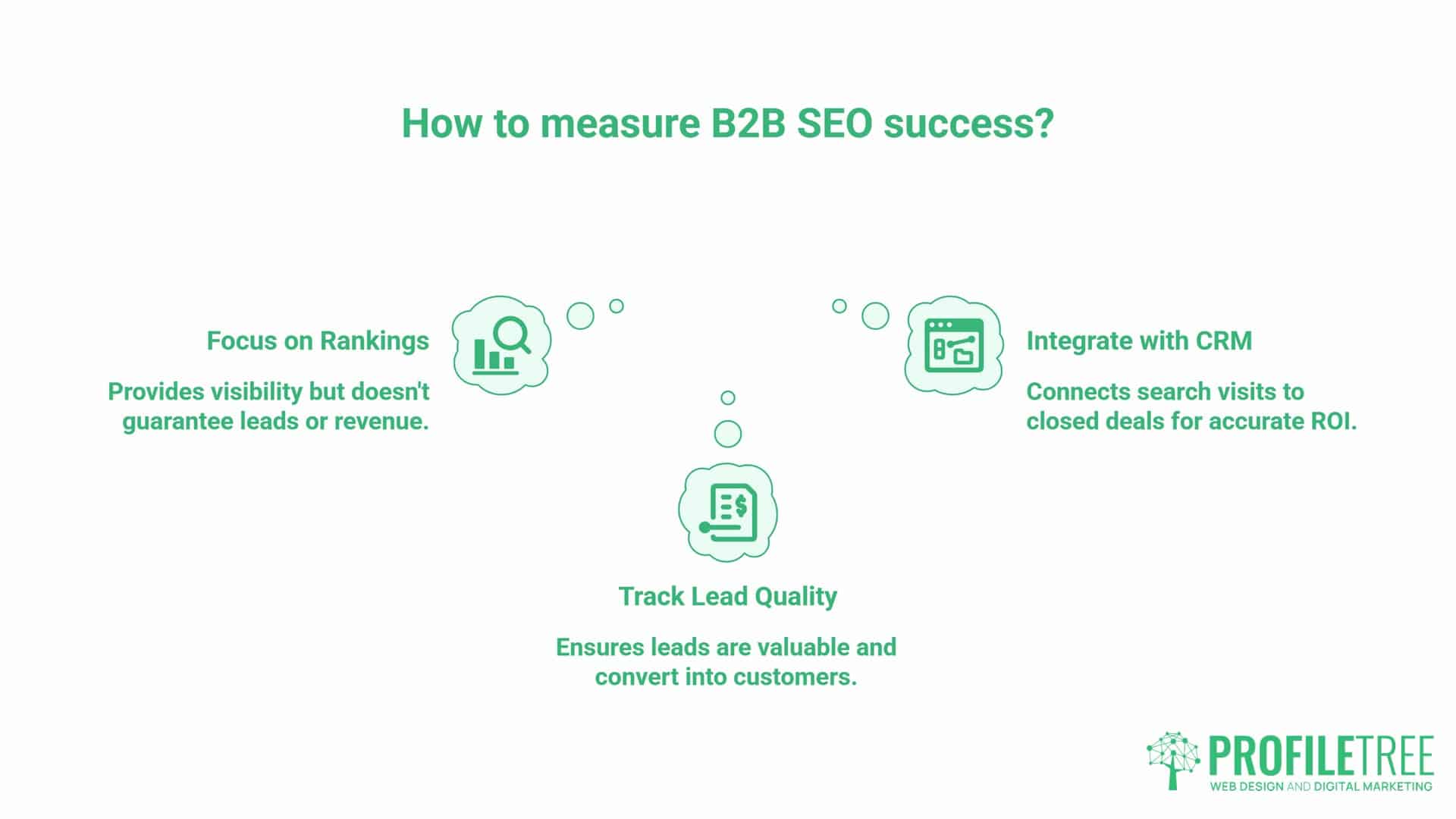
A page-one ranking for a term nobody in your buying audience searches is worth nothing. B2B SEO has to be measured against lead quality and pipeline, not visibility for its own sake.
Tracking Lead Quality Over Traffic Volume
Traffic is easy to report and largely meaningless in isolation for B2B. What matters is whether the traffic converts into Marketing Qualified Leads, whether those leads get accepted by sales as Sales Qualified Leads, and whether they eventually become closed business. A campaign that halves your traffic but doubles your qualified leads is a better outcome than one that doubles traffic and changes nothing else.
| Metric | What It Actually Tells You |
|---|---|
| Organic traffic | Visibility only, not value |
| Marketing Qualified Leads | Leads meeting your defined criteria |
| Sales Qualified Leads | Leads sales are accepted as worth pursuing |
| Pipeline value | Revenue potential currently in progress |
| Closed won | Actual revenue attributable to SEO |
Integrating SEO With CRM Data
Because B2B sales cycles run for months, connecting first-touch search visits to eventual closed deals in your CRM is the only way to see whether SEO is actually working, rather than guessing from ranking reports alone. This takes patience: a lead that arrives via search in January might not close until the autumn, and reporting on SEO in isolation from the sales pipeline tends to undervalue it as a result.
Why Work With ProfileTree on B2B SEO
ProfileTree has worked with B2B clients across the manufacturing, professional services, and technology sectors in Northern Ireland and Ireland, so the strategy behind this guide isn’t theoretical. Ciaran Connolly, founder of ProfileTree, puts it directly: “B2B SEO fails the moment you treat it like a consumer campaign. You’re not chasing volume, you’re building trust with a handful of specific people who each need a different answer, often months apart. That’s a different job entirely, and it needs a different plan.”
A Full-Funnel Approach
B2B SEO for us isn’t a standalone service bolted onto a website. It sits alongside website design for the site structure a complex B2B offering needs, content marketing for the thought leadership that earns trust with each stakeholder, and video production for the explainer and demo content technical buyers often want before they’ll pick up the phone.
We’re a five-star rated agency on Google, based in Belfast, with experience across B2B sectors that most generalist agencies haven’t worked in. When you’re shortlisting a B2B SEO agency, ask what sectors they’ve actually delivered results in, not just what they claim to cover.
Key Takeaways for B2B Leaders
B2B SEO succeeds or fails on whether it reflects how business buyers actually search: slowly, through several people, using specific and often technical language, across a sales cycle that can run for months. Northern Irish and Irish B2B firms face an added layer that most generic guidance ignores, cross-border search behaviour and export-market intent, that a copy-pasted template will not address.
If your current SEO strategy still measures success in traffic rather than qualified pipeline, that’s the first thing worth changing. Get in touch with ProfileTree to talk through what a B2B SEO strategy for your sector and market would actually involve.
FAQs
How is B2B SEO different from B2C SEO?
B2B SEO targets fewer, more qualified searchers across longer sales cycles, often involving several decision makers rather than one. B2C SEO optimises for volume and fast conversion; B2B SEO optimises for trust, depth, and relevance to a specific buying committee, where the reward is a handful of high-value leads rather than a high volume of transactions.
How much does B2B SEO cost in the UK and Ireland?
Retainer-based B2B SEO for UK SMEs typically ranges from £1,500 to £5,000 per month. Irish B2B retainers can be lower for local or single-market campaigns, but climb into a similar range for national, sector-specific, or multi-stakeholder campaigns of the kind this guide covers. Given that a single enterprise-level contract can be worth tens of thousands of pounds, the return on a sustained campaign is usually easier to justify in B2B than in lower-value consumer markets, provided the campaign is measured against pipeline rather than traffic alone.
How long does it take to see results from B2B SEO?
Most B2B SEO campaigns show ranking movement within four to six months, with genuine lead generation typically following at six to nine months. Because B2B sales cycles are longer than consumer ones, revenue impact can take longer again to show clearly in reporting. This is not a reason to delay measurement; it is a reason to track leading indicators (rankings, qualified leads, pipeline entries) rather than waiting for closed revenue before judging progress.
Should I focus on high-volume keywords?
No. Low-volume, highly specific keywords tend to convert better in B2B because the person searching already understands roughly what they need. A term with fifty monthly searches from procurement managers actively evaluating suppliers is usually worth more than a generic term with ten times the volume and none of the buying intent.
What is the best B2B SEO strategy for a SaaS company?
Focus on category education and problem-solution content rather than competing purely on feature lists. SaaS buyers often compare several similar tools, so content that helps them understand which solution category they actually need, followed by honest comparisons, tends to perform better than generic product marketing.
Can B2B SEO genuinely support lead generation, not just brand visibility?
Yes, provided the content is built around the stages a buyer actually moves through, from problem recognition to vendor evaluation, with clear next steps at each stage. SEO that only produces awareness content without a path to enquiry generates visibility without leads; SEO built with conversion points at every relevant stage generates both.