
How to Write a Perfect Introduction and Conclusion
Table of Contents
Arguably, the most important parts of any piece of writing, including those enhanced by paper writing services, introductions and conclusions, are what explain the article and summarise it. The introduction sets out the argument you want to make, whereas the conclusion summarises it through the evidence you have produced in your body paragraphs.
Using your introduction to identify your topic helps the reader decide whether or not they shall remain on the piece or move off it. It is used to provide crucial information and context to a reader and needs to be written to engage a reader. Conclusions bring a sense of closure to every piece of work, so ensuring they are sound and informative is integral to effective writing.
Mastering both the introduction and conclusion is essential for effective communication. Together, they frame your message, guide the reader’s journey, and give your writing purpose and polish. In this article, we’ll explore how to craft compelling openings and memorable endings that elevate your writing and keep readers engaged from the first sentence to the last.
The Importance of an Introduction
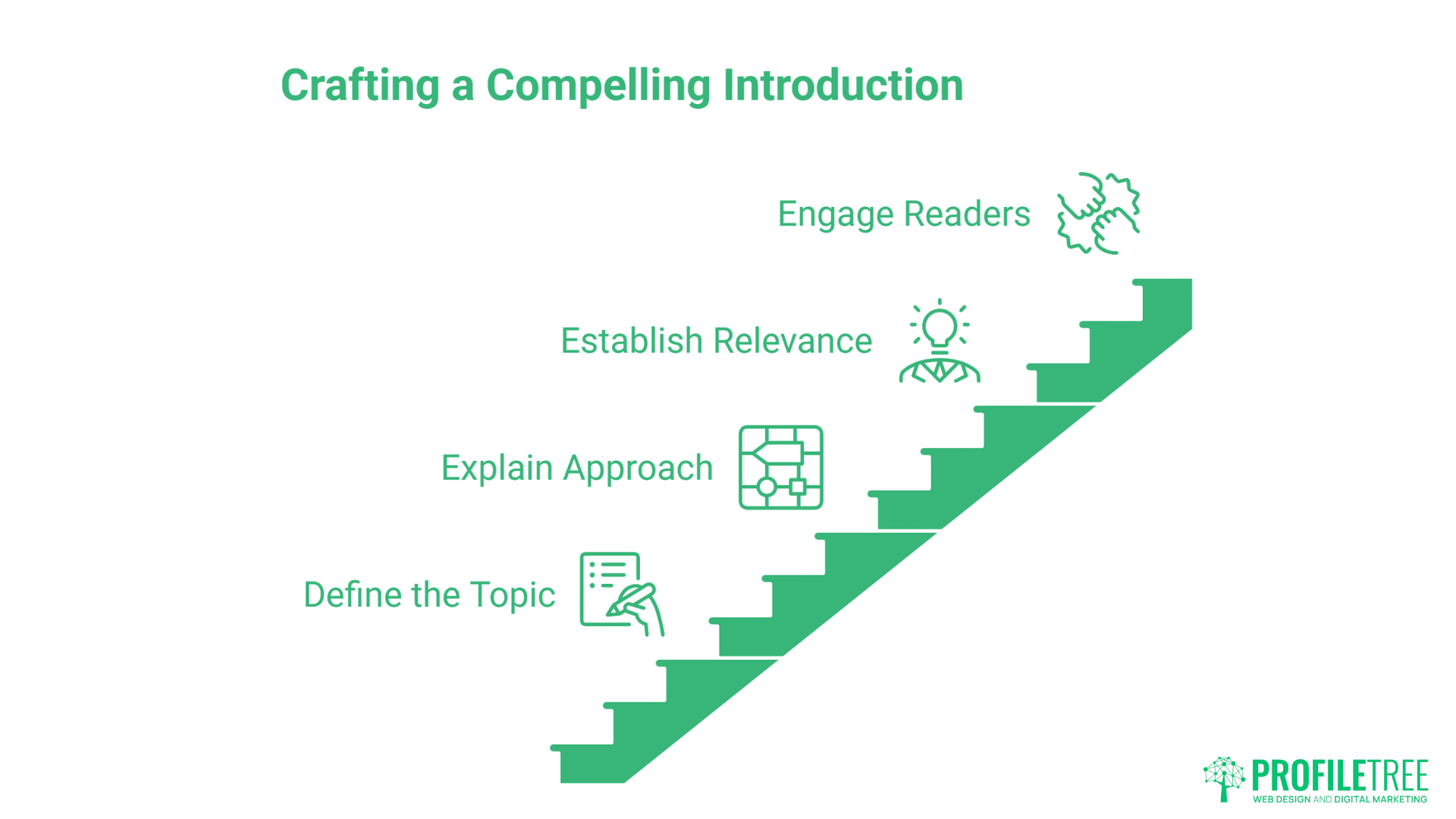
For many writers, the most difficult part of any piece of writing is the introduction. Getting those first sentences right sets the tone for everything that follows.
- What: it defines what your body of the text is and explains the purpose of the piece. This helps the reader understand what you are going to discuss and whether it addresses their needs.
- How: it helps readers grasp how you will approach a particular topic and the opinions you are going to share. This is particularly important for business content where you need to establish credibility.
- Why: it helps readers understand why you are discussing this topic and why it is important or relevant to your field of study or work. For marketing content, this connects directly to solving customer problems or meeting business objectives.
Introductions function as bridges between your reader and the topic you are going to investigate. It allows them to see the general format of your blog and the points that you want to stress.
Something that has a confused or distorted introduction can confuse the reader and make them unsure of what they’re about to read. This has a negative impact on bounce rate and can dim your content marketing efforts. Creating fresh, exciting content begins with a strong introduction and that’s something that experienced copywriters want to deliver to their audience.
Studies show that readers form an opinion about a piece of writing within the first few seconds. A compelling introduction makes a positive first impression and draws readers in, whilst a weak opening sends them back to search results. This principle applies across all content types, whether you’re writing blog posts for SEO, creating copy for web design projects, crafting video scripts for YouTube content, or developing training materials for AI implementation workshops.
How to Write a Perfect Introduction
When writing an effective introduction, the first thing that you should begin with is working out the questions you want to answer. This content strategy will help you focus on what keywords and phrases you want to illustrate in your body copy that can help this page become valuable, moving you up the results page.
The Hook That Captures Attention
Some methods for developing a good introduction include using a statistic to pull people in. This helps others see the problem or how something could be a solution to their problem.
For example, video marketing will make up 82% of internet traffic according to Cisco. This makes the reader want to take action around video content and introduces why you think video marketing is an important part of their content strategy. At ProfileTree, we use this approach when explaining YouTube strategy and video production services to clients, leading with the business case before diving into methodology.
You can quote an expert in the industry or field that you are going to talk about. This ensures that people will engage with your content as they recognise the name, and you are basing your content on something that an authority in the industry has said.
The hook is your first opportunity to demonstrate authority. In UK business writing, understated authority outperforms exaggerated claims. Instead of proclaiming a topic “the most important issue in the world,” demonstrate its importance through specific, localised examples.
Example of a weak hook: “Content marketing is very important for businesses today.”
Example of a strong UK hook: “Whilst 73% of UK SMEs maintain business websites, fewer than 40% publish regular content—creating opportunities that forward-thinking businesses exploit for competitive advantage.”
The Funnel Method: Broad to Specific
Once you’ve captured attention with your hook, you need to narrow your focus. This is where you provide context and define parameters. If you’re writing about AI implementation for small businesses, specify whether you’re addressing customer service automation, marketing applications, or operational efficiency.
This clarity serves multiple purposes. It manages reader expectations, preventing disappointment when their specific need isn’t addressed. It also improves SEO performance by signalling to search engines exactly what your content covers, helping you rank for precise search queries.
The Thesis Statement: Your North Star
The thesis is the most critical sentence in your introduction. It’s a one-sentence distillation of your entire argument. A common pitfall is making the thesis a “statement of intent” (e.g., “This essay will look at…”) rather than a “statement of argument” (e.g., “This article demonstrates how…”).
The Thesis Acid Test: If you removed every other sentence from your introduction, could a reader still tell exactly what your conclusion will be? If the answer is no, your thesis is a description, not an argument.
For business content, this translates to clear value propositions. Rather than “We will discuss various web design principles,” write “Conversion-focused web design prioritises user journey mapping, typically increasing lead generation by 40-60% for service-based SMEs.
“Most businesses struggle with their thesis statements because they confuse describing what they do with demonstrating why it matters,” explains Ciaran Connolly, Director at ProfileTree. “The strongest introductions make a clear promise to the reader—and then the content delivers on that promise.”
Things to Avoid in Your Introduction
When crafting introductions, certain practices undermine effectiveness:
Don’t go into too much detail in your introduction. This should be left for your body copy to allow for a full and complex explanation. Your introduction previews your argument—it doesn’t make the entire case.
Avoid dictionary definitions. Most of the time, this is entirely unnecessary. Opening with “According to the dictionary, content marketing means…” signals amateur writing. This is only appropriate if you are using a word or term that people genuinely would not have heard before.
Skip the throat-clearing. Many writers spend two paragraphs on generalities before reaching their point. Review your drafts by deleting the first paragraph entirely. Often, your second or third paragraph contains your actual opening.
Why You Need an Effective Conclusion
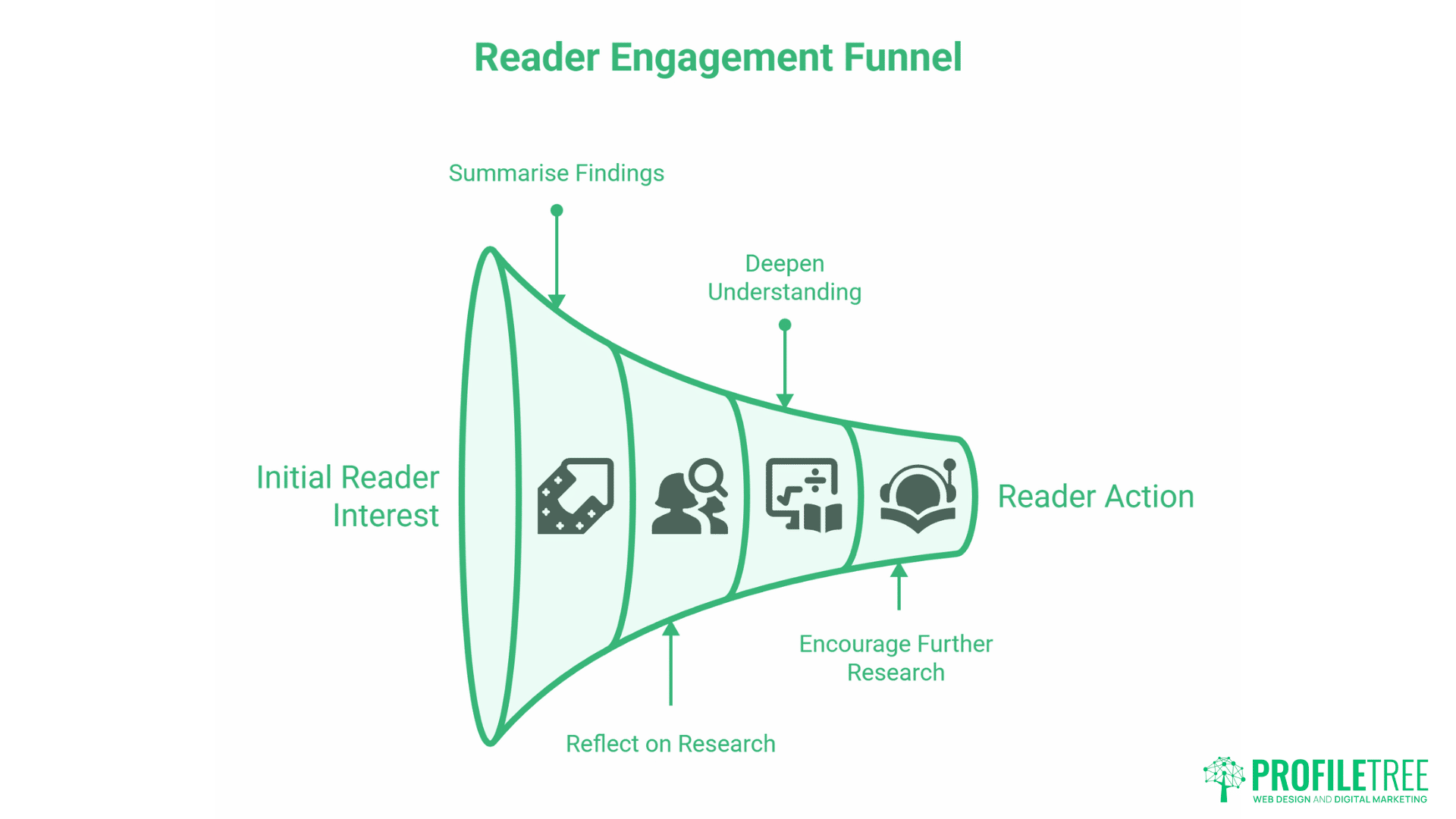
Conclusions are a wonderful way of summarising your findings to your reader and give them clarity on the topic that you have just formed. Usually, they provide key takeaway information that the reader will be able to scan if they don’t have the time to read the full article.
The conclusion presents your evidence from your findings in a digestible way for your reader. It lets you reflect on your research and gives you time to apply it to a wider picture as well. For example, hiring a copywriter will help with social engagement because of the constant output of fresh content.
Through a conclusion, your target audience will be able to have a deeper understanding of the major points you were trying to make in your content as well. This encourages them to keep researching, and if you have content on site about a relevant topic, you are more likely to keep them interested in what you have to offer on your website.
The recency effect means the final “flavour” you leave in the reader’s mouth determines their overall satisfaction and whether they take action. For businesses, this translates to whether visitors fill out contact forms, request consultations, or move to competitor websites.
Structure and Types of a Good Conclusion
Whilst introductions narrow from broad to specific, effective conclusions reverse this pattern. Start with specific insights from your body content, then expand to broader implications and applications.
- Summarise the Main Points: Begin by succinctly revisiting the major arguments or pivotal information from your work. This isn’t just about reiterating facts, but synthesising them in a way that highlights their significance. Use this recap to show how each key point supports your overall thesis.
- Reiterate the Thesis Statement: Reinforce the core of your message. However, avoid merely repeating it verbatim from the introduction. Instead, rephrase it to reflect the deeper understanding or perspective gained through your writing.
- Provide Closure with Impact: Your final sentence is your chance to make a lasting impression. It should resonate with readers, leaving them with something memorable. Consider linking your conclusion back to the wider context, emphasising the relevance and implications of your work.
The Action-Focused Conclusion
For blog posts aimed at business owners ready to implement changes, provide specific next steps. This approach works particularly well for how-to content, guides, and tutorials.
Instead of saying, “This essay has provided a glimpse into the fascinating world of renewable energy solutions,” you should say, “Let us embrace these innovations and collectively work towards a cleaner and more sustainable future for our planet.”
For business content, direct readers to concrete actions: “Optimising your website content begins with audit, not creation. First, identify your ten highest-traffic pages using Google Search Console. Second, analyse their current conversion rates through Google Analytics.”
The Insight-Driven Conclusion
When your content aims to educate rather than immediately convert, close with an insight that reframes how readers think about your topic.
Example: “The distinction between businesses that succeed with content marketing and those that abandon it after six months rarely comes down to budget or resources. It hinges on whether marketing teams view content as decoration—nice to have but peripheral—or as infrastructure—essential to business operations.”
The Warning Conclusion
For topics where inaction carries risk—website security, SEO penalties, competitive positioning—closing with carefully framed warnings motivates action without fear-mongering.
Use your conclusion as a means of warning readers about the consequences of not taking action on the topic you’re writing about. Direct your readers to a specific course of action so they know what to do when in this situation.
Conclusion Elements to Avoid
- Never Use “In Conclusion”: Opening your final section with “In conclusion” or “To sum up” signals amateur writing. Your paragraph structure and content should make clear you’re concluding without explicitly announcing it.
- Don’t Introduce New Information: Your conclusion synthesises existing arguments—it doesn’t introduce fresh concepts requiring explanation. Raising new topics in final paragraphs frustrates readers who expected closure.
- Avoid Apologising for Your Content: Never close by diminishing what you’ve written: “This is just a brief overview” or “There’s much more to learn about this topic.” These statements undermine the value you’ve provided.
- Connect Introduction to Conclusion Seamlessly: The most sophisticated conclusions create symmetry with introductions through the “echo” technique. Reference your opening hook, return to your initial example, or mirror your introduction’s language to create satisfying closure.
Organisational Strategies
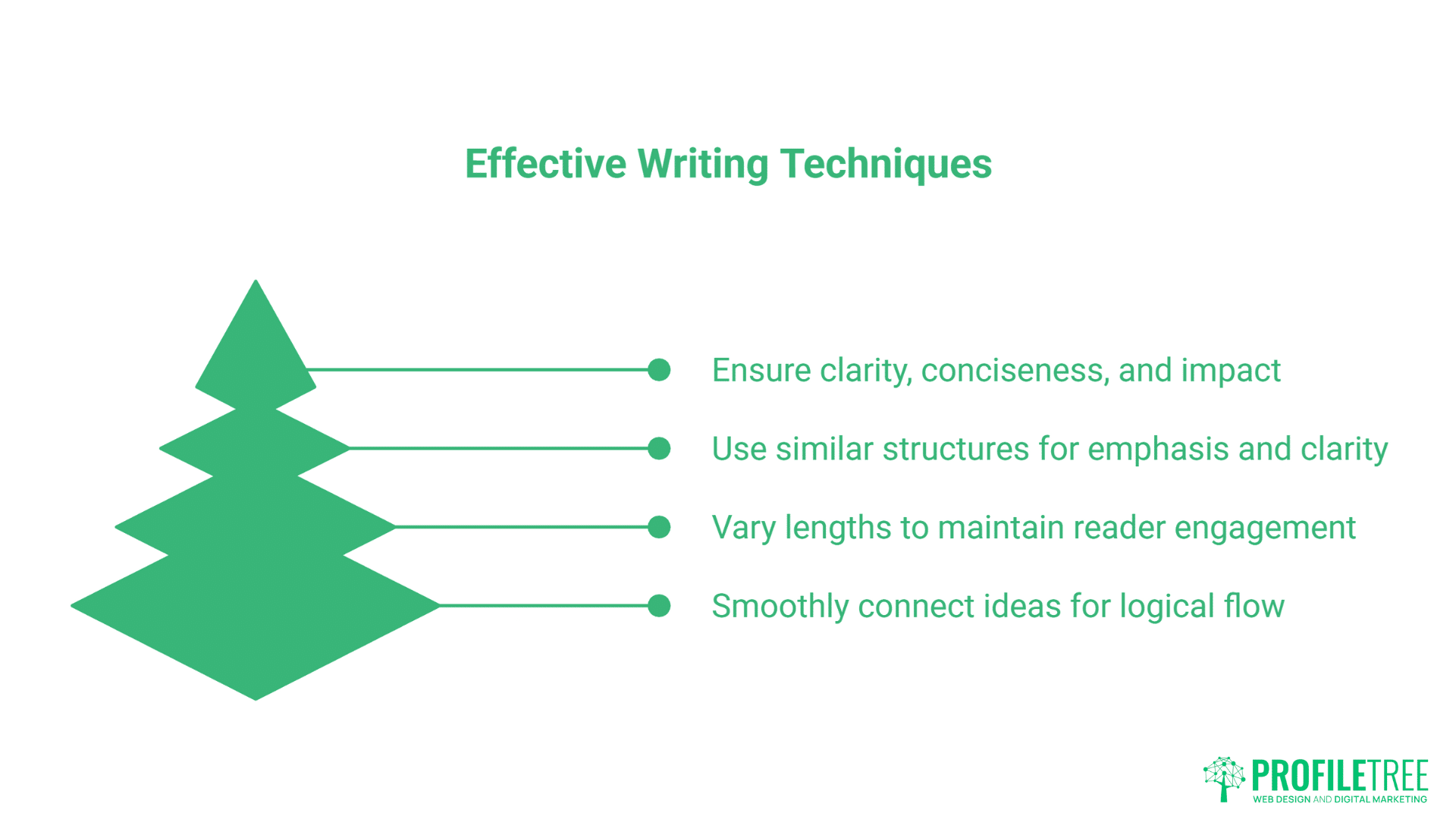
Effective introductions and conclusions require strong organisational techniques to guide readers smoothly through your content.
- Use Transition Words and Phrases: Employ transition words and phrases to smoothly connect ideas and guide the reader through your writing. This helps create a logical flow and promotes understanding. Words like “however,” “therefore,” “additionally,” and “consequently” help readers follow your argument.
- Vary Sentence Structure: Utilise different sentence structures and lengths to avoid monotony and maintain reader engagement. A combination of short and long sentences adds rhythm and keeps readers actively involved. Short sentences create impact. Longer sentences allow for detailed explanation and nuanced argument.
- Employ Parallelism: Use parallel sentence structure to create emphasis and clarity in your writing. This can be particularly effective in summarising key points or concluding remarks. For example: “SEO generates traffic, web design converts visitors, content builds authority.”
- Proofread and Revise: Carefully proofread and revise your introduction and conclusion to confirm clarity, conciseness, and impact. Check for grammatical errors, awkward phrasing, and any redundancy. These sections deserve extra attention as they shape first and last impressions.
Captivating Introductions and Conclusions: Examples and Samples
Understanding theory helps, but seeing concrete examples makes principles actionable. Here are samples demonstrating effective techniques.
Start with a Question Hook
Hook: “Can artificial intelligence ever truly replace human creativity?”
Background Information: “As technology advances at an unprecedented pace, the line between human and machine capabilities continues to blur.”
This approach works particularly well for thought leadership content and blog posts exploring emerging trends in digital marketing, AI implementation, or web development.
End with a Call to Action
Instead of saying, “This essay has provided a glimpse into the fascinating world of renewable energy solutions.”
You should say, “Let us embrace these innovations and collectively work towards a cleaner and more sustainable future for our planet.”
For business content, your call to action might direct readers to book consultations, download resources, or explore related services that address the challenges discussed in your article.
Sample Introduction (Argumentative Content)
“Climate change remains a critical concern for businesses worldwide. As scientific evidence mounts and regulatory requirements intensify, the need for sustainable practices becomes undeniable. This article argues that transitioning to renewable energy sources offers not only environmental benefits but also significant cost savings and competitive advantages for forward-thinking organisations.
Sample Conclusion (Argumentative Content)
“Therefore, it is imperative for businesses to implement sustainable energy solutions. By adopting renewable sources, companies can reduce operational costs, meet regulatory requirements, and position themselves as industry leaders in environmental responsibility. The question is no longer whether to transition, but how quickly you can implement these changes.”
Writing Content for Businesses
When writing content, whether for websites, blogs, marketing materials, or training documentation, introductions and conclusions take on additional strategic importance.
Key Takeaways for Business Content
Some key principles for business introductions and conclusions include:
- Take the ‘What, Why, and How’ Approach: When you’re writing your introduction, address these three elements clearly. Business readers have limited time and need to quickly assess whether your content meets their needs.
- Frame the Questions You’re Going to Answer: Your introduction should always establish the specific questions or problems you’re addressing. This helps with SEO by aligning with search intent, and it helps readers confirm they’re in the right place.
- Use Quotes or Statistics to Engage Readers: Data-driven hooks work particularly well for business audiences. They provide concrete evidence of problems or opportunities that merit attention.
- Direct Readers to Specific Actions: Your conclusion should guide readers toward clear next steps. For service-based businesses like digital agencies, this might mean offering consultations, directing to related resources, or inviting readers to explore specific services.
Aligning Content with Search Intent
Google’s algorithms increasingly prioritise content that matches specific search intent. Understanding the four primary intent types helps you craft appropriate introductions and conclusions:
- Informational Intent: Users seeking information want educational content. Your introduction should establish credibility through expertise signals. Your conclusion should provide actionable frameworks they can implement immediately.
- Navigational Intent: Users searching for specific resources already know what they want. These searches typically lead to homepage or service pages where introductions focus on clear value propositions.
- Commercial Intent: Users comparing options need decision-making frameworks. Introductions should acknowledge their research stage and outline evaluation criteria.
- Transactional Intent: Users ready to purchase require efficiency. State your service, credentials, and process clearly. Conclusions should remove friction from conversion with clear calls-to-action.
The Content Audit Approach
Before writing new content, assess your existing material. Use Google Search Console to identify which pages generate impressions versus clicks. Pages with high impressions but low clicks often suffer from weak titles and meta descriptions, essentially, poor introductions.
At ProfileTree, we apply these principles across all our services, web design, SEO, content marketing, video production, AI training, and digital strategy. Strong introductions and conclusions aren’t just writing techniques; they’re business tools that drive measurable results.
For web design projects, we craft homepage and service page introductions that immediately communicate value propositions. For SEO campaigns, we optimise blog post openings to match search intent and conclusions to encourage deeper site engagement. When developing video content and YouTube strategy, we apply the same principles—hooks in the first 15 seconds, clear thesis statements about what viewers will learn, and conclusions that direct to related content.
Conclusion
Crafting effective introductions and conclusions is essential for business writing. First and last impressions matter, strong openings capture attention in crowded digital spaces, while clear conclusions turn that attention into meaningful business outcomes. As Ciaran Connolly, Director at ProfileTree, explains, “Every word on a business website either drives conversion or builds trust for future conversion, and introductions and conclusions decide which outcome you achieve.”
If you need support refining your introductions and conclusions, ProfileTree can help. Our content writing team works with businesses across Northern Ireland, Ireland, and the UK to strengthen websites, blogs, video content, AI initiatives, and digital marketing strategies—delivering clear communication that produces measurable results.
FAQs
What is the most important element of an introduction?
The most important element is the hook. It should grab the reader’s attention and make them want to read more. For business content, effective hooks combine relevance (addressing reader needs), specificity (concrete data or examples), and clarity (no jargon or confusion).
What makes a good thesis statement?
A good thesis statement is clear, concise, and presents a specific argument or position. It should state your main point in a way that can be proven or supported by evidence. For business writing, strong thesis statements connect directly to reader value or business outcomes.
How can I vary my sentence structure?
Varying your sentence structure keeps writing engaging. Try using a mix of short and long sentences, as well as different types of sentences (declarative, interrogative). Short sentences create impact and urgency. Longer sentences allow for nuanced explanation.
What is the difference between summarising and rephrasing?
Summarising is providing a concise overview of the main points, while rephrasing is stating the same information in different words. In conclusions, synthesis goes beyond both—it reveals relationships between ideas and generates new understanding.
How long should an introduction and conclusion be?
The length varies depending on your overall content length. However, a good rule of thumb is to keep them relatively short—no more than a few paragraphs each. For blog posts between 1,400-2,000 words, aim for 150-250 words in introductions.
Should I write the introduction first or last?
Many professional writers draft a working introduction first, write body content, then revise the introduction substantially. This approach maintains momentum during drafting whilst allowing your opening to accurately reflect your final content.
ProfileTree is a Belfast-based digital agency helping businesses across the UK and Ireland grow through web design, SEO, content marketing, video, AI training, and digital transformation. We combine strategy and technical expertise to create content that ranks and converts, from WordPress and local SEO to YouTube strategy and AI workshops. If your content isn’t delivering leads, our consultations refine your messaging and strategy. Contact ProfileTree today to transform your digital marketing results.