
Sustainable Marketing: A Practical Guide for UK and Irish Businesses
Table of Contents
Sustainable marketing has moved from ethical nicety to commercial necessity. UK consumers are making purchasing decisions based on environmental and social values, and regulators are watching closely to make sure the claims businesses make hold up to scrutiny. For SMEs in Northern Ireland, Ireland, and across the UK, this creates a real opportunity: the businesses that communicate their sustainability story clearly, honestly, and digitally will pull ahead of those still relying on vague green claims and expensive print campaigns.
This guide covers what sustainable marketing actually means, the UK’s regulatory framework for green claims, practical digital strategies for businesses without corporate-sized budgets, and how to measure whether any of it is working.
What is Sustainable Marketing?
Sustainable marketing is the practice of promoting products, services, and brands in ways that are environmentally responsible, socially fair, and economically viable over the long term. It goes beyond green messaging. A business can use recyclable packaging and still engage in unsustainable marketing if it exploits workers, misleads consumers, or operates a digital estate that’s unnecessarily carbon-heavy.
The most commonly used academic framework is the Triple Bottom Line: People, Planet, and Profit. Every sustainable marketing decision should be evaluated against all three dimensions, not just the environmental one.
People covers fair labour practices, honest advertising, community impact, and inclusive messaging. Planet covers the environmental footprint of both the product and the marketing activity itself, including the digital channels used to promote it. Profit ensures the approach is financially sustainable, because a business that goes under trying to be green helps nobody.
The 5 Principles of Sustainable Marketing
The five core principles provide a useful decision-making framework for marketing managers trying to put sustainability into practice.
Consumer-oriented marketing means understanding what your customers genuinely value, including environmental and social values, and reflecting that honestly in how you communicate. It does not mean telling people what they want to hear.
Customer value marketing prioritises long-term value over short-term sales. Durable products, honest lifecycle information, and post-purchase support all fall here.
Innovative marketing involves staying current with changing expectations. What counted as a credible green claim five years ago may now look inadequate, or even misleading, against today’s standards.
Sense-of-mission marketing means your sustainability position is embedded in the organisation’s values, not bolted on as a campaign. Consumers and regulators are increasingly able to tell the difference.
Societal marketing requires businesses to balance consumer wants, company requirements, and society’s long-term interests. This is the principle that most directly conflicts with traditional short-term sales thinking.
Sustainable Marketing vs Green Marketing: Why the Distinction Matters
Green marketing refers specifically to environmental claims, such as recycled materials, reduced emissions, and biodegradable packaging. Sustainable marketing is broader. It includes green credentials but also encompasses social responsibility, ethical supply chains, honest pricing, and inclusive communication.
The distinction matters practically because UK regulators treat them differently. A business that claims its product is “eco-friendly” faces scrutiny under the green claims guidance. A business claiming it “gives back to the community” faces scrutiny under broader consumer protection rules. Both claims need to be substantiated, and both are examined by the Competition and Markets Authority (CMA).
| Green Marketing | Sustainable Marketing | |
|---|---|---|
| Focus | Environmental impact | Environmental + social + economic |
| Scope | Product and packaging | Entire business operation |
| Regulatory risk | CMA Green Claims Code | CMA + Consumer Protection from Unfair Trading Regulations |
| Typical claim | “Made from recycled materials” | “We are a responsible business” |
The UK Regulatory Landscape: The CMA Green Claims Code
The Competition and Markets Authority published its Green Claims Code in 2021, and enforcement has intensified steadily since. The code sets out six principles that all environmental claims must meet. Getting this wrong is not just a reputational risk; it can result in legal action.
The six principles of the CMA Green Claims Code:
- Claims must be truthful and accurate. If your product reduces emissions by 10%, you cannot say it is “low emission” without context.
- Claims must be clear and unambiguous. Vague words like “green,” “eco,” and “natural” are not acceptable without substantiation.
- Claims must not omit or hide relevant information. Highlighting one environmental benefit while concealing a greater environmental harm is a breach.
- Comparisons must be fair and meaningful. Comparing your product to a discontinued version of itself to show “improvement” is not a fair comparison.
- Claims must consider the product’s full lifecycle. A business cannot claim its packaging is sustainable while ignoring the carbon cost of manufacturing.
- Claims must be substantiated. Every green claim needs evidence, and that evidence must be available to consumers on request.
For businesses in Northern Ireland, there is an additional layer of complexity. Northern Ireland’s unique position under the Windsor Framework means some EU environmental regulations still apply alongside UK law. Businesses selling into the Republic of Ireland face two regulatory environments: the UK’s CMA and the Competition and Consumer Protection Commission (CCPC). If you trade cross-border, your green claims need to satisfy both.
The Advertising Standards Authority (ASA) also has authority over marketing communications. Recent ASA rulings have found against brands for claiming carbon neutrality without explaining the role of offsetting, and for using imagery (green landscapes, clean water) that implied environmental benefits the product did not deliver.
Digital Sustainable Marketing Strategies for UK SMEs
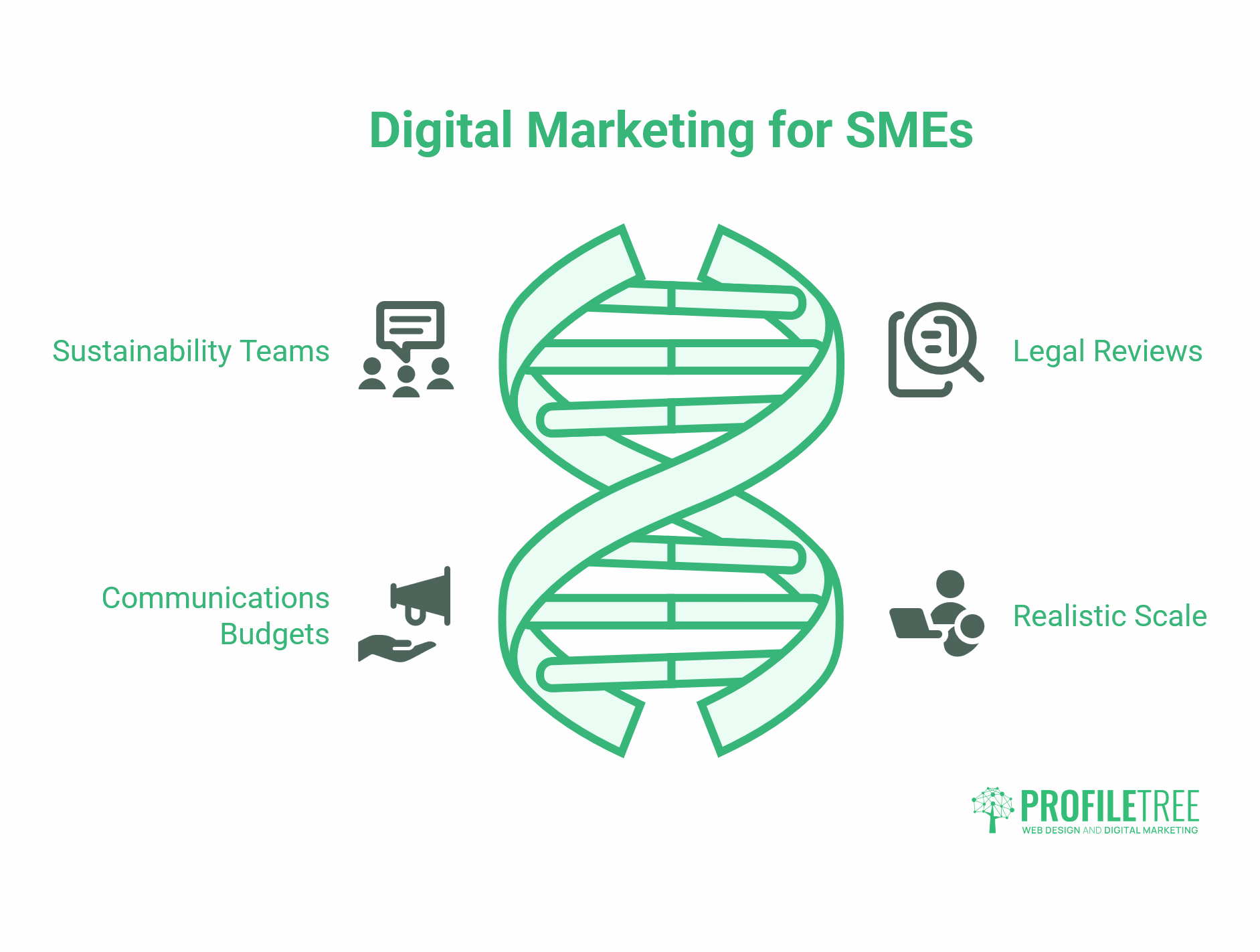
Large corporations have sustainability teams, legal reviews, and communications budgets measured in millions. Most businesses in Northern Ireland and across the UK lack that. These are the digital marketing approaches that work at a realistic scale.
Build a Sustainability Page That Can Actually Be Found
The most common mistake is burying sustainability credentials in a PDF, a press release, or a footer link. A dedicated sustainability page, properly structured, keyword-rich, and internally linked from service pages, lets search engines surface your credentials when people are actively looking for responsible businesses to work with.
The page should answer the following: what you do, why you do it, how you measure it, and where people can verify your claims. It should not be a mission statement.
ProfileTree’s SEO services include content architecture work that helps businesses surface the right pages for the right queries. A sustainability page buried three levels deep in a site hierarchy will not rank, and if it does not rank, it cannot build trust.
Use Content Marketing to Show, Not Just Tell
A food producer in County Down claiming to be sustainable is asking people to trust them. A food producer publishing monthly supplier updates, sharing their packaging waste figures, and documenting their transition to renewable energy on the farm is showing people evidence they can evaluate.
Content marketing, written articles, short video updates, and email newsletters are the most cost-effective ways for SMEs to build a track record of verifiable claims. It also has compounding value: each piece adds to a body of evidence that supports the brand’s credibility over time. ProfileTree’s transparency in content marketing approach covers exactly this kind of evidence-based publishing.
Video Is the Most Credible Format for Sustainability Claims
Greenwashing is almost always a text problem. A brand says something it cannot prove, in language that sounds more impressive than the reality. Video makes vague claims much harder to sustain because it shows things. A 90-second video of your production facility, your packaging process, or your supply chain visit is more credible than three pages of copy asserting the same things, and viewers can see for themselves whether the claims stack up.
For SMEs with limited production budgets, short documentary-style video, filmed on location, featuring real staff and real processes, performs better on social media and in email than polished corporate production. ProfileTree’s video production team works with businesses across Northern Ireland on exactly this kind of content.
Align Your Digital Strategy with Your Ethical Marketing Position
Sustainable marketing is not consistent with certain digital advertising practices. Tracking-heavy programmatic advertising, email campaigns with no clear unsubscribe mechanism, and retargeting that follows users across every platform all sit in tension with a brand claiming to respect people and the environment. An ethical marketing strategy starts with auditing your own digital channels.
This does not mean abandoning digital advertising; it means choosing channels and tactics that reflect the brand’s stated values. First-party data, permission-based email, and content that earns attention rather than interrupts it are all more consistent with a genuine sustainability position.
The Carbon Cost of Your Digital Marketing Activity
This section rarely appears in competitor guides, but it matters. A website with unoptimised images, excessive JavaScript, and poor caching generates more carbon than a technically clean one, because every page load pulls energy from a data centre. Email campaigns to large, unengaged lists produce measurable carbon that could be cut significantly by pruning inactive subscribers and improving targeting.
Website speed optimisation reduces carbon and improves search rankings. Reducing ad spend on low-quality placements that generate impressions, but no engagement, cuts both costs and carbon. The overlap of sustainability in digital marketing strategies is more direct than most marketing managers realise.
The 7 Ps of Sustainable Marketing
The traditional 4 Ps (Product, Price, Place, Promotion) do not fully account for what sustainable marketing requires. The extended 7 Ps model adds People, Process, and Physical Evidence, and in a sustainability context, each one carries new weight.
Product: Designed for longevity, repairability, and end-of-life management. Are materials verifiable? Is the lifecycle documented?
Price: Reflects true cost, including environmental and social externalities. Sustainable pricing is honest pricing; it does not obscure the cost of ethical sourcing.
Place: Distribution choices affect carbon footprint. Local sourcing, reduced packaging in transit, and digital delivery options all belong here.
Promotion: All the guidance in this article applies here. Honest, substantiated claims delivered through channels that respect the consumer.
People: Staff, suppliers, and community. Sustainable marketing is only credible if the business treats people well throughout its operations.
Process: How the product is made and delivered. Transparent processes, shared publicly, not just internally, build genuine trust.
Physical Evidence: The visible proof of your sustainability claims. Certifications, audit results, supplier information, and verifiable real data.
Measuring Sustainable Marketing: KPIs That Go Beyond Brand Sentiment
“Brand awareness” and “sentiment scores” are real metrics, but they tell you nothing about whether your sustainable marketing is working in any meaningful sense. These are the more useful measures.
Green-qualified leads: Track what proportion of enquiries mention your sustainability credentials as a reason for choosing you. Even a simple question in your contact form (“How did you hear about us, and what matters most to you?”) can surface this.
Content engagement on sustainability pages: If your sustainability page has a high bounce rate and a short average session time, the content is not landing. If people read it and then visit your services pages, it is doing its job.
Email list health: A large, unengaged email list is both a carbon liability and a marketing inefficiency. Engagement rate per campaign is a better measure than list size.
Search visibility for ethical/sustainable queries: Are you ranking for terms like “sustainable [your industry] [your location]”? Organic visibility for these queries is a long-term asset. A digital marketing strategy should include search-based sustainability targets.
Certification and verification completion rate: If you claim to be working towards a specific standard (B Corp, ISO 14001, Living Wage accreditation), publicly track progress towards it. The commitment itself builds credibility, not just the certificate at the end.
Sustainable Marketing for UK and Irish SMEs: A 5-Step Roadmap
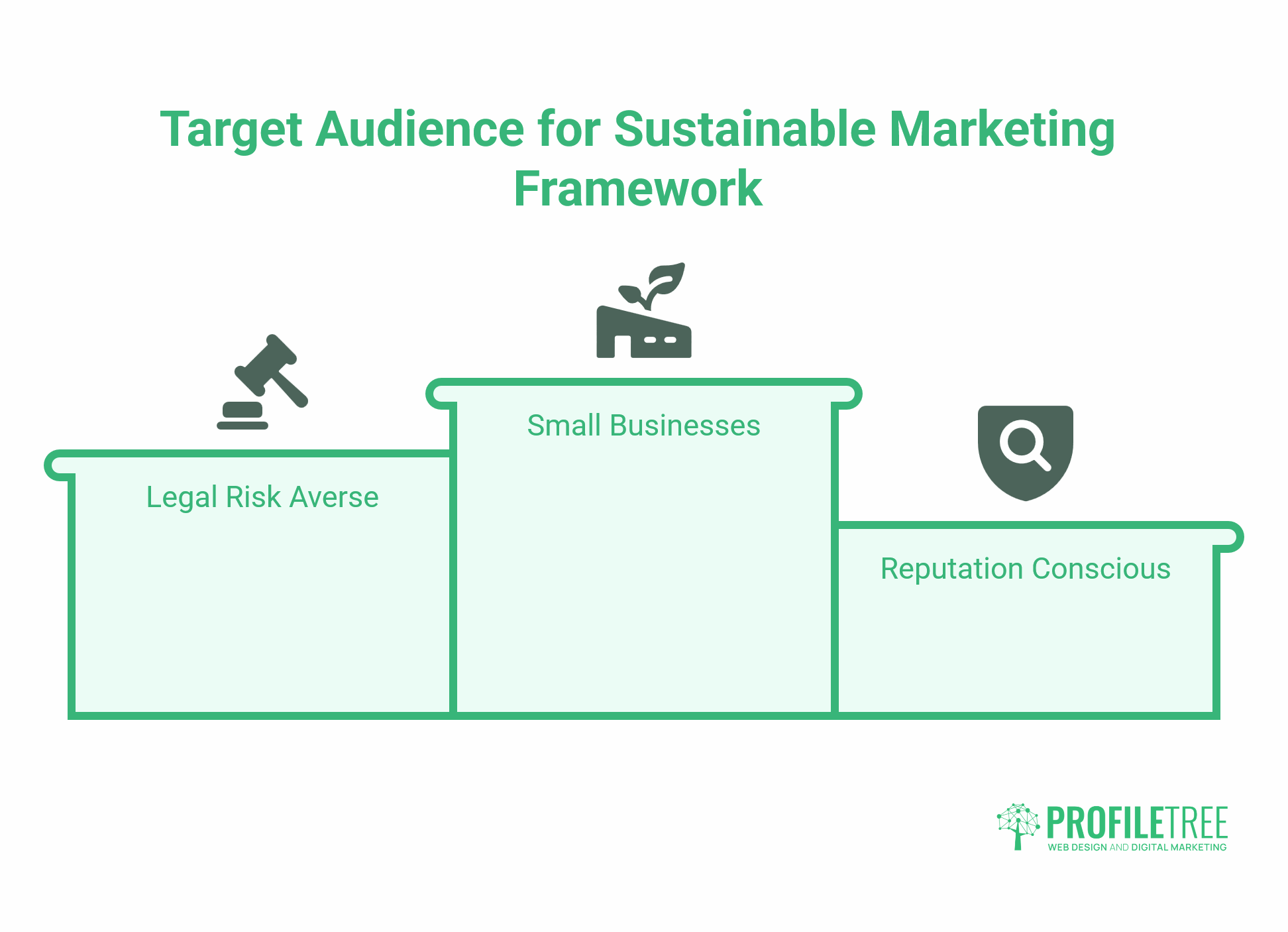
This is not a framework for businesses with corporate sustainability teams. It is for businesses of 5 to 50 people that want to market their genuine sustainability work without legal risk or reputational overreach.
Step 1: Audit before you claim. Before publishing any sustainability content, document what you actually do. Not what you intend to do, or what you aspire to, but what you do now, with evidence. Claims without documentation are liabilities.
Step 2: Get your green claims language checked. The CMA Green Claims Code is publicly available and straightforward to apply. If you are unsure whether a specific phrase or claim is defensible, do not use it until you have verified it. Consider a one-off legal review for any campaign making specific environmental claims.
Step 3: Build a sustainability hub on your website. This does not need to be elaborate. A single, well-structured page documenting your credentials, supply chain approach, and measurement methodology is sufficient to get started. Link to it from your homepage, your services pages, and your footer. ProfileTree’s digital marketing training covers how to structure content for search visibility.
Step 4: Choose two or three channels and do them well. Most SMEs spread themselves too thin. Pick the channels where your target customers are actually spending time, whether that is LinkedIn, a weekly email, or local press, and produce consistent, honest content on those channels rather than mediocre content on six.
Step 5: Publish your progress, not just your position. A business that publishes its sustainability targets and then reports quarterly on progress, including setbacks, builds more credibility than one that publishes a polished annual report. Real-time, imperfect transparency beats edited perfection. Platforms like AI-assisted reporting tools can help smaller teams produce consistent sustainability updates without a dedicated resource. ProfileTree’s AI and sustainability work covers exactly this application.
Conclusion
Sustainable marketing works when it is honest, specific, and built into how a business communicates digitally, not bolted on as a campaign. For SMEs across Northern Ireland, Ireland, and the UK, the opportunity is real: most competitors are either saying too much without evidence or saying nothing at all. A clear sustainability page, consistent content that shows rather than tells, and a working knowledge of the CMA Green Claims Code are enough to get ahead of both. ProfileTree works with businesses at every stage of this, from content strategy and SEO through to video production and digital training. Talk to the team about building a digital presence that reflects your business’s actual values.
FAQs
What are the 5 principles of sustainable marketing?
Consumer-oriented, customer value, innovative, sense-of-mission, and societal marketing. Together, they describe an approach that prioritises long-term value, honest communication, and social benefit alongside commercial performance.
What is the CMA Green Claims Code?
The Competition and Markets Authority’s framework requires all environmental claims made to UK consumers to be truthful, clear, complete, fair, based on the full product lifecycle, and supported by evidence. Businesses in breach can face enforcement action.
How is sustainable marketing different from green marketing?
Green marketing focuses on environmental claims. Sustainable marketing is broader, covering environmental, social, and economic responsibility across the entire business.
Is sustainable marketing more expensive for SMEs?
Not in the digital channels that matter most. The real cost is the internal work of documenting and verifying genuine credentials, which requires honesty rather than budget.
What is greenwashing, and how do I avoid it?
Making environmental claims that are misleading, exaggerated, or unsubstantiated. Avoid it by claiming only what you can prove, being specific rather than vague, and showing your workings.
How do I start a sustainable marketing strategy on a small budget?
Document your existing credentials, build a sustainability page on your website, and publish one honest piece of content per month about your actual practices. Focus on search visibility over paid promotion.