
Personalising Content: A Practical Guide for UK SMEs
Table of Contents
Most businesses put real effort into driving visitors to their websites, then give every one of them the same experience. A first-time visitor researching your services sees the same homepage as a returning customer who already knows what they want. That mismatch is where conversions leak away.
Content personalisation closes that gap. It uses data about who your visitors are, where they came from, and what they have already done to serve content that fits each person at each moment. ProfileTree, a Belfast-based digital marketing agency, applies content personalisation across client projects in Northern Ireland and the wider UK, and the difference it makes to engagement is measurable even on a modest budget.
This guide covers what content personalisation actually means, a maturity model to determine where your business sits today, how to stay UK GDPR compliant as you do it, and a five-step plan for building a strategy without an enterprise tech budget.
Content Personalisation in the UK: What’s Changing
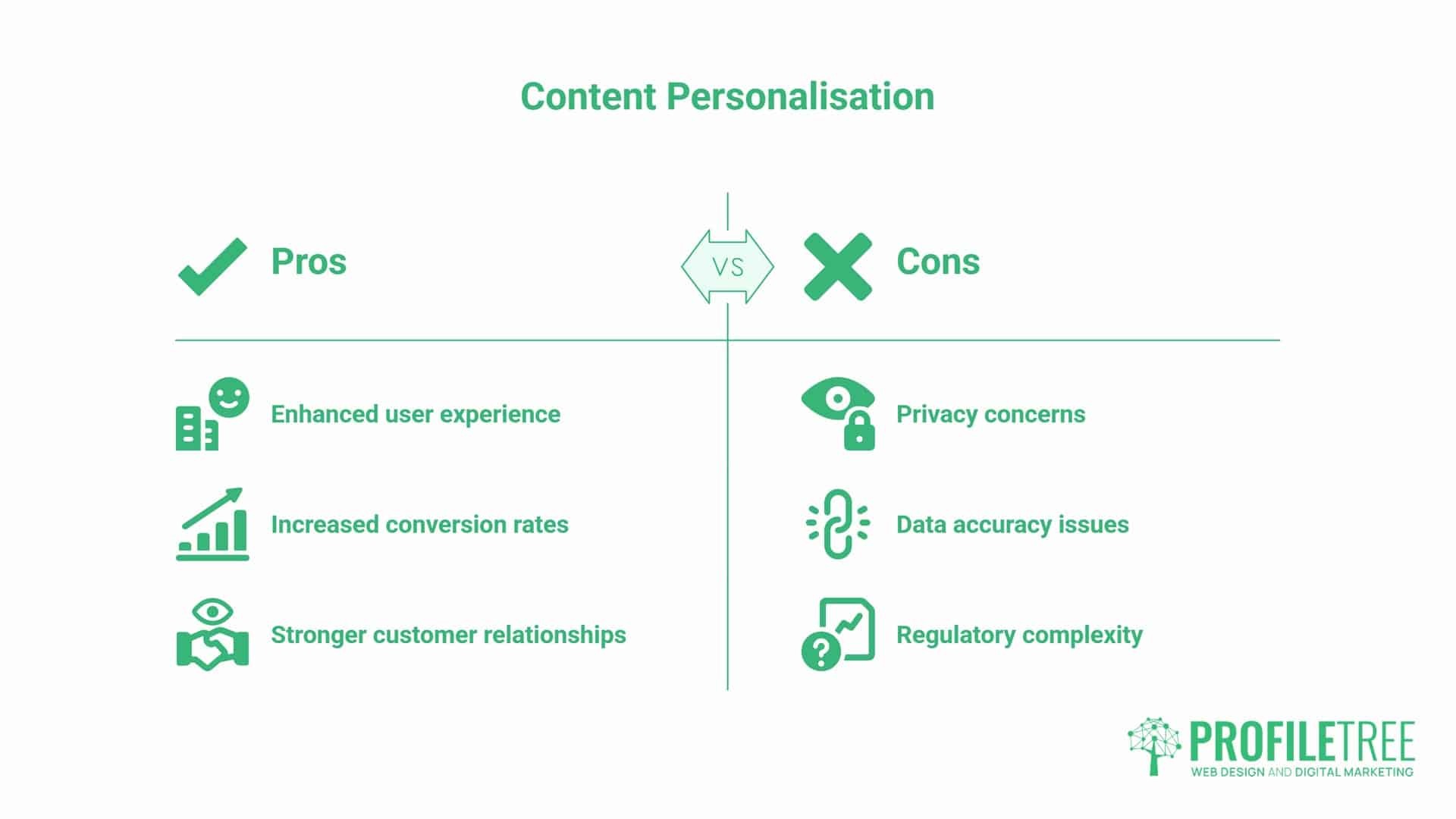
UK consumers have grown more cautious about how their data gets used, not less. Third-party cookies are being phased out across major browsers, so first-party data, the information a business collects directly from its own customers and website visitors, is becoming the foundation for any content personalisation that survives the shift. A UK shopper who feels a website has “guessed” too much about them, rather than responded to something they actually did, tends to disengage rather than convert.
That is the practical boundary for content personalisation done well. Personalise based on what a visitor has done on your site or told you directly. Do not personalise based on data points that a visitor would not expect you to have. A returning visitor seeing content related to the service page they read last week feels helpful. A visitor receiving an email that references their exact location alongside a product they viewed once feels like surveillance.
For businesses trading across Northern Ireland and the Republic of Ireland, there is an added layer. Northern Ireland sits in a slightly different position on data alignment than Great Britain because of its trading relationship with the EU, so a business collecting customer data on both sides of the border should check that its consent and data transfer approach covers both frameworks rather than assuming UK GDPR alone is sufficient.
It is worth being precise about terminology here, too, because content personalisation and customisation get used interchangeably when they describe different things.
| Approach | Who Controls It | Example |
|---|---|---|
| Segmentation | Marketer (broad groups) | All UK visitors see a localised offer |
| Customisation | User (manual preferences) | A visitor selects their industry on a preferences page |
| Personalisation | System (algorithm-driven) | A homepage adapts based on past behaviour without the user doing anything |
The Content Personalisation Maturity Model: Where Do You Sit?
Content personalisation is not an all-or-nothing investment. It scales from simple tactics any UK SME can implement this month to the kind of predictive, always-on personalisation that only larger organisations can justify. Most SMEs get the most value from working through the first two levels properly before looking any further.
Level 1: Basic Segmentation
This is the entry point for most businesses, and it needs no machine learning at all. Rule-based content personalisation runs on straightforward “if this, then that” logic: if a visitor is browsing from Northern Ireland, show Northern Ireland pricing and case studies; if they arrived from a specific email campaign, show content that matches that campaign’s offer.
Most CMS platforms, including WordPress, handle basic conditional content with the right plugin, and this is a common starting point in web development projects for SME clients who want a homepage that adapts to where a visitor is browsing from without a full personalisation platform. Email marketing platforms support audience segmentation out of the box too. Start with one clear hypothesis, for example, “our Northern Ireland clients respond differently to pricing messaging than our GB clients”, and test it before adding a second segment.
Level 2: Behavioural Triggers and Adaptive Content
At this level, content personalisation responds to what a visitor has actually done on your site. Someone who has read three articles about SEO might see a prompt for an SEO guide. Someone who has looked at a pricing page twice might see a case study addressing the hesitation that page usually creates.
This needs analytics integration and a CMS that can serve conditional content based on session behaviour. It is also where content mapping becomes a real content marketing task rather than a technical one: someone needs to determine which existing articles and pages actually serve each segment and where the gaps are.
Level 3: Predictive and Omnichannel Personalisation
Predictive personalisation uses pattern matching across many similar visitors to anticipate what an individual wants next. For most UK SMEs, this level needs either a dedicated marketing automation platform or a CRM capable of behavioural scoring, and the investment step up is real. If your business is weighing this stage, our guide to AI transformation for SMEs and our dedicated piece on AI-driven personalisation go into more depth on what that technology actually involves and when it earns its cost.
“Most SMEs try to jump straight to predictive personalisation because it sounds more advanced, but the businesses that actually see a return are the ones who get segmentation and behavioural triggers working properly first. First-party data collected well is worth more than a clever algorithm applied to data you barely trust,” says Ciaran Connolly, founder of ProfileTree.
Navigating UK Compliance: GDPR and Data Ethics
The UK’s Data Protection Act 2018 and the retained UK GDPR framework impose specific obligations on any business that collects and processes personal data for content personalisation purposes. Much of the personalisation guidance is written for a US audience and sidesteps this altogether. For a UK business, getting it wrong is not a hypothetical risk.
Personal data in this context includes IP addresses, cookie identifiers, browsing history tied to an identified user, email addresses, and any behavioural data linked to a profile. If your personalisation setup connects any of these to a specific person, you need a lawful basis for processing it, and that basis is usually either consent or legitimate interests. Neither can be assumed by default.
Consent is required before you track behaviour for marketing personalisation, and it needs a proper cookie banner and an updated privacy notice that actually describes what personalisation you are doing. Legitimate interest can cover some processing, but only with a documented Legitimate Interest Assessment, and visitors still need a clear way to opt out of profiling.
| Requirement | Consent Basis | Legitimate Interest |
|---|---|---|
| Cookie consent banner in place | Required | Required |
| Privacy notice updated to cover personalisation | Required | Required |
| Explicit consent before tracking behaviour for marketing | Required | Not applicable |
| Legitimate Interest Assessment documented | Not applicable | Required |
| Right to opt out of profiling respected | Required | Required |
| Data retention periods defined for personalisation profiles | Required | Required |
Businesses trading across both the UK and Ireland should treat this as a cross-border question, not a single-jurisdiction one, and build data flows that satisfy both frameworks from the start rather than retrofitting compliance later.
5 Steps to Building a Content Personalisation Strategy
A content personalisation strategy does not need to be complicated to work. These five steps take a UK business from nothing to a functioning first stage, without assuming an enterprise budget.
- Audit your current data health. Look at what you already collect through Google Analytics 4, your CRM, and your email platform before buying anything new. Most SMEs already hold more useful data than they use.
- Define your UK audience segments. For a B2B business, this usually means industry, company size, or job role. For a B2C business, it is more often a lifecycle stage or region. Build these from the data you already hold rather than guessing.
- Choose an SME-friendly tech stack. Most UK SMEs do not need Adobe Target or Salesforce to start. GA4 for behavioural data, an email platform such as Mailchimp or Klaviyo for segmentation, and a WordPress personalisation plugin for on-site conditional content will cover the first two maturity levels for most businesses.
- Map content to segments and fill the gaps. Audit your existing content and work out honestly which pieces serve which segment well. You will usually find generic content covering a topic that a specific, high-value segment needs something sharper on.
- Test, measure, and set a UK benchmark. Track open and click rates by segment for email, time on page, and conversion rate by on-site personalisation condition, and treat every initiative as a hypothesis you are testing rather than a finished project.
A UK professional services firm running this sequence typically sees the clearest early win at step three, once a CRM-integrated email platform lets a team send genuinely different content to a manufacturing lead and a healthcare lead from the same campaign, rather than one generic version to both.
The Tech Stack: Tools Worth Considering for UK SMEs
| Tool | Ideal Business Size | Primary Use Case | Notes on UK Compliance |
|---|---|---|---|
| Mailchimp | Sole trader to small team | Email segmentation and basic behavioural triggers | Offers EU/UK data hosting options; confirm current terms with the provider |
| Klaviyo | Small to mid-sized ecommerce | Behavioural email and SMS personalisation | Check current DPA terms for UK/EU data transfer before signing up |
| HubSpot (free/starter tier) | Small to mid-sized B2B | CRM-based segmentation and lifecycle personalisation | Widely used by UK B2B firms; verify plan-specific data residency options |
| WordPress personalisation plugins | Any WordPress site | Conditional on-site content by referral source or location | Compliance depends on the specific plugin; review its own privacy documentation |
Treat this table as a starting point for research rather than a final recommendation. Terms, pricing, and compliance features change, so confirm current details directly with each provider before choosing.
Integrating Content Personalisation into Your Marketing Services
Content personalisation rarely sits on its own. It touches several other parts of a marketing operation, and that is usually where a UK SME needs outside support rather than more in-house headcount.
On the SEO side, content that changes based on visitor data can confuse search engine crawlers if it is not handled carefully, since Google typically crawls as a generic user. Our SEO services (https://profiletree.com/services/search-engine-optimisation/) work covers how to personalise calls to action and recommended content modules while keeping the core indexable content consistent, so personalisation does not quietly undo your rankings.
On the web build side, the conditional content blocks, referral-based homepage variants, and the CMS plugin work that Level 1 personalisation depends on are exactly the kind of projects our website development team handles for SME clients moving beyond a static site.
On the content side, mapping existing articles to audience segments and finding the gaps, Step 4 above, is a natural fit for a proper content marketing engagement, since it needs someone to audit content honestly rather than just produce more of it.
For teams that want to build this capability internally rather than outsource it entirely, our digital training programme covers GA4, segmentation, and first-party data collection for marketing teams who want to run Level 1 and Level 2 personalisation themselves.
And because a personalisation strategy sits within a wider plan rather than replacing it, our digital marketing strategy service is where most of this work is scoped and sequenced for a specific business.
Common Pitfalls UK Marketers Should Avoid
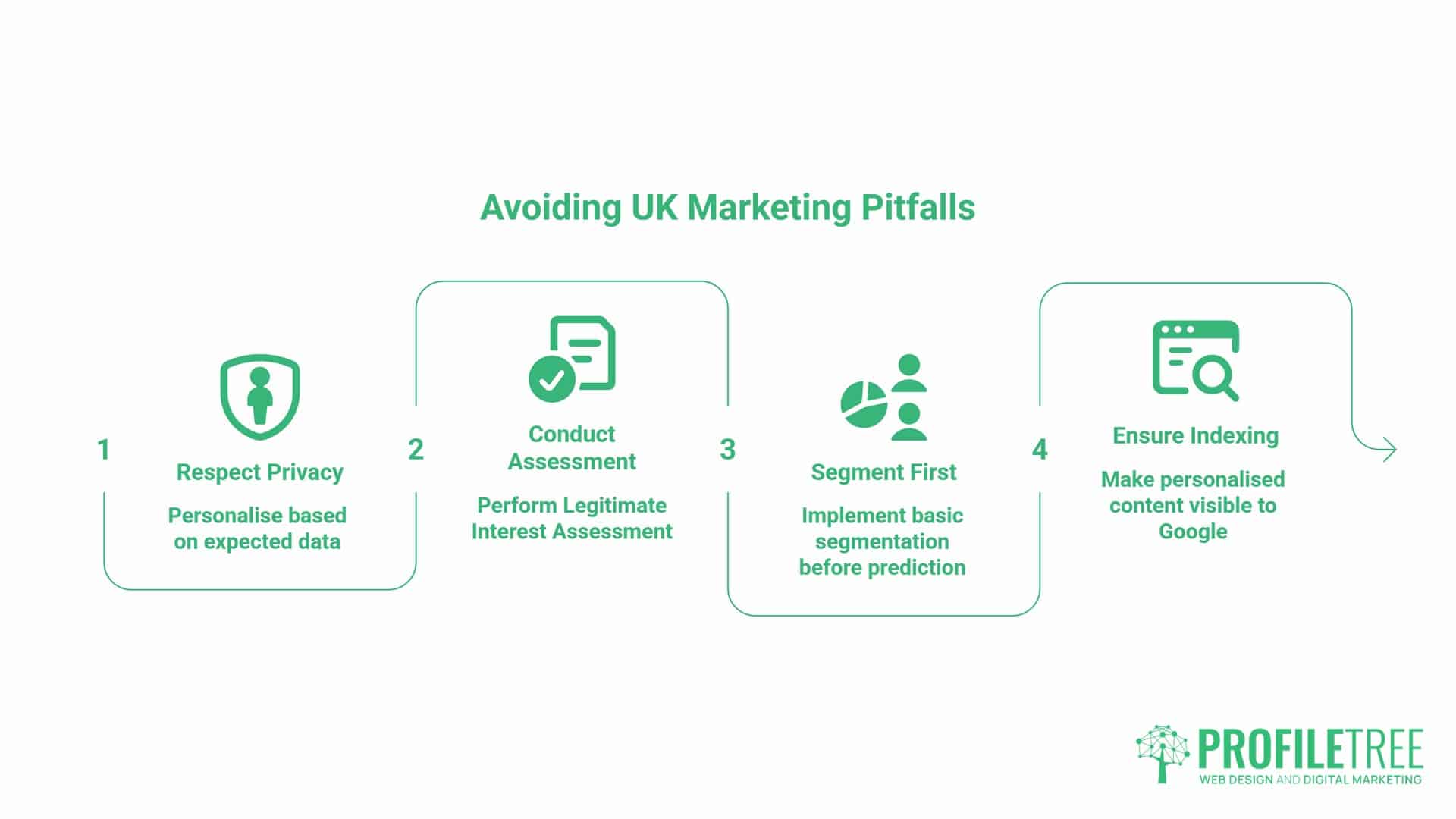
- Do not personalise based on data a visitor would not expect you to have. This is the fastest way to trigger the “creepy” reaction and lose trust that you cannot easily rebuild.
- Do not skip the Legitimate Interest Assessment because it feels like paperwork. It is the one document that shows a regulator you thought about this properly.
- Do not jump to predictive personalisation before basic segmentation is working. Analysis paralysis at Level 3 is a common cause of a content personalisation project stalling entirely.
- Do not let personalised content variations become invisible to Google. If you use JavaScript to render personalised content, make sure the default state still contains the content you want indexed.
Content Personalisation as an Ongoing Practice
Content personalisation is not a single purchase or a one-off project. It compounds. Every data point collected properly, every segment defined clearly, and every test run honestly adds to what a business actually knows about its different audiences.
For UK businesses specifically, getting the compliance side right from the start is not just about avoiding a fine. Visitors who trust a business with their data tend to engage more, not less, with the personalised experience that follows. Getting content personalisation right is as much a trust exercise as a technical one.
If your business is at the point of choosing a first step, our digital marketing strategy team can help you determine which maturity level best fits your current data and budget, rather than starting with a tool and working backwards.
Frequently Asked Questions
What is the best content personalisation tool for a UK SME?
For most UK SMEs starting out, the answer is whatever email or CMS platform you already use, configured properly, rather than a new dedicated platform. Mailchimp, Klaviyo, and WordPress personalisation plugins cover basic segmentation and behavioural triggers without new procurement.
Does content personalisation affect my site’s SEO?
It can, if handled carelessly. Google generally crawls your site as a generic user, so personalised content variations may not get indexed at all. The safer approach is to personalise elements like calls to action and recommended content modules while keeping your core page content consistent for every visitor.
How much does content personalisation cost to implement?
Basic segmentation within an email platform you already pay for costs little beyond the time to set it up. A dedicated Customer Data Platform is a genuine investment, and it is typically only worth it once you have enough audience volume and a clear enough use case to measure the return.
Is content personalisation GDPR compliant?
It can be, but compliance depends entirely on how you implement it. You need a documented lawful basis, either consent or a Legitimate Interest Assessment, a cookie banner and privacy notice that actually describe the personalisation you run, and a working way for visitors to opt out.
How do I measure the return on content personalisation?
Track open and click-through rates by segment for email personalisation, and time on page plus conversion rate by personalisation condition for on-site content. Treat each personalisation initiative as a hypothesis with a measurable outcome rather than a permanent feature.