
Personalised Email Marketing Campaigns: A Complete Guide
Table of Contents
Most marketing inboxes receive dozens of emails every day. The ones that get opened are rarely the ones shouting the loudest. They are the ones that feel relevant, written for the reader, not broadcast at them.
Personalised email marketing has moved well past inserting a subscriber’s first name into a subject line. By 2026, the gap between brands doing it properly and those stuck on basic token replacement will be visible in open rates, conversion figures, and subscriber retention.
This guide sets out a practical framework for UK SMEs: what personalisation actually means at each level of maturity, which AI-driven tactics are now accessible without an enterprise budget, how to stay on the right side of UK data law, and where the psychological line sits between relevance and overreach. Whether you are building a strategy from scratch or auditing what you already have, the sections below give you a clear picture of where to start and what to prioritise.
What Personalised Email Marketing Means in 2026
The definition has shifted. Personalisation in email marketing no longer describes a cosmetic change to a template; it describes a system in which content, timing, and offer all adapt to what you know about an individual subscriber. Understanding that distinction is the first step to building something that actually performs.
From Token Replacement to Predictive Content
Early email personalisation relied almost entirely on merge tags: “Dear [First Name],” followed by the same copy sent to every address on the list. That approach is still common, but it carries minimal weight with subscribers who receive hundreds of emails a week.
The shift that has happened over the past three years is a move toward predictive content. Rather than using stored attributes to fill a template, predictive personalisation uses behavioural signals, purchase history, browse patterns, engagement frequency, and device type to determine which version of an email a subscriber should receive before they have even opened it. The content itself adapts, not just the salutation.
For a practical overview of how email works as a channel before layering personalisation on top, the email marketing guide covers the foundations worth revisiting.
Why Basic Personalisation No Longer Moves the Needle
Several forces have reset subscriber expectations simultaneously. The volume of email in UK inboxes continues to grow. Spam filters have become more aggressive, meaning low-engagement senders get deprioritised. And Apple’s Mail Privacy Protection, combined with the continued uptake of privacy-focused clients, has eroded the reliability of open-rate data as a proxy for genuine engagement.
The result is that a subject line with a first name no longer signals effort. Subscribers have learned to recognise it. What signals effort, and what earns consistent engagement, is an email that addresses a specific need at a relevant moment, built from a genuine understanding of the subscriber’s behaviour.
Industry data shows that email performance data across sectors, but the pattern holds universally: segmented, behaviourally triggered campaigns outperform broadcast newsletters on every metric that matters.
Personalisation vs Segmentation: Clearing the Confusion
These two terms are often used as if they mean the same thing. They do not, and conflating them leads to a strategy that stalls at Level 1.
Segmentation is the process of grouping your audience by shared characteristics, industry, location, purchase frequency, and life cycle stage, so that different groups receive different messages. It operates at the list level. Personalisation operates at the individual level, using real-time or stored data to shape the specific content, offer, or send time for a single subscriber.
| Approach | Data Required | Operates At | Example |
|---|---|---|---|
| Segmentation | Demographic or firmographic attributes | Group level | All subscribers in Belfast receive a localised offer |
| Personalisation | Behavioural, transactional, or declared preferences | Individual level | A subscriber who browses running shoes receives a restocking email for that specific brand. |
Both are valuable,e and both work together. Effective customer segmentation provides the structure within which personalisation operates. Without good segments, personalisation has no framework to work within.
The Personalisation Maturity Model
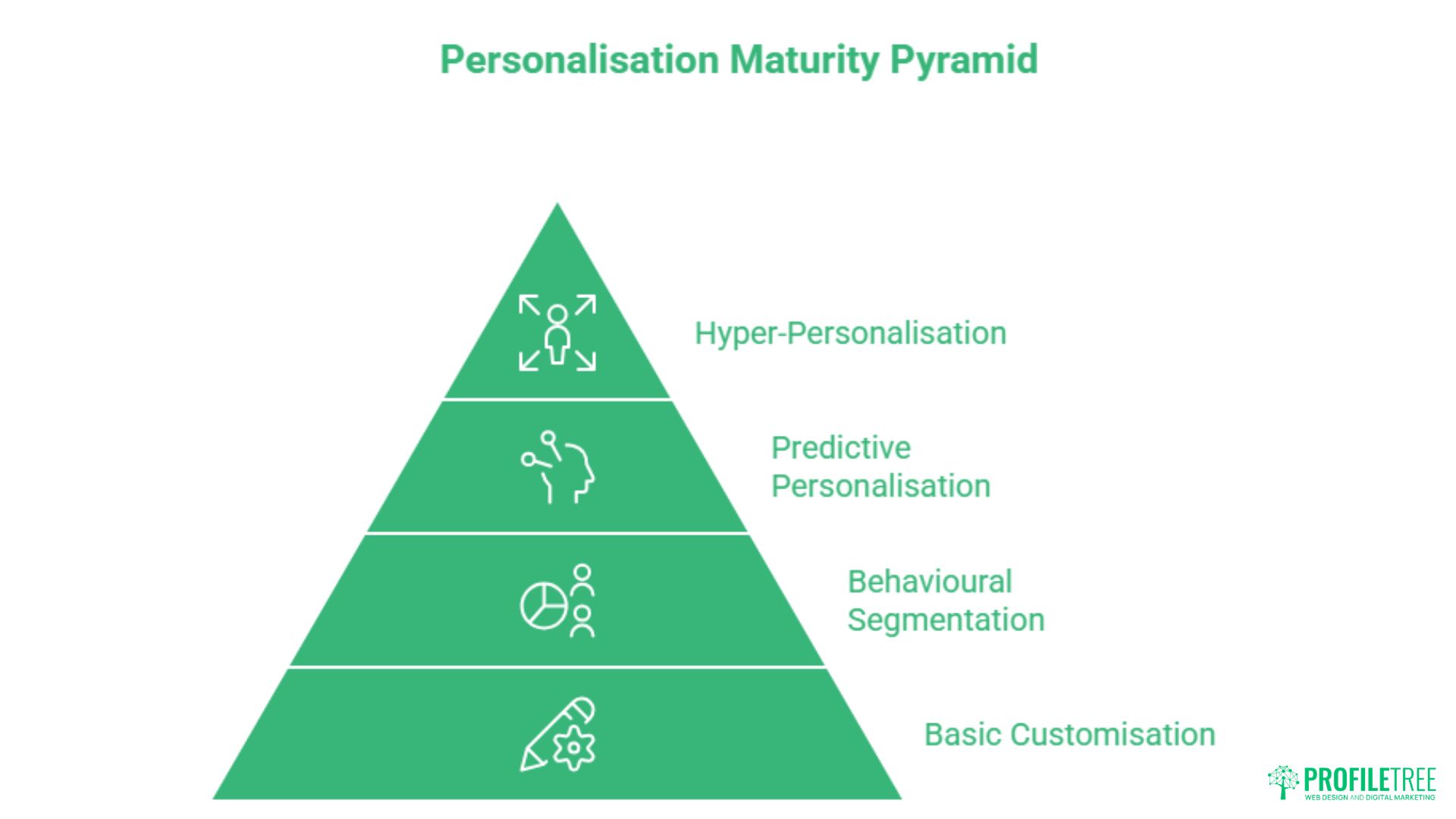
Most businesses overestimate where they sit on the personalisation scale. A useful self-assessment framework breaks the journey into four distinct levels, each requiring a different combination of data, technology, and editorial investment. The model below gives you an honest benchmark.
Level 1: Basic Customisation
At Level 1, personalisation is driven by stored attributes: name, location, company, or the list segment a subscriber was placed in at sign-up. Emails are mostly identical across the audience, with token replacements and occasional conditional blocks that show different content to different cities or job titles.
This is where the majority of UK SMEs sit. It works better than a fully generic email, but the ceiling on improvement is low. The data required is minimal (a clean CRM record), the technology is built into every major email service provider, and the expected uplift over unsegmented broadcast is modest, typically a 5 to 15 per cent improvement in open rates for name personalisation in the subject line, with diminishing returns as subscribers become habituated to the technique.
Level 2: Behavioural Segmentation
Level 2 introduces behaviour as a data source. Browse history, purchase frequency, email engagement patterns, and on-site actions all feed into which email a subscriber receives and when. Triggered sequences replace purely scheduled sends: a cart abandonment email fires when a subscriber leaves without completing a purchase; a re-engagement series activates after 90 days of inactivity; a post-purchase sequence begins the moment a transaction completes.
This level requires more infrastructure, ESP automation rules, a website that passes event data to your email platform, and a thought-through trigger map, but the payoff is significant. Triggered emails consistently generate three to five times the revenue per send of standard broadcast campaigns, because they arrive when the subscriber’s intent is still warm. Understanding how email automation integrates with your broader marketing stack is a practical starting point for building this out.
Level 3: Predictive Personalisation
At Level 3, machine learning enters the process. Rather than responding to actions the subscriber has already taken, the system predicts which action they are most likely to take next. This is sometimes called “next best action” logic: the ESP or connected CDP analyses historical patterns to determine whether a subscriber is about to churn, likely to upgrade, or approaching a natural repurchase window.
The emails that result from this logic are not just timely, they anticipate a need before the subscriber has consciously formed it. A subscription box company might send a “running low” email based on the average consumption rate for a product, timed to arrive a few days before the subscriber would notice the problem themselves. That kind of relevance builds a fundamentally different relationship with the brand than any Level 1 or Level 2 tactic can achieve.
Level 4: Hyper-Personalisation
Level 4 is where real-time data and AI-generated content converge. Every element of the email, hero image, subject line, product recommendations, offer amount, and send time is determined dynamically at the moment of open, not at the moment of send. No two subscribers receive precisely the same email, even if they are on the same list.
| Level | Data Required | Tech Complexity | Expected ROI Uplift | Accessible for UK SMEs? |
|---|---|---|---|---|
| Level 1: Basic | Name, location, list segment | Low | 5,15% open rate improvement | Yes, immediately |
| Level 2: Behavioural | Browse history, purchase data, engagement events | Medium | 3,5x revenue per triggered send | Yes, with mid-tier ESP |
| Level 3: Predictive | Historical patterns, churn signals, lifecycle data | Medium-High | Significant churn reduction | Partially (Klaviyo, MailerLite AI features) |
| Level 4: Hyper | Real-time behavioural, contextual (weather, device, time) | High | Highest ceiling, longest build time | Limited without bespoke setup |
For most UK SMEs, the realistic near-term goal is to move from Level 1 to a solid Level 2 while laying the data foundations needed for Level 3. The good news is that several mid-market ESPs now include predictive features in their standard plans, making the infrastructure gap smaller than it was even two years ago. Businesses already exploring broader AI adoption will find the transition more straightforward; see ProfileTree’s analysis of SMEs implementing AI for context on that wider shift.
Seven Advanced Tactics for UK SMEs in 2026
Knowing where you sit on the maturity model is useful. Knowing which specific tactics to implement next is more useful. The seven approaches below are ordered roughly by complexity, starting with changes that can be made within most existing setups and moving toward more involved builds.
Build a Zero-Party Data Preference Centre
Zero-party data is information a subscriber actively chooses to share: their preferences, their goals, the topics they care about. It is fundamentally different from inferred data (built from tracking) or third-party data (purchased or sourced externally), and it carries none of the legal risk associated with either.
A preference centre is the simplest mechanism for collecting it. Rather than guessing what a subscriber wants based on their past behaviour, you ask them directly. “How often would you like to hear from us?” “Which topics are most relevant to your business?” “What are you hoping to achieve in the next six months?” The answers feed directly into segmentation logic and content selection.
This approach is also the most defensible from a compliance standpoint, which matters considerably in the UK market. Consent that is freely given and clearly documented is not only legal best practice under the current framework; it produces better data than anything scraped from a tracking pixel.
AI-Generated Adaptive Image Personalisation
Adaptive images in email have existed for years, but the cost and complexity of generating them at scale kept the technique out of reach for smaller senders. AI image generation has changed that calculus.
Several mid-tier ESPs now support adaptive image blocks that can be populated with personalised variables, a subscriber’s name overlaid on a banner, a localised city skyline for regional segments, or a product image drawn from their most recent browse session. The images are generated or assembled at send time, meaning the production overhead is minimal once the template logic is in place.
For B2C brands with a strong visual identity, this is one of the highest-impact Level 3 tactics available. For B2B senders, personalised company logo inclusion or industry-specific imagery can produce a meaningful uplift in click-through rates without requiring a dramatic content overhaul.
Predictive Churn Risk Messaging
Every subscriber list has a proportion of contacts whose engagement is quietly declining. They opened regularly six months ago; they have not opened in the last sixty days. Without intervention, they will become permanently inactive and sending to disengaged contacts harms deliverability scores across the entire list.
Predictive churn models identify these contacts before they fully disengage, triggering a re-engagement sequence at the point where recovery is still statistically likely. The sequence typically involves a change of tone, a reduced offer cadence, and a direct prompt: “We’ve noticed you haven’t heard from us in a while. Is this still useful to you?”
The explicit opt-down or opt-out option included in that prompt is not a concession; it is a signal to your ESP that you are managing your list responsibly, which protects deliverability for the contacts who do remain engaged.
Send-Time Optimisation and All-Island Localisation
Send-time optimisation (STO) uses engagement history to determine the specific hour at which each subscriber is most likely to open. For a UK and Ireland audience, this matters more than it might seem. Sending at 1010 amelfast time is not the same as sending at 10 am, and neither is the same as sending at 10 am, London time, for a subscriber who typically opens on a commute.
For businesses marketing across Northern Ireland, the Republic of Ireland, and Great Britain, there is also a subtler localisation opportunity. Post-Brexit trading dynamics have created genuinely different business contexts on each side of the Irish border, and email content that acknowledges this, referencing relevant regulations, funding schemes, or local market conditions, signals a level of contextual awareness that generic campaigns cannot match. ProfileTree’s analysis of the Brexit digital marketing is worth reading alongside this for relevant context on the two-market opportunity.
Northern Ireland businesses operating in both the UK and EU single market occupy a genuinely unique commercial position. If you serve that audience, your email personalisation should reflect it. For inspiration on the regional character of the areas you are serving, Northern Ireland cities are a useful cultural reference point.
Hyper-Personalised Post-Purchase Journeys
The moment after a purchase is completed is one of the highest-intent moments in a customer’s relationship with a brand. The default post-purchase email, an order confirmation with a generic upsell, squanders it.
A well-built post-purchase journey uses what you now know about the customer to deliver content that is genuinely useful: care instructions for the product they just bought, complementary accessories based on the specific model purchased, and a usage guide timed to arrive the day after delivery. These emails do not feel promotional because they are not promotional. They feel like competent customer service, which is precisely the association you want to build.
The data required for this is already present in every transactional system. The gap is almost always in connecting that data to the email platform cleanly enough to drive adaptive content. That connection is worth the investment: post-purchase sequences consistently show the highest revenue attribution of any triggered email type, and their contribution to overall marketing ROI is often underreported because the attribution window is short.
Localised Cost-of-Living Messaging for UK Audiences
UK consumer behaviour has shifted noticeably in response to sustained cost-of-living pressure. Subscribers who were receptive to aspirational messaging two years ago are now more likely to engage with value-led communication: proof of durability, transparent pricing, comparisons that demonstrate genuine savings, or content that helps them make better decisions with a constrained budget.
Personalisation that acknowledges this shift, even implicitly, through the framing of offers and the language used around value outperforms campaigns built on pre-2022 messaging assumptions. Localising this further, to the specific economic conditions of Northern Ireland, Scotland, or Wales versus London and the South East, is a second-order refinement that very few competitors are making.
B2B Contextual Personalisation Without Declared Data
Not every subscriber provides a name or fills in a preference centre. For B2B senders with incomplete CRM records, contextual personalisation offers a practical alternative. Rather than personalising to the individual, you personalise to the context: the device they are opening on, the time of day, the content category they most recently engaged with on your website, or the industry vertical inferred from their company domain.
This is Level 2 personalisation applied without the full data set of Level 2. It is less precise than true individual personalisation, but it is substantially more relevant than a fully generic send, and it works within whatever data you actually have, rather than what you wish you had.
The Creep Factor: Where Personalisation Becomes a Problem
There is a point at which personalised email stops feeling relevant and starts feeling intrusive. Most marketers know where that line is in the abstract; fewer have a clear policy for where it sits in their own campaigns. Understanding the psychology behind it is as important as understanding the technology that makes personalisation possible.
The Privacy-Personalisation Paradox
Subscribers exist in a state of genuine ambiguity about data use. Research consistently shows that people want more relevant communication, and also that they are uncomfortable when brands demonstrate detailed knowledge of their behaviour. These are not contradictory positions. They reflect a distinction between what subscribers are willing to tolerate when the value exchange feels clear and what they reject when it feels exploitative.
The tipping point is usually specificity without context. An email recommending running shoes to someone who browsed running shoes yesterday feels useful. An email referencing the exact time and duration of that browse session feels like surveillance. The underlying data might be identical; the framing determines whether the recipient feels served or watched.
A practical policy is to personalise to intent, not to the data point that revealed it. Use the fact that someone browsed running shoes to inform your recommendation. Do not use the fact that they browsed at 111:47 pmto imply you were watching.
Human-Centric Personalisation
The most durable approach to personalisation is one that a subscriber could describe to a colleague without feeling embarrassed. “They recommended something I was actually interested in” is the standard to aim for. “They somehow knew I was on my phone at midnight looking at trainers” is not.
Ciaran Connolly, founder of ProfileTree, puts it this way: “The brands that win on email in the long term are the ones that use data to be genuinely helpful, not impressive. If your personalisation makes the subscriber think about the data rather than the offer, you have used it wrong.”
Transparency in marketing communications is an increasingly important signal for both subscribers and regulators. The ProfileTree piece on content marketing transparency explores the broader principle in more depth.
Building Trust Through Honest Data Use
One practical way to manage the creep factor is to tell subscribers, briefly, why they are receiving a particular email. “Because you purchased X last month, we thought this might be useful” is not an admission of surveillance; it is a demonstration of relevance. It contextualises the personalisation and makes the data use legible, which most subscribers respond to positively.
This kind of transparency also serves a compliance function. It signals that data is being used in line with the purpose for which it was collected, which is a core principle of the UK data protection framework. The relationship between AI and privacy is worth understanding in full if you are using machine learning to drive your personalisation.
UK Legal Framework: GDPR, PECR, and What They Mean for Email
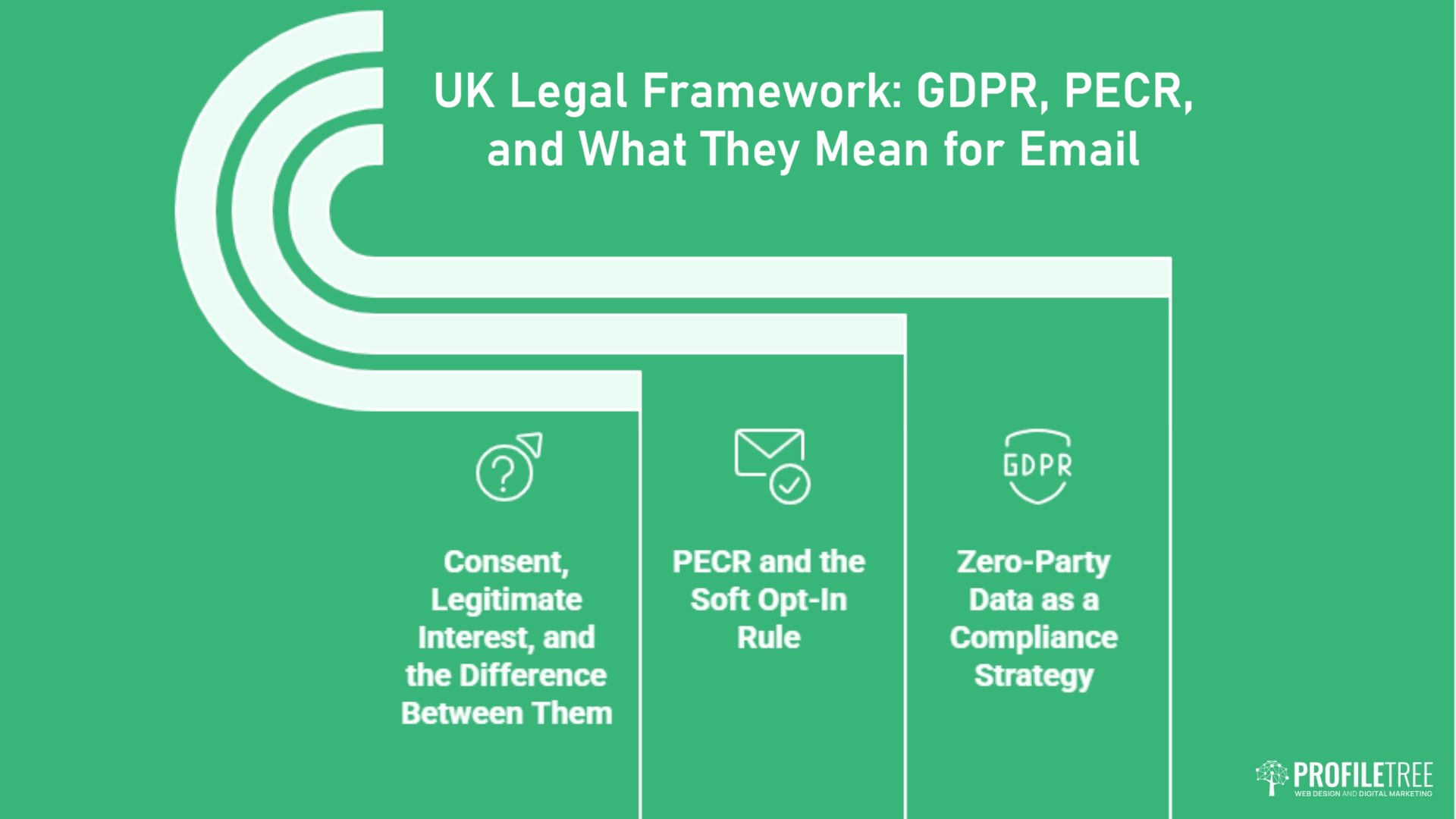
Data-driven personalisation in email does not operate in a legal vacuum. The UK has its own version of GDPR (the UK GDPR, retained post-Brexit alongside the Data Protection Act 2018) and the Privacy and Electronic Communications Regulations (PECR), which sit alongside it specifically for electronic marketing. Understanding both is not optional for any business running personalised email campaigns to UK subscribers.
Consent, Legitimate Interest, and the Difference Between Them
UK GDPR requires a lawful basis for processing personal data. For email marketing, two bases are most commonly cited: consent and legitimate interest. They are not interchangeable, and choosing the wrong one creates legal exposure.
Consent must be specific, informed, freely given, and unambiguous. A pre-ticked box does not qualify. A subscriber who signed up for a newsletter has consented to receive that newsletter; they have not necessarily consented to their behaviour being tracked to drive personalised product recommendations. If you are using behavioural data beyond what was described at the point of sign-up, you need to review whether your original consent was broad enough to cover that use.
Legitimate interest is available as a lawful basis where the processing is necessary for a genuine business purpose, and that purpose is not overridden by the subscriber’s rights and interests. It requires a documented three-part test, purpose, necessity, and balancing, and it cannot be used to avoid the need for consent under PECR, which has its own consent requirement for direct marketing to individuals.
PECR and the Soft Opt-In Rule
PECR applies specifically to electronic marketing communications. It requires prior consent from individuals before sending marketing emails, with one important exception: the “soft opt-in” rule, which permits marketing emails to existing customers about similar products or services, provided they were given a clear opportunity to opt out when their contact details were first collected, and on every subsequent communication.
For B2B marketers, the position is slightly different. Emails sent to corporate addresses (rather than personal ones) are subject to different rules under PECR. However, UK GDPR still applies to any processing of personal data, including data associated with business email addresses.
Practical compliance for personalised email starts with consent architecture at sign-up, a functioning preference centre, and a documented data retention policy. Designing GDPR-compliant forms is a practical first step that shapes everything downstream. The ProfileTree resource on e-commerce data privacy covers the intersection of transactional and marketing data in more detail.
Zero-Party Data as a Compliance Strategy
The compliance case for zero-party data collection is straightforward: if a subscriber has voluntarily told you their preferences, the legal basis for using those preferences to personalise their emails is on solid ground. You are using data they provided, for the purpose they provided it, in a way they can explain to themselves.
This is why the preference centre approach described earlier in this guide is not just a tactic for better personalisation, it is also a risk management mechanism. A zero-party data strategy reduces dependence on inferred or tracked data, which carries higher legal risk and increasingly lower reliability as tracking technologies erode. For more on the ethics that underpin this approach, the digital marketing ethics is useful background reading.
If your business processes significant volumes of personal data for marketing purposes, a periodic internal audit against both UK GDPR and PECR requirements is worth building into your annual calendar. The topic of customer data privacy in sustaining long-term marketing performance tends to become more urgent after a complaint than before one.
Conclusion
Personalised email marketing done properly is a strategic choice, not a technical one. The gap between basic name-tagging and genuine behavioural or predictive personalisation is increasingly bridgeable for UK SMEs, with mid-tier tools now offering capabilities that were enterprise-only two years ago. The businesses that close that gap in 2026 will build subscriber relationships that their competitors cannot replicate.
ProfileTree supports SMEs across Northern Ireland and the UK in building email strategies. Talk to the team about where your current setup sits.
FAQs
What is the difference between email segmentation and personalisation?
Segmentation divides your list into groups based on shared characteristics, such as location, industry, or purchase history. Personalisation goes further, adapting the specific content, timing, or offer within an email for an individual subscriber based on their behaviour or declared preferences. The two approaches are complementary: segmentation provides the structure, and personalisation operates within it.
How do I personalise emails if I don’t have the subscriber’s name?
Contextual personalisation works without a name or any declared attribute. You can personalise based on the device the subscriber is opening on, the time of day, the last content category they engaged with on your website, or the industry vertical inferred from their email domain.
Is personalised email marketing GDPR compliant in the UK?
It can be, provided you have a documented lawful basis for the data processing involved, and the personalisation does not exceed what subscribers were told their data would be used for at the point of collection. Consent is the safest basis for individual-level personalisation. Legitimate interest may apply in some B2B contexts, but requires a documented three-part test.
Can AI automate all my email personalisation?
AI can automate the data analysis, content selection, send-time optimisation, and adaptive image generation that underpin sophisticated personalisation. What it cannot replace is brand voice, editorial judgement, and the human understanding of where the line sits between helpful and intrusive.
What is the best tool for personalised email marketing for UK SMEs?
The right choice depends on your existing tech stack, budget, and maturity level. Klaviyo is well-suited to e-commerce businesses with Shopify or WooCommerce integrations. MailerLite offers strong automation features at a lower price point. ActiveCampaign provides deeper CRM integration for B2B senders. For businesses already using HubSpot across sales and marketing, its email personalisation features are often sufficient without adding a separate ESP.