
Content Formats and User Engagement: What Works for SME Marketers
Table of Contents
Publishing content and getting results from it are two different things. The gap is usually not the topic or the publishing schedule; it is the format. Content formats and user engagement are directly connected, and choosing the wrong one undermines everything else.
For SMEs in Northern Ireland, Ireland, and the UK, this has practical consequences. With attention spans under pressure, the businesses that grow their digital presence are those that match the right format to the right goal and deliver it at a standard that reflects well on the brand.
Why Format Shapes Engagement
Format is not a cosmetic decision. It determines who sees your content, how long they stay, and whether they do anything with it afterwards.
Content format is the delivery mechanism for your message. The same information, presented as a 1,500-word article, a two-minute video, and an infographic, will reach different people at different stages on different platforms. Choosing the wrong format for a given goal not only reduces engagement; it can actively push the right audience away.
For SME marketers, this has practical implications. Budget and team capacity are finite. Producing every format is not realistic. The question is: which formats best serve your audience’s behaviour and your business goals, and where professional support makes the biggest difference to output quality?
Three principles hold across most markets:
Format should match intent. Informational queries suit detailed written guides. Awareness content suits short-form video. Decision-stage content suits case studies or comparison pieces.
Format affects dwell time. Video and interactive formats typically hold attention longer than static text, and longer dwell signals quality to search engines.
Format affects shareability. Visual and interactive content tends to generate more social sharing than text alone, which affects organic reach and backlink potential.
Choosing the Right Format: A Decision Framework
Picking a format at random wastes time and budget. Mapping your goal, your audience’s habits, and your available resources before production starts will save time and resources.
Before producing anything, map format choice to three variables: your goal, your audience’s preferred consumption habits, and the resources available to produce the content at the required quality.
UK and Irish B2B audiences, particularly in professional services, tend to respond strongly to case studies and written guides over entertainment-led formats. LinkedIn remains the dominant distribution channel for B2B content in this market, rewarding text and document formats alongside video. Knowing your platform shapes your format decision as much as knowing your goal.
Video Content: The Highest-Engagement Format
No other format combines reach, trust-building, and retention the way video does. For SMEs looking to explain a service, introduce a team, or demonstrate a process, this format converts viewers into enquiries faster than almost anything else.
Video consistently delivers higher engagement rates than static content, across both social platforms and on-site. It is the format best suited to explaining complex services, introducing a team, or demonstrating a process in a way that builds genuine trust before a sale.
Short-Form vs Long-Form Video
The choice between short and long videos is not about preference; it is about where the audience is and what you need them to do next.
For SMEs, the key distinction is between short-form and long-form video. Short-form videos under 60 to 90 seconds perform on social channels and suit awareness campaigns. Long-form video, including explainers, tutorials, and case-study walkthroughs, performs better on YouTube and as embedded content on service pages.
Neither format replaces the other. Short-form generates reach and initial awareness. Long-form builds the depth of understanding that turns an interested viewer into a genuine prospect.
What Makes Video Hold Attention
Most videos lose viewers in the first ten seconds. The ones that hold attention share a small number of consistent characteristics.
A clear opening hook that states the value of watching within the first five seconds. A significant proportion of social video is watched with sound off. A single focused topic rather than a broad overview. Production quality that reflects the brand’s credibility: visibly poor audio damages trust more than most businesses realise.
Professional video production raises the bar significantly for SMEs that want to use video as a genuine commercial asset rather than social filler. A product explainer or service overview filmed with proper lighting, sound, and editing will perform on a website for years. Shot on a phone without preparation, the same content can actively undermine credibility.
Written Content: The Foundation of Search Visibility
Video drives engagement on social. Written content drives organic search traffic and for most SMEs, that makes it the format most directly tied to enquiries and commercial outcomes.
For most SMEs, the written format is the primary route to being found by someone actively searching for what they offer. Written content falls into three broad categories, each serving a different purpose.
Long-Form Guides and Pillar Pages
Depth is what separates a page that ranks from one that does not. Long-form guides give search engines a reason to show your content over thinner alternatives.
Long-form guides and pillar pages cover a topic thoroughly enough to rank for multiple related queries. They work because search engines reward depth, and because users searching with commercial intent want answers that go beyond surface level. A guide on choosing a web design agency, for example, serves both the searcher and the agency producing it but only if it is genuinely useful rather than thinly disguised promotion.
Blog Posts and Articles
A single article rarely builds authority on its own. It is the consistent pattern of coverage across a topic cluster that earns sustained search performance over time.
Blog posts and articles target specific questions or subtopics within a broader subject. They build topical authority over time by demonstrating consistent expertise across a cluster of related subjects. Individual posts rarely rank well in isolation; it’s the pattern of coverage across a site that builds sustained search performance.
Case Studies
At the bottom of the funnel, nothing converts a browser into an enquiry as reliably as evidence of real outcomes. Case studies do that job better than any service page.
Case studies sit at the bottom of the funnel. They are the format that converts browsers into enquiries, because they show evidence of outcome rather than just describing capability. A well-structured case study covering the brief, the approach, and the measurable result is worth considerably more than any amount of service-page copy in the minds of a prospective client.
The Content Marketing Institute consistently finds that organisations with a documented content strategy outperform those producing content without one, a distinction that matters as much for a 10-person SME as for a large enterprise.
For businesses that lack in-house writing resources or content strategy expertise, a content marketing retainer provides a systematic approach: planned topics, consistent publication, content aligned with keyword opportunities, and service page support from the outset.
Visual and Infographic Content
Visual content earns attention quickly and shares easily. The question is not whether it works — it is whether the production quality is high enough to do the job it is meant to do.
Infographics
A well-made infographic compresses several paragraphs of explanation into something a reader absorbs in 30 seconds. That is its primary value, and it is why they continue to earn shares and backlinks long after publication.
Infographics work where data or a process needs to be understood quickly. That compression makes them highly shareable, which explains their strong continued performance on social channels and as backlink earners.
The practical question for most SMEs is not whether infographics work, they do but whether the production quality justifies the investment. A poorly designed infographic is worse than no infographic: it signals that the brand does not take visual presentation seriously. Creating an infographic that earns shares requires either design skills in-house or a brief clear enough to hand to a designer who can execute it properly.
Static Images and Photography
Stock photography tells the audience nothing they did not already know. Original imagery photographs of real work, real people, and real places provide visual information that stock images cannot.
Static images, photography, branded graphics, and illustrated explainers support written content by breaking up text, adding visual context, and improving the reading experience. Original imagery consistently outperforms stock photography in both engagement and search performance, because it provides genuine visual information rather than a decorative placeholder.
Accessibility and Visual Content
Accessibility is not a compliance afterthought for UK businesses; it is increasingly a requirement, and for many sectors it is already a legal obligation.
For SMEs in Northern Ireland and Ireland, the accessibility dimension of visual content is increasingly relevant. UK public sector bodies are subject to accessibility regulations requiring alt text and text-based alternatives for visual content. Private-sector businesses serving public-sector clients or those aiming to reach the widest possible audience are well served by building accessibility into visual production from the start rather than retrofitting it later.
Interactive Content
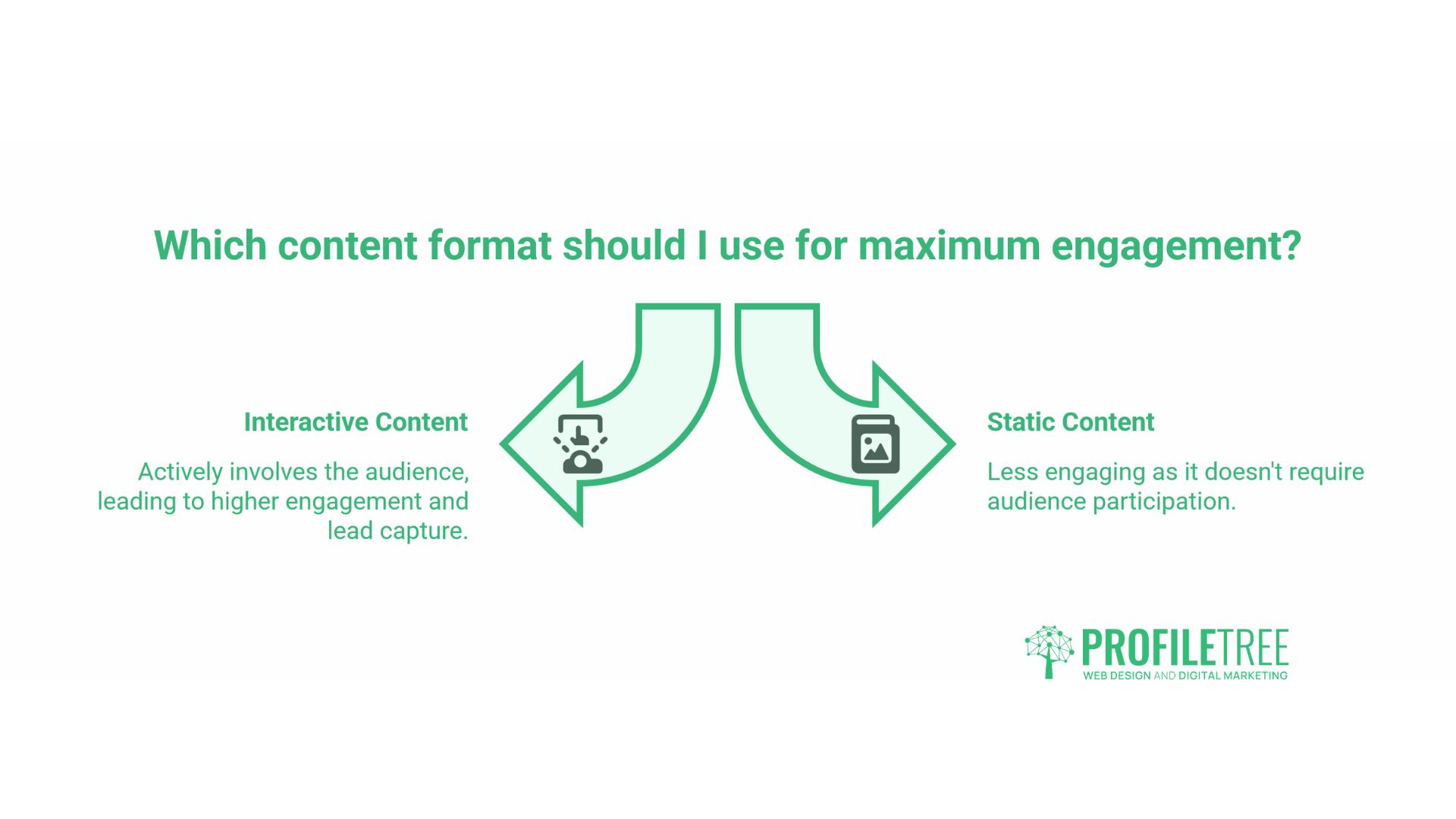
Interactive formats ask the audience to do something. That active participation is what separates them from every other format, and it is why they consistently outperform static content for engagement and lead capture.
Why Interactive Formats Drive Deeper Engagement
The difference between a reader and a participant is significant. When someone answers a question, completes a quiz, or uses a calculator, they are invested in the outcome in a way that passive reading never produces.
Interactive content quizzes, assessments, calculators, polls, and configurators generate significantly higher engagement than static equivalents because they require the audience to participate rather than passively consume. That participation increases dwell time, reduces bounce rate, and creates a data-collection opportunity that static content cannot match.
Interactive Content for B2B Lead Generation
For B2B, the most valuable interactive formats are those that help a prospective client understand their own situation, as this helps them qualify themselves as a lead.
For B2B contexts, the most effective interactive formats are diagnostic or decision-support tools. A web design readiness assessment, a digital marketing audit quiz, or a cost calculator all help the user understand their own situation and qualify the lead before a conversation takes place.
Creating interactive content for lead generation is covered in more detail in our dedicated guide. The key commercial point is that interactive content tends to outperform static content for lead capture precisely because it asks something of the user, and users who engage actively are self-selecting as genuinely interested.
Tools and Training for SMEs
Building interactive content does not require a development team. The tools available today put this format within reach of any SME with a clear brief and modest budget.
For SMEs without development resources, tools like Typeform, Outgrow, and Involve.me allow interactive formats to be built without code. The investment is relatively low; the engagement uplift relative to a standard contact form is typically significant. Teams that need support with tool selection and content strategy can access this through training your team to work with AI, which covers AI-assisted content production alongside traditional formats.
Measuring Engagement That Actually Matters
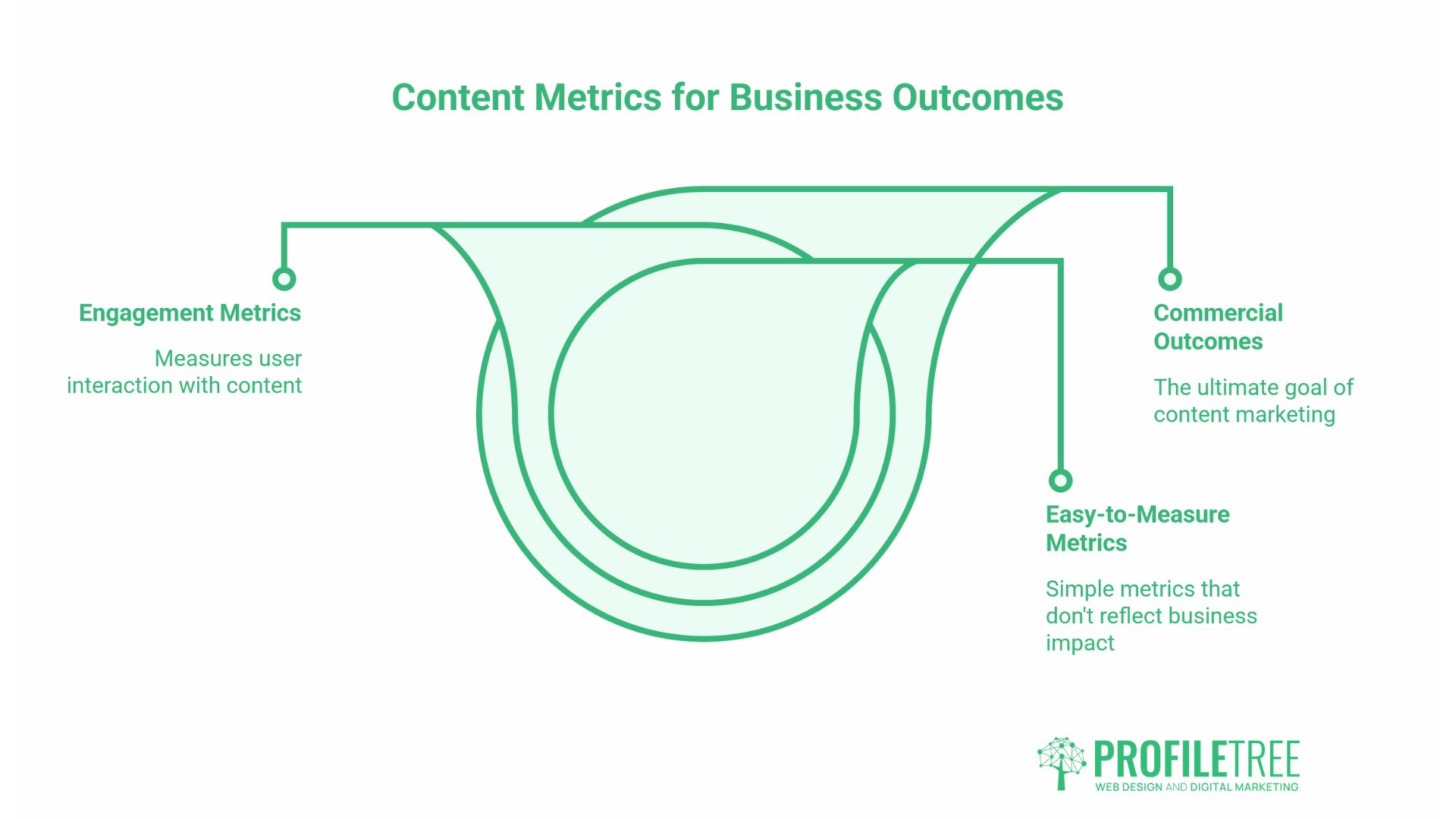
Tracking the wrong metrics leads to the wrong decisions. The numbers that matter are those that connect content performance to commercial outcomes, not those that are easy to measure.
On-Site Metrics
Page views tell you how many people visited the page. Engagement metrics tell you what they did next, and that second question is the one worth answering.
For on-site content, the metrics worth monitoring are scroll depth (how far down the page visitors scroll), average engagement time per session in GA4, and conversion events triggered by content consumption, form submissions, service page visits, and phone calls. A blog post that drives 200 monthly visitors with a 4% conversion to enquiry is more valuable than one with 2,000 visitors and no downstream action.
Social and Distribution Metrics
Reach without action is noise. The social metrics worth tracking are the ones that indicate genuine interest rather than passive exposure.
For social content, reach matters less than engagement rate and profile clicks. A video that reaches 500 people and generates 40 profile visits outperforms one that reaches 5,000 people and generates no profile visits beyond passive views.
Understanding content-sharing behaviour helps separate genuinely useful content from content that is simply seen. Shares, saves, and bookmarks are stronger engagement signals than impressions alone.
Privacy-First Analytics in the UK and Ireland
Cookie consent has changed the amount of data available by default. UK and Irish businesses that rely entirely on GA4 are working with an incomplete picture.
For UK and Irish businesses, engagement tracking requires attention to cookie consent and privacy-first analytics. GA4 operates on a consent model, and a significant proportion of visitors decline tracking. Supplementing GA4 with a server-side or privacy-first analytics tool, such as Matomo, provides a more complete picture of content performance without relying entirely on consented sessions.
“By blending strategic digital marketing with creativity, we build a loyal customer base. Content is only as strong as the strategy behind it, the format, the frequency, and the way it connects to what the business is actually trying to achieve,” says Ciaran Connolly, ProfileTree Founder.
Conclusion: Content Formats and User Engagement
No single format wins across every goal or audience. The businesses that see consistent results from content are those that match format to intent, invest in quality over volume, and track what actually connects to commercial outcomes. For most SMEs, that means a written foundation for search, video for awareness and trust, and interactive formats for lead capture built as a connected system rather than isolated pieces.
FAQs
Which content format has the highest engagement?
Video leads for reach and awareness, particularly short-form under 90 seconds. Interactive formats, quizzes, and assessments outperform static content for dwell time and lead capture. Long-form written guides and case studies deliver the strongest results for search traffic and conversion. The right answer depends on whether your goal is awareness, engagement, or enquiry.
How do you measure user engagement in GA4?
Focus on engaged sessions, average engagement time, scroll depth, and conversion events such as form submissions or phone link clicks. These tell you what visitors did with your content, not just that they arrived. Tracking which pages precede a conversion is more useful than monitoring page views alone.
What are the four main types of content?
Written, visual, audio, and interactive. Written covers blogs, guides, and case studies. Visual covers video, infographics, and photography. Audio covers podcasts and voice content. Interactive covers quizzes, calculators, and assessments. Most effective strategies use a combination rather than committing to one type.
Does content format affect SEO rankings?
Indirectly, yes. Format affects dwell time, scroll depth, and pogo-sticking, the engagement signals Google uses to assess quality. Structured content, including tables and lists, supports featured snippet eligibility. Video content can appear in video carousels. Choosing a format that holds attention is part of how well-optimised pages outperform thin ones.
What content formats work best for B2B marketing in the UK?
Written guides, case studies, and thought leadership articles distributed via LinkedIn perform consistently well in the UK B2B market. For website content, detailed service pages with verifiable proof points outperform generic overviews. Webinars and video tutorials work well for mid-funnel nurturing once an audience relationship has been established.
How can SMEs with limited budgets approach content format choices?
Start with written content, lowest production cost, highest long-term search value. Invest video budget in two or three priority services rather than spreading it thin. Use free tools like Typeform for interactive content. Where professional production is needed, a single well-made video asset used across a website, YouTube, and social channels over several years will outperform cheaper alternatives that date quickly.