
Brand Consistency for Small Business Websites: A Practical Guide
Table of Contents
Inconsistent branding is one of the most common and quietly damaging problems in small business marketing. A logo in three different shades of blue, a website tone that shifts from formal to chatty by the third page, a social media profile that looks nothing like the homepage: each one chips away at the trust a potential customer is trying to form.
Brand consistency for small business websites means presenting the same visual identity, tone of voice, and core messaging everywhere a customer encounters the business: on the website, across social platforms, in email, and in any published content marketing. This guide sets out what consistent branding covers, why it affects far more than aesthetics, and how to build a governance approach that holds as a site grows. For an SME owner or marketing manager in Northern Ireland, Ireland, or the UK working on a web design project or a broader digital marketing strategy, the steps below provide a practical starting point.
What Is Consistent Branding?
Consistent branding covers three distinct layers.
Visual consistency is the most obvious: logo, colour palette, typography, and imagery follow the same rules on every page and platform. A visitor arriving from a Google search should see the same visual identity they would encounter on Instagram or in an email footer.
Verbal consistency is about how a business writes and speaks. Tone on a product page, a blog post, and a customer service reply should be recognisably the same voice. This doesn’t mean identical (tone naturally shifts with context), but the underlying personality stays constant. A brand that sounds authoritative and direct on its services page shouldn’t suddenly turn breezy and informal in its FAQs.
Behavioural consistency is how a business acts: how quickly it responds, how it handles complaints, how it follows up after an enquiry. Customers form brand impressions from behaviour just as much as from design.
Most brand problems affecting SMEs sit in the verbal and behavioural layers, not the visual ones. Getting a logo right is straightforward. Maintaining a consistent voice across a website with dozens of pages, a monthly newsletter, and an active LinkedIn presence takes deliberate governance, which is where a documented brand consistency framework earns its keep.
Why Consistent Branding Matters for SME Websites
A website is the most controllable brand environment a business has. Social media platforms shape how content appears through their own layouts and algorithms; a website gives full control over every element. That control makes the inconsistency there particularly visible.
When someone lands on a website for the first time, they make a rapid judgement about whether to stay. Familiar, coherent design reduces friction. Mismatched fonts, a header image that feels like it belongs to a different site, or a tone that changes mid-page can put a visitor off even when they can’t say exactly why. The Nielsen Norman Group lists consistency as one of its core usability heuristics precisely because repeated, predictable patterns reduce the mental effort required to use an interface, and that principle applies as much to brand voice as to navigation menus.
Search engines read a website as a set of entity signals. Google is trying to establish who a business is, what it does, where it is based, and who it serves. When a business name appears in three different forms across a site, when its location is described inconsistently, or when service terminology shifts from page to page, that ambiguity can suppress the entity’s authority. Consistent naming (the same company name, location description, and service terminology appearing identically throughout) strengthens the semantic clarity that helps search engines categorise content correctly, which is part of why SEO services work, and brand consistency overlaps more than most SMEs realise.
Every piece of content published (a blog post, a social update, a video) is an investment. Consistent branding means those investments compound. A reader who encounters a brand on LinkedIn and then visits the website should feel continuity, which deepens brand memory. Without consistency, each touchpoint starts from zero, and customers accumulate fragments rather than a coherent impression.
The Three Pillars of Brand Consistency
Most conversations about branding jump straight to logos and colour palettes, but a website only holds together when three separate layers stay aligned at once. Visual identity gets a business noticed. Tone of voice gets it remembered. Behaviour, how quickly it responds and follows through, is what actually earns the trust that the other two are trying to build. Treat any one of these in isolation, and the brand starts to feel disjointed even when nothing looks obviously wrong. The sections below break down what each pillar covers and where SMEs typically slip up.
Colour, Typography, and Visual Language
A website’s visual identity needs a documented system, not a vague idea. At a minimum, that means defining primary and secondary colours as hex codes, selecting two or three typefaces applied consistently across headings, body text, and interface elements, and establishing image guidelines governing the style and subject matter of photographs and graphics.
For WordPress-built websites, which account for the majority of SME sites across the UK and Ireland, these rules are typically encoded into a child theme or a site-wide design system. A website development build that locks these rules into the theme, rather than leaving them to individual page editors, is what turns brand consistency from a policy into a technical default. The most common failure point is photography: a professional header image followed by low-quality stock photos in blog posts immediately breaks visual cohesion. A defined photography style, even a simple one, has more impact than most businesses expect.
Tone of Voice Across Every Page
Tone of voice is where most websites quietly fall apart. The homepage sounds confident and clear. The about page turns vague and corporate. The blog shifts between formal and casual depending on who wrote it. The FAQ section sounds like it was written by someone else entirely.
A tone-of-voice guide doesn’t need to be long. It needs to answer four questions: who are we talking to, what do we want them to feel, what words do we use, and what words do we avoid. Once those are defined, everyone contributing to the site, whether an internal team member or an external writer, has a reference point. A content marketing engagement typically starts with exactly this kind of tone-of-voice brief before any copy gets written.
Behavioural Consistency in Service Delivery
The third pillar gets the least attention but affects trust the most directly. Response times, complaint handling, and follow-up after an enquiry all shape how a brand is perceived, regardless of how polished the website looks. A business that promises fast, straightforward service on its homepage but is slow to reply to enquiries creates a gap between the brand promise and the brand experience, and customers notice that gap faster than they notice a mismatched font.
Brand Consistency in Familiar UK Brands
It helps to see the three pillars in businesses that most UK readers already know, without needing invented statistics to make the point. Monzo built its identity around a distinctive coral card and a conversational, plain-English tone that carries through its app, its marketing, and its customer support, so the brand feels the same whether someone is reading a tweet or resolving a support query. Greggs maintains an informal, self-aware social media voice that stays recognisable across platforms, even as the format of each post changes. Neither example needs a big budget to imitate; the underlying discipline is the same one available to any SME: decide on a small number of rules and apply them everywhere, including the small, unglamorous touchpoints like automated emails and social media bios.
Maintaining Brand Consistency in the Age of AI-Generated Content
One of the genuine challenges facing SMEs is maintaining a recognisable brand voice as more content is produced using AI tools. The risk isn’t that AI content is poor; it defaults to average. Large language models produce fluent, plausible text that sounds professional, but that text tends to sound like every other brand using the same tools with the same default settings. Distinctiveness disappears unless something actively counters it.
The practical response is a tone-of-voice guide for AI-generated content, built as an input to the workflow rather than an edit applied afterwards. Before generating anything with an AI tool, feeding in a description of the brand’s tone, examples of its best existing copy, and specific terminology that characterises the brand gives the output a proper starting point. It will still need editing, but it starts from the right place rather than the generic default. This is a growing part of what AI implementation and transformation work looks like for SMEs: not replacing a content process with AI, but governing how AI gets used inside an existing brand system. Teams building this governance internally often benefit from structured digital training covering prompt frameworks and review processes, rather than leaving individual staff members to experiment with tone on their own.
How to Audit Your Brand Consistency
A brand audit doesn’t need external consultants or specialist software. A structured internal review, done honestly, surfaces the issues that matter. Work through the checklist below across the website, social profiles, and email communications.
| Area | What to Check |
|---|---|
| Logo | Same version, correct colours, consistent placement across all pages and platforms |
| Colour palette | Only approved colours used; no ad-hoc variations in buttons, headers, or graphics |
| Typography | Consistent heading and body fonts; no random font introductions in blog images or banners |
| Tone of voice | Same personality evident across service pages, blog posts, FAQs, and error pages |
| Messaging | Core value proposition appears consistently; no contradictory positioning between pages |
| Imagery | Consistent visual style; no obvious stock photo mixing with brand photography |
| Company name | Identical naming convention throughout; no switching between abbreviated and full versions |
| Contact details | Same address format, phone format, and email across all pages and directories |
| Social profiles | Bios, profile images, and cover images aligned with website identity |
| Email templates | Headers, footers, and tone match website branding |
When inconsistencies turn up, prioritise by visibility: homepage and service pages first, blog content second, social media third. This audit maps closely onto the Audit stage of a structured digital marketing strategy process, where brand signals get reviewed alongside technical SEO and content performance rather than treated as a separate exercise.
Building a Brand Governance Framework
A governance framework sounds more complicated than it is. For an SME, it comes down to three things: a document, a process, and a person.
The document is the brand guide. It doesn’t need to be long. A short PDF covering logo usage, colour codes, typography rules, tone-of-voice principles, and core messaging guidelines is enough for most businesses to eliminate the most common inconsistency problems. What matters is that it exists and stays accessible to everyone who creates content for the brand.
The process is a simple check applied before anything goes live: Does this look and sound like us? If the answer needs debate, the brand guide needs more clarity. If the answer is obviously no, it needs editing. This applies to AI-generated, externally commissioned, and in-house content alike, and it’s a natural fit for the editorial checkpoints already built into most content marketing workflows.
The person is whoever owns brand decisions, usually the owner or a senior marketing manager for most SMEs. The role isn’t to approve every piece of content; it’s to maintain the guidelines, update them as the brand evolves, and make the final call when there’s genuine uncertainty.
Consistent Branding and Your Website Build
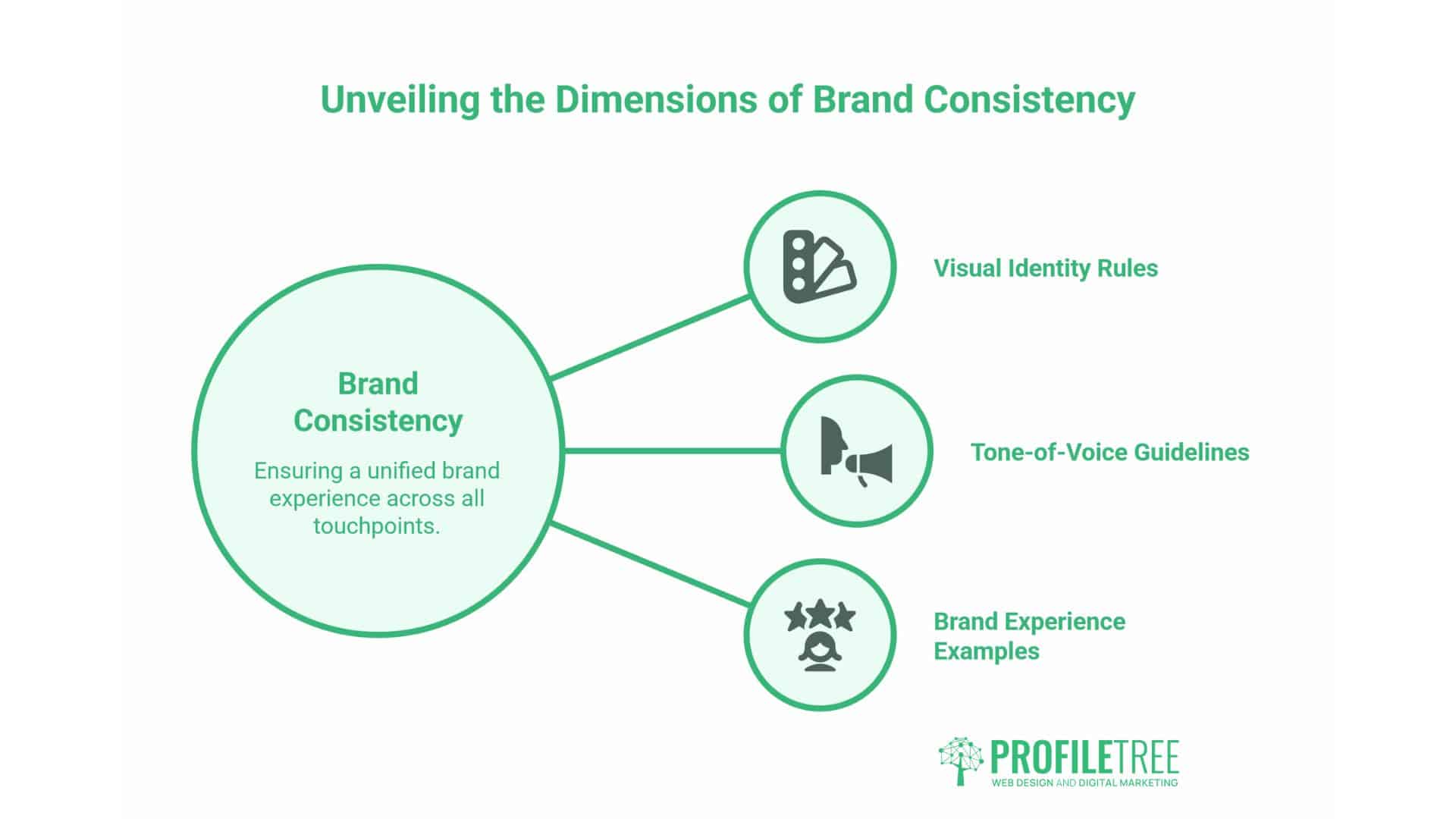
For a business building or rebuilding a website, brand consistency is a specification, not an afterthought. The brief given to a web design agency should include visual identity rules, tone-of-voice guidelines, and examples of the brand experience the business wants to create.
A well-built WordPress site embeds brand consistency into its architecture: a design system that controls typography globally, a colour palette that can’t be overridden on individual pages, and template structures that make it difficult to deviate from the brand standard. That is considerably more durable than a visually attractive site with no underlying system, because the brand holds as the site grows. The same principle applies to broader website development work, whether that means adding new service pages, building out a blog, or integrating a booking or e-commerce function; the technical build should reinforce the brand system rather than work against it. Anyone auditing their own site’s technical foundations alongside this is likely to find Google PageSpeed Insights and an accessibility review worth running at the same time, since a slow or inaccessible site undermines a consistent brand just as much as a mismatched font does.
“The brands that hold up best online are the ones that treated their visual and verbal identity as a system from the start, rather than a mood board,” says Ciaran Connolly, founder of ProfileTree, a Belfast-based web design and digital marketing agency. “When the rules are built into the site, consistency becomes the default rather than something you have to police.”
Consistent Branding Across Your Marketing Channels
A website is the hub, but brand consistency has to extend to everything that drives traffic to it.
Social media is where visual consistency breaks down most visibly. Profile images, cover photos, and the visual style of posts should be recognisably aligned with the website identity. Not every post needs to be a designed graphic, but there should be a thread of visual coherence that a regular follower can identify. Businesses working through this alongside broader visibility efforts, such as getting listed correctly on free business listing sites or tracking their standing through tools covered in the Alexa Rank explainer, tend to catch naming and description inconsistencies they’d otherwise miss.
Email marketing is often the most overlooked channel for brand consistency. Templates that don’t match the website, a subject line tone that feels disconnected from the wider content voice, and footer details that use different address formats from the website all add up to a fragmented impression.
Video content adds a layer of complexity because voice, literally, becomes part of the brand. How a presenter speaks, the visual style of titles and graphics, and production quality all contribute to brand perception. For SMEs investing in video production, animation, and YouTube marketing, a consistent visual template for thumbnails and titles, paired with a consistent presenting style, pays off quickly. The same discipline applies to a business’s approach to video marketing campaigns more broadly, and to how results get read afterwards through social media analytics and wider online community statistics.
Treating Brand Consistency as an Ongoing Standard
Consistent branding is not a one-off design project. It is a standard set, documented, and applied every time new content goes live or a new channel comes into play. For most SMEs, the starting point is rarely a full rebrand; it is an honest audit of what already exists, a simple set of documented rules, and the discipline to apply them. Get those three things right, and the commercial benefits follow. A business whose site needs a structural overhaul to properly reflect its brand identity, and whose team wants a grounding in how AI tools fit into that system, may find it useful to start with the AI websites and website-building process guide alongside a wider look at web design options.
FAQs
What is consistent branding?
Consistent branding means presenting a business with the same visual identity, tone of voice, and messaging across every channel: website, social media, email, and printed materials. The goal is for anyone encountering the brand in any context to receive the same impression, whether they land on a service page, a social post, or a support email.
Is brand consistency the same as brand identity?
No. Brand identity is the toolkit: the logo, colours, typefaces, and tone-of-voice rules a business defines. Brand consistency is the discipline of applying that toolkit the same way everywhere, every time. A business can have a well-designed identity and still be inconsistent if the rules aren’t followed on every page and channel.
Why is brand consistency important for small businesses?
For SMEs, brand consistency builds familiarity, which drives trust and affects both conversion rates and customer retention. It also strengthens SEO by creating clear entity signals for search engines and reduces marketing costs by making every channel reinforce the others rather than starting from zero.
How do you maintain brand consistency across social media?
Begin with the documented visual identity and tone guide already used on the website. Apply the same profile image, cover image, and colour conventions across all platforms, and review profiles against the website guidelines at least twice a year, since platform redesigns and new features can quietly introduce drift.