
Business objectives for SMEs: examples and how to set them
Table of Contents
Business objectives are specific, measurable targets a company commits to reaching by a set date, and each one serves a wider goal such as growth or profitability. ProfileTree advises SMEs in Belfast and across Northern Ireland to run three to five at a time, each written in SMART form and tied to figures the business already tracks.
What is a business objective?
A business objective is a measurable step towards a goal, with a target figure and a date, and one named person responsible for it. “Grow the business” is a goal, while “win 15 new retainer clients from Belfast manufacturers by next March” is an objective, because anyone in the company can check in April whether it happened.
The difference matters most when money is about to be spent. An owner who asks an agency for “more visibility online” has given a direction. Until that direction becomes a target with a figure and a date, there is no fair way to judge whether a new website or an SEO retainer has paid for itself. Turning ambitions into targets of that kind is the first piece of work in every engagement behind our digital marketing Belfast service, before any design or content is discussed.
Objectives also help settle trade-offs. When a business knows that this year’s priority is enquiries from outside Belfast, a request for a fresh brochure or a social media refresh can be judged against that target and set aside if it does not move it.
Goals and objectives do different jobs
Goals set the direction of a business over several years, and objectives break that direction into targets a team can work on this quarter. The two words are often used interchangeably, including in business plans and funding applications, but treating them as separate layers makes both easier to write.
| Business goal | Business objective | |
|---|---|---|
| Scope | Broad and directional | Narrow and specific |
| Timeframe | Usually one to five years | Usually one to twelve months |
| How it is measured | By direction of travel | Against a stated figure |
| Example | Become the first choice for office cleaning in Belfast | Sign 20 new office cleaning contracts in Belfast by 30 June |
| What it guides | Strategy and investment | Weekly priorities and budgets |
Below each objective sit key performance indicators (KPIs), the regular measurements that show whether the objective is heading the right way. If the objective is 20 new contracts, the KPIs might be the number of quote requests each week and the share of quotes that convert. A fall in either warns the owner months before the deadline.
The five types of business objectives most SMEs need
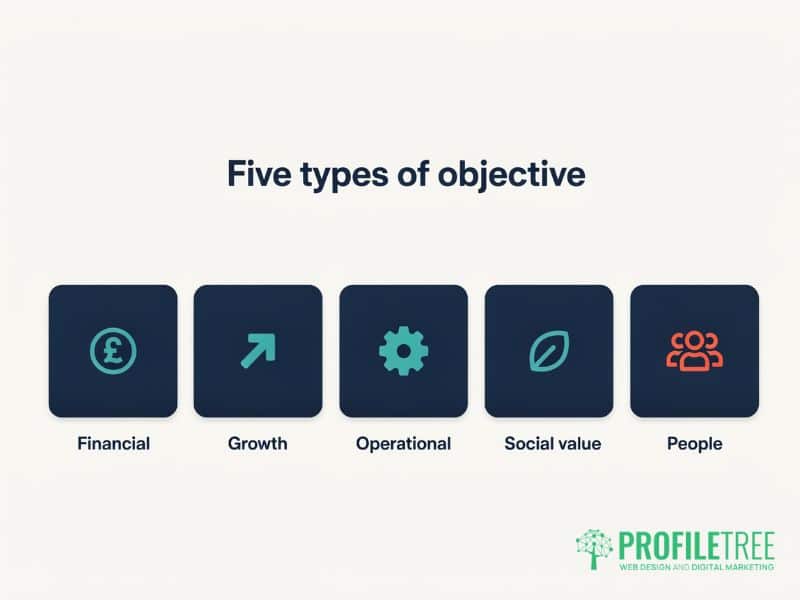
Nearly every SME needs objectives in more than one area, because a revenue target that ignores staffing or delivery capacity tends to fail for reasons nobody planned for. The types below cover what most owner-managed businesses in Northern Ireland and Great Britain plan for, although few need all five active at once.
Financial objectives
Financial objectives cover revenue and cash flow, and they usually sit at the top of the list because every other objective depends on the business staying solvent. Typical examples are a monthly revenue figure or a maximum number of days between sending an invoice and being paid.
Most of these targets now have a website element, even when the owner does not think of them that way. If enquiries arrive through the website, the conversion rate (the share of visitors who get in touch or buy) is one of the cheapest levers on revenue, because raising it earns more from the visitors the business already has.
Growth and market objectives
Growth objectives say where the business will compete next, whether that is a new region or a new type of customer. For firms in Northern Ireland, that often means selling into Great Britain or the Republic of Ireland. Either brings a second market with its own buying habits and, for the Republic, a second currency.
Before committing to premises or staff in a new market, a business can test demand with a dedicated service page and a handful of articles written for that audience, then set an objective on the enquiries those pages produce. The test is slower than buying attention, but the pages cost little to keep and continue to bring in enquiries after the test ends.
Operational objectives
Operational objectives deal with how the business delivers its work, for example turnaround times or the hours spent on administration. AI tools now sit firmly in this category. The objectives that succeed with them name one process, measure how long it takes today, and set a target for the time it should take once the tool is in place. Broad objectives such as “use AI more” rarely change anything, because there is nothing to count at the end.
Social value and ESG objectives
Social value objectives describe what a business contributes to its community and the environment, and for firms that bid for public contracts, they now carry marks in the tender. ESG (environmental, social and governance) is the wider term that investors and larger customers use for the same commitments.
The rules differ across the UK. Central government contracts let under the Procurement Act 2023 follow Procurement Policy Note 002, which has applied since 24 February 2025 and means social value must carry at least 10 per cent of the total available score. In Northern Ireland, the Department of Finance’s PPN 01/21 on scoring social value sets the same 10 per cent minimum for works contracts above the UK procurement threshold and for services contracts above £500,000 including VAT.
For an SME, a sensible start is one or two social value objectives that can be evidenced in a tender response. Examples include a set number of paid placements for local students each year or a target share of spend with suppliers based in Northern Ireland. Objectives like these are easier to prove than broad statements of intent, and tender evaluators score evidence.
People and skills objectives
People objectives cover hiring and the skills staff need to deliver the other objectives. When a growth objective depends on the team writing content or using AI tools well, a training objective belongs alongside it, with a measure that shows the new skill is being used. ProfileTree builds its digital training around each business’s own website and keywords for that reason, so the measure is a change made on the live site.
Business objectives examples for SMEs
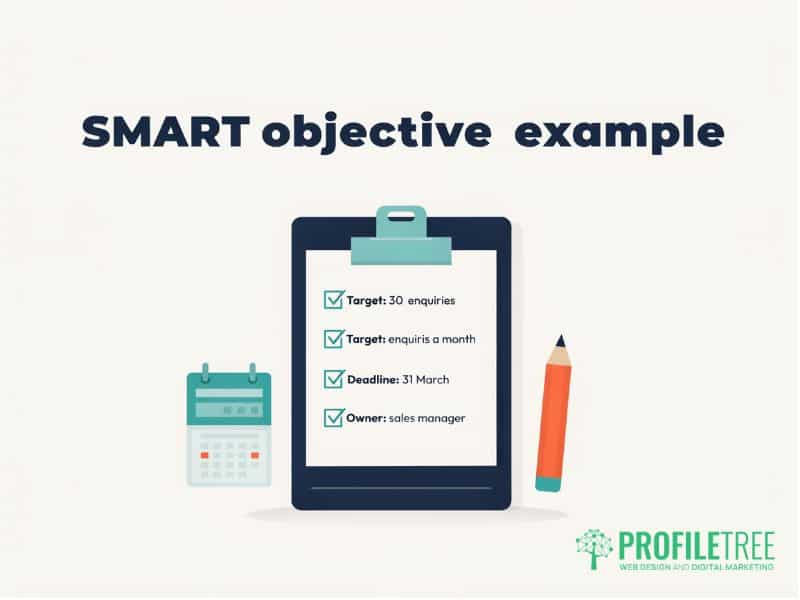
The examples below are written as complete SMART objectives that an SME can adapt by changing the figures and dates. They are illustrative targets, and the right numbers depend on each business’s baseline, which is why every objective should start from current figures.
Revenue and enquiries
Increase enquiries through the website’s contact form from an average of 20 a month to 30 a month by 31 March, by rewriting the five main service pages and adding a clear call to action to each one. The baseline comes from the business’s analytics, and the sales manager owns it.
Reduce the average time between a website enquiry and the first reply to under four working hours within the next quarter, measured from the timestamps in the business’s CRM (customer relationship management software). The target is set in hours because the team can act on it every working day.
Search and AI visibility
Reach the first page of Google, measured from Belfast, for eight named service and location search terms within nine months, by improving the service pages and publishing two supporting articles a month. Tracking from the place customers search from matters, because a national average position can differ widely from what a local customer sees.
Have the business named correctly in answers from Google AI Overviews and Microsoft Copilot for three questions customers commonly ask, within two quarters. Do this by publishing a clear answer to each question on the website and keeping the business’s details consistent across its online listings. Progress is checked by asking each question once a month and recording the answer.
Content and video
Publish one short video each month for six months, each answering a question that customers raise on sales calls. Over the same period, increase the average engaged time on the pages carrying those videos by a fifth against the previous half-year. The marketing manager owns this one and reports it at the monthly review.
Operations and AI
Cut the time spent writing first drafts of quotes from two hours to under one hour per quote before July, by putting one AI drafting process in place and checking every draft before it is sent. The operations lead measures progress by timing ten quotes before the change and ten after it.
People and training
Have every member of the customer-facing team complete training on the business’s website editor and Google Business Profile within the quarter. Each person then makes at least one approved update to the live site or profile within a month of the training. The second half of the objective is the measure, because it shows the training is being put to use.
How to set SMART objectives
SMART is a checklist that turns a goal into an objective by forcing five decisions: what exactly will change, how it will be measured, whether it is achievable, why it matters to the business, and when it will happen. George T. Doran introduced the idea in Management Review in November 1981. His original letters stood for specific, measurable, assignable, realistic and time-related. The modern version usually drops “assignable”, which is a pity, because an objective without a named owner is the one most likely to stall.
Work through the five tests in order for each draft objective.
- Specific means the objective names the outcome and the audience it comes from, so “more online visibility” becomes “more enquiries from Belfast landlords through the lettings page”.
- Measurable means there is a number and a source for it, such as the form submissions recorded in your analytics or the closed deals in your CRM.
- Achievable means the target stretches the business from its own baseline, so a business that gets no search enquiries today should not aim for 100 a month by the summer.
- Relevant means the objective serves a goal the owner cares about, so a business growing in the Republic of Ireland should not set its search targets on terms only people in Great Britain use.
- Time-bound means a deadline and a review date, and it is the deadline that decides what the team works on this week.
Then give each objective an owner and agree on the budget behind it. An SEO objective with no budget for content or technical work will not be met, however well it is written. A named owner stops the situation where everyone assumes someone else is tracking it.
A finished example reads like this: “Increase enquiries from organic search by a quarter within six months by publishing four articles a month on our main service areas and fixing the site speed issues in the first eight weeks, owned by the marketing manager and reviewed monthly.” That sentence hands the content writer a publishing target and the developer a deadline, and it leaves the owner with a figure to hold both of them to.
Measuring progress against your objectives
Measurement has to be agreed before an objective starts, because tracking added halfway through leaves the first months without a baseline. For digital objectives, four free or low-cost sources cover most needs.
Google Analytics 4 records what visitors do on the website, including key events (the actions that matter, such as a form submission or a phone click). It is the source for most enquiry and conversion objectives. Google Search Console shows the searches a site appears for and how often people click through, so it is the source for search visibility objectives. Bing Webmaster Tools provides the equivalent view of Bing, the search engine behind Microsoft Copilot. A CRM records what happens after the enquiry, which is where revenue and retention objectives are measured.
Our guide to website KPIs sets out which figures to start with on most business websites. The marketing measurement framework guide explains how to connect channel figures to revenue. Review short-term objectives monthly and annual objectives each quarter, and write each review down so that next year’s objectives start from evidence.
Why three to five objectives is enough for most SMEs
A typical SME makes better progress with no more than five active objectives than with ten, because a small team cannot give real attention to more than a handful at once. A long list spreads budget and management time so thinly that each objective moves a little and none is finished by the deadline.
The fix is to rank objectives by their effect on the main goal and park the rest until the next review. A parked objective stays written down, and it moves onto the active list when one of the current objectives is met or dropped.
Turning your objectives into a digital plan with ProfileTree
The next step once the objectives are written is to decide which digital work will move each one, and in what order. ProfileTree is a Belfast web design and digital marketing agency, founded in 2011 and based at the McSweeney Centre. We help SMEs across Northern Ireland and Great Britain turn objectives like the ones above into a plan for their website and their search visibility.
“Ask any agency three things before you agree a digital strategy: who will actually do the work, what you will own when it is finished, and how you will know it worked. The third question is the business objective, and any Belfast business is welcome to put all three to ProfileTree first,” says Ciaran Connolly, founder of ProfileTree.
If you want a second opinion on your objectives or a plan to meet them, our digital strategy service starts from the figures you already have. Strategy work is quoted on request, and the first conversation is about what you want to achieve before it turns to our services.
FAQs
1. What are the main objectives of a business?
Most businesses have four underlying objectives: survival, profit, growth, and, increasingly, a social or environmental contribution. For an SME, survival and cash flow come first in practice, and growth objectives are only safe once the business can fund them.
2. What is the difference between business aims and objectives?
An aim is a broad statement of what the business wants to achieve, and an objective is a measurable step towards it with a target figure and an end date. In a business plan, each aim is usually followed by two or three objectives that show how it will be reached.
3. How do you write aims and objectives for a business plan?
Start with one aim for each area the plan covers, then write the objectives under each aim in SMART form. Lenders and grant bodies read the objectives closely, so each one should state a number and a date along with the evidence that will show it has been met.
4. What are corporate objectives?
Corporate objectives are the objectives set for the whole company, usually by the directors, and departmental objectives are then written to support them. In an SME, the corporate and departmental levels are often the same few people, so a single short list usually works better than two layers.
5. What objectives should a small business set first?
A small business should usually set a cash flow objective and an enquiries objective first, because both can be measured within weeks and both keep the business running while longer goals take shape. Objectives on brand or market expansion can follow once those two are moving in the right direction.
AI words to avoid, and what detectors really measure
How to add a domain to your Wix site