
Brand Attributes List: Examples and How to Choose Yours
Table of Contents
Brand attributes are the qualities customers associate with a business: reliable, local, responsive or fairly priced, for example. ProfileTree, a Belfast web design and marketing agency, helps SMEs choose three to five attributes that are true of them and then prove those qualities on the website and in the content customers see before they get in touch.
Most firms already have a list of flattering adjectives in a strategy document. The difficult part is getting customers to use those words unprompted, in their reviews and, increasingly, in the answers AI tools give when someone asks who to hire.
This guide explains how brand attributes differ from values and personality, then sets out a working list. Later sections cover testing your own candidates, showing them online and checking that they land.
What Attributes Are and How They Differ from Values and Personality
An attribute is an observable quality that people link to your business, and it lives in the customer’s head rather than in your marketing plan. Most confusion around the term comes from mixing it up with neighbouring ideas, so this section separates them before any list can help. It is also where most digital marketing Belfast projects at ProfileTree begin, because messaging cannot be planned until the business knows which qualities it is trying to be known for.
Sorting attributes in a few different ways makes the idea concrete. The first split is between what you can see and what customers feel, the second between practical and emotional qualities, and the third places attributes next to values and positioning.
Hard and Soft Attributes
Hard attributes are the tangible parts of a brand that the business controls directly: the name, logo, colour palette, typeface, packaging and the design of the website. Several of these can be legally protected, and the UK Intellectual Property Office explains what you can register as a trade mark, including words, logos, colours and sounds that identify your goods or services.
Soft attributes are the impressions those assets and your behaviour leave behind: trustworthy, approachable, careful or prompt. You cannot register “dependable”, and you cannot simply declare it either. Customers award them gradually, depending on whether the visible assets keep matching their experience of working with you.
Functional and Emotional Attributes
Functional attributes describe what a business does well in measurable terms. A plumber who arrives within the hour, an accountant who files on time, and an online shop with free returns are all trading on functional qualities that a customer can check.
Emotional attributes describe how the business makes people feel: reassured, looked after, proud to be seen with it, or relieved that someone else is handling the problem. These are harder to copy than functional promises, because a competitor can match your delivery time far more easily than the sense of confidence your customers have built up. The ProfileTree guide to emotional branding looks at that second category in more depth.
Where Attributes Sit alongside Values, Personality and Positioning
Values are internal beliefs that guide decisions, while personality describes how your communication sounds and positioning is the space you claim against competitors. Attributes are what people observe once all of that has been put into practice, so a company can hold honesty as a value for years without ever earning the attribute “honest”.
| Term | What it describes | Who sets it | Example |
|---|---|---|---|
| Brand values | Beliefs that guide internal decisions | Owners and leadership | “We tell customers the full price up front” |
| Brand personality | How your tone and visuals come across | Marketing and content | Plain-spoken, warm, formal |
| Brand positioning | The place you claim in the market | Strategy | The specialist for listed buildings in County Down |
| Brand attributes | Qualities customers notice and repeat | Customers, over time | Transparent, punctual, local |
Read the table from top to bottom, and you have the order of the job. A company that settles its beliefs and its place in the market first finds the attribute question much easier to answer.
A Brand Attributes List Grouped by What Customers Notice
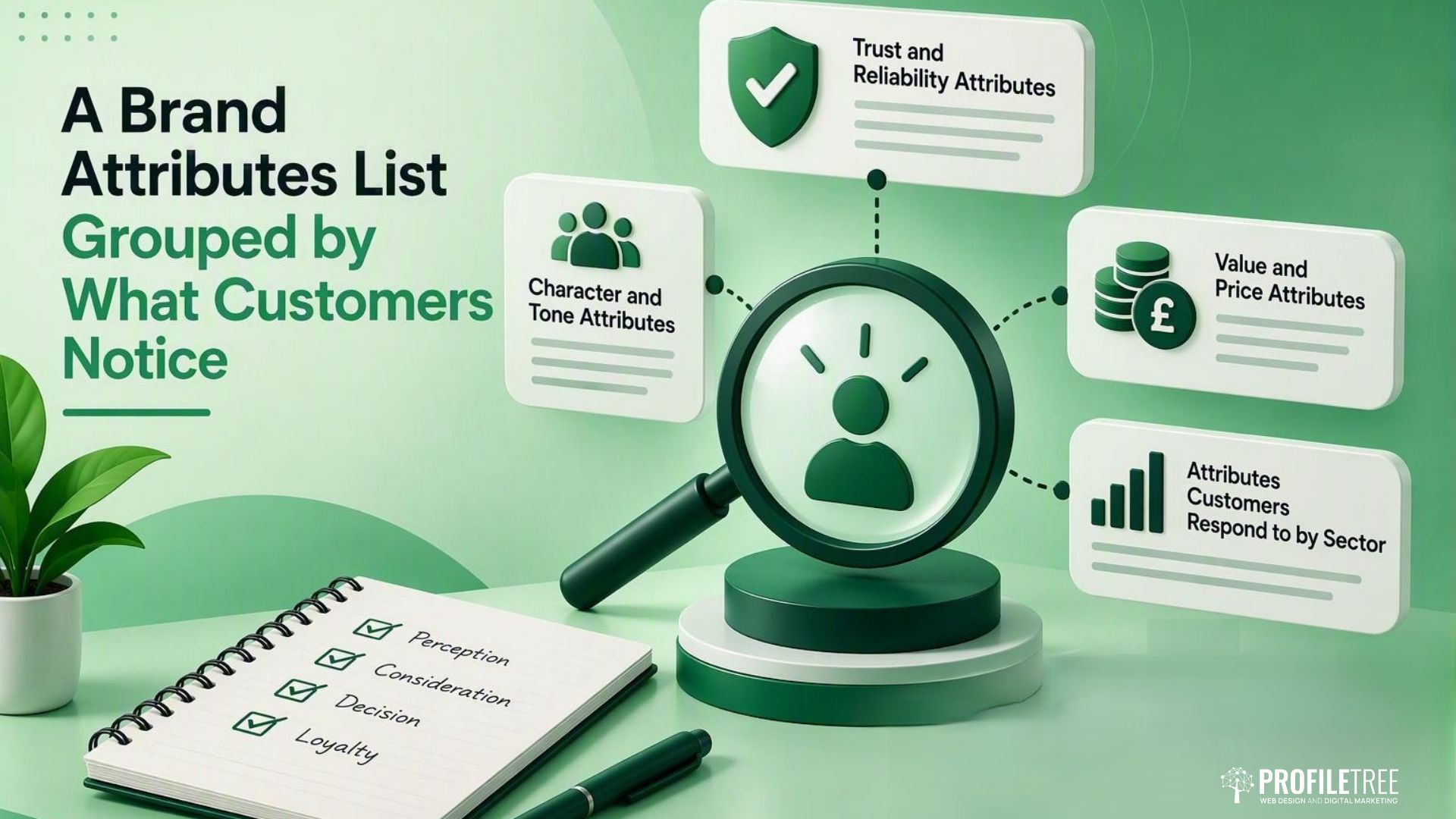
Generic lists of 100 adjectives rarely help an owner decide anything, so the list below is organised by the kind of judgement a buyer is making. Use it as a starting point for discussion, and expect to discard most of it.
Each group answers a different question in the buyer’s mind, and a closing table shows which qualities usually matter in particular sectors.
Trust and Reliability Attributes
Trust attributes answer the customer’s question of whether you will do what you said. Typical examples are dependable, consistent, experienced, thorough, discreet, accurate, accountable and responsive. They carry the most weight wherever the buyer is taking a risk, as in legal services, finance, healthcare, building work and business software, and they cannot be rushed.
They are also fragile. A single public complaint about a missed deadline can undo months of reviews praising punctuality, and ProfileTree therefore treats brand trust as something to be protected in every customer touchpoint, from the contact form to the follow-up email.
Character and Tone Attributes
Character attributes describe the personality a customer meets: friendly, plain-spoken, playful, formal, bold, calm, irreverent, warm or understated. They decide whether a visitor feels the company is for “people like me”, and they shape everything from the wording on a quote to the music behind a social video.
There is no correct character, only a consistent one. A family-run funeral director and a craft brewery will choose very different words, and both will succeed if the tone in their emails, signage and website copy matches the way staff speak on the phone.
Value and Price Attributes
Value attributes explain what the customer gets for their money. Affordable, good value, premium, exclusive, worth the wait and no hidden costs all belong here, and vague claims damage them more than any other group.
Choose one end of the scale and commit to it. A company that calls itself both “premium” and “budget-friendly” confuses visitors, while a firm that explains clearly why it costs above the cheapest option often earns “worth it”, which is a stronger value attribute than “cheap”.
Attributes Customers Respond to by Sector
The right attribute depends on what is being bought, so one word can be decisive in one sector and irrelevant in another. The table below sets out qualities buyers commonly want across five broad sectors.
| Sector | Qualities buyers usually want |
|---|---|
| Professional services (legal, accountancy, consultancy) | Trustworthy, experienced, discreet, thorough, responsive |
| Technology and software | Reliable, secure, intuitive, fast, well supported |
| Retail and ecommerce | Convenient, keenly priced, well reviewed, simple returns, fast delivery |
| Hospitality and food | Welcoming, authentic, consistent, generous, local |
| Manufacturing and trades | Durable, precise, punctual, fairly priced, safe |
Clients hiring a solicitor are buying certainty, so “different” rarely helps them decide, while a trades firm earns repeat work through punctuality long before anyone asks whether it is exciting. That pattern holds whether the business trades from Belfast, Cork or Manchester.
How to Identify and Test Your Own Brand Attributes
Working out which attributes apply to you takes a structured process, and a single brainstorm in a meeting room rarely produces it. The four steps below move from evidence to decision, and each one removes candidates that sound good but would not survive contact with customers.
Most SMEs can complete the process within a fortnight with input from the people who deal with customers every day.
Start with the Words Customers Already Use
Collect the language people use about you without prompting. Read your Google reviews, testimonials, survey comments and the emails people send after a job, and note every adjective or phrase that describes how you work. Ask whoever answers the phone what callers say when they ring back.
Patterns appear quickly. If a dozen reviews mention “kept us updated”, responsiveness is already a quality you own, whether or not your adverts mention it. If nobody mentions the quality your website leads with, that gap is the first thing to fix.
Map the Attributes Competitors Already Own
List three or four direct competitors and write down the attributes their reviews, websites and social channels have already established. A rival that has spent five years building a name for speed will not be displaced on speed, however loudly you promote it.
Look for the quality nobody in your local market has claimed convincingly. It may feel less glamorous than “forward-looking”, but an uncontested attribute like “explains everything in plain English” can win more enquiries than a crowded one.
Test Each Candidate for Truth, Delivery and Distinctiveness
Put every shortlisted attribute through three checks. It must be true today on the evidence from customers, the whole team must be able to deliver it on an ordinary Tuesday as well as a good day, and it must separate you from the competitors you mapped. Drop anything that fails a check, however appealing it looks on paper.
The truth test matters most, because customers are quick to notice when a brand’s claims and its reality diverge. The food sector offers a clear example: delivery-only restaurants that run several “virtual” brands from one kitchen have faced questions about honesty when diners discover the same cooks behind different names, a problem covered in this explainer on how ghost kitchens work.
Write the Attributes Down Where the Team Will Use Them
Agree the final set and record each attribute with a sentence explaining what it means in practice. “Responsive” might become “we reply to every enquiry within one working day”. That written definition turns a word into something staff, freelancers and suppliers can act on.
Put the document where it will be used: in the brand guidelines, the onboarding pack for new staff and the brief for anyone writing content. Many small teams find that a session on tone of voice and content standards, of the kind covered in ProfileTree’s digital training, keeps the attributes alive long after the planning meeting.
Showing Your Attributes across Your Website, Search and Content
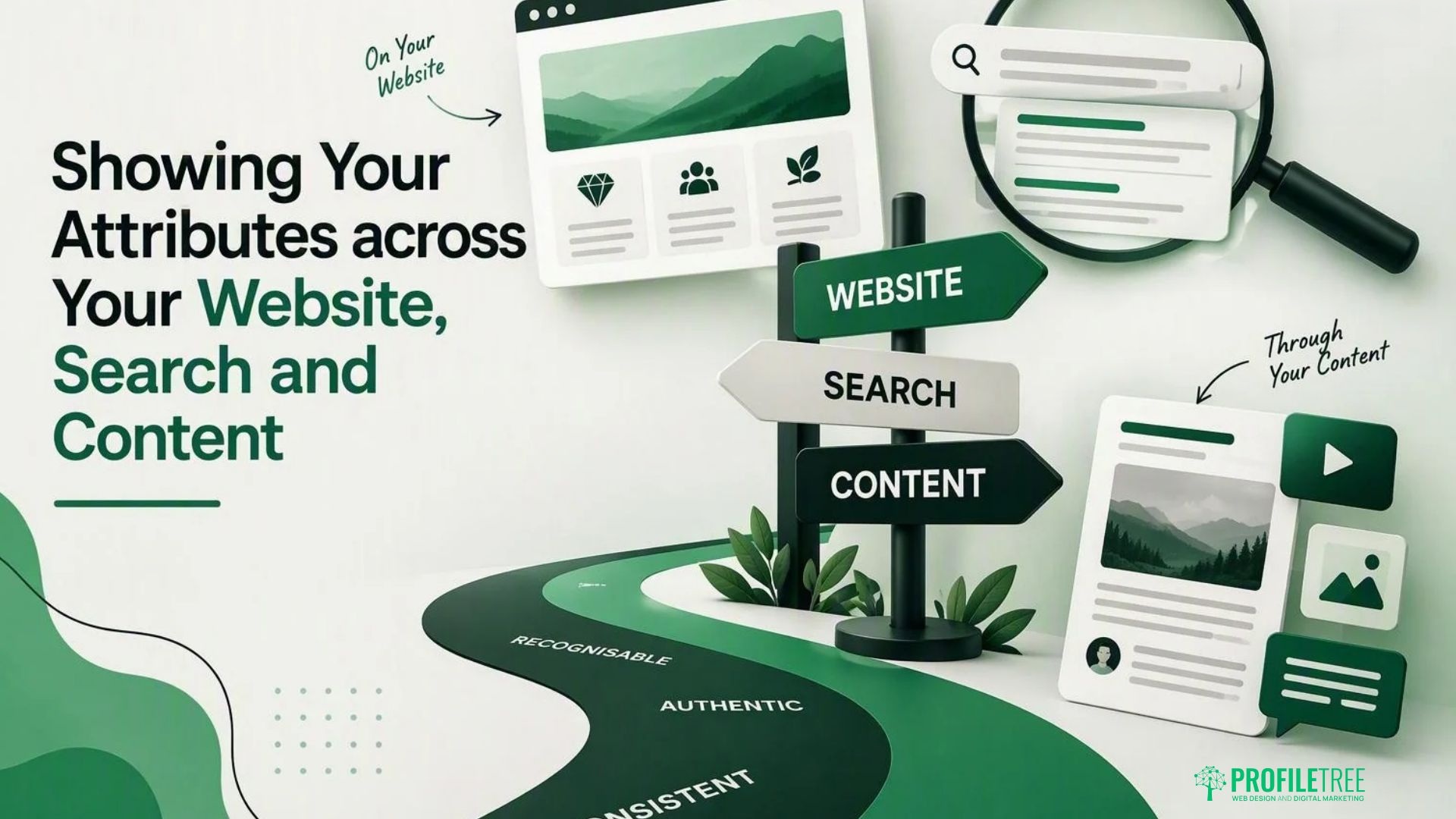
Defining attributes is the easier half of the job. The harder half is showing them consistently wherever people meet the business online, and this is where most SMEs run short of time or technical help.
ProfileTree is a Belfast web design and digital marketing agency, founded in 2011 and based at the McSweeney Centre, and the four areas below are where its team sees attributes confirmed or contradicted most frequently.
Visual Identity and Web Design
Colour, typography and layout communicate a quality before a visitor reads a word. Muted blues and generous white space usually suggest calm and competence, while brighter palettes and bolder type suit an organisation built on energy or approachability. The logo, the photography and the icons should all point the same way.
A website is usually the place where these choices come together initially. When ProfileTree takes on website design for a client, the agreed attributes go into the brief alongside the sitemap, so that a firm describing itself as “approachable” does not end up with a cold, corporate template.
Speed, Usability and Accessibility as Proof of Character
An attribute such as “efficient” falls apart the moment a page takes several seconds to load or a form fails on a phone. Visitors read loading speed, clear navigation and working forms as evidence of how the company itself operates, so technical quality is a brand matter as much as a development one.
Accessibility does double duty. A site that works with a screen reader, has readable contrast and can be used without a mouse reaches more people, and it also backs up attributes such as “considerate” or “inclusive” for every visitor who benefits.
How Search Engines and AI Assistants Describe a Business
Search engines and AI assistants now summarise businesses in their own words, drawing on your site, your reviews and what other websites say. ProfileTree’s own search data for this page shows thousands of automated prompts from brand-monitoring software asking for the “top 10 attributes” linked to named companies, which tells you that businesses are already being described to buyers this way.
The practical response is to make your chosen attributes simple to find and to verify. State them plainly on your homepage and service pages, support each one with a specific example, and keep your Google Business Profile and directory listings consistent, so that a chatbot asked about you repeats the description you want.
Video and Written Content That Backs Up the Claim
Content lets you demonstrate a quality where a slogan can only assert it. A detailed pricing page proves “transparent” far more convincingly than the word itself, and a case study showing how a problem was handled proves “thorough” better than any tagline.
Video goes further for qualities such as “authentic” or “experienced”, because a film of the workshop or the staff at work shows people exactly who they would be hiring. ProfileTree’s video marketing work is often built around exactly that, and animation offers a similar route for businesses whose service is hard to film, for example, software or financial advice.
Checking Whether Customers See the Attributes You Intend
Attributes are simple to define and surprisingly difficult to measure, so many businesses stop after the workshop and never check the outcome. Two signals give a practical picture without a research budget, and the last part of this section covers the mistakes behind most poor results.
Review the signals every six months, or sooner after a rebrand, a new website or a change in what you sell.
Review Language and Repeat Custom
Go back to the comments you collected at the start and compare them with recent ones. If your intended attribute is “reliable”, count how often customers now use that word or close equivalents such as “dependable” and “on time”. A rise suggests the message is being lived as well as stated.
Repeat business and referrals tell the same story from another angle. Clients who come back, or recommend you to a colleague, are confirming the qualities they valued, and a drop in either is often the earliest sign that delivery has drifted away from the promise.
Search Visibility and AI Answer Signals
Check which search queries bring people to your website. A firm that wants to be known as local and responsive should see growing visibility for location and service searches, and analytics can then show whether those visits turn into enquiries.
Ask a couple of the main AI assistants to describe your company and two competitors. If the answers echo your chosen attributes, your pages and reviews are reaching the sources those tools read. If they describe you in terms you never chose, find the pages shaping that impression and update them.
The Vague Attributes That Fail Most Often
The most common mistake is choosing words so broad they could describe anyone in the sector. “Quality”, “professional” and “customer-focused” appear on so many websites that customers treat them as entry requirements and give them no weight when deciding.
The second mistake is picking attributes for how they sound and not for their accuracy. Claiming to be “ahead of the curve” when nothing about the service is different invites comparison with reality, and as Ciaran Connolly, founder of ProfileTree, puts it: “ProfileTree has more than 500 Google reviews with a 5.0 rating, and what I notice reading them is how many mention a conversation more than a deliverable. A Belfast business can choose its brand attributes, but its customers decide whether they stick, whether we built their website or ran their content marketing.”
Putting Your Attributes to Work
A handful of honest, specific attributes, shown consistently on your website and across your marketing, will do more for a growing business than a long list nobody can maintain. Start with what buyers already say, test each candidate and write the final set down. If you would like help expressing them across your site and content, talk to the team about content marketing that proves what your brand promises.
FAQs
What Are Brand Attributes in Marketing?
They are the qualities people link to a company, for instance, reliable, friendly or good value. They include hard attributes the company controls, like its logo and colours, and soft attributes that buyers award after experiencing its service.
What Are Some Examples of Brand Traits?
Common examples include trustworthy, responsive, transparent, approachable, durable, premium, playful and local. The right traits depend on the sector, so an accountancy practice usually relies on trust and accuracy, whereas a café relies on warmth and consistency.
What Is the Difference between Brand Attributes and Brand Personality?
Brand personality is the voice and style an organisation chooses to project. Brand attributes are the qualities people actually notice and repeat about it. Personality is one input, and attributes are the outcome once buyers have experienced the service.
How Many Brand Attributes Should a Small Business Have?
Three to five suits most small businesses. Fewer than three gives little to work with, and a longer list dilutes the message, because people rarely recall beyond two or three clear impressions about any one company.
How Do AI Assistants Decide Which Attributes Describe a Business?
They build descriptions from a company’s own website, its reviews and what other sites say about it. Stating your attributes clearly, backing each with evidence and keeping listings consistent makes it more likely that an assistant describes you as you intend.