
What Is Brand Trust? A Practical Guide for UK and Irish SMEs
Table of Contents
Brand trust is the confidence a customer has that your business will do what it says it will do, every time. It is not a mood you can manufacture with a clever campaign. It is the residue of every promise kept, every deadline met, and every awkward conversation handled well.
That definition carries more weight now than it did five years ago. Buyers across Northern Ireland, Ireland and the wider UK are more sceptical, better informed and far quicker to share a poor experience publicly. Price pressure has sharpened the questions people ask before they hand over money.
This guide sets out what brand trust means, why it decides purchases for UK and Irish SMEs, how to build it through everyday operations, how to measure it with a brand trust score you can actually run, and what to do when something goes wrong.
What Brand Trust Actually Means
Ask five marketers what brand trust is,t and you will get five versions of “believing a company will deliver”. That is accurate, te but too thin to act on. Trust is better understood as three separate judgments a customer makes about you, often within minutes of landing on your website. Each one can be strong while the others quietly fail.
Defining Brand Trust in Plain Terms
The working definition of brand trust used throughout this guide is straightforward: a customer’s expectation that your business will behave predictably and in good faith, based on what they have seen you do before. The word “before” is doing the heavy lifting. Trust is retrospective. It is built from evidence, not intent.
That is why brand trust marketing rarely works as a campaign, and why branding that builds trust and credibility takes years rather than quarters. You can advertise a promise, but you cannot advertise a track record. What you can do is make the track record visible. The most useful brand trust examples are rarely campaigns at all, and the brand storytelling that actually moves people is never the work with the biggest production budget. It is the piece where a named customer describes a specific problem being solved.
Competence: Can You Deliver What You Sold?
Competence trust is the belief that you are capable of doing the job. A web agency that ships on time and to the brief earns it. A takeaway that gets the order right on a wet Friday earns it. This pillar collapses fastest because failure is visible and immediate.
Competence is also the easiest pillar to evidence. Published timelines, named project leads, a clear scope document and a support arrangement that survives the invoice all demonstrate it. Every ProfileTree website development project agrees on its build stages and sign-off points in writing before anyone opens a code editor, which removes the ambiguity most client disputes grow out of.
Integrity: Do Your Claims Hold Up?
Integrity trust is the belief that you are honest. It covers pricing, terms, reviews, sourcing and every claim on your marketing. It is tested hardest where a claim is hard to verify, which is precisely why food and drink brands live or die on provenance. Among Irish artisan food producers, traceability and named suppliers have become the mark of authenticity, because customers have learned to check.
The same logic applies to services. Vague claims about results invite scrutiny; specific ones invite verification. Brand integrity comes down to publishing only what you could defend if someone asked for the workings, which is the same discipline that makes transparency in content marketing effective.
Benevolence: Whose Interests Come First?
Benevolence trust is the belief that you have the customer’s interests in mind alongside your own. It is the hardest of the three to build and the most valuable once you have it. It shows up in how you handle a request that costs you money: an unnecessary upsell declined, a refund given without a fight, a smaller client given the same care as a larger one.
Loyalty schemes often try to buy this feeling and mostly fail when the underlying relationship is transactional. Even carefully built AI-driven loyalty programmes run into the same wall: rewards amplify goodwill that already exists and do very little to manufacture it from nothing.
A weakness in one pillar does specific damage rather than general damage. The table below shows how each failure tends to play out.
| Pillar | What failure looks like | How customers respond |
|---|---|---|
| Competence | Missed deadlines, poor quality, repeated errors | They stop buying and leave public reviews |
| Integrity | Misleading claims, hidden fees, unclear terms | They feel deceived and warn others |
| Benevolence | Ignored complaints, weak after-sales support | They churn quietly and do not refer |
Why Brand Trust Matters for UK and Irish SMEs
The commercial case is not abstract. Edelman’s 2019 Trust Barometer special report on brands found that 81% of respondents said being able to trust a brand to do the right thing was a deciding factor in whether they bought from it. That figure has been quoted so widely that it has lost its edge, so it is worth restating what it actually measures: trust ranked alongside price and quality, not below them.
From Aspiration to Reliability
Sustained cost pressure has changed what UK and Irish consumers want a brand to signal. Aspirational identity still sells in some categories, but for most purchases, the questions are practical. Is this price fair? Will anyone answer the phone in six months? Are these reviews real?
Those questions reward businesses that can answer plainly and punish those that cannot. Positioning that ignores them will not convert, which is why strategic marketing for SMEs now opens with proof points rather than aspiration.
Where Smaller Businesses Have the Edge
A large brand builds trust through scale and consistency. An SME builds it through proximity. A firm in Belfast, Derry or Dublin can put a named person in front of a customer, answer within the hour and be recognised at a trade event. No multinational can replicate that.
The catch is that proximity only counts if it is visible online. The businesses getting most from web design in Belfast tend to win on the least glamorous pages: the team page, the process page and the phone number sitting in the header.
What UK Regulators Expect From Your Claims
Brand integrity in the UK has a legal floor. The Competition and Markets Authority and the Advertising Standards Authority both police misleading marketing, and environmental claims attract particular attention. The CMA’s Green Claims Code sets out six principles for making environmental claims that stand up to challenge.
For online retailers,s the obligations stack up quickly across pricing display, terms, cancellation rights and consent, and UK digital compliance for e-commerce websites is where SME stores most often fall short.
Data Handling as a Trust Signal
Nothing damages brand trust faster than a badly handled data breach, and nothing quietly erodes it faster than a cookie banner designed to trick people. Customers now read consent flows as a character reference.
Getting this right is partly legal and partly editorial: say what you collect, say why, and delete it when you said you would. Treating customer data privacy as a marketing asset rather than a compliance chore rests on exactly that point.
How to Build Brand Trust in Practice
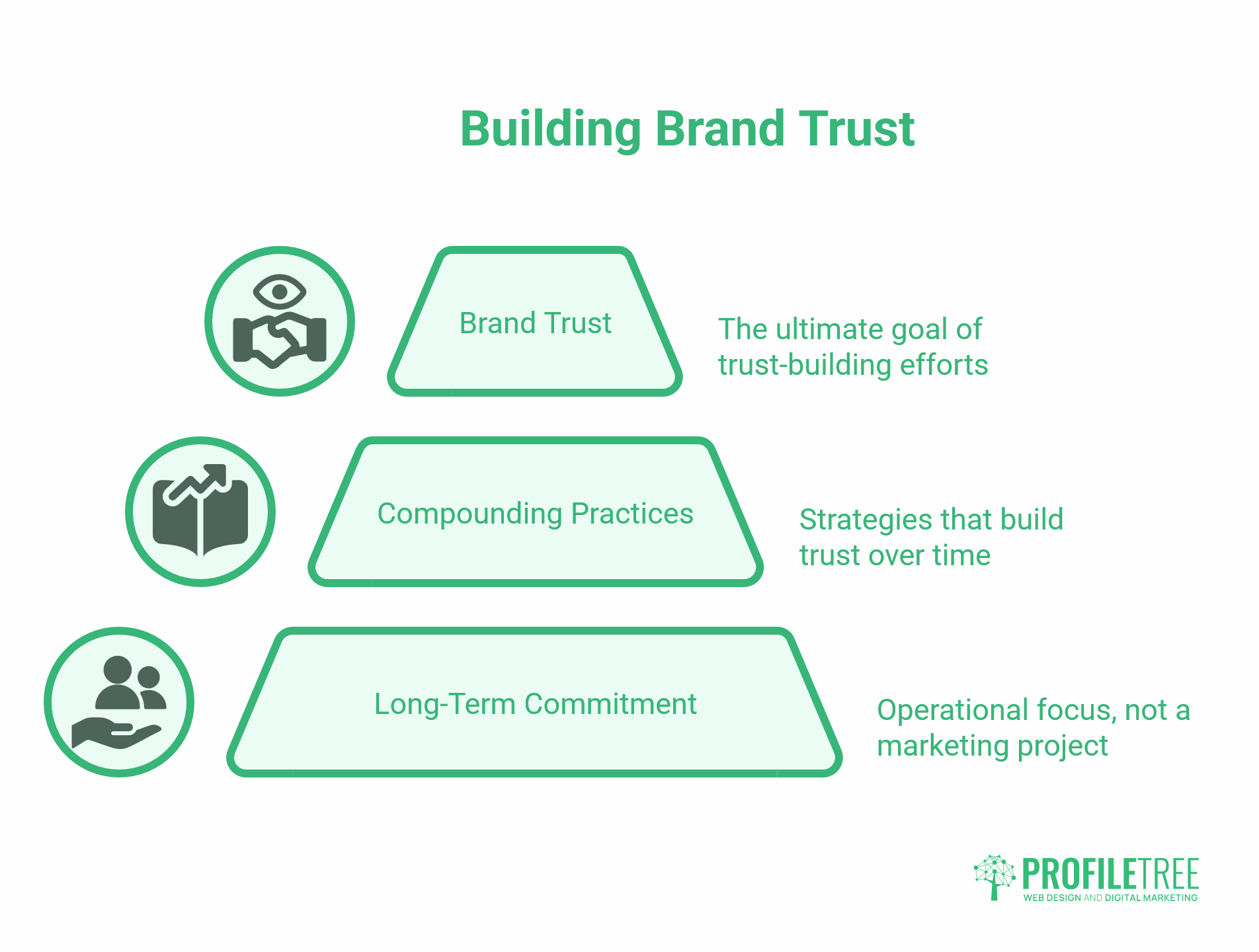
Building it is operational work dressed up as marketing work. The four practices below compound over months rather than weeks, and none of them requires a campaign budget.
Make Pricing and Terms Transparent
Hidden fees and surprise charges destroy trust faster than almost anything else a business can do. If your pricing genuinely varies by project, publish the variables: scope, timeline, integrations, and ongoing support. Customers do not need a fixed number; they need to understand what moves the number.
This is a positioning decision as much as a commercial one. Agencies that publish indicative ranges attract better-qualified enquiries and waste less time on the wrong calls, which is why the pricing structure belongs early in a digital marketing strategy rather than bolted on at the end.
Treat Complaints as Trust Moments
How you behave when something goes wrong tells customers more than any amount of marketing. A fast, unqualified, resolution-first response can turn a dissatisfied customer into an advocate. A defensive one gets screenshotted.
Train the team on this explicitly rather than hoping instinct covers it. Structured online reputation management treats complaint handling as a repeatable process with named owners and agreed response times, not as an emergency.
Use Social Proof You Do Not Control
Testimonials on your own website carry limited weight because customers know you chose them. Third-party platforms carry more, because you cannot edit or withhold what appears there. ProfileTree holds 463 Google reviews averaging five stars, and that figure is verifiable in seconds by anyone who wants to check.
Volume and recency both matter. A handful of five-star reviews from three years ago reads worse than a steady drip of four-star ones from last month, and the online reputation management statistics point the same way on recency. Claiming your profiles on free business listing sites is the cheapest way to widen that footprint before you spend anything on ads.
Keep One Voice Across Every Channel
A brand that sounds warm on Instagram and bureaucratic by email creates a small, persistent doubt. Customers rarely articulate it, but they register it. Tone can flex by channel; the underlying voice should not.
Fixing this is usually a governance problem rather than a creative one. Sales templates, support macros and social captions all need to come from the same rulebook, which is exactly what consistency in brand voice delivers. Drift shows up first where replies are fastest and least reviewed, so social media marketing needs the same editorial standards as the website.
How to Measure Brand Trust
Trust is often treated as immeasurable, which is convenient for anyone who would rather not be held to it. In practice, it leaves a clear data trail across surveys, review platforms, search behaviour and support systems.
A Brand Trust Score You Can Actually Run
A brand trust score does not need to be sophisticated to be useful. Pick five or six metrics, set a benchmark for each, track them monthly and watch the direction of travel rather than the absolute number.
The scorecard below works for most SMEs and takes about an hour a month to maintain once the sources are connected. Most of the value sits in the qualitative side, where structured customer feedback turns loose comments into something the marketing team can act on.
| Metric | What it measures | Benchmark | Source |
|---|---|---|---|
| Net Promoter Score | Likelihood to recommend | 50+ B2C, 40+ B2B | Post-purchase survey |
| Review rating | Public perception of quality | 4.5+ across 50+ reviews | Google, Trustpilot |
| Repeat purchase rate | Satisfaction over time | 25%+, varies by sector | CRM or e-commerce platform |
| Branded search volume | Unprompted recall | Month-on-month growth | Google Search Console |
| Complaint resolution rate | Response to failure | 95%+ resolved | Support platform |
| Social sentiment | Tone of unprompted mentions | Majority positive | Social listening tools |
Branded Search as an Unprompted Signal
Branded search volume is the most honest number on that list. Nobody types your company name into Google unless something made them want to find you specifically. Growth in branded queries usually lags improvements in delivery by a few months, which makes it a lagging indicator worth watching.
It is also a ranking signal in its own right. Sites with a healthy branded search share have proved more resilient through recent Google updates, and an SEO programme that chases pure keyword volume while ignoring brand demand is optimising for the wrong thing.
Brand Trust and Brand Loyalty Are Not the Same
Trust is a belief; loyalty is a behaviour. A customer can trust you completely and still switch to a cheaper option or a shorter drive. Trust creates the conditions for loyalty without guaranteeing it.
The practical implication is sequencing. Loyalty tactics work on people who already trust you and are close to wasted on people who do not. The online community statistics behind most successful brand communities suggest that elonging follows credibility rather than creating it.
What the Numbers Miss
No scorecard captures everything. A five-star average hides the customer who never complained and never came back. Sentiment tools misread sarcasm. NPS rewards enthusiasm rather than reliability.
Treat metrics as prompts for conversations rather than verdicts. Be sceptical, too, of any single composite number sold as a brand trust index. The rise and quiet retirement of Alexa Rank is a useful reminder of how fast a headline score can stop meaning anything.
Repairing and Protecting Brand Trust

Every business eventually faces a moment where it is tested: a service failure, a public complaint, a data incident, an unflattering story. Recovery is possible in almost every case. What determines the outcome is honesty and sequencing rather than speed.
The Four-Stage Recovery Framework
Acknowledge. State the failure plainly and without qualification. A response opening with “whilst we understand your frustration” reads as self-defence. “We got this wrong, and we are sorry” reads as accountability.
Amend. Fix it specifically and without making the customer fight for it, in proportion to the harm and visibly to anyone who saw the original problem.
Audit. Find the root cause. If it was a one-off, say so and show the safeguard. If it was systemic, say that too.
Achieve. Demonstrate the change over months rather than days. Trust recovery is never finished in a statement, which is why serious crisis management in marketing treats the follow-through as the actual work and the apology as the easy part.
Trust Signals Your Website Must Carry
Most trust judgments happen on your website before anyone speaks to you. Four signals do the heavy lifting: a physical address and phone number in a predictable place, real photographs of named team members, third-party review ratings linked to their source, and an explanation of how pricing works.
Stock photography of generic offices does the opposite of what it is meant to do. The pattern is clearest where the stakes are highest: a website built for financial advisers has to put credentials and named people above the fold, and the same principle scales down to any web design project where the buyer is taking a risk on a stranger.
AI, Video and Honest Communication
AI video tools have made it realistic for a small business to publish explainer content, personalised follow-ups and training material without a production budget. Used well, this builds trust by increasing the frequency and clarity of communication.
Used badly, it destroys trust quickly. Fabricated testimonials, synthetic reviews and undisclosed AI presenters are the fastest route to a credibility problem, and UK audiences are getting better at spotting them. The tells that AI content detection picks up are becoming easier to read, not harder. The safer position is to let AI help produce the work while a human stays accountable for every claim in it, which is how ProfileTree’s video production team handles AI-assisted projects.
Building Trust Through Your Digital Presence
A fast, clearly structured website communicates competence before a single word is read. A slow or dated one contradicts everything your sales team says. Reviewing your site for trust signals costs nothing and usually surfaces two or three fixable gaps.
Beyond the website, consistent, useful publishing does the slow work. Content marketing that answers real questions without asking for anything in return builds credibility a page at a time, and teams wanting to produce more of it in-house usually start with AI training for business, so that speed does not cost them accuracy.
“The businesses we work with that have the strongest reputations in their sectors are almost always the ones that have focused on consistent delivery and honest communication over time,” says Ciaran Connolly, founder of ProfileTree. “Trust is not built in a campaign. It is built in every customer interaction, month after month.”
The Bottom Line on Brand Trust
Brand trust is earned in delivery, not in messaging. Keep your claims defensible, handle failures openly, publish the proof, and make your track record easy for a stranger to check in under a minute. For SMEs across Northern Ireland, Ireland and the UK, that consistency is both the hard part and the competitive advantage. If your website is not reflecting the credibility your business has already earned, talk to the ProfileTree team about closing the gap.
FAQs
What is the simplest brand trust definition?
Brand trust is a customer’s confidence that a business will consistently deliver what it promises. It is built from repeated experience rather than advertising.
What are the three pillars of brand trust?
Competence, integrity and benevolence. Competence is the ability to deliver, integrity is honesty in claims and pricing, and benevolence is acting in the customer’s interest. A weakness in one undermines the other two.
How long does it take to build brand trust?
Most businesses see measurable movement in trust metrics within six to twelve months of consistent delivery. Strong sector reputations take considerably longer.
How can you measure brand trust?
Track a small brand trust score: Net Promoter Score, review rating, repeat purchase rate, branded search volume, complaint resolution rate and social sentiment. Watch the trend rather than the number.
What are good brand trust examples for a small business?
Publishing pricing ranges, naming the team on your website, linking to third-party reviews rather than curated testimonials, and responding publicly to negative feedback within 24 hours.