
AI Prompts for Website Copy: Boost Landing Page Conversions
Table of Contents
The difference between websites that convert and those that merely exist lies in sophisticated prompt engineering that understands user psychology, conversion triggers, and persuasive architecture. Modern web copy requires more than clever words—it demands strategic messaging that guides visitors seamlessly toward desired actions.
This comprehensive guide discusses how to use AI prompts for website copy, revealing the precise prompt frameworks that businesses across Northern Ireland, Ireland, and the UK are using to create copy that converts browsers into buyers. You’ll discover how to craft prompts that generate compelling headlines, persuasive value propositions, and conversion-optimised content that transforms your digital presence into a revenue-generating machine.
Using AI Prompts for Website Copy: Homepage Comes First
Strategic homepage prompts create comprehensive narratives that immediately communicate value whilst guiding visitors deeper into your site.
Your homepage serves as the digital front door to your business. The right prompts help AI generate copy that captures attention, builds trust, and creates clear pathways to conversion within seconds of arrival.
Hero Section and Value Proposition Development
Craft headlines that stop scrollers: “Generate ten hero section headlines for a Belfast web design agency targeting SMEs. Include five benefit-focused headlines (‘Get a Website That Actually Generates Leads’), three problem-agitation headlines (‘Your Website Is Costing You Customers‘), and two authority-position headlines (‘Belfast’s Most Trusted Web Design Partner’). Each should be under 10 words, create immediate understanding, and include emotional triggers. Test clarity versus intrigue balance.”
Develop compelling value propositions: “Create a value proposition for an accounting firm that differentiates from competitors. Format: ‘We help [target customer] achieve [desired outcome] through [unique method] unlike [alternative] which [limitation].’ Generate five variations testing different angles: time savings, stress reduction, growth enablement, compliance confidence, cost optimisation. Include supporting proof points for each angle. Maximum 30 words for main proposition, 50 words for expansion.”
ProfileTree’s homepage optimisation strategies consistently achieve 12% conversion rates—triple the industry average of 4%—through systematic message testing and refinement.
Navigation and Information Architecture Copy
Guide users intuitively: “Write navigation menu labels for a B2B SaaS platform. Replace generic labels with benefit-focused alternatives. Instead of ‘Products’, use ‘Solutions’ or ‘How We Help’. Transform ‘About’ into ‘Why Choose Us’. Change ‘Contact’ to ‘Get Started’ or ‘Book Demo’. Generate variations for different user intents: researchers, evaluators, ready-to-buy. Include microcopy for dropdown descriptions adding context without overwhelming.”
Create logical content flow: “Design homepage section progression for professional services firm. Opening: immediate value statement and credibility. Problem identification: challenges target audience faces. Solution presentation: how you uniquely solve these. Social proof: client success and testimonials. Process explanation: how engagement works. Call-to-action: clear next step. Generate transitional copy connecting sections smoothly. Include scroll-triggered engagement points maintaining momentum.”
Trust Signal Integration Strategies
Build credibility systematically: “Incorporate trust elements throughout homepage copy. Credentials: professional qualifications, certifications, awards. Experience: years in business, clients served, projects completed. Social proof: testimonial snippets, client logos, case study previews. Guarantees: risk reversal, satisfaction promises, performance commitments. Security: data protection, compliance standards, insurance coverage. Generate natural integration points avoiding trust signal clustering.”
According to Ciaran Connolly, ProfileTree founder, “Homepage copy should answer three questions within five seconds: What do you do? Who is it for? Why should I care? Every word should earn its place by contributing to these answers or guiding toward conversion.”
Landing Page Copywriting Prompts: Focused Conversion Machines
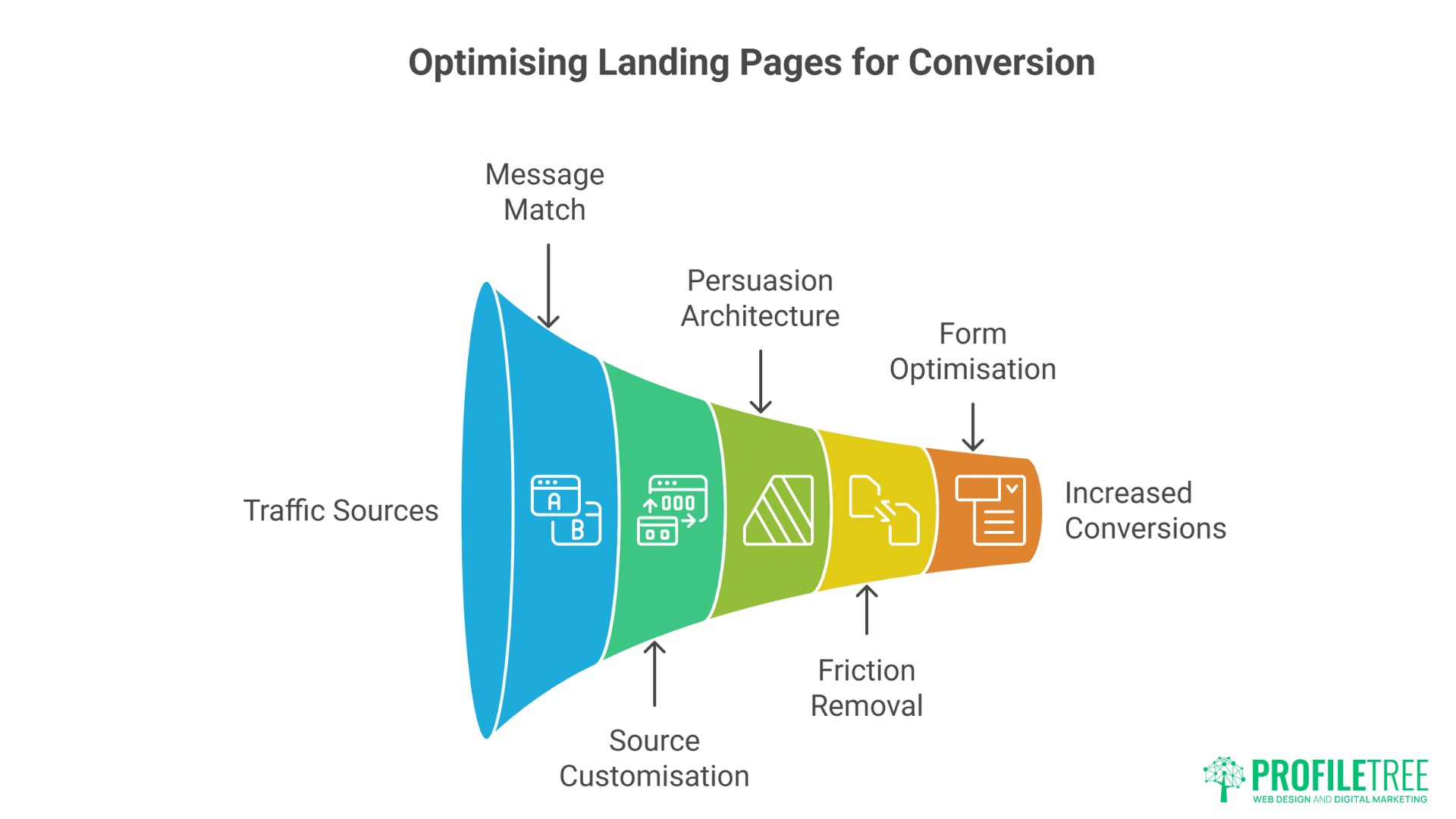
Sophisticated landing page prompts create single-purpose pages that eliminate distractions whilst maximising persuasion.
Landing pages serve specific campaign objectives. Your prompts should generate copy that maintains laser focus on converting traffic from particular sources into defined actions.
Campaign-Specific Message Match
Ensure seamless ad-to-page continuity: “Create landing page copy that matches Google Ads campaign for ’emergency plumber Belfast. Ad headline: ’24/7 Emergency Plumber – Belfast’. Landing page must immediately confirm visitor landed correctly. Repeat key terms from ad. Address specific emergency scenarios mentioned. Maintain urgency without seeming opportunistic. Include same offers or guarantees promised in ad. Generate variations for different ad groups maintaining consistency.”
Source-specific customisation: “Develop landing page copy variations for different traffic sources. Google Ads: keyword-focused, high commercial intent. Facebook: story-driven, emotional connection. Email: personalised, relationship-based. Organic search: comprehensive, information-rich. Direct traffic: brand-reinforcing, trust-building. Generate dynamic content rules adapting to traffic source whilst maintaining core message.”
Persuasion Architecture and Flow
Structure copy for psychological impact: “Design landing page copy following AIDA framework for online course sales. Attention: shocking statistic or provocative question about career stagnation. Interest: preview of transformation possible through course. Desire: detailed benefits, success stories, exclusive bonuses. Action: enrolment process, urgency factors, guarantees. Generate multiple versions testing different emotional triggers at each stage.”
Remove friction systematically: “Identify and address conversion obstacles through copy. Price concerns: value stacking, payment plans, ROI calculations. Trust issues: guarantees, testimonials, credentials. Complexity worries: simple process, support available, success likelihood. Time concerns: implementation speed, immediate access, flexibility. Commitment fears: trial periods, cancellation policies, success stories. Generate objection-handling copy for each concern.”
Form Optimisation and Microcopy
Reduce abandonment through strategic microcopy: “Write form field copy that increases completion rates. Labels: clear, specific, and reassuring. Placeholder text: examples rather than redundant labels. Help text: why information needed, how it’s used. Error messages: friendly, specific, and solution-focused. Progress indicators: steps remaining, time estimates. Submit buttons: action-focused rather than generic. Generate variations testing different tones from professional to conversational.”
Progressive disclosure strategies: “Create multi-step form copy that maintains momentum. Step 1: low-commitment information (name, email). Step 2: qualifying questions building investment. Step 3: detailed requirements with context. Each step should include: progress visualisation, value reminder, completion encouragement. Generate transitional copy between steps maintaining enthusiasm whilst managing expectations.”
Service and Product Page Optimisation
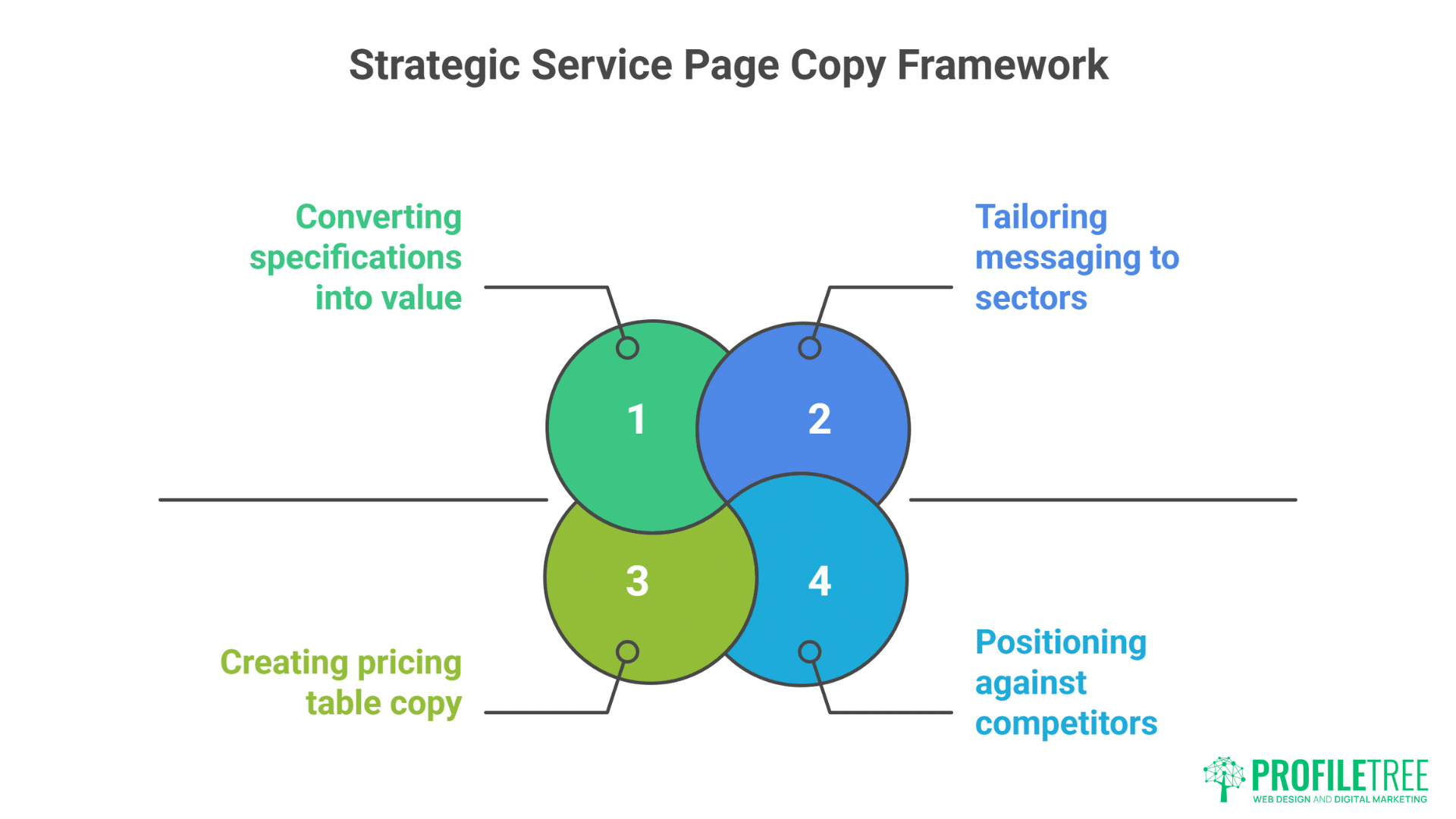
Strategic service page prompts transform features into benefits whilst addressing specific customer needs and concerns.
Service and product pages must balance information delivery with persuasion. Your prompts should generate copy that educates whilst moving visitors toward enquiry or purchase.
Feature-to-Benefit Translation Frameworks
Convert specifications into value: “Transform technical features into customer benefits for web development services. Feature: ‘Mobile-responsive design’. Benefit: ‘Your website looks perfect on every device, capturing the 67% of users browsing on phones’. Feature: ‘SSL certificate’. Benefit: ‘Your customers feel safe sharing information, boosting trust and sales’. Feature: ‘CMS integration’. Benefit: ‘Update your site instantly without calling developers or paying maintenance fees’. Generate benefit statements for twenty common features.”
Layer benefits strategically: “Create benefit hierarchy for accounting services. Functional benefits: accurate books, tax compliance, financial reporting. Emotional benefits: peace of mind, confidence, control. Social benefits: professional credibility, investor readiness, growth capability. Self-actualisation benefits: focus on core business, achieve ambitions, build legacy. Generate copy connecting all benefit levels to specific service features.”
Comparison and Differentiation Copy
Stand out from alternatives: “Write comparison copy positioning your service against competitors without naming them directly. Traditional agencies: slow, expensive, inflexible. Freelancers: unreliable, limited skills, no support. DIY tools: time-consuming, limited results, steep learning curve. Your solution: professional quality, affordable pricing, ongoing support. Generate diplomatic comparisons that educate rather than attack.”
Package and pricing presentation: “Create pricing table copy that guides selection. Starter package: perfect for new businesses, essential features, growth foundation. Professional package: ideal for established companies, advanced capabilities, priority support. Enterprise package: custom solutions, dedicated resources, white-glove service. Generate psychological anchoring through strategic ordering. Include subtle nudges toward preferred option without manipulation.”
Industry-Specific Service Copy
Tailor messaging to sectors: “Develop service page copy for web design targeting different industries. Retail: focus on e-commerce capabilities, conversion optimisation, inventory integration. Healthcare: emphasise compliance, patient portals, appointment booking. Professional services: highlight credibility, lead generation, client portals. Manufacturing: feature product catalogues, B2B functionality, supply chain integration. Generate industry-specific pain points, solutions, and success metrics.”
About Page and Team Copy Prompts
Authentic about page prompts create human connections that transform companies from faceless entities into trusted partners.
About pages often influence conversion more than expected. Your prompts should generate copy that builds emotional connections whilst establishing expertise and credibility.
Brand Story and Origin Narratives
Craft compelling company stories: “Write brand story for digital agency founded in Belfast. Include: founder’s moment of realisation about market gap, early struggles and breakthrough moments, evolution from startup to established agency, core values driving daily decisions, vision for client success and industry impact. Generate narrative arc creating emotional investment. Balance professional achievements with human elements. Include specific Belfast/Northern Ireland context showing local roots.”
Mission and values articulation: “Transform generic mission statement into compelling copy. Instead of ‘We deliver excellent customer service’, write ‘We answer every call within three rings because we remember being frustrated by endless hold music’. Convert abstract values into concrete behaviours. Generate five examples showing values in action rather than listing them. Include employee quotes demonstrating lived values.”
Team Member Profile Optimisation
Humanise your expertise: “Create team member profiles balancing professionalism with personality. Professional: qualifications, experience, specialisations, achievements. Personal: interests outside work, favourite project, why they love their job, quirky fact. Generate profile templates for different roles: technical, creative, customer-facing, leadership. Include conversation starters that make contact less intimidating.”
Collective expertise presentation: “Write team section copy emphasising collaborative strength. Combined years experience, diverse skill sets, complementary perspectives, shared passion. Avoid individual glorification whilst celebrating collective capability. Generate copy showing how team structure benefits clients. Include subtle calls-to-action encouraging contact with specific team members based on needs.”
Call-to-Action (CTA) Optimisation Prompts
Strategic CTA prompts create action triggers that feel like natural next steps rather than pushy sales tactics.
CTAs determine whether visits convert. Your prompts should generate action-oriented copy that creates urgency without desperation, clarity without boredom.
Primary CTA Development
Engineer irresistible action triggers: “Create twenty CTA button variations for B2B software free trial. Action-focused: ‘Start Free Trial’, ‘Try It Free’, ‘Get Instant Access’. Benefit-focused: ‘Boost Productivity Now’, ‘Save Hours Weekly’, ‘Automate Your Workflow’. Urgency-driven: ‘Start Today’, ‘Limited Spots Available’, ‘Join 500+ Users’. Personal: ‘Start My Trial’, ‘Show Me How’, ‘Yes, I Want Access’. Generate supporting microcopy for each addressing hesitations.”
Context-specific CTA adaptation: “Develop CTAs for different page positions and user states. Top of page: soft commitment (‘Learn More’, ‘See How It Works’). Mid-page: moderate commitment (‘View Pricing’, ‘Book Consultation’). Bottom of page: strong commitment (‘Get Started Now’, ‘Buy Today’). Exit intent: last chance (‘Wait! Special Offer’, ‘Before You Go’). Return visitor: acknowledgment (‘Welcome Back’, ‘Continue Where You Left Off’). Generate progressive commitment strategies.”
Secondary and Tertiary CTA Strategy
Build conversion safety nets: “Design CTA hierarchy for visitors not ready for primary action. Primary: ‘Book Free Consultation’. Secondary: ‘Download Service Guide’. Tertiary: ‘Join Newsletter’. Micro-conversions: ‘Calculate Savings’, ‘View Case Study’, ‘Watch Demo’. Generate value exchange for each level. Create logical progression from lowest to highest commitment. Include copy explaining why each action benefits visitor.”
Conversion Rate Optimisation Copy Prompts
Data-driven CRO prompts generate copy variations that systematically improve conversion metrics.
Optimisation requires continuous testing. Your prompts should create copy variations that explore different psychological triggers and messaging approaches.
A/B Testing Copy Variations
Structure systematic experiments: “Generate A/B test variations for landing page headline. Control: feature-focused (‘Advanced SEO Tools for Agencies’). Test A: benefit-focused (‘Rank Your Clients #1 on Google’). Test B: problem-focused (‘Stop Losing Clients to Poor Rankings’). Test C: social proof (‘Join 10,000 Agencies Growing with Our SEO Tools’). Test D: curiosity gap (‘The SEO Secret Agencies Don’t Want You to Know’). Include hypothesis for each variation.”
Multivariate testing frameworks: “Create multivariate test combining multiple elements. Headlines: urgency vs value. Subheadlines: features vs benefits. Button copy: first-person vs second-person. Button colour: green vs orange. Form fields: minimal vs comprehensive. Social proof: testimonials vs statistics. Generate sixteen combinations testing interactions. Predict winning combination based on audience psychology.”
Psychological Trigger Implementation
Leverage behavioural psychology: “Incorporate psychological principles into web copy. Reciprocity: offer free value before asking for commitment. Social proof: show others taking desired action. Authority: demonstrate expertise and credentials. Scarcity: highlight limited availability or time. Consistency: get micro-commitments building to major action. Liking: create affinity through shared values. Generate natural integration avoiding manipulation.”
Emotional trigger calibration: “Write copy targeting different emotional states. Fear: risks of inaction, competitive disadvantage, missed opportunities. Hope: transformation possible, success within reach, problems solvable. Pride: status elevation, peer recognition, achievement satisfaction. Belonging: community membership, shared journey, insider access. Generate emotionally resonant copy maintaining authenticity and ethics.”
Urgency and Scarcity Implementation
Create legitimate urgency: “Develop urgency copy without fake scarcity. Real deadlines: event dates, price increases, bonus expiration. Logical scarcity: limited capacity, personal attention, quality maintenance. Opportunity cost: delayed benefits, competitive advantage, market timing. Seasonal relevance: tax deadlines, budget cycles, industry events. Generate urgency that helps rather than manipulates visitors.”
Mobile-First Copy Optimisation

Mobile-specific prompts ensure your copy performs perfectly on devices where most visitors first encounter your brand.
Mobile users have different needs and behaviours. Your prompts should generate copy optimised for small screens and touch interactions.
Condensed Messaging Strategies
Communicate more with less: “Rewrite desktop copy for mobile consumption. Desktop headline: ‘Transform Your Business with Our Comprehensive Digital Marketing Solutions. Mobile version: ‘Grow Your Business Online. Desktop paragraph: 100 words explaining services. Mobile version: 30 words covering essentials. Generate mobile versions maintaining core message whilst reducing word count by 60%.”
Progressive disclosure implementation: “Create expandable content sections for mobile. Initial view: compelling hook and core benefit. Tap to expand: detailed explanation and features. Further expansion: specifications and technical details. Generate teaser copy encouraging expansion. Design smooth reading experience avoiding frustration. Include visual indicators showing more content available.”
Touch-Friendly CTA Design
Optimise for thumb navigation: “Write mobile CTAs considering touch targets. Minimum 44×44 pixel tap area. Clear action words avoiding ambiguity. Contrasting button colours ensuring visibility. Adequate spacing preventing mis-taps. Sticky positioning for persistent visibility. Generate copy fitting comfortably within mobile buttons whilst remaining compelling.”
SEO-Optimised Web Copy Strategies
Search-focused prompts create copy that ranks well whilst maintaining natural readability and conversion focus.
SEO and conversion copywriting must work together. Your prompts should generate content that satisfies search algorithms without sacrificing user experience.
Semantic SEO Implementation
Build topical relevance naturally: “Write service page copy incorporating semantic SEO for ‘business coaching Belfast. Primary keyword: naturally integrated 2-3 times. Related terms: mentoring, business growth, leadership development, strategy consulting. Entity connections: Belfast business community, local success stories, regional challenges. Question answering: common coaching queries addressed. Generate comprehensive coverage demonstrating expertise whilst maintaining readability.”
Search intent alignment: “Create copy matching different search intents for ‘website design’. Informational intent: education about importance, process, considerations. Commercial intent: service comparisons, pricing factors, selection criteria. Transactional intent: clear services, immediate action options, contact simplification. Navigational intent: brand reinforcement, unique positioning, location confirmation. Generate appropriate copy depth and CTAs for each intent.”
Meta Description and Title Tag Optimisation
Craft clickable SERP listings: “Write meta descriptions that improve click-through rates. Include: primary keyword naturally integrated, clear value proposition or benefit, specific numbers or statistics when relevant, emotional trigger or curiosity gap, call-to-action when space permits. Maximum 160 characters. Generate ten variations testing different psychological approaches.”
Title tag engineering: “Create title tags balancing SEO and clicks. Format options: ‘Primary Keyword | Brand’, ‘Primary Keyword – Secondary Keyword | Brand’, ‘Number + Primary Keyword + Benefit | Brand’. Maximum 60 characters. Include power words when relevant. Local businesses include location. Generate variations for testing whilst maintaining brand consistency.”
Industry-Specific Web Copy Frameworks
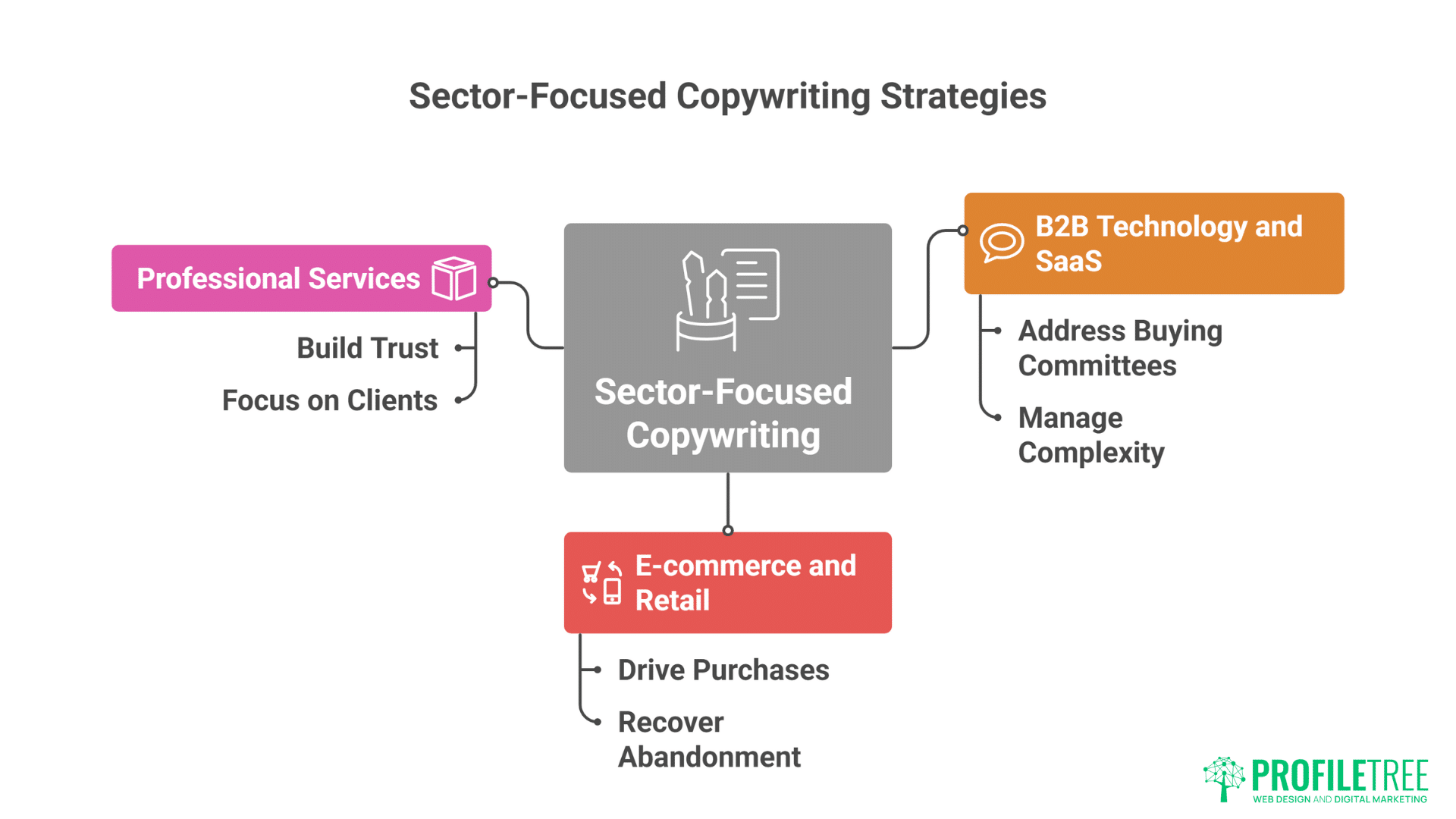
Sector-focused prompts address unique challenges and opportunities within specific industries.
Different industries require distinct approaches. Your prompts should generate copy that resonates with sector-specific audiences whilst addressing industry norms and expectations.
B2B Technology and SaaS Copy
Address complex buying committees: “Write SaaS landing page copy speaking to multiple stakeholders. IT decision-makers: security, integration, technical specifications. Finance executives: ROI, cost savings, budget predictability. End users: ease of use, productivity gains, daily benefits. C-suite: strategic advantage, competitive edge, growth enablement. Generate modular content sections addressing each audience. Include navigation helping visitors find relevant information.”
Feature complexity management: “Translate complex technical features into clear benefits. API integration: ‘Connects with tools you already use’. Machine learning: ‘Gets smarter with every interaction. Cloud infrastructure: ‘Access anywhere, never lose work’. Encryption: ‘Bank-level security protecting your data’. Generate analogies making technical concepts accessible. Balance technical accuracy with comprehension.”
E-commerce and Retail Copy
Drive immediate purchases: “Create product category copy that sells. Category description: problem-solving focus, selection guidance, quality assurance. Filter explanations: helping choose right option. Urgency elements: stock levels, shipping cutoffs, sale endings. Trust builders: returns policy, customer service, guarantees. Generate copy reducing purchase hesitation whilst building excitement.”
Cart abandonment recovery: “Write checkout page copy reducing abandonment. Security assurances: payment safety, data protection. Shipping clarity: costs, timeframes, options. Return confidence: policy summary, ease emphasis. Support availability: help accessible, questions answered. Progress indicators: steps remaining, time estimate. Generate reassuring microcopy for each potential concern.”
Professional Services Copy
Build trust before meeting: “Develop law firm website copy establishing credibility. Expertise demonstration: practice areas, case results, attorney profiles. Process transparency: consultation process, fee structures, timelines. Client focus: understanding concerns, protecting interests, achieving goals. Accessibility: plain language, question encouragement, multiple contact methods. Generate copy balancing authority with approachability.”
Accessibility and Inclusive Copy
Inclusive copy prompts ensure your website serves all visitors regardless of ability or circumstance.
Accessible copy benefits everyone. Your prompts should generate content that’s clear, understandable, and usable by the widest possible audience.
Plain Language Implementation
Simplify without dumbing down: “Rewrite complex business copy in plain language. Original: ‘We leverage synergistic methodologies to optimise operational efficiencies’. Plain version: ‘We find better ways to run your business’. Maintain professionalism whilst improving clarity. Generate plain language alternatives for twenty common business phrases. Include guidelines for when technical terms remain necessary.”
Reading level optimisation: “Adjust copy for appropriate reading levels. B2B professional: 12th-grade level allowing complexity. Consumer services: 8th-grade level ensuring accessibility. Healthcare: 6th-grade level for critical information. Generate techniques for simplification: shorter sentences, common words, active voice, concrete examples. Maintain accuracy whilst improving comprehension.”
Screen Reader Optimisation
Write for assistive technologies: “Create screen reader-friendly copy. Descriptive link text: ‘Download pricing guide’ not ‘Click here’. Image descriptions: conveying meaning not just content. Form labels: clear and associated correctly. Error messages: specific and helpful. Navigation: logical and predictable. Generate implementation guidelines ensuring equal access to information.”
International and Multi-Language Considerations
Global copy prompts address cultural differences whilst maintaining brand consistency.
International audiences require nuanced approaches. Your prompts should generate copy that translates well whilst respecting cultural preferences.
Localisation Strategy
Adapt for regional markets: “Localise web copy for UK, Irish, and American audiences. UK: British spelling, pound sterling, VAT references. Ireland: Euro pricing, local examples, cultural references. US: American spelling, dollar amounts, state considerations. Generate versions maintaining message whilst adapting details. Include cultural sensitivity guidelines avoiding assumptions.”
Translation-friendly writing: “Write copy that translates effectively. Short sentences reducing complexity. Active voice maintaining clarity. Concrete terms avoiding idioms. Cultural neutrality where possible. Expandable design accommodating text length variations. Generate guidelines for writing with translation in mind.”
Continuous Improvement and Testing
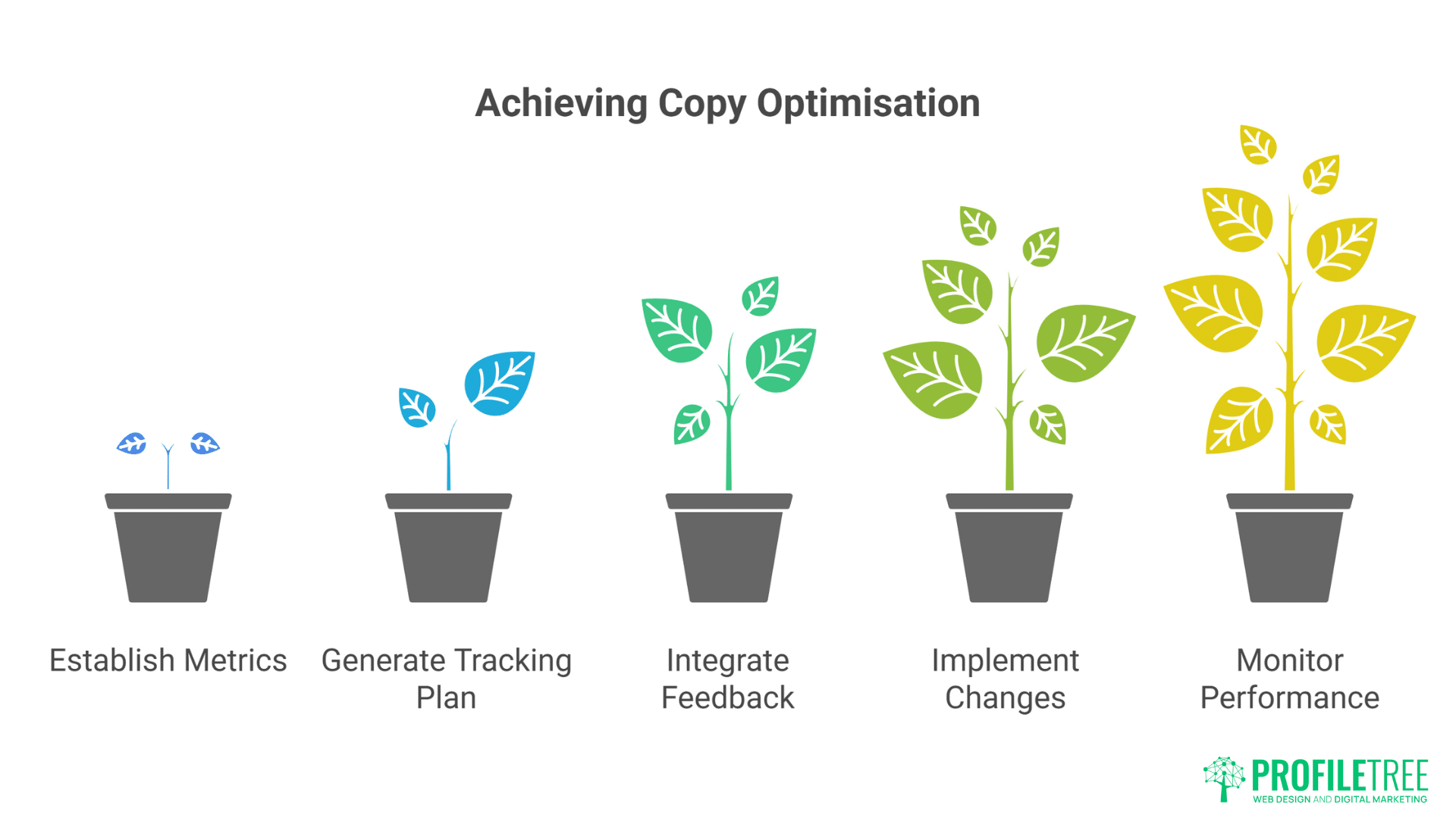
Iterative optimisation prompts create systematic approaches to copy improvement based on real user behaviour.
Web copy should evolve with insights. Your prompts should generate testing frameworks and improvement strategies based on data.
Performance Monitoring Frameworks
Track copy effectiveness: “Establish copy performance metrics. Engagement: time on page, scroll depth, interaction rate. Conversion: form completions, click-through rates, purchase rates. Clarity: support queries, bounce rates, task completion. Generate tracking plan connecting copy elements to business outcomes. Include testing priorities based on impact potential.”
User Feedback Integration
Incorporate voice of customer: “Integrate customer feedback into copy improvements. Support tickets: addressing common confusion points. Reviews: highlighting appreciated features. Surveys: understanding decision factors. User testing: observing interaction patterns. Generate systematic approach for collecting and implementing feedback. Include version control for tracking changes and results.”
Professional Implementation Support
ProfileTree helps businesses across Northern Ireland, Ireland, and the UK create high-converting website copy that transforms visitors into customers.
Whilst this guide provides comprehensive frameworks for web copy success, many businesses benefit from professional implementation. Our team combines conversion copywriting expertise with deep understanding of user psychology and technical SEO to create websites that genuinely perform.
We offer website copy audits identifying immediate improvement opportunities. Our landing page optimisation service dramatically improves conversion rates. Our complete website copywriting packages ensure consistent, compelling messaging throughout your site. For businesses seeking ongoing optimisation, we provide continuous testing and improvement programmes.
FAQs
How long should website homepage copy be?
Homepage copy length should match visitor needs and business complexity. B2B services typically benefit from 1,000-1,500 words allowing comprehensive value communication. Simple services or products might need only 500-750 words. Focus on scannability through headers, bullets, and progressive disclosure rather than arbitrary word counts. Mobile visitors especially appreciate concise messaging with expansion options.
What’s the ideal reading level for web copy?
Most web copy performs best at 8th to 10th-grade reading level, ensuring accessibility whilst maintaining professionalism. B2B technical content may reach 12th-grade level when necessary. Healthcare and financial information should aim for 6th to 8th-grade level ensuring understanding. Test your copy with readability tools, but prioritise clarity and action over scores.
How often should I update website copy?
Review website copy quarterly for relevance and performance. Update immediately when offerings change, new competitors emerge, or conversion rates decline. Annual comprehensive reviews ensure messaging remains aligned with business evolution. High-traffic pages deserve monthly performance reviews. Test new copy continuously on landing pages before rolling out site-wide changes.
Should every page have the same tone of voice?
Maintain consistent brand voice whilst adapting tone for context. About pages can be more conversational. Service pages should be informative yet persuasive. Legal pages require formal clarity. Blog content allows personality. The key is recognising your voice (consistent) versus your tone (adaptable) and ensuring smooth transitions between sections.
How do I write for both search engines and humans?
Write for humans first, then optimise for search engines. Create valuable, clear content addressing user needs. Naturally incorporate keywords where they fit conversationally. Use semantic variations avoiding repetition. Structure content with headers for scannability. Include comprehensive topic coverage demonstrating expertise. Search engines increasingly reward content that genuinely serves users, making this balance easier.
Transforming Digital Presence Through Strategic Copy
Mastering AI prompts for website copy and landing page optimisation revolutionises how businesses communicate online. The frameworks and strategies outlined here enable creation of web copy that doesn’t just inform but persuades, converting casual browsers into committed customers.
Success requires treating web copy as a strategic business asset rather than afterthought. Your prompts should generate content that aligns with business objectives, speaks to specific audiences, and guides visitors through carefully crafted conversion paths. The combination of AI efficiency and strategic copywriting principles creates websites that genuinely drive business growth.
The digital landscape continues evolving with changing user expectations, new devices, and emerging technologies. Sophisticated prompt engineering enables businesses to maintain compelling web presence whilst adapting quickly to market changes. Whether launching your first website or optimising an established presence, mastering AI-powered web copywriting provides the competitive edge necessary for digital success.