
AI Brand Positioning Prompts: A Digital Intelligence Guide for SMEs
Table of Contents
AI prompts for brand strategy are everywhere now. Copy one into ChatGPT, and you will have a positioning statement in seconds. The trouble is, so will everyone else in your sector, because they are copying the same prompt from the same list. The output starts to sound identical: “unlike the competition, we deliver”, dressed up in a different font.
If you are an SME owner in Northern Ireland, Ireland or the wider UK trying to sharpen your brand, generic AI prompts for brand strategy will get you a first draft. They won’t get you a defensible market position. What works better is treating AI as a fast research assistant rather than a strategist in its own right: feed it real data, ask sharper questions, then apply human judgement before anything reaches your website or your sales deck. That’s the digital intelligence framework this guide walks through, prompt by prompt.
Why Generic AI Prompts Fail UK & Irish SMEs
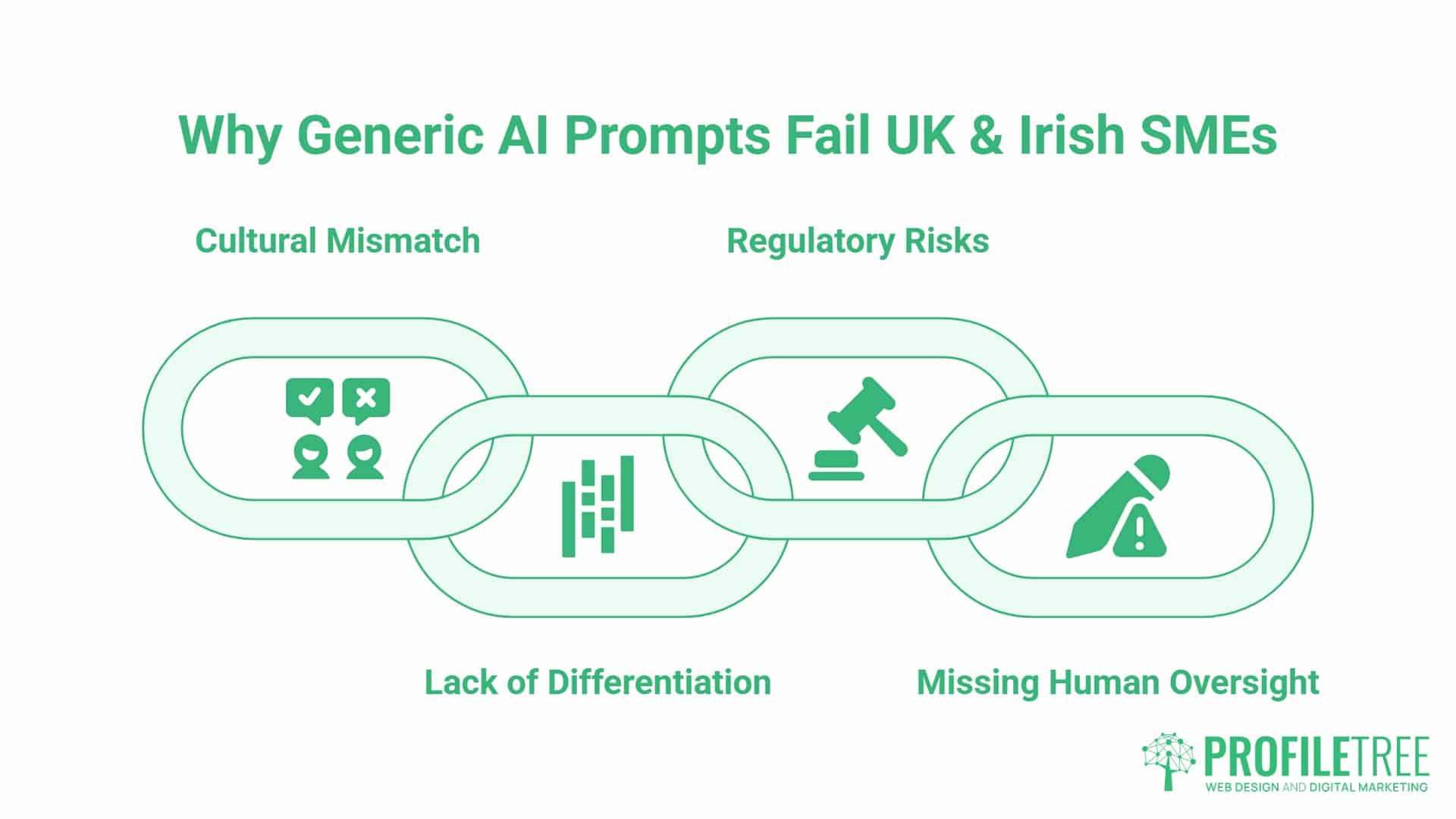
Most AI prompts for brand strategy circulating online were written for a US audience, and it shows. They default to hype: “unleash”, “revolutionise”, “game-changing.” Northern Irish and Irish buyers tend to respond to the opposite tone. A straight, slightly understated claim earns more trust here than a superlative-heavy one, and a positioning statement that reads like a Silicon Valley pitch deck can actively work against a Belfast joinery firm or a Dublin accountancy practice.
There’s a second problem, and it’s more structural. If you and three competitors all run the same “brand positioning AI prompts” through the same tool, you get three very similar answers. AI models are trained to produce statistically likely text, so left unchecked, an AI brand strategy exercise tends to converge on the safest, most generic phrasing rather than anything genuinely differentiated. The prompt isn’t the problem; using it without a filter is.
There’s also a regulatory dimension that most US-focused guides skip entirely. Any claim your AI drafts about being “the best,” “the only,” or “number one” needs to stand up to the UK Advertising Standards Authority’s rules on substantiation before it goes anywhere near a website or an advert. An AI prompt doesn’t know what you can actually prove, so that check has to happen after the fact, by a person.
None of this means the underlying idea is wrong. AI prompts for brand strategy are genuinely useful for the parts of the job that involve processing a lot of information quickly: reading through competitor websites, summarising customer feedback, or drafting ten variations of a sentence so you can pick the strongest one. The failure mode is using them as a finished strategy rather than a starting point, and skipping the local, regulatory and factual checks that turn a plausible-sounding paragraph into something you would actually put your name to.
The Digital Intelligence Framework: From Prompts to Strategy
This is where AI prompts for brand strategy actually earn their keep, as one stage in a three-stage process rather than the whole job. We call this the digital intelligence framework for brand positioning, and it runs in three steps: data input, strategic prompting, and human validation.
Data input means telling the AI what is true about your business before asking it to say anything clever. Customer feedback, sales objections your team hears every week, a rough note on who your three real competitors are, and what your last twelve months of enquiries actually looked like. Skip this step, and every prompt that follows is working from guesswork.
Strategic prompting is where the “mega-prompts” later in this guide come in: layered, specific instructions rather than a single generic line. A prompt that asks for “a brand positioning statement” produces something usable. A prompt that asks for three positioning options, tested against believability, relevance, and defensibility, using the customer data you just fed it, produces something you can actually decide among.
Human validation is the step most guides leave out. Every AI output needs a person who knows the business to check it against reality, cut anything that sounds cliched, and confirm the claims are provable. For SMEs without a marketing team, this is usually where an outside pair of eyes, such as a structured digital strategy session, adds the most value: turning a rough AI draft into something you would actually stake your reputation on.
Businesses that skip straight from strategic prompting to publishing, without that validation stage, tend to end up back at the drawing board within a few months. The position looked fine on screen, but it never quite matched how the sales team actually talked to customers, or it made a claim a competitor could publicly challenge. Building the validation step into the process from the start, rather than treating it as an afterthought, is usually the difference between a brand position that sticks and one that gets quietly abandoned. This is the piece of AI prompts for brand strategy that most guides skip entirely. You can read more about how that process works on our digital strategy page.
Essential AI Prompts for Brand Discovery
Before you touch tone of voice or taglines, you need a clear picture of where you actually sit in your market, because brand positioning built on a guess falls apart the first time a customer asks a hard question. Skipping straight to voice and personality work without this grounding is one of the more common mistakes we see, because a beautifully written positioning statement built on a guess about your competitors or your customers rarely survives contact with either. These three prompts are the foundation, and they work best run in the order below rather than cherry-picked.
Prompts for Competitive Gap Analysis
Try this: “List my five closest competitors in [your sector and region]. For each one, note their stated positioning, their obvious strengths, and one gap in what they offer that a customer might complain about. Do not guess at figures you cannot verify; flag anything you are unsure of.”
That last sentence matters more than it looks. AI models will happily invent a competitor’s revenue or client count if you don’t tell them not to. Adding an explicit instruction to flag uncertainty rather than fill gaps with invented numbers is one of the simplest ways to keep an AI brand strategy exercise honest.
Prompts for Ideal Customer Persona (ICP) Mapping
Try this: “Based on the following list of our last twenty customer enquiries [paste anonymised list], identify common patterns in company size, industry, and the problem they were trying to solve. Do not invent demographic detail that is not present in the data.”
This works far better than the generic “create a customer persona” prompt found on most US blogs, because it is grounded in your actual enquiry history rather than an imagined archetype. The same underlying approach applies just as well to AI prompts for product positioning, where the same real-enquiry data can sharpen a single product’s pitch rather than the whole brand’s.
Identifying Your Unfair Advantage
Try this: “Given [list your services, your team’s actual background, and how long you have traded], identify three things about this business that would be genuinely hard for a new competitor to copy quickly.”
The answer is rarely the thing you expected. It’s often a specific accreditation, a founder’s prior industry experience, or a niche most competitors think is too small to bother with. This kind of gap analysis feeds directly into the technical side of visibility too. A positioning gap a competitor has left unaddressed is often the same gap your search engine optimisation strategy should be targeting.
Advanced AI Prompts for Brand Identity and Voice
Once the groundwork above is done, these prompts help translate a position into something that actually sounds like your business.
The Brand Archetype Mega-Prompt
Try this: “Based on [describe your business, your customers, and three words your best customers have used to describe you], suggest a primary brand archetype and a secondary archetype that would suit us. Explain in plain terms what that combination means for our tone of voice, and give five sample sentences in that voice describing our main service.”
Localising Tone: UK/Ireland Consumer Sentiment
This is the piece almost every US-written prompt guide misses entirely. Try adding this instruction to any voice prompt: “Write in a grounded, understated UK and Ireland business tone. Avoid American marketing phrasing such as ‘game-changing’, ‘revolutionary’ or ‘unlock your potential’. Favour specific, provable claims over broad ones.”
The difference in output is immediate. Instead of “we revolutionise how SMEs approach digital marketing,” you get something closer to “we have worked with over a thousand SMEs across Northern Ireland, Ireland and the UK since 2011, mostly on the unglamorous parts: getting a site to load properly, getting found on Google, and getting the phone to ring.” One of those reads like an advert. The other reads like something a Belfast business owner would actually say to another one.
Building a Brand Scarcity and Value Framework
Try this: “List five ways our business could credibly frame limited availability or specialist focus, based on our actual capacity and client mix, without exaggerating or implying false urgency.”
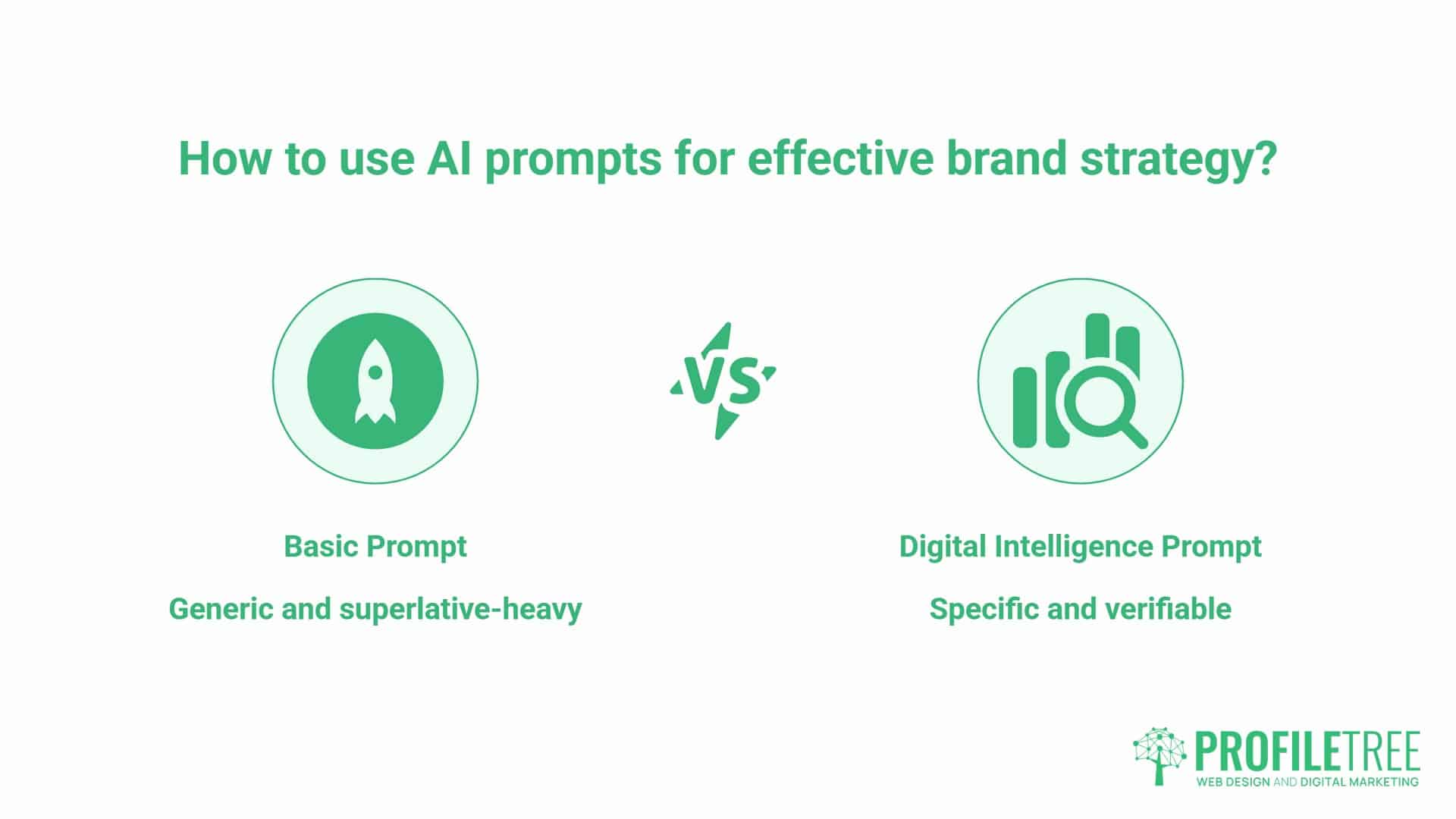
The table below shows the difference between a generic and a properly briefed prompt in practice.
| Aspect | Basic Prompt Output | Digital Intelligence Prompt Output |
|---|---|---|
| Positioning line | “We are the leading digital agency delivering unparalleled results” | “We have delivered over a thousand web and marketing projects for SMEs across Northern Ireland, Ireland and the UK since 2011” |
| Tone | Generic, superlative-heavy | Specific, understated, provable |
| Verifiability | Cannot be checked or sourced | Traceable to real business data |
| ASA risk | High, unsubstantiated superlatives | Low, claims are factual and specific |
Getting to that right-hand column consistently across a whole team, not just from one lucky prompt, is usually the point where a business benefits from proper training rather than trial and error, since one well-briefed marketer and three untrained colleagues will produce four different versions of the same brand. Our AI training sessions cover exactly this: building a shared prompt library so everyone on a team produces on-brand output, not just whoever wrote the best one-off prompt.
The Human Filter: How to Audit AI Outputs
This is the step that separates AI prompts for brand strategy from an actual brand strategy, and it is the one step almost every generic prompt guide leaves out entirely. It does not need to take long; for most small businesses, running a draft through the seven points below takes less time than the original prompting did. Before anything AI has drafted reaches a website, a pitch deck or an advert, run it through this checklist:
- Can every factual claim be traced to a real source, whether that is your own sales data, a genuine accreditation, or a published statistic?
- Does any line use a superlative such as “best,” “leading” or “number one” without evidence that would satisfy the ASA?
- Would this sentence survive being read aloud to your most sceptical customer?
- Does the tone sound like your business, or like every other AI-generated paragraph on the internet?
- Has the AI invented a competitor detail, a statistic, or a case study that you have not actually verified?
- Is there a cliche buried in here, the kind of phrase that shows up in thousands of other AI-written pages?
- Would you be comfortable putting your name to this if a customer asked where the claim came from?
A recent ProfileTree client review from ASCERT NI touches on exactly this gap between a document and something a team can actually use: “The Team at ProfileTree have provided excellent service to ASCERT for our recent brand review. Not only did their Team provide a brand review document, they provided educational videos to help us implement their findings.” The document is only half the job; making sure a team can apply it correctly is the other half, and that’s precisely where an AI-only process tends to fall short.
“AI can process a thousand competitor websites in the time it takes a person to read one, but it still can’t tell you why a customer chose you over the business three doors down. That’s the bit strategy still needs a human for.”
Ciaran Connolly, founder of ProfileTree
Turning a checked, human-validated position into copy that actually ranks and reads well across a website is a separate skill from the AI drafting stage. That is usually where content marketing support comes in, taking a validated position and building it out into pages, posts and product copy that hold together across a whole site.
Bridging the Gap: When to Move Beyond DIY AI
Running AI prompts for brand strategy yourself is a reasonable way to get a first draft of your brand position, especially if you’re a sole trader or a very small team. AI generates the ingredients. Turning those ingredients into a strategy that survives contact with a real market, across a website, social channels, sales conversations and everything in between, is a different job.
The moment to bring in outside support usually shows up as one of a few signs: your team’s producing inconsistent messaging because everyone is prompting AI slightly differently, you are about to make a decision with real budget behind it such as a rebrand or a new market launch, or your brand positioning keeps drifting because you keep drafting statements that feel fine in isolation but don’t actually change how customers describe you. A full digital marketing strategy pulls all of this together, so your positioning, content, and channels work from the same brief rather than three different AI sessions.
There is nothing wrong with starting the DIY way. Most businesses we work with have already run some version of these prompts before they get in touch, and that groundwork is genuinely useful; it means the conversation starts from a real draft rather than a blank page. What tends to prompt the move to outside support is scale: one person prompting AI for one page is manageable, but a growing team, multiple channels and a consistent brand voice across all of them is a coordination problem AI alone does not solve. For businesses further along, particularly those restructuring how AI fits across the whole organisation rather than just marketing, our AI transformation work covers that wider shift.
AI prompts for brand strategy are a genuinely useful starting point, not a shortcut around the thinking. Run the discovery prompts first, apply the human filter before anything goes live, and treat every AI output as a draft written by someone who has never actually met your customers. For SMEs across Northern Ireland, Ireland and the UK, that combination of AI speed and human judgement is usually what separates a brand position that gets noticed from one that reads exactly like everyone else’s, prompts and all.
FAQs
Can AI replace a brand strategist?
No, AI handles data processing and first drafts well, generating options faster than a person can type. It can’t read a room, sense when a client’s uncomfortable with a direction, or apply the judgement that comes from having sat across from hundreds of customers. Use it for speed, not for the final decision.
What is the best AI tool for brand strategy?
There’s no single answer, since different tools suit different tasks. Many teams use one model for creative writing and voice work and a separate research-focused tool for competitor and market analysis, then compare outputs before deciding.
How do I stop AI-generated brand voice from sounding robotic?
Add explicit negative instructions to your prompts, naming the cliches you want avoided rather than just asking for something “unique.” Telling a prompt what not to do is usually more effective than asking it to be original.
Is AI-generated brand positioning good for SEO?
Only if it’s edited into something genuinely original, accurate and useful. AI prompts for brand strategy that get copied straight from the AI into a live page tend to read exactly like every other page built the same way, which is the opposite of what search engines reward.
How often should I refresh brand positioning using AI?
Every six to twelve months is a sensible baseline, or sooner if something material changes, such as a new competitor entering your market, a shift in what your customers are asking for, or a major operational change on your side.