
What Is a Value Proposition? Marketing Success Lessons for Growth
Table of Contents
A value proposition is a strategic statement that defines why a customer should choose your product or service over alternatives. This fundamental marketing concept can determine success or failure for businesses across Belfast, Northern Ireland, and the broader UK market. Whether you’re a start-up seeking initial traction or an established SME looking to refine your market position, understanding and articulating your unique value proposition is critical.
This guide explores the meaning of value proposition, provides practical frameworks for creating one, examines successful examples from companies like IKEA and Amazon, and shows you how to apply these principles to your business. We’ll also address how ProfileTree helps companies to develop compelling value propositions through our web design, digital strategy, and content marketing services.
Definition and Core Principles
At its most basic level, a value proposition is a clear statement that explains how your product or service solves customer problems, delivers specific benefits, and explains why someone should buy from you rather than a competitor. The value proposition meaning extends beyond simple product features—it captures the fundamental reason your business exists and what makes it worth a customer’s time and money.
Definition
The Oxford Dictionary defines a value proposition as “an innovation, service, or feature intended to make a company or product attractive to customers”. However, this definition barely scratches what makes a truly compelling value proposition.
A comprehensive value proposition definition should include:
- The specific problem you solve for your target audience
- The solution you provide and how it works
- The measurable benefits customers receive
- The unique differentiators that set you apart from competitors
- The reason to believe your claims (proof points, credentials, results)
For digital agencies like ProfileTree, this might translate to: “We build websites that generate leads and sales through strategic SEO, compelling content, and conversion-focused design—helping Northern Ireland SMEs compete effectively in digital markets.
Why It Matter for Business Success
The importance of a clear value proposition cannot be overstated. Research consistently shows that businesses with well-defined value propositions achieve higher conversion rates, stronger customer loyalty, and more effective marketing campaigns. When your value proposition is unclear, potential customers struggle to understand why they should choose you, leading to lost sales and wasted marketing spend.
A strong value proposition serves several critical functions for SMEs operating in competitive markets across Northern Ireland, Ireland, and the UK. It directs business development, acting as a north star for decision-making. Your value proposition helps you evaluate new products, services, or market opportunities by asking: “Does this align with our core value proposition?”
A clear value proposition creates marketing focus by giving your team a consistent message across all channels. From your website copy to social media posts, email campaigns to video content, every touchpoint should reinforce your core value. This consistency builds recognition and trust far more effectively than scattered messaging.
“A strong value proposition is the foundation of every successful digital strategy,” says Ciaran Connolly, Director of ProfileTree. “We’ve seen businesses transform their results simply by clarifying what they offer and communicating it consistently across their website, content, and marketing materials.”
Customer Value Proposition vs. Unique Selling Proposition
Many businesses confuse value propositions with unique selling propositions (USPs), but they serve different purposes. A USP focuses specifically on what makes you different from competitors—your unique advantage. A customer value proposition is broader, encompassing the entire value you deliver to customers, including benefits that might not be unique but are still crucial to your target audience.
For example, an IKEA unique selling proposition might be “affordable, flat-pack furniture with Scandinavian design.” Their broader value proposition, however, encompasses “offering a wide range of well-designed, functional home furnishing products at prices so low that as many people as possible will be able to afford them”—which includes accessibility, functionality, and democratic design principles alongside affordability.
Design: Creating One That Converts
Creating a compelling value proposition requires deep customer understanding, market analysis, and strategic thinking. It’s not simply about listing your features or making bold claims—it’s about articulating genuine value in terms that resonate with your specific audience.
The Value Proposition Canvas: A Strategic Framework
Alexander Osterwalder’s value proposition canvas provides a structured approach to designing propositions that match customer needs. This framework has two main components: the customer profile and the value map.
Customer Profile: Understanding Your Audience
The customer profile helps you create a detailed picture of your target audience and their motivations. It consists of three elements:
Customer Jobs: What tasks are customers trying to accomplish? For a Belfast retailer, this might include “attract more footfall to our physical store” or “compete with online-only competitors.” For a professional services firm, it could be “generate qualified leads consistently” or “establish thought leadership in our sector.”
Pains: What challenges do customers face while trying to accomplish these jobs? Common pains for SMEs might include limited marketing budgets, a lack of in-house digital expertise, difficulty measuring marketing ROI, or struggles to rank in search results against larger competitors.
Gains: What benefits or outcomes do customers hope to achieve? These might include increased revenue, improved brand recognition, better customer retention, reduced operational costs, or a competitive advantage in their market.
Value Map: Defining Your Solution
The value map describes how your product or service addresses the customer profile. It also has three components:
Products/Services: The actual offerings you provide. For ProfileTree, this includes web design, WordPress development, SEO services, video production, content marketing, AI training, and digital strategy consulting.
Pain Relievers: How your offerings alleviate customer pains. For example, our web design service relieves the pain of “websites that don’t generate leads” by creating conversion-focused designs backed by SEO best practices. Our AI training addresses the pain of “being left behind by technology” by providing practical, accessible training for SME teams.
Gain Creators: How your offerings create gains for customers. Our SEO services create the gain of “improved search visibility and organic traffic.” Our video production services create the gain of “engaging content that builds brand authority and connects with audiences.”
The Four Levels of Value Proposition
To create a comprehensive value strategy, consider value propositions at four different levels of your business:
Primary Level
Your primary value proposition is the overarching answer to the question, “Why should people buy from you rather than competitors?” It is your company-level value proposition that defines your core competitive advantage.
For IKEA, this primary value proposition centres on affordable, well-designed furniture accessible to the masses. For Uber, it’s convenient, on-demand transportation at the tap of a button. For your business, this should capture the fundamental reason you exist and the core problem you solve better than anyone else.
Prospect-Level
This addresses specific customer segments or personas: “Why should this particular type of customer buy from you rather than competitors?” Different customer groups may value other aspects of your offering.
A local Belfast café might have one value proposition for morning commuters (speed and convenience) and another for weekend visitors (atmosphere and experience). Similarly, ProfileTree’s value proposition for a start-up might emphasise cost-effectiveness and speed to market. In contrast, our proposition for an established enterprise might focus on scalability and integration with existing systems.
Product-Level
Each specific product or service should have its value proposition: “Why should X buy this product rather than alternatives?” This explains how each offering delivers value in its own right.
For example, IKEA’s value proposition for a sofa differs from that for kitchen utensils. The sofa requires demonstrating durability, comfort, style, and value for money. A wooden spoon needs much less explanation—it’s functional, affordable, and readily available.
Process-Level
This considers the customer journey: “What information do customers need at different stages of the buying process?” Understanding this helps you deliver the right value messages at the right time.
Low-consideration purchases require minimal information. High-consideration purchases, particularly in B2B contexts, require substantial education, proof, and trust-building. Your value proposition should adapt to these different decision-making processes.
Value Proposition Statement: Putting It All Together
Once you’ve mapped customer needs and solutions, you can craft a value proposition statement that articulates your unique value. An effective value proposition statement typically follows this structure:
“We help [target customer] achieve [specific outcome] through [unique approach/solution], unlike [competitors or alternative approaches], which [common problem or limitation].”
For example: “ProfileTree helps Northern Ireland SMEs generate more leads and sales through websites built specifically for ranking, traffic, and conversions—unlike template-based solutions that prioritise aesthetics over business results.”
Customer Examples: Learning from Success
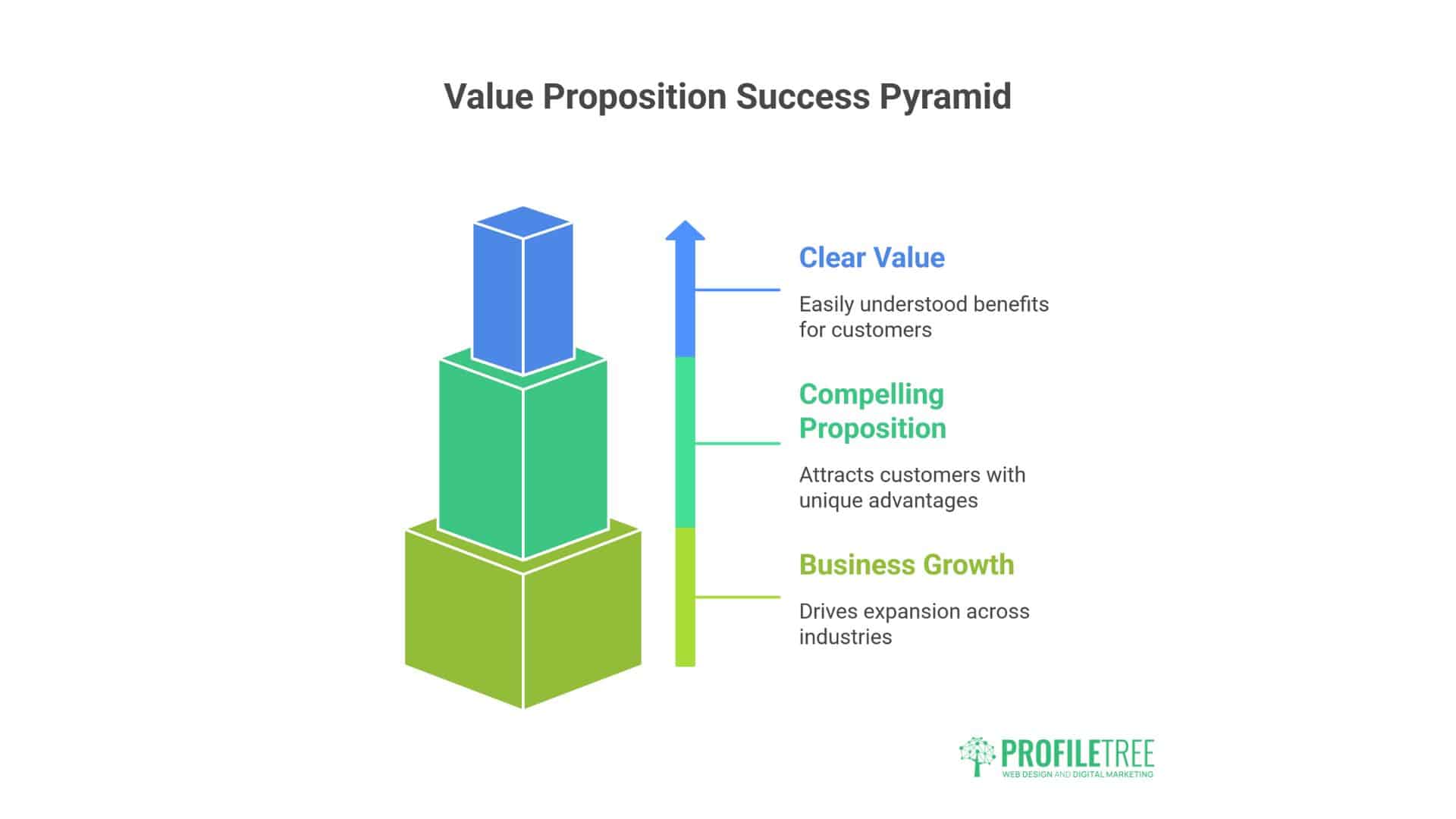
Examining successful value propositions from established brands provides practical insights you can apply to your business. These examples demonstrate how clear, compelling value propositions drive business growth across different industries and market positions.
IKEA: Democratic Design
IKEA has built one of the world’s most successful retail businesses on an obvious value proposition: “to offer a wide range of well-designed, functional home furnishing products at prices so low that as many people as possible will be able to afford them.”
This IKEA value proposition succeeds because it addresses a real problem—quality furniture has traditionally been expensive and accessible only to affluent customers. IKEA recognises that everyone deserves well-designed homes, regardless of budget.
Through innovative flat-pack design, efficient supply chains, and self-assembly, IKEA dramatically reduces costs while maintaining quality and design standards. Customers save substantial money compared to traditional furniture retailers while still getting functional, attractive furniture. The self-assembly trade—off is clearly communicated and accepted as part of the value exchange.
Everything IKEA does reinforces this core value proposition, from warehouse-style stores that reduce overhead to the famous Swedish meatballs that provide affordable dining. The entire customer experience is designed around making quality design accessible.
The IKEA customer value proposition extends beyond mere affordability. It includes sustainability commitments, renewable materials, and circular economy principles. This demonstrates how value propositions can evolve to address changing customer priorities while maintaining core principles.
Uber Example: Convenience at Your Fingertips
Uber’s value proposition fundamentally disrupted urban transportation: “Tap a button, get a ride.” This deceptively simple statement captures several layers of value.
Traditional taxi services were unreliable, difficult to hail, and offered inconsistent quality. Uber solved these problems through app-based booking, transparent pricing, and driver ratings. Beyond solving existing problems, Uber created new benefits: seeing your driver’s location in real time, cashless payments, fare estimates before booking, and the ability to split fares with friends.
Similar to IKEA, Uber has made its service accessible to more people. In cities with expensive taxi services or limited public transport, Uber provided affordable, convenient alternatives.
Dollar Shave Club: Disrupting Through Simplicity
Dollar Shave Club entered a market dominated by expensive, heavily marketed razors from established brands. Their value proposition—”A great shave for a few bucks a month”—challenged industry norms and attracted millions of customers.
This example is particularly relevant for SMEs because Dollar Shave Club succeeded through clear value communication. Their viral launch video immediately communicated their value proposition with humour and directness, cutting through traditional marketing noise.
By delivering razors regularly at a low price through a subscription model, they eliminated the inconvenience of remembering to buy razors and the frustration of expensive retail prices. Their value proposition wasn’t just about price—it was about being straightforward, unpretentious, and customer-focused in an industry known for gimmicks and inflated prices.
Amazon Prime: Bundled Value
Amazon Prime presents an interesting case study in value proposition evolution. The initial proposition—”Free two-day shipping”—was simple and compelling. Over time, Amazon added substantial value without fundamentally changing the core appeal: Prime Video streaming, Prime Music, Prime Reading, Amazon Photos, grocery delivery, and exclusive deals.
Amazon Prime’s value proposition is “Everything you need, delivered fast, with entertainment and exclusive benefits included.” The bundled nature creates exceptional perceived value—even if customers primarily join for shipping, they discover additional benefits that increase switching costs and loyalty.
This teaches an essential lesson for service businesses: value propositions can expand over time as you understand customer needs better and develop complementary offerings. Your initial proposition should be clear and focused, but you can add layers of value that increase customer loyalty and lifetime value.
Measuring and Optimising Your Value Proposition
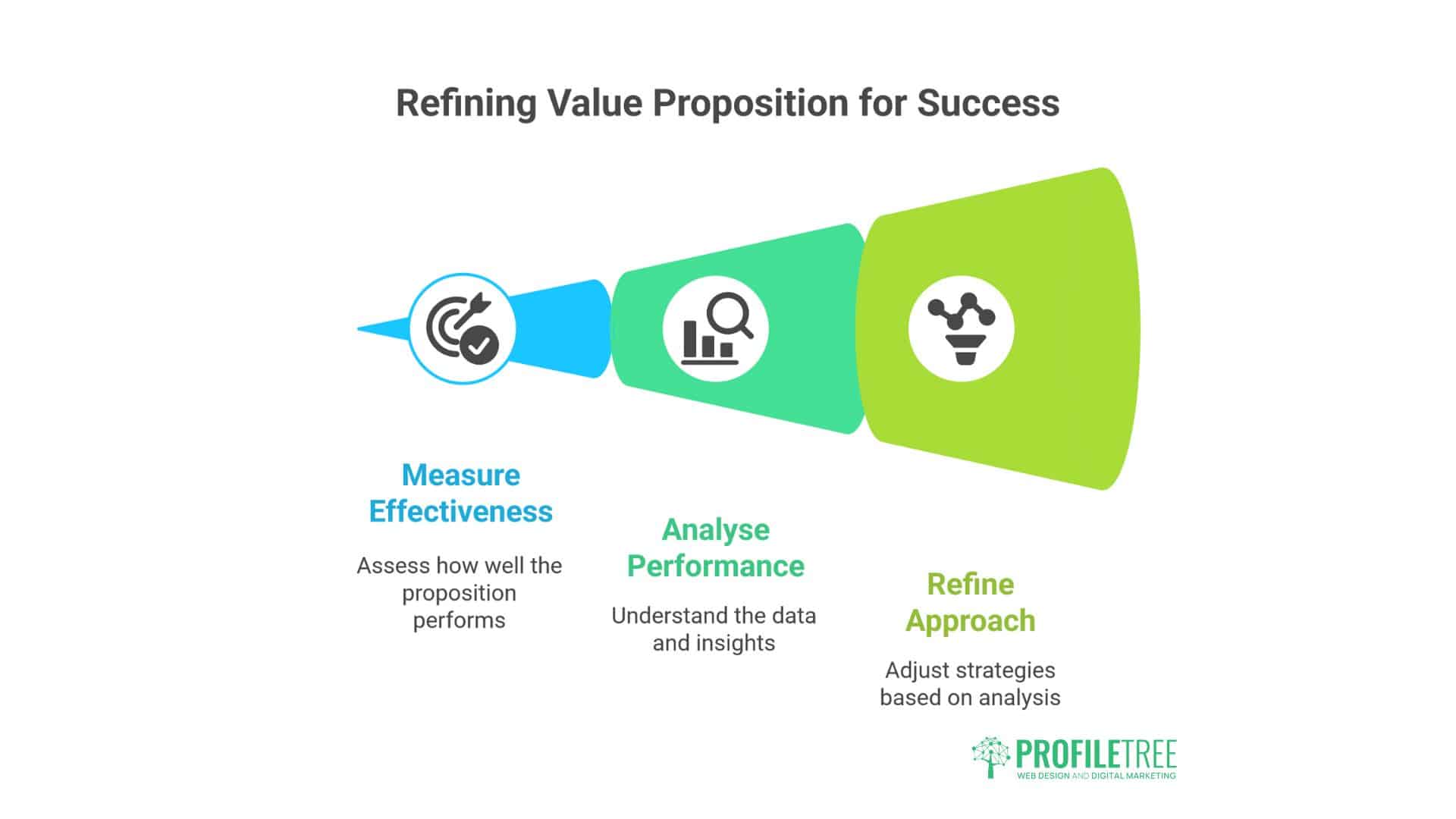
Creating a value proposition is only the first step. To ensure it drives business results, you must measure its effectiveness and continuously refine your approach based on real-world performance.
Key Metrics for Value Proposition Effectiveness
Several metrics indicate whether your value proposition resonates with your target audience:
Website Conversion Rate: If your value proposition is clear and compelling, visitors should take desired actions—requesting quotes, signing up for consultations, or making purchases. Low conversion rates often indicate confusion about your value or misalignment with visitor expectations. For web design and digital marketing agencies, typical conversion rates for service inquiries range from 2-5%.
Time on Site and Bounce Rate: Visitors who quickly leave your site may not understand your value or may realise you’re not right for them. While some bounces are inevitable, patterns of immediate exits suggest your value proposition isn’t immediately clear or compelling.
Sales Cycle Length: A clear value proposition should shorten sales cycles by quickly establishing whether there’s a good fit. If prospects take excessive time to make decisions, they may struggle to understand your unique value or differentiate you from alternatives.
Customer Lifetime Value: Strong value propositions attract customers who receive genuine value, leading to longer relationships, repeat business, and referrals. Low lifetime value might indicate your proposition attracts price-sensitive customers seeking short-term solutions rather than strategic partnerships.
Common Mistakes to Avoid
Even experienced businesses make value proposition mistakes that undermine their marketing effectiveness. Here are the most common pitfalls:
Being Too Generic: Generic statements like “quality service,” “competitive prices,” or “experienced team” don’t differentiate you because every competitor makes identical claims. Specificity is powerful. Instead of “quality web design,” try “websites optimised for ranking on page one of Google within 6 months.”
Focusing on Features Rather Than Benefits: Many businesses describe what they do (features) rather than the value customers receive (benefits). Customers don’t care about technical approaches unless they understand how it benefits them. Always translate features into customer outcomes.
Making Unsubstantiated Claims: Bold claims without evidence create scepticism rather than trust. Support claims with evidence—case studies, testimonials, data, or qualifications. ProfileTree can credibly claim SEO expertise because we rank for competitive terms like “digital marketing Northern Ireland” and “Belfast web design agency.
Trying to Appeal to Everyone: When you try to be everything to everyone, you become nothing to anyone. Define your ideal customer clearly. While you might work with other types of clients, your primary value proposition should speak directly to your best-fit customers.
Failing to Differentiate: If your value proposition doesn’t explain why customers should choose you over alternatives, it’s not doing its job. Articulate your unique approach, philosophy, or specialisation that makes you the right choice for specific customers.
Communicating Your Value Proposition Effectively
Even the strongest value proposition fails if it is not communicated clearly across all customer touchpoints. Your website is typically the first place potential customers encounter your value proposition. It should be immediately visible above the fold on your homepage—visitors shouldn’t need to scroll to understand what you offer and why it matters.
Every page should reinforce your value proposition through consistent messaging, examples, and proof points. Use case studies, testimonials, data, and results to support your claims. For ProfileTree, this might include showcasing websites that rank on page one for competitive keywords or client testimonials about increased leads and sales.
Your content marketing—blog posts, videos, and social media—should consistently communicate your value proposition through educational content demonstrating your expertise, case studies showing real examples of delivered value, and thought leadership establishing your unique perspective on industry challenges.
ProfileTree’s Digital Services Value Propositions
For businesses considering ProfileTree’s services, our value propositions address specific challenges facing SMEs across Northern Ireland, Ireland, and the UK:
Web Design and Development: “We build websites that generate leads and sales through strategic SEO, conversion-focused design, and platforms you can manage yourself.” This addresses the pain of beautiful websites that don’t generate business, prioritising results over aesthetics.
AI Implementation and Training: “We make AI practical and accessible for SMEs through hands-on training and implementation support—helping you adopt AI without enterprise complexity or costs.” This addresses the critical gap for smaller organisations with limited budgets and technical resources.
Digital Marketing and SEO: “We help businesses across Northern Ireland and the UK compete effectively online through integrated digital strategies, local SEO expertise, and content that ranks and converts.” This combines integrated approaches with local expertise and measurable results.
Content Marketing and Video Production: “We create content that builds authority, engages audiences, and drives business results—from written content and blog strategies to professional video production and YouTube optimisation.” This addresses the growing importance of multi-format content marketing with strategic, SEO-optimised approaches.
Taking Action: Developing Your Value Proposition
Creating a compelling value proposition requires honest analysis of your business, a deep understanding of your customers, and clear thinking about what makes you different. Start by answering these questions:
- What specific problem do you solve for customers? Be precise—avoid generic issues.
- Who experiences this problem most acutely? Define your ideal customer in detail.
- How does your solution address this problem uniquely? What’s different about your approach?
- What measurable benefits do customers receive? Quantify where possible.
- Why should customers believe you can deliver? What proof do you have?
Once you’ve answered these questions, craft and test your value proposition statement. Does it immediately make sense to someone unfamiliar with your business? Does it differentiate you from competitors? Does it focus on customer benefits rather than your features?
If you’re struggling to articulate your value proposition clearly, or if your current marketing isn’t generating the desired results, ProfileTree can help. Our digital strategy services help businesses clarify their positioning, develop compelling value propositions, and communicate them effectively through websites, content, and marketing campaigns that drive business growth.
Your value proposition isn’t just marketing copy—it’s the foundation of your entire business strategy. Get it right, communicate it clearly, and watch how it transforms your ability to attract and convert the right customers.