
Direct Mail Marketing Statistics: What the UK Data Shows
Table of Contents
Direct mail never went away. While email volumes exploded and digital ad costs climbed, physical mail quietly maintained response rates that most digital channels struggle to match. For UK businesses weighing up their marketing mix, the statistics make a stronger case for direct mail than many expect.
This guide pulls together the most reliable direct mail data available, focuses on what is relevant to UK and Northern Irish SMEs, and looks at where physical mail fits alongside digital channels. The figures below are drawn from published industry research; sources are noted throughout.
Direct Mail Response Rate Statistics
Response rate is the most cited metric in direct mail, and the data is consistently encouraging. According to the Data & Marketing Association (DMA) UK, direct mail achieves an average response rate of 2%-5%, depending on targeting quality and the offer. That range sits well above the email marketing benchmark of 0.1–0.3% for cold or broadcast sends.
The DMA’s Customer Engagement report found that door drops — unaddressed mail delivered to all households in a postcode area — achieve an average response rate of 2.7%. Addressed mail to opted-in or existing customer lists performs higher, reaching 4–5% for well-targeted campaigns.
For context, display advertising achieves a click-through rate of around 0.1%, while paid social averages 0.5–1% across platforms and creative. Direct mail’s physical presence — and the time a recipient spends handling it — accounts for a significant part of the gap.
What drives higher response rates:
- Personalisation: Campaigns using the recipient’s name and tailored offers consistently outperform generic mail. Variable data printing, which customises each piece based on customer data, has become standard practice for larger campaigns.
- Format: Oversized envelopes and dimensional mail generate higher open rates than standard C5 envelopes.
- Timing: Mail arriving on Tuesday, Wednesday, or Thursday performs better than mail arriving over the weekend, according to Royal Mail data.
- Data quality: Response rates drop sharply when address data is outdated. PAF-cleansed (Postcode Address File) data is the UK standard for any serious campaign.
Direct Mail ROI: How It Compares
Return on investment is where direct mail data often surprises marketers who have moved entirely to digital channels. The DMA’s Response Rate Report pegged the median ROI for direct mail at approximately £3.22 per £1 spent, placing it ahead of paid social and broadly in line with paid search across many B2C categories.
The table below compares median ROI figures across common UK marketing channels based on DMA and Econsultancy benchmark data:
| Channel | Median ROI per £1 spent | Average response or CTR |
|---|---|---|
| Direct mail (addressed) | £3.22 | 2–5% |
| Email marketing | £3.50–£4.00 | 0.1–0.3% |
| Paid search (Google Ads) | £2.00–£3.00 | 2–5% CTR |
| Display advertising | £1.50–£2.00 | 0.05–0.1% CTR |
| Paid social | £1.80–£2.50 | 0.5–1% CTR |
Email’s headline ROI figure looks comparable or higher, but it reflects very low cost-per-send on existing lists. Direct mail’s ROI is more expensive per send, but it reaches audiences that do not open emails, engages at a different attention level, and can support richer creative formats than a screen ad.
The strongest ROI case for direct mail tends to come from high-value B2C sectors: financial services, insurance, automotive, and travel. For B2B, targeted account-based mail to senior decision-makers often justifies the cost, particularly when the lifetime value of a single converted customer is high.
For SMEs in Northern Ireland and across the UK, cost management is the main barrier. A mailing to 1,000 addresses using Royal Mail’s Advertising Mail tariff costs roughly £280–£400 in postage alone, before design and print. That is not negligible for a small business, which is why integration with digital channels matters. Mail drives people online, and the website handles the conversion. That connection between physical outreach and digital landing pages is something ProfileTree’s content and web teams regularly work through with clients.
Direct Mail vs Email Marketing
These channels are more complementary than competitive, but the comparison is worth making clear for businesses deciding where to allocate their budgets.
| Factor | Direct Mail | Email Marketing |
|---|---|---|
| Cost per contact | Higher (£0.40–£2.00+) | Very low (£0.001–£0.01) |
| Average open or handling rate | 80–90% | 20–35% |
| Response rate | 2–5% | 0.1–0.3% |
| Speed to market | 5–10 working days | Same day |
| Shelf life | Days to weeks | Hours |
| GDPR data requirement | Postal address | Email address with consent |
| Best for | New prospects, high-value offers, lapsed customers | Existing customers, nurture sequences, transactional messages |
The standout difference is shelf life. An email typically drives action within 48 hours or is ignored. A well-designed piece of direct mail may sit on a desk or kitchen counter for days, which matters for offers with a longer decision cycle — a home services quote, a financial product, or a B2B meeting request.
A sensible channel strategy for most UK SMEs uses email to nurture existing customer relationships, while using direct mail selectively for acquisition campaigns or re-engagement of lapsed buyers. ProfileTree’s digital marketing strategy work covers how these channels interact and which combination tends to deliver the best cost-per-acquisition for different business types.
UK Consumer Behaviour and Direct Mail
Royal Mail MarketReach publishes the most comprehensive UK-specific data on how consumers interact with physical mail, and their findings are worth understanding in detail.
Key findings from MarketReach research:
- 70% of consumers say direct mail makes them feel more valued than digital advertising
- 57% of people say receiving addressed mail makes them feel more positively about the brand that sent it
- 45% of people who received a door drop visited a website or searched online as a result
- 87% of 18–34 year olds find mail easier to absorb than digital advertising
That last figure consistently surprises marketers who assume direct mail is irrelevant to younger audiences. Physical mail stands out precisely because it is less common for that age group to receive it. The tactile engagement it creates is genuinely distinct from screen scrolling.
For retail, hospitality, and service businesses in Northern Ireland and beyond, door drop campaigns targeting specific postcodes remain a practical acquisition tool. Royal Mail’s Advertising Mail products allow targeting at postcode sector level, and their Door to Door service does not require a mailing list at all — it delivers to every address in a designated area. That suits local businesses running area-specific promotions where building a list first is not practical.
Direct Mail and GDPR in the UK
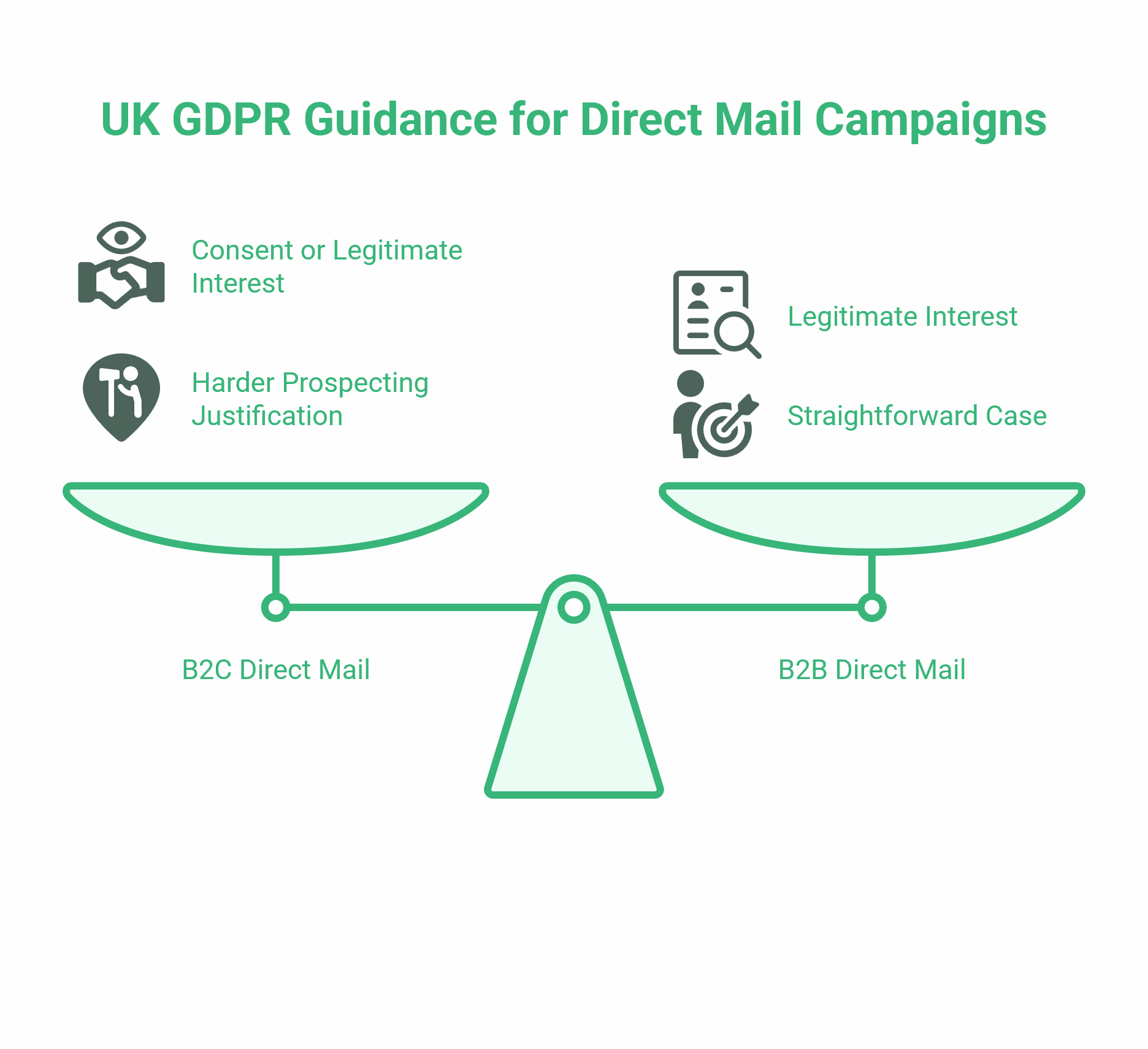
This is the area where UK-specific guidance matters most and where US-published statistics roundups offer nothing useful. UK GDPR governs the use of data for direct mail campaigns, and the rules differ depending on whether you are mailing consumers or businesses.
B2C direct mail: Sending addressed mail to consumers requires either their consent or a legitimate interest basis. Legitimate interest is available but requires a three-part test — the interest must be genuine, necessary, and not outweighed by the individual’s rights. For prospecting (mailing to people who have not previously engaged with you), legitimate interest is harder to justify than for existing customers.
B2B direct mail: Sending addressed mail to individuals at companies is generally permissible under legitimate interest where there is a clear, relevant commercial reason. Mailing a marketing manager at a manufacturing firm to offer marketing services is a more straightforward legitimate interest case than mailing a consumer at home.
Practical steps for GDPR compliance in UK direct mail:
- Use PAF-cleansed data from a reputable UK data provider
- Document your legitimate interest assessment if relying on that basis
- Include your company’s contact details and a clear opt-out mechanism on every mail piece
- Check your data against the Mail Preference Service (MPS) for B2C consumer mailings
- For purchased lists, ensure the data supplier has the correct permissions in place
Non-compliance carries the same ICO enforcement risk as any other UK GDPR breach. This is not an area where a “probably fine” approach makes sense.
How SMEs Can Use Direct Mail Effectively
Direct mail’s cost structure means it rewards precision. A broadcast mailing to 50,000 unqualified addresses is expensive and unlikely to pay back for most SMEs. A targeted mailing to 500 well-qualified prospects in a specific sector or postcode can deliver strong results on a realistic budget.
Formats that work for SME budgets:
- Postcards: Low-cost to print and post; no envelope required. A5 is the most common size. Image-led formats work well for service businesses and local promotions.
- Letters: Higher perceived value, particularly for B2B and financial offers. Personalised letters in plain envelopes often outperform obviously promotional formats.
- Door drops (unaddressed): Lower cost per household than addressed mail, useful for local area marketing. Restaurants, tradespeople, and estate agents use these regularly.
- Folded leaflets: Cost-effective for product or service information, often paired with a promotional code to track response.
Integrating direct mail with digital channels makes a significant difference to results. Using a URL or QR code unique to the mailing lets you track responses directly and attribute conversions. Running a Google Ads campaign targeting the same geographic area as your door drop in the same week amplifies recall. Sending an email to existing customers in the days following a mail piece reinforces the message at a lower additional cost.
For businesses working with ProfileTree on their wider digital strategy, direct mail fits into a channel plan rather than operating in isolation. The website that receives direct mail traffic needs to be built to convert those visitors, which brings web design, landing page structure, and user experience into the picture alongside the mail campaign itself.
Conclusion
Direct mail’s performance data makes a stronger case than the channel’s reputation suggests. For UK businesses, the combination of high handling rates, clear response tracking through unique codes or URLs, and the ability to reach audiences who have stopped engaging with digital advertising makes it worth including in a well-planned marketing mix.
The channel performs best when it sits within a broader strategy rather than operating in isolation. If you want to understand how direct mail fits alongside your digital channels, ProfileTree works with businesses across Northern Ireland and the UK on integrated marketing strategies that make each channel do the right job.
FAQs
Is direct mail still effective in the UK?
Yes, for the right use case. UK direct mail achieves average response rates of 2–5% according to DMA benchmarks, making it competitive with most digital channels. It works best for high-value offers, local area marketing, and re-engaging lapsed customers.
What is a good response rate for direct mail?
The DMA UK benchmark for addressed mail is 2–5%. Door drops average around 2.7%. Response rates vary based on data quality, offer relevance, and creative execution, so treat the benchmark as a starting point rather than a guarantee.
How much does direct mail cost in the UK?
Royal Mail’s Advertising Mail tariff starts from around £0.28 per item. A5 postcards printed and posted in quantities of 1,000 typically cost £0.60–£1.20 per piece, including print. Budget separately for design, data, and a response mechanism, and verify current Royal Mail rates before planning.
Do I need consent to send direct mail in the UK?
For B2C addressed mail, you need either consent or a documented legitimate interest basis under UK GDPR. B2B addressed mail to corporate addresses is generally permissible under the legitimate interest ground. Door drops carry a lower GDPR risk as no personal data is used. Always include an opt-out mechanism.
What is the difference between direct mail and email marketing?
Email is low-cost, fast to deploy, and suits existing customer communication. Direct mail costs more per contact but achieves higher handling rates and longer shelf life. The channels work well together: mail builds awareness and drives online response while email nurtures leads.
What types of direct mail work best for small businesses?
Postcards, door drops, and folded leaflets offer the best cost-to-impact ratio for most SMEs. Postcards need no envelope and print cheaply. Door drops suit hyper-local campaigns without a mailing list. Letters work well for B2B outreach and high-value offers where personalisation matters.